
Top Feminine Hygiene Products Market Companies 2026
Author:
Intellectual Market Insights Research
Published Date:
17 Jul 2026
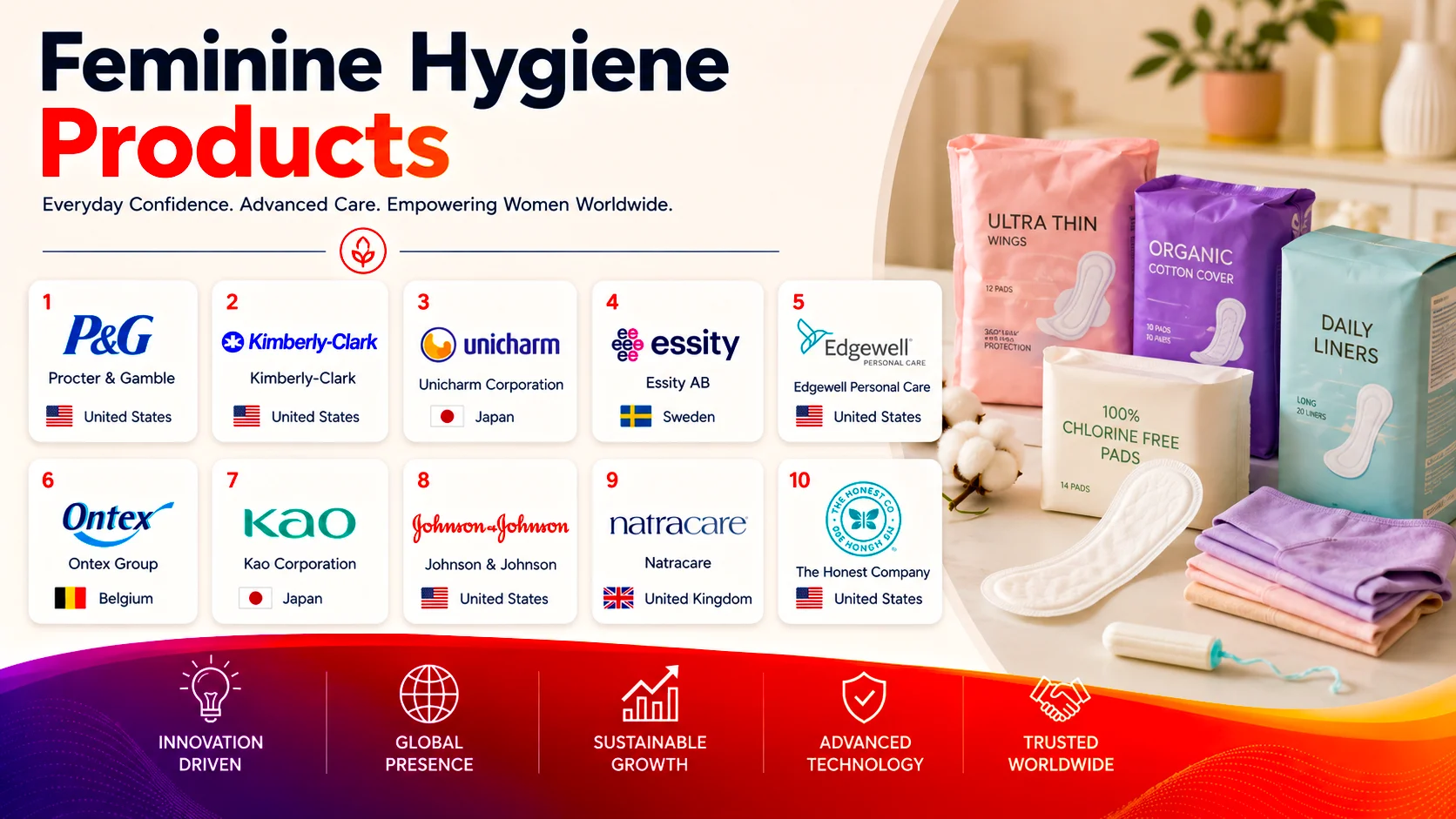
Top 10 Companies in the Global Feminine Hygiene Products Market Driving Industry Growth in 2026
Introduction
Menstrual health has moved from a private, often stigmatized subject to a global public-health and consumer-goods priority, and the business of manufacturing safe, comfortable, and sustainable feminine hygiene products has become one of the personal care industry's most closely watched segments. The global Feminine Hygiene Products Market sits at the intersection of women's health, sustainable materials science, and everyday consumer packaged goods, making it a strategically important and highly competitive sector.
According to the latest market intelligence from Intellectual Market Insights Research (IMIR), the Feminine Hygiene Products Market was valued at USD 29.84 billion in 2023 and reached USD 31.72 billion in 2024, and is expected to surge to USD 52.46 billion by 2032, advancing at a compound annual growth rate (CAGR) of 6.49% throughout the forecast period of 2024–2032. This near-doubling of market value over eight years reflects not just population growth but the profound transformation of the products, materials, and awareness campaigns underpinning women's hygiene worldwide.
At its core, the feminine hygiene products market encompasses sanitary napkins, tampons, menstrual cups, pantyliners, and a growing range of organic and biodegradable hygiene solutions each playing a critical role in supporting women's health and dignity across global markets.
The industry's growth is being propelled by multiple converging forces. First, rising awareness of menstrual health driven by governments, NGOs, and healthcare organizations is normalizing conversations and increasing product adoption. Second, the growing global female population is directly expanding the addressable consumer base. Third, the rapid expansion of e-commerce is improving discreet, convenient access to both mainstream and niche feminine care brands.
Perhaps most importantly, the product backbone of feminine hygiene is evolving quickly. From ultra-thin, high-absorbency pads to biodegradable and reusable menstrual cups, companies that invest in comfort, sustainability, and accessibility are gaining decisive competitive advantages in this crowded market. Investment activity remains strong, with global consumer goods giants and specialist organic brands alike allocating capital to R&D, sustainable materials, and emerging-market penetration.
The industry also faces real headwinds: lingering social stigma in some regions, regulatory scrutiny of product ingredients, and the higher cost of sustainable materials are creating adoption and margin pressures. Nevertheless, the long-term trajectory of the market remains firmly positive, underpinned by demographic realities, expanding healthcare access, and the essential nature of feminine hygiene products in supporting women's health globally.
This article profiles the top 10 companies shaping the global Feminine Hygiene Products Market in 2026, provides a competitive landscape analysis, examines regional dynamics and emerging trends, and offers a forward-looking outlook for the industry.
Market Overview
|
Parameter |
Details |
|---|---|
|
Market Size (2023) |
USD 29.84 Billion |
|
Market Size (2024) |
USD 31.72 Billion |
|
Market Size (2032) |
USD 52.46 Billion |
|
CAGR (2024–2032) |
6.49% |
|
Forecast Period |
2024–2032 |
|
Base Year |
2023 |
|
By Product Type |
Sanitary Napkins/Pads, Tampons, Menstrual Cups, Pantyliners, Organic/Biodegradable Hygiene Products |
|
By Distribution Channel |
Supermarkets/Hypermarkets, Pharmacies, E-commerce, Convenience Stores |
|
Key Regions |
North America, Europe, Asia-Pacific, Latin America, MEA |
|
Dominant Region |
North America / Europe |
|
Fastest Growing Region |
Asia-Pacific |
Key Market Drivers:
- Rising awareness about menstrual health through government, NGO, and healthcare campaigns
- Growing global female population directly expanding consumer demand
- Expansion of e-commerce platforms enabling discreet, wider access to feminine care brands
- Rising demand for organic and sustainable hygiene products
- Increasing disposable income enabling premium product adoption in emerging economies
- Government-led menstrual hygiene initiatives and subsidized product distribution
- Urbanization and lifestyle changes increasing demand for convenient hygiene solutions
Key Market Opportunities:
- Organic and biodegradable sanitary product development
- Menstrual cups and reusable hygiene solutions
- Premium and technologically advanced feminine care products
- Rural and emerging-market penetration, particularly in India and China
- E-commerce and direct-to-consumer feminine care brands
- Sustainable and plastic-free packaging innovation
- Broader women's wellness and intimate care product lines
Key Market Challenges:
- Persistent social stigma around menstruation in several regions limiting open adoption
- Higher production costs of organic and biodegradable materials affecting affordability
- Regulatory scrutiny over product ingredients, labelling, and safety standards
- Price sensitivity in low-income and rural markets limiting premium product penetration
- Environmental concerns tied to single-use plastic applicators and packaging
Why the Feminine Hygiene Products Market Is Growing
The trajectory of the feminine hygiene products market is the result of powerful structural and social shifts reshaping how women worldwide access and use hygiene products.
1. Rising Awareness About Menstrual Health
Increasing awareness campaigns by governments, NGOs, and healthcare organizations are encouraging better menstrual hygiene practices and expanding product adoption globally. Reduced stigma is translating directly into higher, more consistent purchasing across both developed and emerging markets.
2. Growing Female Population
The increasing global female population, particularly in fast-growing emerging economies, is directly contributing to sustained long-term demand for feminine hygiene and personal care products.
3. Expansion of E-Commerce Platforms
Online retail platforms are improving product accessibility, offering discreet purchasing options, and enabling premium and niche feminine care brands such as organic and direct-to-consumer players to reach wider audiences without the friction of in-store purchases.
4. Demand for Organic & Sustainable Products
Consumers are increasingly preferring biodegradable sanitary pads, reusable menstrual cups, and chemical-free feminine hygiene products due to growing environmental and health consciousness, pushing manufacturers to reformulate and re-package their offerings.
5. Increasing Disposable Income
Rising income levels, especially across emerging economies in Asia-Pacific and Latin America, are enabling consumers to trade up to premium and branded feminine hygiene products rather than lower-cost generic alternatives.
6. Government Menstrual Hygiene Initiatives
Governments across developing countries are introducing awareness programs and subsidized sanitary product distribution schemes to improve women's health outcomes, simultaneously expanding the addressable market and legitimizing category growth.
7. Urbanization & Lifestyle Changes
Rapid urbanization and changing lifestyles are increasing demand for convenient, hygienic, and high-quality feminine care solutions, particularly among working women in dense urban centers.
8. Product Innovation & Technology
Manufacturers are investing in ultra-thin pads, high-absorbency materials, leak-protection technologies, and emerging smart feminine wellness products, each innovation cycle creating opportunities to premiumize the category.
9. Growing Focus on Women's Wellness
The broader women's healthcare and wellness movement is positively influencing demand for intimate care and menstrual hygiene products as part of a holistic personal health routine rather than a purely functional purchase.
10. Social Media & Influencer Awareness
Social media campaigns and influencer marketing are helping reduce stigma around menstruation and increasing consumer awareness about feminine hygiene, particularly among younger, digitally native consumers.
Top 10 Companies in the Global Feminine Hygiene Products Market
- Procter & Gamble
- Kimberly-Clark
- Unicharm Corporation
- Essity AB
- Edgewell Personal Care
- Ontex Group
- Kao Corporation
- Johnson & Johnson
- Natracare
- The Honest Company
1. Procter & Gamble
|
Category |
Details |
|---|---|
|
Company Name |
Procter & Gamble |
|
Headquarters |
Cincinnati, Ohio, USA |
|
Founded |
1837 |
|
Industry Focus |
Consumer Goods, Personal Care, Feminine Hygiene |
|
Global Presence |
Operations across 70+ countries, products sold in 180+ countries |
|
Company Overview |
Procter & Gamble is one of the world's largest consumer goods companies and holds a dominant position in the global feminine hygiene market through its globally recognized brands. The company focuses heavily on product innovation, comfort engineering, and women's health awareness initiatives, employing approximately 100,000+ people and generating revenue of around USD 80–85 billion. |
|
Key Products & Services |
Always, Tampax, sanitary pads, tampons, feminine care liners, women's health products. |
|
Market Position |
The global category leader in feminine hygiene, supported by an extensive retail and distribution network across developed and emerging markets. |
|
Recent Developments |
Continued R&D investment in comfort and absorbency technology, alongside expanding sustainability commitments for packaging and product materials under its Always and Tampax lines. |
|
Strategic Advantages |
Strong global brand portfolio, extensive retail and distribution network, continuous product innovation, and deep R&D investment capacity. |
2. Kimberly-Clark
|
Category |
Details |
|---|---|
|
Company Name |
Kimberly-Clark |
|
Headquarters |
Irving, Texas, USA |
|
Founded |
1872 |
|
Industry Focus |
Personal Care, Hygiene Products |
|
Global Presence |
Products sold in 175+ countries |
|
Company Overview |
Kimberly-Clark is a leading global manufacturer of feminine care products, employing approximately 40,000+ people and generating revenue of around USD 20–22 billion. The company focuses on comfort, skin-friendly materials, and accessible hygiene solutions for women worldwide through its well-known brand portfolio. |
|
Key Products & Services |
Kotex sanitary pads, pantyliners, tampons, feminine hygiene solutions. |
|
Market Position |
A top-tier global player with strong retail presence and consistent brand loyalty in both developed and emerging markets. |
|
Recent Developments |
Ongoing investment in sustainable and skin-safe product formulations, alongside expansion of the Kotex brand into new geographies. |
|
Strategic Advantages |
Popular global Kotex brand, strong retail presence, focus on sustainable and skin-safe products, and continuous innovation investment. |
3. Unicharm Corporation
|
Category |
Details |
|---|---|
|
Company Name |
Unicharm Corporation |
|
Headquarters |
Tokyo, Japan |
|
Founded |
1961 |
|
Industry Focus |
Hygiene Products, Personal Care |
|
Global Presence |
Strong presence across Asia with expanding operations in emerging markets |
|
Company Overview |
Unicharm Corporation is a leading Asian hygiene products company specializing in feminine care, baby care, and personal hygiene products, employing approximately 16,000+ people and generating revenue of around USD 7–8 billion. The company has built a strong presence across Asia and emerging markets through affordable and innovative feminine hygiene products. |
|
Key Products & Services |
Sanitary napkins, pantyliners, feminine hygiene products, absorbency-focused hygiene solutions. |
|
Market Position |
A dominant regional player across Asian markets, competing through affordability, localized product development, and advanced absorbency technology. |
|
Recent Developments |
Expanding manufacturing operations globally and deepening localized product development for emerging Asian and international markets. |
|
Strategic Advantages |
Strong presence across Asian markets, affordable and premium product tiers, advanced absorbency technology, and expanding global manufacturing footprint. |
4. Essity AB
|
Category |
Details |
|---|---|
|
Company Name |
Essity AB |
|
Headquarters |
Stockholm, Sweden |
|
Founded |
2017 (spin-off) |
|
Industry Focus |
Hygiene & Health Products |
|
Global Presence |
Operations across developed and emerging markets globally |
|
Company Overview |
Essity AB is a global hygiene and health company offering innovative feminine care and personal hygiene solutions, employing approximately 46,000+ people and generating revenue of around USD 14–15 billion. The company is recognized for its strong focus on sustainability and women's wellness. |
|
Key Products & Services |
Feminine care products, intimate hygiene solutions, sustainable hygiene product lines. |
|
Market Position |
A leading global hygiene and health player with a growing eco-friendly feminine product portfolio serving both developed and emerging markets. |
|
Recent Developments |
Expanding its eco-friendly feminine product portfolio alongside global healthcare and hygiene awareness campaigns. |
|
Strategic Advantages |
Strong sustainability initiatives, expanding eco-friendly product portfolio, global healthcare and hygiene presence, and women's health awareness leadership. |
5. Edgewell Personal Care
|
Category |
Details |
|---|---|
|
Company Name |
Edgewell Personal Care |
|
Headquarters |
Shelton, Connecticut, USA |
|
Founded |
2015 |
|
Industry Focus |
Personal Care |
|
Global Presence |
Global distribution network across multiple regions |
|
Company Overview |
Edgewell Personal Care is a major personal care company offering feminine hygiene products through globally recognized brands, employing approximately 6,000+ people and generating revenue of around USD 2–3 billion. The company focuses on comfort, convenience, and women-centric product innovation. |
|
Key Products & Services |
Feminine hygiene products, personal care solutions. |
|
Market Position |
A well-established mid-tier global player expanding its presence in emerging markets alongside its core personal care portfolio. |
|
Recent Developments |
Expanding presence in emerging markets while continuing to invest in product innovation and customer comfort. |
|
Strategic Advantages |
Strong feminine care and personal care portfolio, global distribution network, and continued investment in product innovation. |
Competitive Landscape
The global feminine hygiene products market is characterized by moderate-to-high concentration among a handful of diversified consumer goods giants, alongside a growing tier of specialist organic and direct-to-consumer challengers.
Among mainstream brands, Procter & Gamble (Always, Tampax), Kimberly-Clark (Kotex), Unicharm, Essity, and Kao Corporation collectively command a dominant share of global revenue through scale manufacturing, extensive retail distribution, and decades of brand equity. However, the market is far from a pure oligopoly; sustainability-focused entrants such as Natracare and The Honest Company are consistently challenging the incumbents by capturing the fast-growing eco-conscious consumer segment.
At the regional level, the competitive landscape is also shaped by strong players such as Ontex Group in Europe and Edgewell Personal Care in North America, both competing on affordability, private-label partnerships, and product comfort innovations.
Key Competitive Trends:
Mergers and Acquisitions: Consolidation activity across the personal care sector continues, as large diversified players seek to acquire niche organic and sustainable feminine care brands to access new consumer segments and accelerate their sustainability roadmaps.
Partnerships and Collaborations: Companies are increasingly partnering with NGOs, healthcare organizations, and government bodies on menstrual health awareness campaigns, while also collaborating with sustainable materials innovators to reformulate product lines.
Innovation Strategies: Leading players are investing in ultra-thin and high-absorbency materials, biodegradable and plastic-free product formats, reusable menstrual cups, and direct-to-consumer digital channels as core innovation priorities.
Regional Analysis
North America
North America represents one of the largest and most mature feminine hygiene markets globally. The United States drives the majority of regional market value, supported by high awareness levels, strong retail infrastructure, and growing demand for organic and sustainable products. Key trends include the rise of clean-label brands such as The Honest Company and continued innovation from Procter & Gamble and Kimberly-Clark. The region is home to major brands including Always, Tampax, Kotex, and a fast-growing direct-to-consumer segment.
Europe
Europe is a mature and diverse feminine hygiene market, home to strong regional players such as Essity, Ontex Group, and Natracare. Consumer preference for sustainable and organic products is particularly pronounced in this region, driven by stringent environmental regulations and high consumer awareness of plastic waste concerns. Strict EU regulations govern product ingredient disclosure and labelling, further shaping product development.
Asia Pacific
Asia Pacific is the fastest-growing feminine hygiene products market, driven by Japan, China, India, and other emerging economies. Unicharm and Kao Corporation, both headquartered in Japan, anchor a strong regional manufacturing and innovation base. Rising female workforce participation, improving product accessibility, and government-led menstrual health awareness initiatives particularly in India are key demand drivers. China and India are becoming major growth centers due to increasing awareness campaigns and improved product accessibility.
Latin America
Latin America presents significant growth opportunities in the feminine hygiene products market, with rising health awareness and urbanization driving demand across the region. Growing organized retail and expanding e-commerce access are improving product availability for both mainstream and premium feminine care brands.
Middle East & Africa
The Middle East and Africa region presents a mix of opportunity and challenge for the feminine hygiene products market. Rising government and NGO-led menstrual health initiatives are helping expand access and reduce stigma, while rapid urbanization and population growth are creating significant long-term growth opportunities for both global and regional manufacturers.
Emerging Trends Shaping the Feminine Hygiene Products Market
- Rise of Organic and Biodegradable Products Consumer and regulatory pressure around plastic waste is accelerating innovation in organic cotton, biodegradable materials, and plastic-free applicators, with pioneers like Natracare leading this shift.
- Menstrual Cups and Reusable Solutions Reusable menstrual cups and washable pads are gaining traction as consumers seek both cost savings and reduced environmental impact, creating a fast-growing product category alongside traditional disposables.
- Direct-to-Consumer and E-Commerce Growth Digitally native brands such as The Honest Company are leveraging direct-to-consumer channels and subscription models to build loyal customer bases and reduce the discreet-purchase friction traditionally associated with in-store buying.
- Government-Backed Menstrual Health Programs Expanding public health initiatives, particularly across India, Africa, and parts of Southeast Asia, are subsidizing product distribution and normalizing menstrual health conversations, expanding the addressable market.
- Premiumization and Comfort Technology Ultra-thin design, high-absorbency materials, and leak-protection technologies remain key battlegrounds for market leaders such as Procter & Gamble, Kimberly-Clark, and Kao Corporation as they compete for premium consumer spend.
- Broader Women's Wellness Integration Feminine hygiene brands are increasingly positioning themselves within the broader women's wellness and intimate care space, expanding product lines beyond core hygiene into adjacent health and comfort categories.
Future Outlook (2026–2032)
The global Feminine Hygiene Products Market is positioned for sustained growth through the 2024–2032 forecast period, underpinned by structural demographic, health-awareness, and accessibility realities that are unlikely to reverse.
Growth Projections: Based on current trajectory, the market is expected to grow from USD 31.72 billion in 2024 to USD 52.46 billion by 2032, reflecting a CAGR of 6.49%. Asia-Pacific will likely remain the fastest-growing regional engine, followed by continued steady growth across Latin America and MEA.
Investment Opportunities: The most compelling investment opportunities lie in organic and biodegradable product development; menstrual cups and reusable hygiene solutions; premium comfort and absorbency technologies; rural and emerging-market distribution expansion; and e-commerce and direct-to-consumer brand building.
Industry Transformation: The feminine hygiene products industry will increasingly look like a sustainability-focused, wellness-integrated sector rather than a simple commodity category. Companies that invest in clean-label formulations, ingredient transparency, and inclusive marketing will capture disproportionate value.
Future Technologies: Key emerging developments likely to reshape the industry over the next decade include advanced biodegradable material science, smart wearable menstrual health tracking, next-generation reusable product designs, and further digitization of the purchasing experience.
Regulatory Evolution: Regulatory frameworks governing product ingredient safety, labelling transparency, and plastic packaging will become more stringent globally. Companies that proactively invest in compliance, testing, and transparent communication will be best positioned to navigate the evolving regulatory landscape.
FAQ Section: Feminine Hygiene Products Market
Q1: What is the current size of the global Feminine Hygiene Products Market?
The global Feminine Hygiene Products Market was valued at USD 29.84 billion in 2023, reached USD 31.72 billion in 2024, and is projected to reach USD 52.46 billion by 2032, growing at a CAGR of 6.49% over the 2024–2032 forecast period.
Q2: Who are the leading companies in the Feminine Hygiene Products Market?
The leading companies include Procter & Gamble (Always, Tampax), Kimberly-Clark (Kotex), Unicharm Corporation, Essity AB, Edgewell Personal Care, Ontex Group, Kao Corporation, Johnson & Johnson, Natracare, and The Honest Company.
Q3: Which region dominates the Feminine Hygiene Products Market?
North America and Europe currently hold the largest shares of the global Feminine Hygiene Products Market, supported by mature retail infrastructure and high awareness levels, while Asia-Pacific is expected to be the fastest-growing region during the forecast period, driven by rising female workforce participation and government-led menstrual health initiatives in countries such as India and China.
Q4: What are the primary growth drivers of the Feminine Hygiene Products Market?
Key drivers include rising awareness of menstrual health, the growing global female population, expansion of e-commerce platforms, growing demand for organic and sustainable products, increasing disposable income, government menstrual hygiene initiatives, and rapid urbanization.
Q5: What is the projected CAGR of the Feminine Hygiene Products Market?
The Feminine Hygiene Products Market is forecast to grow at a CAGR of 6.49% from 2024 to 2032.
Q6: What product types are covered in the Feminine Hygiene Products Market?
Key product types include sanitary napkins/pads, tampons, menstrual cups, pantyliners, and a growing range of organic and biodegradable hygiene products.
Q7: What are the main distribution channels for feminine hygiene products?
The primary distribution channels are supermarkets and hypermarkets, pharmacies, convenience stores, and increasingly e-commerce platforms, which are improving discreet access and enabling niche and premium brands to reach wider audiences.
Conclusion
The global Feminine Hygiene Products Market stands as one of the most socially significant and steadily evolving sectors within the broader personal care and consumer goods landscape. Growing from USD 31.72 billion in 2024 to a projected USD 52.46 billion by 2032 at a CAGR of 6.49%, the market's trajectory reflects the convergence of rising menstrual health awareness, growing disposable income, expanding e-commerce accessibility, and increasing demand for sustainable and organic hygiene products.
The companies profiled in this article spanning global consumer goods giants like Procter & Gamble, Kimberly-Clark, and Johnson & Johnson; regional leaders including Unicharm, Essity, Kao Corporation, Ontex Group, and Edgewell Personal Care; and sustainability-focused specialists like Natracare and The Honest Company collectively represent the full ecosystem of innovation, investment, and competitive intensity shaping this market in 2026 and beyond.
For investors, procurement professionals, industry analysts, and strategic decision-makers, understanding the dynamics of this market from the promise of organic and reusable product innovation, to the challenges of lingering social stigma and sustainable material costs is essential for identifying where opportunity lies and where risk must be managed. The feminine hygiene products industry is not merely a commodity business: it is a wellness-integrated, sustainability-defined sector whose evolution will shape how women around the world access safe, comfortable, and dignified hygiene care for decades to come.