
Top Global Leaders in Natural Carotenoids Market
Author:
Intellectual Market Insights Research
Published Date:
17 Aug 2026
Introduction
Carotenoids are the pigments responsible for the vivid reds, oranges, and yellows found throughout the natural world, from salmon and egg yolks to carrots and marigolds. Beyond color, compounds like astaxanthin, beta-carotene, and lutein carry recognized antioxidant and health-supporting properties, making natural carotenoids a sought-after ingredient across animal feed, food and beverage, dietary supplements, cosmetics, and pharmaceuticals. As consumers increasingly scrutinize ingredient labels and shift away from synthetic additives, natural, algae- and plant-sourced carotenoids are capturing a growing share of a market long dominated by synthetic alternatives.
The global natural carotenoids market was valued at approximately USD 478.2 million in 2025 and is projected to reach USD 685.32 million by 2034, expanding at a compound annual growth rate (CAGR) of 4.06% over the forecast period, according to Intellectual Market Insights Research. This growth reflects rising clean-label demand, expanding use of carotenoids in aquaculture and animal feed, and continued innovation in algae- and microorganism-based production methods.
Natural carotenoids sit at an interesting crossroads of the specialty chemicals, nutrition, and biotechnology industries. Large diversified life-science and nutrition companies bring global manufacturing scale and broad application expertise, while specialist algae- and fermentation-based producers compete on purity, sustainability credentials, and the ability to produce specific high-value carotenoids like natural astaxanthin at commercial scale.
Understanding which companies lead this specialized but steadily growing market is essential for ingredient buyers, nutraceutical and food formulators, and industry analysts. This article provides a research-based analysis of the top companies in the global natural carotenoids market, their positioning, flagship offerings, and the regional and technological forces shaping the competitive landscape.
Market Overview
|
Parameter |
Details |
|---|---|
|
Market Size (2025) |
USD 478.2 Million |
|
Projected Market Size (2034) |
USD 685.32 Million |
|
CAGR (2025–2034) |
4.06% |
|
Base Year |
2024 |
|
Forecast Period |
2025–2034 |
|
Leading Region |
North America |
|
Fastest-Growing Region |
Asia-Pacific (China, Japan, India) |
|
Key Growth Drivers |
Clean-label and natural ingredient demand, growth in aquaculture and animal feed, dietary supplement expansion |
|
Key Challenges |
Higher production costs versus synthetic carotenoids, supply variability in natural feedstocks |
|
Key Opportunities |
Algae-based astaxanthin production scale-up, cosmetics and nutraceutical application growth, source diversification |
Why the Natural Carotenoids Market Is Growing
1. Rising Clean-Label and Natural Ingredient Demand
Consumers are increasingly avoiding synthetic food colorants and additives, pushing food, beverage, and supplement manufacturers toward naturally sourced carotenoids like beta-carotene, lutein, and lycopene as clean-label alternatives.
2. Growth in Aquaculture and Animal Feed Applications
Natural astaxanthin and other carotenoids are widely used to enhance pigmentation and support the health of farmed salmon, shrimp, and poultry, and rising global aquaculture output is directly expanding demand for feed-grade carotenoids.
3. Expansion of the Dietary Supplement Industry
Growing consumer interest in eye health, immune support, and antioxidant supplementation is driving demand for carotenoids such as lutein, zeaxanthin, and astaxanthin in the fast-growing nutraceutical and supplement segment.
4. Advances in Algae- and Microorganism-Based Production
Innovation in fermentation and algae cultivation technology is improving the cost-efficiency and scalability of producing high-value natural carotenoids, narrowing the price gap with synthetic alternatives.
5. Rising Use in Cosmetics and Personal Care
Natural carotenoids' antioxidant and skin-protective properties are driving their incorporation into a growing range of natural and organic cosmetic and personal care formulations.
6. Regulatory Support for Natural Additives
Tightening regulations and consumer pressure around synthetic food dyes and additives in several regions are accelerating the shift toward naturally sourced colorants and functional ingredients.
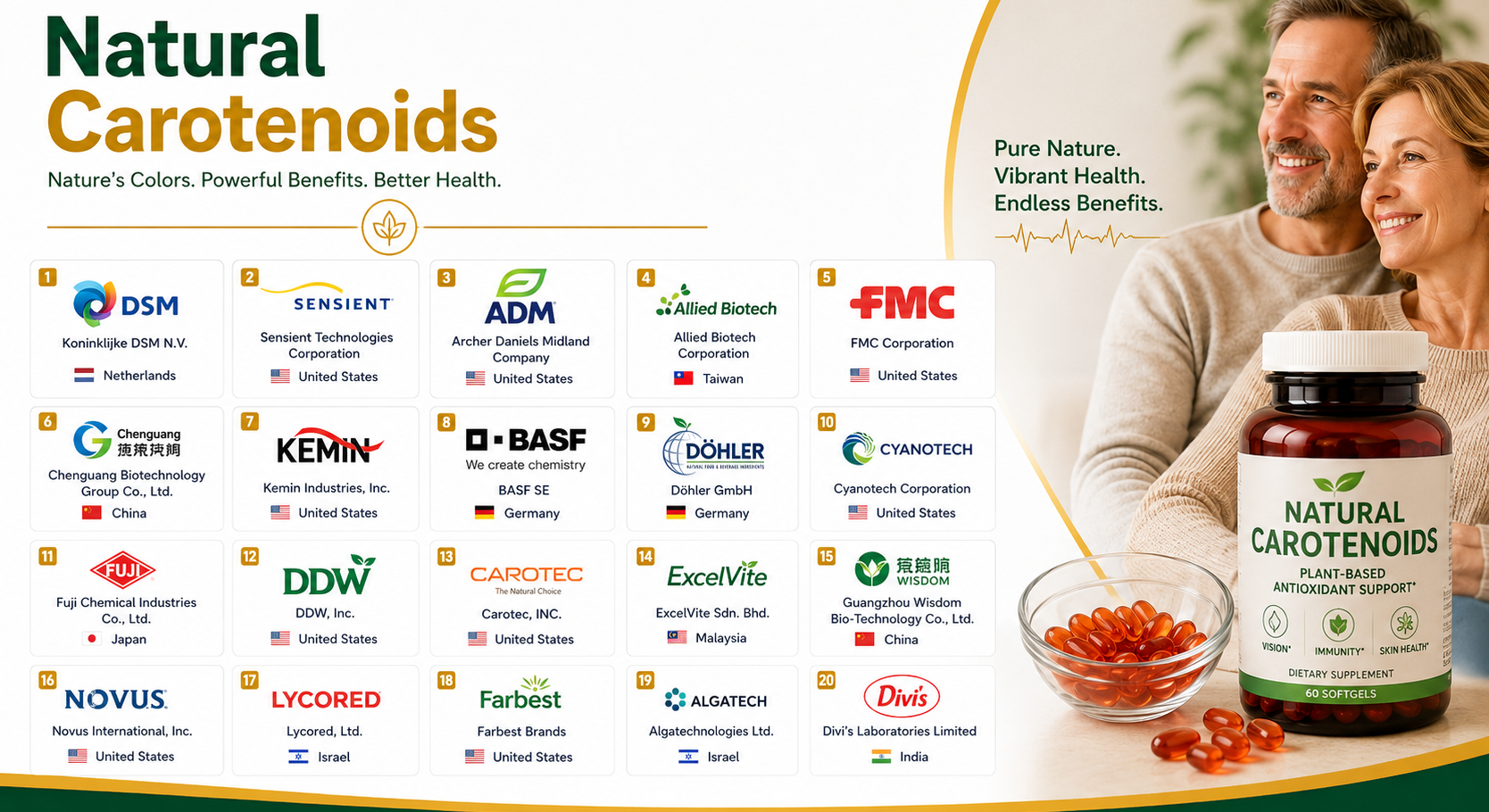
Top 10 Companies in the Natural Carotenoids Market
- Koninklijke DSM N.V. (dsm-firmenich)
- BASF SE
- Archer Daniels Midland Company
- Sensient Technologies Corporation
- Kemin Industries, Inc.
- Chenguang Biotechnology Group Co., Ltd.
- Cyanotech Corporation
- Fuji Chemical Industries Co., Ltd.
- Lycored, Ltd.
- Algatechnologies Ltd.
1. Koninklijke DSM N.V. (dsm-firmenich)
|
Category |
Details |
|---|---|
|
Company Name |
dsm-firmenich AG (formerly Koninklijke DSM N.V.) |
|
Headquarters |
Kaiseraugst, Switzerland, and Maastricht, Netherlands (dual headquarters) |
|
Founded |
1902 (as DSM; merged with Firmenich in 2023) |
|
Employees |
Approx. 30,000 |
|
Revenue (2024) |
Approx. USD 13 Billion (€12.8 billion) |
|
Company Overview |
dsm-firmenich is a global science-based nutrition, health, and beauty company whose carotenoid portfolio, spanning astaxanthin, beta-carotene, and canthaxanthin, serves feed, food, and supplement customers worldwide. |
|
Key Products |
Carophyll and CaroCare branded carotenoid products, including natural and nature-identical beta-carotene, astaxanthin, and canthaxanthin for feed and nutrition applications. |
|
Market Position |
One of the largest and most diversified global suppliers of carotenoids, with deep integration across feed, food, and supplement ingredient portfolios. |
|
Recent Developments |
Continued portfolio rationalization and investment following the 2023 DSM-Firmenich merger, with ongoing focus on nutrition and biosolutions. |
|
Strategic Advantages |
Massive R&D scale, broad application expertise across feed and food, and a well-established global distribution and regulatory-support network. |
2. BASF SE
|
Category |
Details |
|---|---|
|
Company Name |
BASF SE |
|
Headquarters |
Ludwigshafen, Germany |
|
Founded |
1865 |
|
Employees |
Approx. 111,000+ |
|
Revenue (2024) |
Approx. USD 70 Billion (group-wide; carotenoids are a portion of Nutrition & Care segment revenue) |
|
Company Overview |
BASF is the world's largest chemical company, and its Nutrition & Health division produces synthetic and nature-identical carotenoids, including beta-carotene and astaxanthin, for feed and food applications. |
|
Key Products |
Lucarotin and Lucantin branded carotenoid products for animal feed pigmentation, food coloring, and human nutrition applications. |
|
Market Position |
A leading global supplier of carotenoids to the animal feed and food coloring industries, leveraging its scale in chemical manufacturing. |
|
Recent Developments |
Continued investment in its Nutrition & Care segment as part of its broader portfolio realignment strategy. |
|
Strategic Advantages |
Enormous manufacturing scale, deep chemical engineering expertise, and an extensive global distribution network across the feed and food industries. |
3. Archer Daniels Midland Company
|
Category |
Details |
|---|---|
|
Company Name |
Archer-Daniels-Midland Company (ADM) |
|
Headquarters |
Chicago, Illinois, United States |
|
Founded |
1902 |
|
Employees |
Approx. 42,000+ |
|
Revenue (2024) |
Approx. USD 85.5 Billion (group-wide; natural colors are a portion of Nutrition segment revenue) |
|
Company Overview |
ADM is a global human and animal nutrition company whose natural colors and flavors portfolio includes plant-sourced carotenoids used in food, beverage, and supplement applications. |
|
Key Products |
Natural color and carotenoid extracts derived from sources such as annatto, marigold, and paprika for food and beverage coloring applications. |
|
Market Position |
A leading global supplier of natural colors and ingredients, with strong integration across agricultural sourcing and food ingredient manufacturing. |
|
Recent Developments |
Continued investment in its Nutrition segment amid a broader company-wide focus on health and nutrition ingredient growth. |
|
Strategic Advantages |
Vast global agricultural sourcing network, integrated supply chain from raw crop to finished ingredient, and deep customer relationships across the food and beverage industry. |
4. Sensient Technologies Corporation
|
Category |
Details |
|---|---|
|
Company Name |
Sensient Technologies Corporation |
|
Headquarters |
Milwaukee, Wisconsin, United States |
|
Founded |
1882 |
|
Employees |
Approx. 4,000+ |
|
Revenue (2024) |
Approx. USD 1.56 Billion |
|
Company Overview |
Sensient is a global developer and marketer of colors, flavors, and specialty ingredients, with a natural colors portfolio that includes carotenoid-based colorants for food, beverage, and cosmetic applications. |
|
Key Products |
Natural carotenoid-based color systems derived from plant and vegetable sources for food, beverage, and personal care coloring. |
|
Market Position |
A leading specialty supplier of natural colors, with strong positioning in the clean-label food and beverage coloring segment. |
|
Recent Developments |
Continued growth in its natural ingredients and colors business, supported by recent bolt-on acquisitions expanding its natural extraction capabilities. |
|
Strategic Advantages |
Deep specialty coloring and flavor expertise, strong customer relationships with major food and beverage brands, and a global manufacturing and innovation footprint. |
|
Category |
Details |
|---|---|
|
Company Name |
Kemin Industries, Inc. |
|
Headquarters |
Des Moines, Iowa, United States |
|
Founded |
1961 |
|
Employees |
Approx. 2,800+ (privately held; global estimate) |
|
Revenue |
Approx. USD 1.5 Billion (est.; privately held company) |
|
Company Overview |
Kemin is a privately held global ingredient manufacturer serving the animal nutrition, human nutrition, and food technology industries, with a natural carotenoid portfolio spanning lutein and marigold-derived extracts. |
|
Key Products |
FloraGLO lutein and other marigold-derived natural carotenoid ingredients for eye-health supplements and animal feed pigmentation. |
|
Market Position |
A leading global supplier of natural lutein, particularly strong in the eye-health dietary supplement segment. |
|
Recent Developments |
Continued investment in its human and animal nutrition ingredient portfolios as part of its long-term family-owned growth strategy. |
|
Strategic Advantages |
Deep application science expertise, strong intellectual property in lutein extraction and stabilization, and long-standing customer relationships in the supplement industry. |
Competitive Landscape
The global natural carotenoids market is moderately fragmented, spanning large diversified life-science and specialty ingredient companies such as dsm-firmenich, BASF, and ADM, alongside specialized natural colors and flavor companies such as Sensient and Kemin, and algae- or fermentation-focused specialists such as Cyanotech, Algatechnologies, and Fuji Chemical Industries.
Scale vs. Specialization: Large diversified players compete on manufacturing scale, application breadth, and integrated feed-to-food supply chains, while specialist algae- and fermentation-based producers compete on purity, sustainability credentials, and expertise in specific high-value carotenoids such as natural astaxanthin.
Natural Astaxanthin as a Premium Battleground: Companies with proprietary algae cultivation technology, such as Cyanotech and Algatechnologies, are capturing premium pricing in the fast-growing natural astaxanthin segment, which commands significantly higher value than synthetic alternatives.
Clean-Label Driving Reformulation: As food and beverage brands reformulate away from synthetic dyes, natural colors specialists such as Sensient and ADM are well positioned to capture incremental share from customers switching to carotenoid-based natural colorants.
Vertical Integration in Feed Applications: Companies with strong ties to the animal feed and aquaculture industries, including dsm-firmenich and BASF, benefit from established distribution relationships as farmed salmon and shrimp production continues to expand globally.
Regional Analysis
North America
North America holds the largest share of the natural carotenoids market, supported by strong demand for natural food colorants, dietary supplements, and a well-established regulatory framework favoring natural over synthetic additives.
Asia-Pacific
Asia-Pacific is expected to see significant growth, driven by the presence of major carotenoid producers in China and Japan, alongside rising demand from the region's large and expanding aquaculture and food processing industries.
Europe
Europe represents a mature but steady market, underpinned by strict regulations around synthetic food additives and strong consumer demand for natural, clean-label ingredients.
Latin America and MEA
These regions represent smaller but developing markets, with growth tied to expanding food processing industries and gradually rising demand for natural ingredients in food, feed, and personal care applications.
Emerging Trends in the Natural Carotenoids Market
1. Algae-Based Astaxanthin Scale-Up: Continued investment in algae cultivation technology is improving the cost-competitiveness of natural astaxanthin, historically among the most expensive natural carotenoids to produce.
2. Fermentation-Based Production Innovation: Microorganism-sourced carotenoid production is emerging as a scalable, potentially lower-cost alternative to traditional plant extraction methods.
3. Expansion into Cosmetics and Personal Care: Natural carotenoids' antioxidant properties are driving growing incorporation into skincare and personal care formulations beyond their traditional food and feed applications.
4. Sustainability and Traceability Focus: Growing customer demand for traceable, sustainably sourced ingredients is favoring producers who can demonstrate transparent, environmentally responsible supply chains.
5. Source Diversification: Manufacturers are increasingly diversifying carotenoid sourcing across plant, algae, and microorganism origins to manage supply variability and meet varying regulatory and labeling requirements across regions.
Future Outlook (2025–2034)
The global natural carotenoids market's trajectory toward USD 685.32 million by 2034 reflects steady, structurally supported growth as clean-label preferences and functional nutrition trends continue to displace synthetic alternatives. The 4.06% CAGR forecast through 2034, more modest than some faster-growing specialty ingredient categories, reflects the market's relative maturity in developed regions balanced against continued expansion in feed, supplement, and personal care applications.
Key investment themes include continued scale-up of algae- and fermentation-based astaxanthin production, further reformulation of food and beverage products away from synthetic dyes, and growing carotenoid demand tied to the global expansion of aquaculture. Leading companies including dsm-firmenich, BASF, and ADM are likely to retain leadership through their scale and application breadth, while specialist players such as Cyanotech and Algatechnologies continue to compete for share in premium, natural-sourced segments.
Frequently Asked Questions (FAQ)
1. What is the current size of the global natural carotenoids market?
The global natural carotenoids market was valued at approximately USD 478.2 million in 2025 and is projected to reach USD 685.32 million by 2034, growing at a CAGR of 4.06%.
2. Who are the top companies in the natural carotenoids market?
Leading companies include dsm-firmenich (formerly Koninklijke DSM), BASF, Archer Daniels Midland, Sensient Technologies, Kemin Industries, Chenguang Biotechnology Group, Cyanotech Corporation, Fuji Chemical Industries, Lycored, and Algatechnologies.
3. Which region dominates the natural carotenoids market?
North America leads the market, supported by strong demand for natural food colorants and dietary supplements, while Asia-Pacific is expected to see significant growth.
4. What is the forecast CAGR for the natural carotenoids market?
The market is forecast to grow at a CAGR of 4.06% from 2025 to 2034.
5. What are the main growth drivers for this market?
Key drivers include rising clean-label and natural ingredient demand, growth in aquaculture and animal feed applications, and expansion of the dietary supplement and nutraceutical industry.
6. What challenges does the natural carotenoids industry face?
The industry faces higher production costs compared to synthetic carotenoids, along with supply variability tied to natural feedstocks such as algae and plant sources.
7. Which carotenoid type is most significant in the market?
Astaxanthin and beta-carotene are among the most commercially significant natural carotenoids, with astaxanthin commanding particularly strong demand and pricing in the aquaculture and dietary supplement segments.
Conclusion
The global natural carotenoids market sits at the intersection of the clean-label movement and the broader shift toward natural, functional nutrition. With a projected size of USD 685.32 million by 2034 at a 4.06% CAGR, the sector offers steady, if modest, growth potential for ingredient manufacturers able to combine natural sourcing with reliable, scalable production.
Companies led by dsm-firmenich, BASF, and ADM are leveraging global scale and integrated feed-to-food supply chains, while specialist producers such as Cyanotech and Algatechnologies are capturing premium value in high-growth segments like natural astaxanthin. The manufacturers that successfully balance production cost, sourcing sustainability, and application versatility across feed, food, supplement, and cosmetic markets will define market leadership through 2034 and beyond.