
Top Key Players in the Interventional Radiology Market Industry Leaders Shaping the Future
Author:
Intellectual Market Insights Research
Published Date:
19 Aug 2026
Introduction
Interventional radiology (IR) sits at the intersection of imaging and therapy, using X-ray, MRI, CT, and ultrasound guidance to perform minimally invasive diagnosis and treatment through small incisions rather than open surgery. What began as a niche complement to conventional surgery has become a mainstream pillar of modern medicine, spanning oncology, cardiology, gastroenterology, urology, and neurology, and delivering faster recovery times, lower complication rates, and reduced procedural costs compared with traditional approaches.
The global interventional radiology market was valued at approximately USD 30.9 billion in 2025 and is projected to reach USD 48.96 billion by 2034, expanding at a compound annual growth rate (CAGR) of 5.24% over the forecast period, according to Intellectual Market Insights Research. This growth reflects the rising global burden of chronic disease, continuous advances in imaging technology, and a broad healthcare-system shift toward minimally invasive, outpatient-compatible care.
The competitive landscape spans diversified global medical imaging giants, specialized interventional device manufacturers, and regional healthcare technology conglomerates that have built dedicated interventional radiology product lines. Because IR systems, particularly advanced imaging platforms and catheter-based devices, require deep engineering expertise, regulatory clearance, and large installed clinical bases, the market rewards companies that can combine technological depth with global distribution and service networks.
Understanding which companies lead this technically demanding but clinically vital market is essential for hospital procurement teams, radiology departments, and medical device investors. This article provides a research-based analysis of the top companies in the global interventional radiology market, their positioning, flagship offerings, and the regional and technological forces shaping the competitive landscape.
Market Overview
|
Parameter |
Details |
|---|---|
|
Market Size (2025) |
USD 30.9 Billion |
|
Projected Market Size (2034) |
USD 48.96 Billion |
|
CAGR (2025–2034) |
5.24% |
|
Base Year |
2024 |
|
Forecast Period |
2025–2034 |
|
Leading Region |
North America (strongest healthcare infrastructure and spending) |
|
Fastest-Growing Region |
Asia-Pacific |
|
Key Growth Drivers |
Rising chronic disease burden, advancements in imaging technology, growing preference for minimally invasive care |
|
Key Challenges |
High cost of equipment, shortage of skilled interventional radiologists and technicians |
|
Key Opportunities |
Expansion into outpatient and ambulatory settings, portable imaging devices, emerging-market infrastructure build-out |
Why the Interventional Radiology Market Is Growing
1. Rising Prevalence of Chronic Diseases
Cancer, cardiovascular disease, and other chronic conditions are climbing worldwide, and the WHO estimates that chronic illness accounts for 71% of all deaths, with cardiovascular disease alone responsible for roughly 17.9 million deaths a year. Ablation, embolization, angioplasty, and stenting offer effective, less invasive alternatives to open surgery for exactly these conditions, positioning IR as an increasingly essential part of frontline chronic-disease care.
2. Advancements in Imaging Technologies
High-definition MRI, CT, and ultrasound systems are giving interventional radiologists clearer, more detailed views of complex anatomy, enabling more precise targeting of tumors and abnormalities while sparing surrounding healthy tissue. Better imaging translates directly into safer, more effective procedures, which is driving continued hospital and clinic investment in next-generation IR technology.
3. Growing Preference for Minimally Invasive Procedures
Patients and providers alike increasingly favor procedures with smaller incisions, shorter hospital stays, and quicker recoveries. This preference is reshaping treatment pathways across oncology, cardiology, and neurology, where techniques such as transarterial chemoembolization and mechanical thrombectomy are displacing more invasive surgical alternatives.
4. Increased Focus on Outpatient and Ambulatory Care Settings
Because IR procedures rely on small incisions and image guidance, they are well suited to outpatient and ambulatory settings, where shorter recovery times reduce the need for extended hospitalization. As healthcare systems prioritize cost efficiency, this shift is fueling demand for portable ultrasound, CT, and fluoroscopy units that can be deployed quickly outside traditional hospital settings.
5. Aging Population and Rising Lifestyle-Related Disease Burden
An aging global population, combined with sedentary lifestyles and rising rates of diabetes and obesity, is driving up the incidence of the cancers and cardiovascular conditions that IR is best positioned to treat, sustaining long-term procedural demand.
6. Expanding Healthcare Infrastructure in Emerging Markets
Countries such as China and India are investing heavily in hospital infrastructure and cancer and cardiac care capacity, directly expanding the addressable base of facilities capable of offering advanced interventional radiology services.
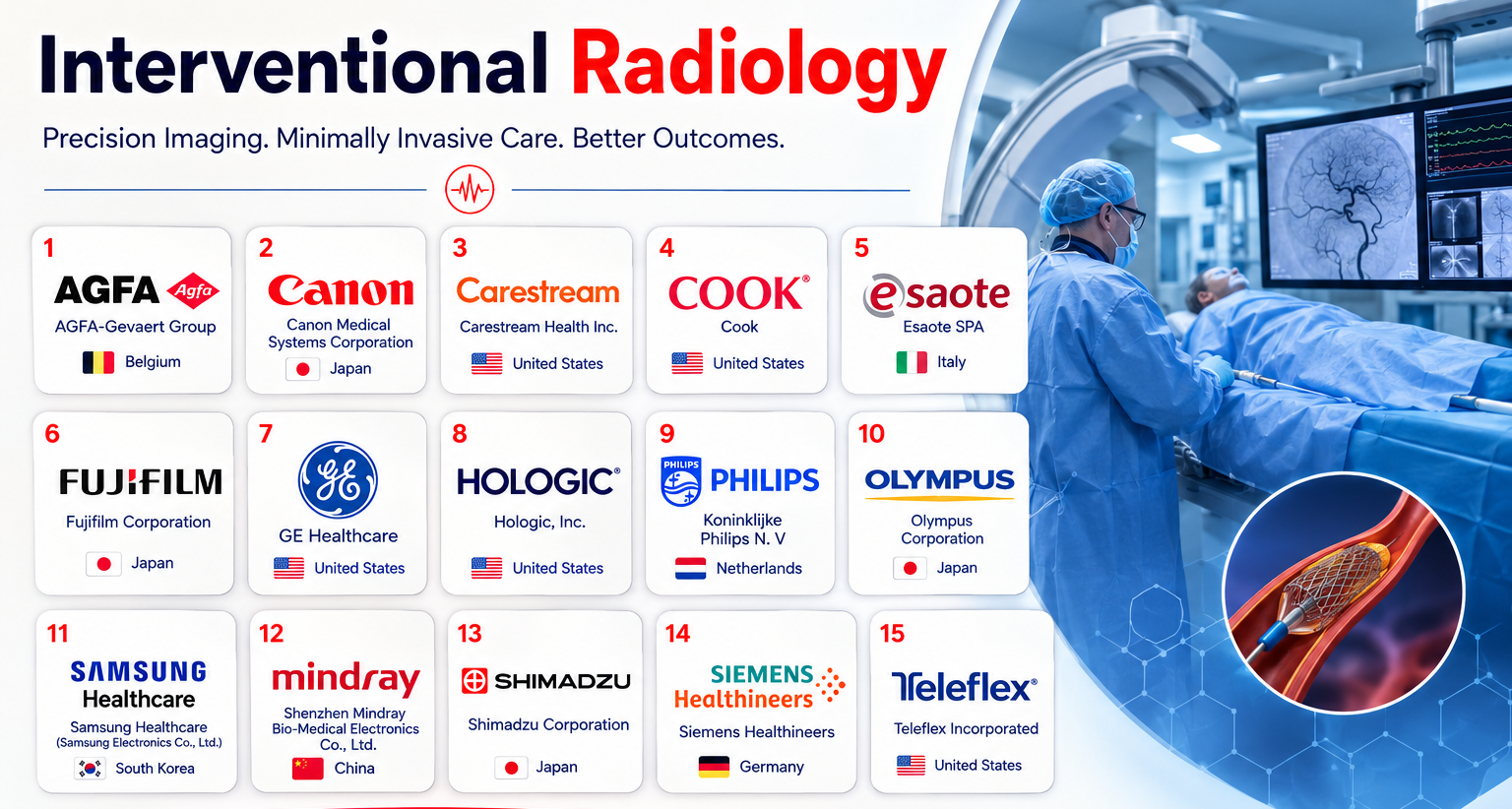
Top 10 Companies in the Interventional Radiology Market
- Siemens Healthineers
- GE Healthcare
- Koninklijke Philips N.V.
- Canon Medical Systems Corporation
- Cook Medical
- Teleflex Incorporated
- Fujifilm Corporation
- Hologic, Inc.
- Shenzhen Mindray Bio-Medical Electronics Co., Ltd.
- Olympus Corporation
|
Category |
Details |
|---|---|
|
Company Name |
Siemens Healthineers AG |
|
Headquarters |
Erlangen, Germany |
|
Founded |
2017 (as an independent listed entity spun out of Siemens AG; medical imaging heritage dating to 1847) |
|
Employees |
Approx. 74,000 |
|
Revenue (FY2025) |
Approx. USD 25 Billion (€23.4 billion) |
|
Company Overview |
Siemens Healthineers is a leading global medical technology company active in imaging, diagnostics, cancer care, and minimally invasive therapies, with angiography and interventional X-ray systems forming a core part of its IR-relevant portfolio. |
|
Key Products |
Angiography and interventional X-ray systems, computed tomography, magnetic resonance imaging, and ultrasound platforms used across image-guided procedures. |
|
Market Position |
One of the largest global suppliers of imaging equipment underpinning interventional radiology, backed by a majority ownership link to Siemens AG and a presence in more than 180 countries. |
|
Recent Developments |
Continued rollout of advanced imaging platforms, including new MRI systems and expanded photon-counting CT reference sites, alongside steady revenue growth despite tariff and currency headwinds in fiscal 2025–2026. |
|
Strategic Advantages |
Deep imaging engineering heritage, a large installed global equipment base, and integration across imaging, diagnostics, and therapy segments that supports cross-selling into IR suites. |
|
Category |
Details |
|---|---|
|
Company Name |
GE HealthCare Technologies Inc. |
|
Headquarters |
Chicago, Illinois, United States |
|
Founded |
Traces to General Electric's medical business; spun off as an independent public company in 2023 |
|
Employees |
Approx. 51,000–53,000 |
|
Revenue (FY2025) |
Approx. USD 20.6 Billion |
|
Company Overview |
GE HealthCare is a global healthcare solutions provider spanning imaging, advanced visualization, patient care solutions, and pharmaceutical diagnostics, with a strong footprint in the imaging systems that anchor interventional radiology procedures. |
|
Key Products |
Advanced angiography and fluoroscopy systems, CT and MRI scanners, ultrasound platforms, and AI-enabled image analysis and workflow software. |
|
Market Position |
A top-tier global imaging equipment supplier with more than 125 years of medical technology heritage and a large installed base across hospitals and specialty clinics worldwide. |
|
Recent Developments |
Continued portfolio expansion through acquisitions such as Intelerad Medical Systems, alongside new MRI system launches and AI integrations aimed at improving imaging efficiency. |
|
Strategic Advantages |
Broad imaging and diagnostics portfolio, strong brand recognition among radiology departments, and growing investment in AI-enabled clinical workflow tools. |
|
Category |
Details |
|---|---|
|
Company Name |
Koninklijke Philips N.V. |
|
Headquarters |
Amsterdam, Netherlands |
|
Founded |
1891 |
|
Employees |
Approx. 63,000–68,000 |
|
Revenue (FY2025) |
Approx. USD 20.2 Billion |
|
Company Overview |
Philips is a Dutch health technology company whose Diagnosis & Treatment business, close to half of group revenue, includes image-guided therapy systems purpose-built for interventional radiology and cardiology procedures. |
|
Key Products |
Azurion image-guided therapy platform, angiography systems, ultrasound and X-ray equipment, and interventional software solutions. |
|
Market Position |
A leading global supplier of image-guided therapy systems, with particular strength in interventional cardiology and radiology suite equipment. |
|
Recent Developments |
Launch of SmartIQ for the Azurion platform, enabling an ultra-low radiation dose protocol that uses over 50% less X-ray exposure than prior low-dose settings in coronary procedures. |
|
Strategic Advantages |
Deep specialization in image-guided therapy systems, continued R&D investment representing roughly 9% of sales, and a strong patent position in medical imaging technology. |
4. Cook Medical
|
Category |
Details |
|---|---|
|
Company Name |
Cook Medical (Cook Group Incorporated) |
|
Headquarters |
Bloomington, Indiana, United States |
|
Founded |
1963 |
|
Employees |
Approx. 8,000–10,000 |
|
Revenue |
Approx. USD 2.3 Billion (privately held) |
|
Company Overview |
Cook Medical is a privately held, family-founded medical device company specializing in minimally invasive devices for interventional radiology, vascular access, urology, and endoscopy applications. |
|
Key Products |
Metal stents, drainage devices, embolization coils, and catheter-based systems for peripheral vascular and interventional oncology procedures. |
|
Market Position |
A leading specialist device manufacturer in interventional radiology, valued for its broad catalog of catheters, wires, and access devices used in day-to-day IR procedures. |
|
Recent Developments |
Continued expansion of its device portfolio supporting complex vascular access and interventional oncology procedures, alongside ongoing global manufacturing investment. |
|
Strategic Advantages |
Deep, decades-long specialization in interventional device engineering, an extensive product catalog spanning multiple IR sub-specialties, and independence as a privately held company able to invest for the long term. |
|
Category |
Details |
|---|---|
|
Company Name |
Teleflex Incorporated |
|
Headquarters |
Wayne, Pennsylvania, United States |
|
Founded |
1943 |
|
Employees |
Approx. 14,000–15,000 |
|
Revenue |
Approx. USD 2.0–2.4 Billion |
|
Company Overview |
Teleflex is a medical technology company supplying devices used across interventional cardiology and radiology, vascular access, and surgery, serving hospitals and high-acuity care settings globally. |
|
Key Products |
Interventional cardiology and radiology catheters, intra-aortic balloon pumps, vascular access devices, and complex catheter systems. |
|
Market Position |
A significant specialist supplier of catheter-based interventional devices, with a dedicated Interventional segment serving cardiology and radiology customers. |
|
Recent Developments |
Progressing a strategic separation into two focused companies, sharpening its emphasis on vascular access, interventional, and surgical product lines following the divestiture of non-core businesses. |
|
Strategic Advantages |
Focused interventional product portfolio, established hospital relationships, and a streamlined operating model aimed at driving commercial focus in priority interventional markets. |
Competitive Landscape
The global interventional radiology market is moderately consolidated among large diversified imaging and medical technology companies such as Siemens Healthineers, GE Healthcare, and Philips, specialized interventional device manufacturers such as Cook Medical and Teleflex, and diversified imaging and optics companies such as Canon Medical, Fujifilm, and Olympus.
Imaging Equipment vs. Interventional Devices: The market splits broadly between companies that supply the large capital imaging systems, MRI, CT, angiography, and ultrasound platforms, that anchor an IR suite, and companies that supply the catheters, stents, and access devices consumed procedure by procedure, with the largest diversified players competing across both categories.
Scale as a Barrier to Entry: Advanced imaging platforms require substantial R&D investment, regulatory clearance, and global service infrastructure, favoring established players with the balance-sheet strength and installed base to support hospital-wide, multi-year equipment relationships.
Specialist Device Focus: Companies like Cook Medical and Teleflex compete on deep specialization in catheter-based and access-device engineering, building broad product catalogs that serve interventional radiologists' day-to-day procedural needs.
AI and Software Integration: Leading imaging suppliers are increasingly differentiating on AI-enabled workflow, dose-reduction, and visualization software layered onto their hardware platforms, shifting competition beyond pure imaging quality.
Regional Analysis
North America
North America is the current market leader, supported by well-developed healthcare infrastructure, high healthcare spending, favorable reimbursement policies, and a concentration of leading IR equipment manufacturers, with the United States driving demand through its aging population and rising rates of cancer and cardiovascular disease.
Europe
Europe represents a mature and steadily growing market, led by Germany, France, and the United Kingdom, where government initiatives support adoption of advanced medical imaging technologies, particularly for cancer-related IR procedures such as chemoembolization and radiofrequency ablation; healthcare spending constraints remain a limiting factor in parts of the region.
Asia-Pacific
Asia-Pacific is expected to register the fastest growth, driven by rising healthcare expenditure, population growth, and expanding awareness of IR's benefits, with China, India, and Japan investing heavily in healthcare infrastructure to strengthen cancer and cardiac care capacity.
Latin America and MEA
These regions represent smaller, slower-growing markets constrained by limited medical infrastructure and economic pressures, though Brazil, Mexico, the UAE, and Saudi Arabia are expanding IR access through targeted healthcare investment.
Emerging Trends in the Interventional Radiology Market
1. AI-Enabled Imaging and Workflow Tools: Leading manufacturers are embedding AI into imaging analysis, dose reduction, and procedural workflow, aiming to improve precision and efficiency in image-guided procedures.
2. Expansion of Interventional Oncology: Techniques such as transarterial chemoembolization and tumor ablation are seeing broader adoption as oncologists seek targeted, less invasive alternatives for patients who are poor surgical candidates.
3. Growth in Neurointervention: Mechanical thrombectomy and other neurological IR applications are expanding as evidence continues to support rapid, minimally invasive treatment of stroke and related conditions.
4. Portable and Point-of-Care Imaging: Demand for portable ultrasound, CT, and fluoroscopy systems is rising as IR services extend into outpatient and ambulatory settings.
5. Industry Consolidation and Portfolio Focus: Several major suppliers, including Teleflex, are streamlining their portfolios through divestitures and acquisitions to sharpen focus on core interventional and vascular access franchises.
Future Outlook (2025–2034)
The global interventional radiology market's trajectory toward USD 48.96 billion by 2034 reflects the durable, structural nature of the forces driving adoption: an aging population, rising chronic disease burden, and a sustained healthcare-system shift toward minimally invasive care. The 5.24% CAGR forecast through 2034 assumes continued advances in imaging resolution and precision, expanding outpatient and ambulatory deployment, and gradual easing of the skilled-workforce shortage that currently constrains capacity in underserved regions.
Key investment themes include deeper AI integration into imaging and procedural workflows, expansion of interventional oncology and neurointervention applications, and growing infrastructure investment across Asia-Pacific. Leading companies including Siemens Healthineers, GE Healthcare, and Philips are likely to retain strong positions in imaging equipment, while specialist device makers such as Cook Medical and Teleflex continue to compete on deep interventional product focus as the addressable procedure base continues to expand globally.
Frequently Asked Questions (FAQ)
1. What is the current size of the global interventional radiology market?
The global interventional radiology market was valued at approximately USD 30.9 billion in 2025 and is projected to reach USD 48.96 billion by 2034, growing at a CAGR of 5.24%.
2. Who are the top companies in the interventional radiology market?
Leading companies include Siemens Healthineers, GE Healthcare, Koninklijke Philips N.V., Canon Medical Systems, Cook Medical, Teleflex Incorporated, Fujifilm Corporation, Hologic, Shenzhen Mindray Bio-Medical Electronics, and Olympus Corporation.
3. Which region dominates the interventional radiology market?
North America currently leads the market due to its strong healthcare infrastructure and spending, while Asia-Pacific is expected to grow at the fastest rate.
4. What is the forecast CAGR for the interventional radiology market?
The market is forecast to grow at a CAGR of 5.24% from 2025 to 2034.
5. What are the main growth drivers for this market?
Key drivers include the rising prevalence of chronic diseases, advancements in imaging technology, and growing preference for minimally invasive procedures over traditional surgery.
6. What challenges does the interventional radiology industry face?
The industry's primary challenges are the high cost of imaging and interventional equipment and a global shortage of skilled interventional radiologists and technicians, particularly in rural and underserved regions.
7. Which application area drives the most IR demand?
Oncology is the largest application area, as tumor ablation and embolization techniques offer targeted, minimally invasive treatment options for a rising global cancer burden; cardiology is a close second given the prevalence of cardiovascular disease.
Conclusion
The global interventional radiology market sits at the intersection of two durable forces: an aging, increasingly chronic-disease-burdened population, and a healthcare system-wide shift toward minimally invasive, image-guided care. With a projected size of USD 48.96 billion by 2034 at a 5.24% CAGR, the sector offers steady growth potential for companies that can combine advanced imaging engineering with broad interventional device portfolios.
Imaging leaders Siemens Healthineers, GE Healthcare, and Philips are leveraging decades of medical technology heritage to anchor hospital IR suites, while specialist device makers like Cook Medical and Teleflex compete on deep, focused interventional product catalogs. The companies that successfully integrate AI-enabled imaging, expand into outpatient settings, and broaden their interventional oncology and neurointervention offerings will define market leadership through 2034 and beyond.