
Top Industrial Automation Control Systems Companies
Author:
Intellectual Market Insights Research
Published Date:
13 Jun 2026
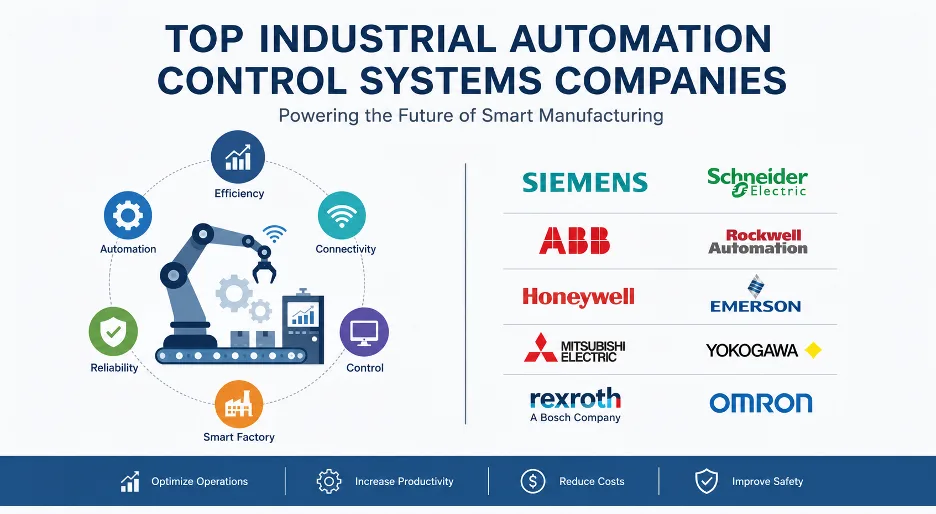
Top 10 Industrial Automation Companies Transforming Smart Manufacturing?
Industrial automation is no longer a productivity initiative sitting inside operations teams.
It has become a boardroom conversation. Manufacturers are under pressure from every direction—labor shortages, volatile supply chains, energy costs, tighter quality standards, and shorter production cycles. The response has been consistent across sectors: automate more, connect more assets, and make production decisions faster.
That shift is creating a new generation of winners among industrial automation control systems companies.
What makes 2026 different is not simply investment volume. It is the changing expectation from buyers. Procurement teams are moving beyond standalone PLCs, sensors, and SCADA deployments. They increasingly expect integrated automation ecosystems that combine hardware, software, analytics, industrial IoT, and lifecycle services.
As a result, the industrial automation companies market is entering a new competitive phase where scale still matters—but flexibility, digital capability, and vertical expertise are becoming stronger differentiators.
For investors, industrial buyers, and market researchers, the opportunity extends beyond equipment demand. The real value sits in platforms, recurring software revenue, industrial data ownership, and operational outcomes.
The companies leading this market are not just selling automation—they are redefining how factories operate.
Market Snapshot: Industrial Automation Control Systems Market
The industrial automation control systems market continues to expand as manufacturing modernization accelerates across discrete and process industries.
Current Market Size (2025): Estimated at approximately USD 230–250 billion
Forecast Market Value (2034): Expected to exceed USD 430–480 billion
Expected CAGR (2025–2034): Approximately 7–9%
Growth momentum is being supported by a combination of digital transformation initiatives and operational economics.
Major growth drivers include:
- Smart factory adoption
- Expansion of industrial IoT infrastructure
- Demand for predictive maintenance
- Rising labor cost pressure
- Industrial cybersecurity investment
- Energy optimization requirements
- Growth of cloud-based industrial software
- Higher automation penetration in emerging economies
Industries generating the strongest demand include:
- Automotive
- Electronics
- Food and beverage
- Chemicals
- Pharmaceuticals
- Oil and gas
- Semiconductor manufacturing
- Warehousing and logistics
Key Takeaways
- Automation investment is shifting from equipment purchases to integrated platforms.
- Software and industrial intelligence are becoming larger profit pools.
- Industrial control system manufacturers with strong service ecosystems are outperforming hardware-centric competitors.
- Asia-Pacific remains the largest expansion opportunity through 2034.
Featured Snippet
What is driving the industrial automation market?
The industrial automation market is being driven by labor constraints, rising operating costs, smart manufacturing adoption, industrial IoT expansion, and the need for higher production efficiency. Manufacturers increasingly prioritize connected control systems that reduce downtime, improve quality, and generate real-time operational visibility across facilities.
The 2026 Buyer Playbook: What Really Drives Purchase Decisions
Buying industrial automation systems has become less transactional.
Decision makers increasingly evaluate automation investments through long-term operational impact rather than initial capital cost.
Functional Benefits
Reliability remains non-negotiable.
Buyers prioritize:
- Production uptime
- Interoperability
- Scalability
- Cybersecurity readiness
- Data visibility
- Lifecycle support
The strongest industrial automation solution providers position themselves around measurable outcomes rather than technical specifications.
Pricing Psychology
Procurement behavior has evolved.
Low upfront pricing rarely wins major projects anymore.
Industrial buyers increasingly evaluate:
- Total cost of ownership
- Maintenance burden
- Energy efficiency
- Upgrade pathways
- Service contracts
Subscription-based software models continue gaining traction.
Trust Factors
Large deployments create operational risk.
That is why buyers favor automation and control companies with:
- Proven installation history
- Strong regional support
- Certified integration partners
- Stable software roadmaps
Trust increasingly acts as a pricing premium.
Convenience
Integrated deployment matters.
Industrial customers want fewer vendors and faster implementation cycles.
End-to-end ecosystems create purchasing advantages.
Brand Perception
Market leaders benefit from more than recognition.
Enterprise buyers associate established automation brands with lower operational risk and stronger long-term support.
Top Industrial Automation Control Systems Companies
1. Siemens
Overview
Siemens remains one of the largest industrial automation companies globally through its combination of industrial software, PLCs, digital twin capabilities, and smart infrastructure offerings.
Its automation portfolio reaches across manufacturing execution, factory control, industrial networking, and digital engineering.
The company has invested heavily in integrating operational technology with enterprise software platforms.
Recent Moves
- Expanded industrial AI capabilities
- Strengthened digital twin ecosystem
- Increased software-led industrial offerings
Competitive Edge
Few competitors combine automation hardware, industrial software, and lifecycle services at comparable scale.
Future Outlook
Expect deeper investment into autonomous production environments and industrial intelligence platforms.
2. Schneider Electric
Overview
Schneider Electric has positioned itself as one of the leading industrial automation companies by connecting automation with sustainability outcomes.
Its portfolio spans industrial control systems, energy management, edge computing, and plant optimization.
The company has benefited from growing demand for energy-efficient manufacturing.
Recent Moves
- Expanded industrial software capabilities
- Increased sustainability-driven solutions
- Strengthened digital services portfolio
Competitive Edge
Energy management integration creates a differentiated value proposition.
Future Outlook
Growth is likely to center around intelligent energy-aware factories.
3. ABB
Overview
ABB remains a dominant force across industrial robotics, process automation, motion systems, and digital manufacturing.
Its strategy combines automation infrastructure with analytics and industrial software.
ABB maintains strong penetration in process-intensive industries.
Recent Moves
- Expansion of robotics footprint
- Increased AI-driven automation initiatives
- Smart operations enhancement
Competitive Edge
Strong domain expertise across heavy industrial environments.
Future Outlook
Industrial robotics and autonomous operations remain major growth vectors.
4. Rockwell Automation
Overview
Rockwell Automation continues strengthening its position through software-led industrial transformation.
The company maintains strong relationships in manufacturing environments requiring high-performance control architecture.
Its strategy increasingly focuses on connected production ecosystems.
Recent Moves
- Expanded industrial analytics
- Strengthened cloud connectivity
- Increased digital manufacturing partnerships
Competitive Edge
Deep manufacturing specialization.
Future Outlook
Expect stronger software monetization and industrial cloud adoption.
5. Honeywell
Overview
Honeywell remains influential in process control system manufacturing and industrial digitalization.
The company operates across industrial software, plant operations, asset management, and advanced controls.
Its solutions maintain strong adoption across energy-intensive industries.
Recent Moves
- Expanded industrial software capabilities
- Increased automation platform investment
- Enhanced operational intelligence solutions
Competitive Edge
Strong installed base and operational expertise.
Future Outlook
Industrial AI and remote operations represent key expansion areas.
6. Emerson
Overview
Emerson has built substantial market presence across process automation and industrial control technologies.
Its portfolio supports optimization across complex industrial environments.
Recent Moves
- Expanded automation software stack
- Increased digital transformation offerings
Competitive Edge
Strong positioning in process-intensive sectors.
Future Outlook
Integrated software ecosystems are expected to drive growth.
7. Mitsubishi Electric
Overview
Mitsubishi Electric remains highly competitive across factory automation and industrial control infrastructure.
Its strength lies in precision manufacturing environments.
Recent Moves
- Expanded automation hardware
- Increased smart manufacturing investment
Competitive Edge
High reliability and manufacturing expertise.
Future Outlook
Industrial connectivity and smart production expansion.
8. Yokogawa Electric
Overview
Yokogawa has maintained leadership in process industries through advanced control systems and operational optimization.
The company emphasizes long-term industrial efficiency.
Recent Moves
- Expanded industrial IoT initiatives
- Enhanced cloud-based control solutions
Competitive Edge
Strong expertise in continuous production industries.
Future Outlook
Industrial intelligence and operational resilience remain priorities.
9. Bosch Rexroth
Overview
Bosch Rexroth combines industrial automation equipment with motion and control technologies.
Its integrated engineering approach supports flexible manufacturing.
Recent Moves
- Expanded automation architecture
- Increased software integration
Competitive Edge
Strong engineering and manufacturing heritage.
Future Outlook
Flexible production systems will drive adoption.
10. Omron
Overview
Omron has established leadership through sensing, automation, and intelligent factory technologies.
The company continues expanding automation capabilities across manufacturing environments.
Recent Moves
- Investment in AI-enabled automation
- Expanded digital factory initiatives
Competitive Edge
Strong innovation pipeline and manufacturing specialization.
Future Outlook
Human-machine collaboration and autonomous manufacturing remain long-term priorities.
Why Competition Is Intensifying Across the Industrial Automation Market
Industrial automation is entering a more competitive phase than many expected.
Demand remains healthy, but growth alone is no longer enough to guarantee leadership. Buyers have become more sophisticated, projects are larger, and technology cycles are moving faster.
Several structural shifts are reshaping the competitive landscape.
Margin Pressure Is Increasing
Automation providers are facing pressure from both sides.
Customers want more capabilities bundled into projects while simultaneously expecting lower operating costs over time. Hardware pricing continues to face standardization pressure, forcing companies to move toward higher-margin software, analytics, and lifecycle services.
The result is a race toward recurring revenue models.
Premiumization Is Creating a New Market Tier
Industrial buyers increasingly differentiate between automation that simply performs and automation that delivers measurable business outcomes.
This trend favors companies offering:
- Predictive maintenance
- AI-enabled production optimization
- Energy intelligence
- Digital twins
- Integrated cloud architecture
Premium positioning is becoming easier to defend than competing on hardware cost alone.
Market Saturation Is Changing Growth Strategies
Large industrial accounts already operate mature automation environments.
Winning market share now often means replacing incumbent vendors or layering additional software onto existing infrastructure.
That changes sales cycles, investment priorities, and partner ecosystems.
New Delivery Models Are Emerging
Traditional industrial procurement is gradually opening to platform-driven purchasing behavior.
Customers expect:
- Faster deployment
- Modular implementation
- Remote support
- Continuous software upgrades
This is creating opportunities for agile industrial automation vendors and specialist industrial automation services providers.
Emerging Players Are Targeting Narrow Segments
Specialized automation engineering companies and industrial IoT companies are increasingly entering through focused use cases.
Examples include:
- Edge analytics
- Vision systems
- Robotics software
- Autonomous inspection
- Low-code industrial applications
Large incumbents still dominate scale, but smaller firms are influencing innovation velocity.
Industrial Automation Market Outlook 2025–2034
The next decade will likely redefine what industrial control systems look like.
The market is moving beyond machine automation toward decision automation.
Several developments appear increasingly likely.
Future Demand Will Expand Beyond Manufacturing
Industrial automation demand is broadening into:
- Warehousing
- Energy infrastructure
- Utilities
- Pharmaceuticals
- Semiconductor operations
- Food processing
- Critical infrastructure
Operational resilience is becoming as important as efficiency.
Software Will Capture a Larger Share of Industry Value
Historically, hardware generated most industrial automation revenue.
That balance is changing.
Industrial automation software companies are creating higher-value recurring revenue opportunities through:
- Monitoring platforms
- Analytics
- Cloud orchestration
- Asset intelligence
- Digital operations
AI and Industrial Intelligence Will Accelerate Adoption
Artificial intelligence is becoming embedded across industrial workflows.
High-growth investment areas include:
- Autonomous process optimization
- Predictive quality
- Real-time scheduling
- Machine vision
- Self-correcting systems
Companies able to convert industrial data into operational action will gain advantage.
Regional Shifts Will Influence Investment Flows
Asia-Pacific remains positioned for the strongest volume growth.
North America continues emphasizing reshoring and advanced manufacturing.
Europe is likely to maintain momentum around sustainable industrial modernization.
Middle East industrial investment is increasingly linked to diversification strategies.
Strategic Outlook
Industrial automation growth opportunities increasingly sit at the intersection of software, connectivity, intelligence, and service delivery.
Scale matters.
Adaptability matters more.
Final Takeaway
The industrial automation control systems companies leading the next decade are unlikely to win on equipment alone.
Market leadership is increasingly tied to ecosystem depth, software capabilities, deployment speed, industrial intelligence, and measurable customer outcomes.
The strongest industrial automation market leaders already operate as platforms rather than vendors.
For business decision makers, the priority is becoming clear: evaluate automation investments through operational value creation, not procurement cost.
For investors, software-led automation and connected industrial infrastructure remain among the most attractive long-term themes.
For manufacturers, waiting for perfect timing may become more expensive than modernization itself.
What industry leaders should do next
- Prioritize automation architectures that scale.
- Build around open integration ecosystems.
- Treat industrial data as a strategic asset.
- Balance hardware investment with software capability.
- Create measurable ROI frameworks before deployment.
FAQs
Which are the top industrial automation companies?
Leading industrial automation companies include Siemens, Schneider Electric, ABB, Rockwell Automation, Honeywell, Emerson, Mitsubishi Electric, Yokogawa Electric, Bosch Rexroth, and Omron.
What is the industrial automation control systems market size?
The industrial automation control systems market is estimated at approximately USD 230–250 billion in 2025 and is projected to exceed USD 430–480 billion by 2034.
What is driving industrial automation growth?
Growth is being supported by smart manufacturing adoption, industrial IoT expansion, labor shortages, rising production costs, predictive maintenance, and increasing digital transformation initiatives.
Which industries use industrial control systems the most?
Automotive, food and beverage, chemicals, pharmaceuticals, electronics, energy, logistics, and semiconductor manufacturing remain among the largest users.
Are industrial automation software companies growing faster than hardware providers?
Software-led industrial businesses are increasingly generating stronger margins and recurring revenue growth compared with traditional equipment-only models.
What technologies will shape the future of industrial control systems?
Artificial intelligence, digital twins, industrial IoT, edge computing, industrial cloud platforms, robotics, and predictive analytics are expected to drive the next wave of adoption.
How do buyers choose industrial automation solution providers?
Procurement teams typically evaluate total cost of ownership, reliability, integration capability, service support, cybersecurity readiness, and long-term scalability.
Which region offers the strongest industrial automation growth opportunity?
Asia-Pacific currently presents the strongest expansion opportunity due to manufacturing scale, industrial investment, and increasing automation penetration.