
Top Companies of Agricultural Micronutrients Market
Author:
Intellectual Market Insights Research
Published Date:
07 Sep 2026
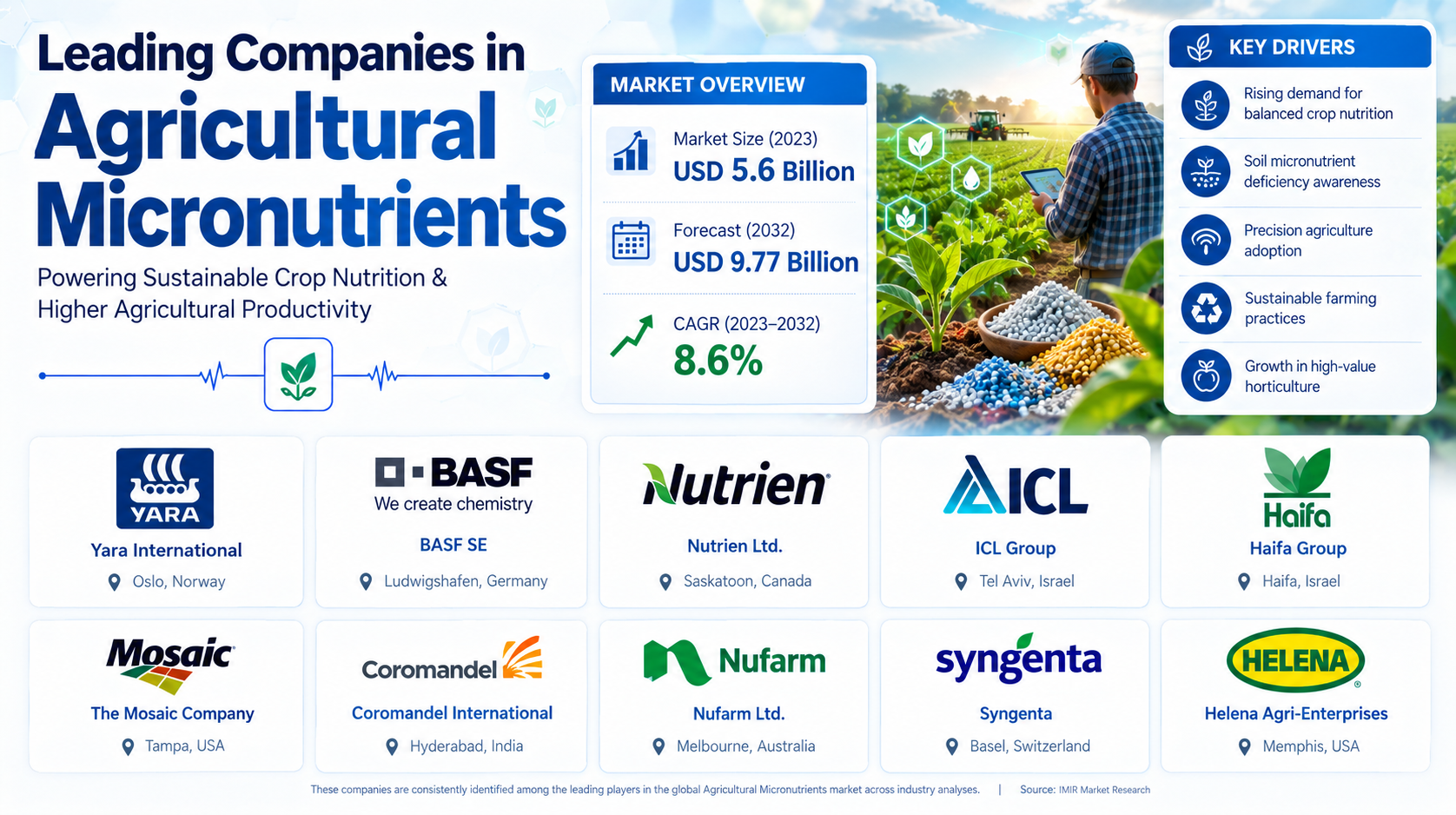
Top Leading Companies in the Agricultural Micronutrients Market 2026
Agricultural micronutrients — zinc, boron, iron, molybdenum, copper, manganese, and other trace elements — are essential in small but critical quantities for healthy plant growth, enzyme activity, and crop yield optimization. Applied through soil, foliar, fertigation, and other delivery modes, these specialty nutrients correct soil deficiencies, improve nutrient-use efficiency, and support the broader push toward sustainable, higher-productivity agriculture.
The global agricultural micronutrients market was valued at USD 5.6 billion in 2023 and is projected to reach USD 9.77 billion by 2032, growing at a compound annual growth rate (CAGR) of 8.6% from 2023 to 2032. Growth is being driven by rising awareness of soil micronutrient deficiencies, growing adoption of precision and foliar application techniques, expanding demand for high-efficiency fertilizers as arable land per capita shrinks, and increasing government and agronomic emphasis on balanced crop nutrition to secure food output for a growing global population.
The competitive landscape spans diversified global fertilizer and crop-nutrition majors such as The Mosaic Company, Yara International, and BASF, specialty agrochemical and biological-nutrition leaders including Syngenta, Nufarm, and Nouryon, and a wide base of regional micronutrient specialists and cooperatives. This article provides a research-based analysis of the top companies shaping the global agricultural micronutrients market, their positioning, flagship offerings, and the regional and technological forces driving the industry forward.
Market Overview
|
Parameter |
Details |
|---|---|
|
Market Size (2023) |
USD 5.6 Billion |
|
Projected Market Size (2032) |
USD 9.77 Billion |
|
CAGR (2023–2032) |
8.6% |
|
Base Year |
2023 |
|
Historic Year |
2019–2022 |
|
Forecast Period |
2024–2032 |
|
Leading & Fastest-Growing Region |
North America (largest share); Asia-Pacific (fastest-growing) |
|
Key Segments (by Type) |
Zinc, Boron, Iron, Molybdenum, Copper, Manganese, Other Types |
|
Key Segments (by Application) |
Soil, Foliar, Fertigation, Other modes of application |
Why the Agricultural Micronutrients Market Is Growing
1. Widespread Soil Micronutrient Deficiencies
Decades of intensive farming, high-yield hybrid cropping, and imbalanced use of primary (NPK) fertilizers have depleted trace-element reserves in soils worldwide, pushing farmers and agronomists toward targeted zinc, boron, and iron supplementation to restore soil health and crop output.
2. Growing Adoption of Foliar and Fertigation Techniques
Foliar sprays and fertigation allow rapid, targeted correction of nutrient deficiencies during critical growth stages, and their rising adoption alongside drip irrigation and precision-agriculture equipment is expanding the addressable market for liquid and chelated micronutrient formulations.
3. Rising Demand for High-Efficiency, Yield-Boosting Inputs
With arable land per capita continuing to shrink, farmers are under pressure to maximize yield per hectare, and micronutrients play an outsized role in improving crop quality, disease resistance, and overall productivity relative to their low application cost.
4. Government and Institutional Support for Balanced Fertilization
Several countries have introduced soil-testing programs, fertilizer subsidy reforms, and balanced-nutrition advisories that specifically promote micronutrient use alongside conventional fertilizers, particularly across major agricultural economies in Asia and Latin America.
5. Expansion of Chelated and Specialty Formulations
Technological advances in chelation chemistry (EDTA, DTPA, EDDHA) and controlled-release coatings are improving micronutrient solubility, plant uptake, and shelf stability, opening new product tiers and premium pricing opportunities for manufacturers.
6. Integration with Biostimulants and Digital Agronomy
Combining micronutrients with biostimulants and offering them through digital crop-advisory platforms is helping suppliers differentiate their portfolios and deepen relationships with large-scale commercial growers.
Market Opportunities & Restraints
A key opportunity lies in specialty and chelated micronutrient innovation: growing farmer awareness of hidden hunger in soils, combined with advances in formulation chemistry, is creating room for premium, high-solubility, and slow-release micronutrient products tailored to specific crops and soil types, while bundling micronutrients with biostimulants and digital advisory tools offers suppliers a path to higher margins. On the restraint side, input cost volatility and fragmented regulatory frameworks remain the primary headwinds, as fluctuating prices for zinc, boron, and other raw materials squeeze manufacturer margins, while inconsistent fertilizer registration and subsidy policies across countries complicate market entry and slow adoption among smallholder farmers who remain price-sensitive and reliant on traditional NPK fertilizers.
Top 10 Companies in the Agricultural Micronutrients Market
- The Mosaic Company
- Yara International ASA
- BASF SE
- Syngenta AG
- Nufarm Limited
- Nouryon
- Coromandel International Limited
- Haifa Negev Technologies Ltd
- Land O'Lakes, Inc.
- Helena Agri-Enterprises, LLC
1. The Mosaic Company
|
Category |
Details |
|---|---|
|
Company Name |
The Mosaic Company |
|
Headquarters |
Tampa, Florida, USA |
|
Founded |
2004 (through the combination of IMC Global and Cargill's crop nutrition division) |
|
Employees |
Approx. 13,000+ |
|
Revenue |
Approx. USD 12.0 Billion (total company revenue across Phosphates, Potash, and Mosaic Fertilizantes segments) |
|
Company Overview |
Mosaic is a leading global producer and marketer of concentrated phosphate and potash crop nutrients, serving customers in more than 40 countries. |
|
Key Products |
Phosphate and potash fertilizers, MicroEssentials micronutrient-enhanced fertilizer, Aspire potash with boron, and biological crop-nutrition solutions. |
|
Market Position |
One of the world's largest crop nutrition companies, with an expanding Mosaic Biosciences platform targeting nutrient-use efficiency. |
|
Recent Developments |
Continues to advance its Mosaic Biosciences platform for next-generation biological and nutrient-efficiency solutions as part of its broader crop-nutrition strategy. |
|
Strategic Advantages |
Vertically integrated phosphate and potash mining and production, a global distribution network across more than 40 countries, and an expanding biologicals pipeline. |
2. Yara International ASA
|
Category |
Details |
|---|---|
|
Company Name |
Yara International ASA |
|
Headquarters |
Oslo, Norway |
|
Founded |
1905 |
|
Employees |
Approx. 15,700 |
|
Revenue |
Approx. USD 14–15 billion |
|
Company Overview |
Yara is a global crop nutrition and industrial solutions company producing nitrogen-based fertilizers alongside specialty and micronutrient formulations under its YaraVita brand. |
|
Key Products |
YaraVita specialty micronutrient foliar products, YaraMila compound fertilizers, YaraLiva calcium nitrate, and digital crop-nutrition tools such as Atfarm and YaraPlus. |
|
Market Position |
A leading global crop-nutrition supplier with sales to roughly 150 countries and production on six continents. |
|
Recent Developments |
Announced a strategic partnership with BASF in 2024 to co-develop next-generation micronutrient fertilizers, and continues expanding its digital crop-nutrition tools across regional markets. |
|
Strategic Advantages |
Deep agronomic R&D capability, an extensive global production and distribution footprint, and a growing suite of digital tools that pair micronutrient recommendations with real-time farm data. |
3. BASF SE
|
Category |
Details |
|---|---|
|
Company Name |
BASF SE |
|
Headquarters |
Ludwigshafen am Rhein, Germany |
|
Founded |
1865 |
|
Employees |
Approx. 111,000 (group-wide); approx. 10,000 within Agricultural Solutions |
|
Revenue |
Approx. EUR 65 Billion (total company); approx. EUR 9.8 Billion (Agricultural Solutions segment) |
|
Company Overview |
BASF is a global chemical major whose Agricultural Solutions segment develops crop-nutrition, biological, and crop-protection products, with manufacturing facilities across roughly 14 countries. |
|
Key Products |
Micronutrient-enriched crop nutrition formulations, biological crop-nutrition solutions, and integrated fungicide, herbicide, and seed-treatment portfolios. |
|
Market Position |
A top-tier global agricultural inputs supplier with products reaching more than 100 countries. |
|
Recent Developments |
Entered a 2024 partnership with Yara International to co-develop next-generation micronutrient fertilizers aimed at improving nutrient efficiency and sustainability. |
|
Strategic Advantages |
Deep chemical R&D infrastructure, global Verbund manufacturing integration, and a diversified Agricultural Solutions portfolio spanning nutrition, biologicals, and crop protection. |
4. Syngenta AG
|
Category |
Details |
|---|---|
|
Company Name |
Syngenta AG |
|
Headquarters |
Basel, Switzerland |
|
Founded |
2000 (Syngenta Group formed 2020) |
|
Employees |
Approx. 50,000+ across the Syngenta Group |
|
Revenue |
Approx. USD 17.0 Billion |
|
Company Overview |
Syngenta is a global agricultural technology company covering crop protection, seeds, and biologicals, with a growing focus on nutrient-efficiency and biostimulant products that complement micronutrient nutrition. |
|
Key Products |
Biocontrol and biostimulant products, seed treatments, and crop-nutrition-adjacent solutions developed through its Syngenta Crop Protection and Seeds business units. |
|
Market Position |
One of the world's largest agricultural input companies, with a growing biologicals manufacturing footprint in the U.S., Brazil, Italy, India, and Norway. |
|
Recent Developments |
Opened a new biologicals production facility in Orangeburg, South Carolina in 2025, and reported double-digit sales growth in its biologicals business for the full year 2025. |
|
Strategic Advantages |
Large-scale global R&D and registration capabilities, an expanding biologicals and biostimulant pipeline, and integration across crop protection, seeds, and nutrient-efficiency technologies. |
5. Nufarm Limited
|
Category |
Details |
|---|---|
|
Company Name |
Nufarm Limited |
|
Headquarters |
Melbourne (Laverton North), Australia |
|
Founded |
1956 |
|
Employees |
Approx. 3,000–3,200 |
|
Revenue |
Approx. AUD 3.4 Billion |
|
Company Overview |
Nufarm is an Australian crop-protection and seed-technology company holding more than 2,100 product registrations and marketing products in more than 100 countries. |
|
Key Products |
Crop protection products (herbicides, insecticides, fungicides) alongside seed technologies through its Nuseed platform, complementing nutrient-management programs. |
|
Market Position |
A leading crop-input supplier across Australia, the Americas, Europe, and Asia-Pacific, with a strong off-patent crop-protection portfolio. |
|
Recent Developments |
Continues expanding its Nuseed seed-technology platform and off-patent crop-protection portfolio across major agricultural regions. |
|
Strategic Advantages |
Broad global product registration base, an established off-patent manufacturing cost position, and integrated crop-protection and seed-technology offerings. |
Competitive Landscape
The global agricultural micronutrients market brings together a broad and diverse set of competitors. Diversified crop-nutrition majors The Mosaic Company, Yara International, and BASF hold particularly strong positions, built on vertically integrated fertilizer manufacturing and decades of agronomic R&D. Global crop-protection and specialty-chemical leaders Syngenta, Nufarm, and Nouryon bring broad formulation expertise and international distribution scale to the market. A large base of regional and specialty manufacturers, including Coromandel International, Haifa Negev Technologies, Land O'Lakes, Helena Agri-Enterprises, Manvert, Zuari Agrochemicals, Stoller Enterprises, Balchem Corp., ATP Nutrition, Wilbur-Ellis, BMS Micro-Nutrients, Koch Agronomic Services, AgroLiquid, and Aries Agro, compete on crop-specific formulation expertise, regional distribution relationships, and price-competitive positioning across the fragmented global supply base.
Regional Analysis
North America
North America holds a leading share of the agricultural micronutrients market, supported by high adoption of precision-agriculture practices, established soil-testing infrastructure, and the presence of large integrated crop-nutrition companies such as Mosaic and Helena Agri-Enterprises.
Asia-Pacific
Asia-Pacific is expected to register significant growth, driven by widespread soil micronutrient deficiencies across major agricultural economies such as India and China, government-backed balanced-fertilization programs, and a large base of domestic micronutrient manufacturers.
Europe
Europe features steady demand for specialty and chelated micronutrient products, supported by strong regulatory frameworks around fertilizer quality and sustainability, alongside the presence of major players such as Yara and BASF.
Latin America & Middle East and Africa
Latin America and the Middle East & Africa represent emerging markets for agricultural micronutrients, with growth tied to expanding commercial farming operations, rising fertilizer subsidy programs, and increasing awareness of balanced crop-nutrition practices.
Emerging Trends in the Agricultural Micronutrients Market
1. Chelated and Specialty Formulation Growth: Advances in chelation chemistry (EDTA, DTPA, EDDHA) are improving micronutrient solubility and plant uptake, supporting premium product tiers targeted at high-value crops.
2. Integration with Biostimulants: Suppliers are increasingly bundling micronutrients with biostimulant products to improve nutrient-use efficiency and offer growers combined crop-health solutions.
3. Precision and Digital Agronomy Adoption: Growing use of soil-testing, satellite imagery, and digital crop-advisory platforms is enabling more targeted, data-driven micronutrient application, reducing waste and improving return on investment for farmers.
4. Expansion of Foliar and Fertigation Delivery: Rising adoption of drip irrigation and foliar spraying equipment is expanding demand for liquid and water-soluble micronutrient formulations over traditional granular products.
5. Strategic Partnerships and Portfolio Expansion: Leading players are pursuing collaborations and regional portfolio expansions, such as the 2024 Yara–BASF partnership on next-generation micronutrient fertilizers, to strengthen their competitive positioning.
Future Outlook (2023–2032)
The global agricultural micronutrients market's trajectory toward USD 9.77 billion by 2032 reflects sustained demand growth driven by soil deficiency correction, precision-agriculture adoption, and rising food-security priorities. The 8.6% CAGR forecast through 2032 assumes continued expansion of chelated and specialty formulations, growing integration with biostimulants and digital agronomy tools, and increasing government support for balanced fertilization programs across major agricultural economies.
Key investment themes include continued innovation in chelated and controlled-release micronutrient products, deeper integration with biological crop-nutrition solutions, and expanding digital agronomy partnerships that pair micronutrient recommendations with real-time farm data. Global crop-nutrition majors Mosaic, Yara, and BASF are likely to retain strong positions built on integrated manufacturing and R&D scale, while Syngenta, Nufarm, and Nouryon continue leveraging their formulation and distribution expertise, and a broad base of regional and specialty manufacturers compete on crop-specific engineering across the fragmented global market.
Frequently Asked Questions (FAQ)
1. What is the current size of the global agricultural micronutrients market?
The global agricultural micronutrients market was valued at USD 5.6 billion in 2023 and is projected to reach USD 9.77 billion by 2032, growing at a CAGR of 8.6%.
2. Who are the top companies in the agricultural micronutrients market?
Leading companies include The Mosaic Company, Yara International ASA, BASF SE, Syngenta AG, Nufarm Limited, Nouryon, Coromandel International Limited, Haifa Negev Technologies Ltd, Land O'Lakes, Inc., and Helena Agri-Enterprises, LLC.
3. Which region dominates the agricultural micronutrients market?
North America currently holds the largest revenue share, while Asia-Pacific is expected to register the fastest growth, supported by the presence of key companies in economies such as Japan, India, and China.
4. What is the forecast CAGR for the agricultural micronutrients market?
The market is forecast to grow at a CAGR of 8.6% from 2023 to 2032.
5. What are the main growth drivers for this market?
Key drivers include widespread soil micronutrient deficiencies, growing adoption of foliar and fertigation application techniques, rising demand for high-efficiency yield-boosting inputs, and government support for balanced fertilization programs.
6. What are the key micronutrient types covered in this market?
The market is segmented by type into Zinc, Boron, Iron, Molybdenum, Copper, Manganese, and Other Types, and by application into Soil, Foliar, Fertigation, and Other modes of application.
7. How are micronutrients typically applied to crops?
Agricultural micronutrients are applied through soil treatment, foliar spraying, fertigation (application through irrigation systems), and other specialized delivery methods depending on crop type and deficiency severity.
Conclusion
The global agricultural micronutrients market sits at the intersection of persistent soil-deficiency challenges and rising demand for high-efficiency, yield-boosting crop nutrition. With a projected size of USD 9.77 billion by 2032 at an 8.6% CAGR, the market offers steady, precision-agriculture-driven growth across soil, foliar, and fertigation application methods.
Mosaic, Yara, and BASF continue to lead on the strength of integrated crop-nutrition manufacturing and decades of agronomic R&D, while Syngenta, Nufarm, and Nouryon bring formulation expertise and global distribution scale, and a broad base of regional and specialty manufacturers compete on crop-specific engineering. As chelated formulations, biostimulant integration, and digital agronomy reshape the industry, the companies that combine deep nutrient-science expertise with data-driven, farmer-centric positioning will define market leadership through 2032 and beyond.