
Top 20 Companies in the Global Airport Kiosk Market Driving Industry Growth in 2026
Author:
Intellectual Market Insights Research
Published Date:
25 Jun 2026
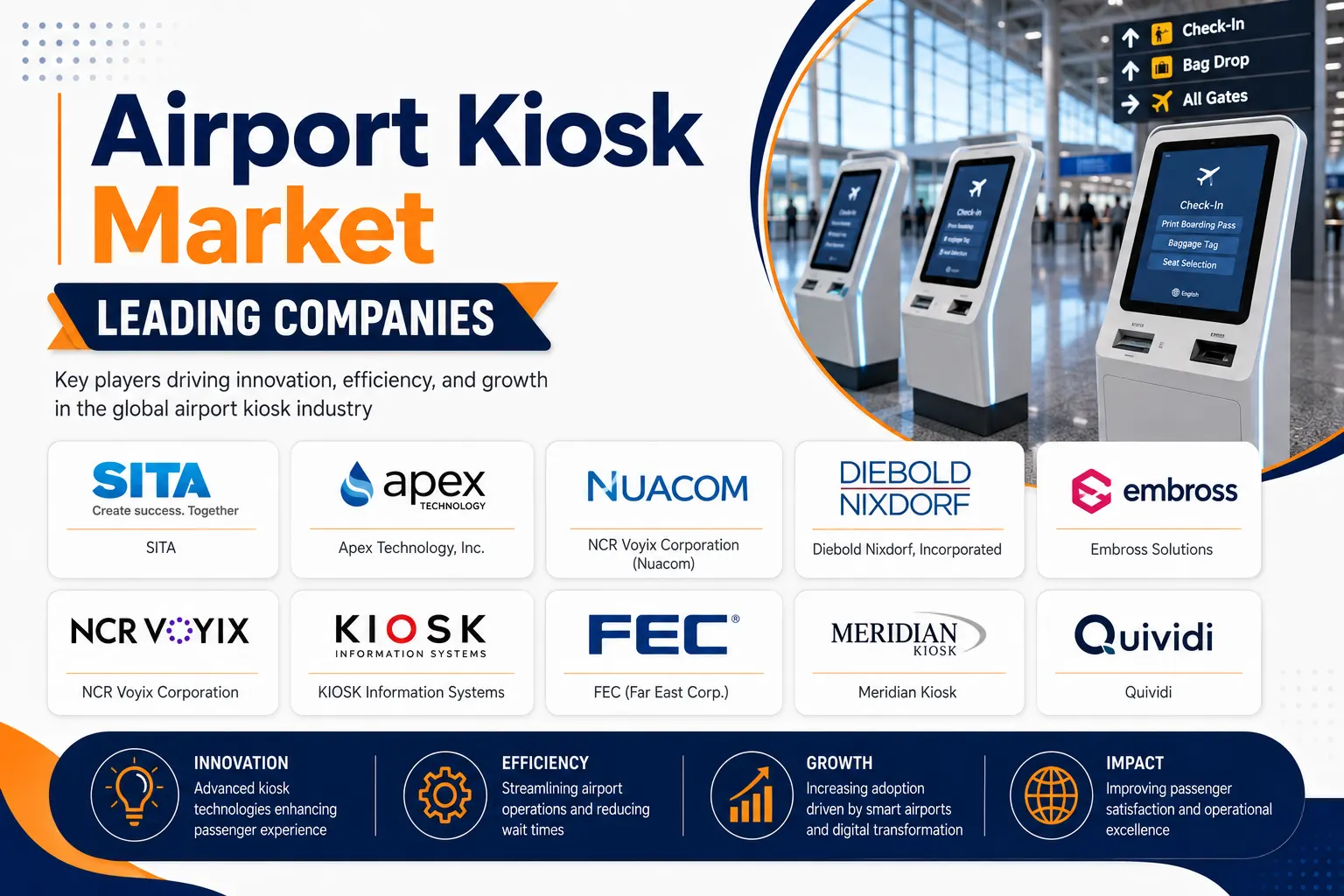
Top Companies in the Global Airport Kiosk Market
Introduction: The Airport Kiosk Industry in 2026
The global airport kiosk market stands at the intersection of aviation expansion, digital transformation, and passenger experience innovation. As air travel continues its robust recovery and growth trajectory, airports and airlines worldwide are investing heavily in self-service kiosk infrastructure to cope with surging passenger volumes, reduce operational costs, and deliver a frictionless, contactless travel experience.
According to market research by Intellectual Market Insights Research (IMIR), the global airport kiosk market was valued at USD 2.10 billion in 2024 and is expected to grow from USD 2.7 billion in 2025 to USD 7.2 billion by 2034, progressing at a robust compound annual growth rate (CAGR) of 8.5% over the forecast period 2025–2034. This growth trajectory reflects the accelerating convergence of biometric technologies, artificial intelligence, cloud computing, and IoT within airport operations worldwide.
Airport kiosks are no longer simply self-service terminals where passengers print boarding passes. Today's kiosks represent sophisticated, multi-function passenger engagement platforms integrating check-in processing, biometric identity verification, baggage tagging and drop management, immigration clearance, security screening support, real-time wayfinding, payment processing, and multilingual customer assistance. They are strategic infrastructure assets for airport operators and airline carriers alike.
The International Air Transport Association (IATA) recorded a 52.4% increase in air passenger traffic as of March 2023 compared to the previous year, a trend that has only intensified. The Airports Council International (ACI) projects a total of 153.8 million aircraft movements globally by 2041, underscoring the critical need for automated, scalable passenger processing solutions. This demand dynamic is the foundational driver for the top companies in the airport kiosk market competing to innovate and capture market share across all geographies.
Several landmark developments in 2023–2024 crystallized the industry's direction. In September 2023, Hamad International Airport, Atos, and Royal Schiphol Group jointly launched Passenger Digital Assistance Kiosks enabling live video calls to customer service agents. In August 2023, SITA upgraded 400 self-service kiosks across major European airports with contactless payment functionality and PCI-standard secure payment services. In July 2023, SITA signed a landmark agreement with India's Airports Authority (AAI) to deploy IATA-certified kiosk solutions across 43 Indian airports.
This article provides an authoritative, research-based analysis of the top 20 companies driving growth, innovation, and competitive differentiation in the global airport kiosk market as of 2026, along with a comprehensive market overview, segmentation analysis, regional insights, investment outlook, and future forecast.
Market Overview Table
| Metric | Value |
|---|---|
| Market Size (2024) | USD 2.10 Billion |
| Market Size (2025) | USD 2.7 Billion |
| Market Forecast (2034) | USD 7.2 Billion |
| CAGR (2025–2034) | 8.5% |
| Base Year | 2024 |
| Forecast Period | 2025–2034 |
| Largest Region | North America |
| Fastest Growing Region | Asia-Pacific |
| Key Growth Drivers | Rising air passenger traffic, contactless travel demand, biometric integration, AI adoption |
| Emerging Opportunities | Smart airport infrastructure, AI + biometric kiosks, baggage automation |
| Major Challenges | High initial investment, maintenance costs, cybersecurity concerns |
| Key Segments by Component | Hardware, Software, Services |
| Key Segments by Functionality | Check-In, Baggage Check-In, Immigration, Ticketing, Security, Wayfinding |
| Key Segments by Airport Type | International, Domestic, Regional |
Executive Summary
The global airport kiosk market is in an accelerated growth phase, transitioning from early mainstream adoption to widespread digital transformation deployment. The market demonstrates moderate fragmentation at the competitive level, with established aviation technology giants—SITA, Collins Aerospace, Thales Group, NCR Voyix, and Amadeus IT Group—coexisting alongside agile specialized providers and emerging technology startups.
Innovation intensity is high and accelerating, with the most competitive differentiators being biometric authentication depth, AI-enabled personalization, cloud-based remote management, and multi-function kiosk platform integration. Regulatory environments across North America, Europe, and Asia-Pacific are increasingly supportive of digital identity verification and self-service airport automation. Investment interest from both strategic corporates and financial sponsors remains robust, with particularly significant activity in Asia-Pacific's airp
Why the Airport Kiosk Market Is Growing
1. Rising Air Passenger Traffic Driving Automation Investment
Global air passenger volumes have rebounded to record levels post-pandemic. ICAO reported 3.6 billion passengers in 2022—a 47% year-on-year increase—and forward projections from ACI suggest continued multi-decade growth. At major international hubs, where hundreds of thousands of passengers transit daily, manual processing simply cannot scale. Self-service kiosks are the most cost-effective and operationally scalable solution for high-volume passenger processing.
2. Contactless and Touchless Travel Imperatives
The COVID-19 pandemic permanently elevated passenger and airport operator sensitivity to touchpoint hygiene and physical contact minimization. Self-service kiosks with touchless interfaces, voice activation, QR code scanning, and gesture-based navigation have become a standard expectation across premium travel segments. Leading airports worldwide are actively replacing older touchscreen-dependent kiosks with next-generation contactless units.
3. Biometric Integration Revolutionizing Identity Verification
Biometric technologies—particularly facial recognition, fingerprint scanning, and e-passport reading—are being embedded into airport kiosks at scale. India's Digi Yatra initiative serves over 9 million registered users and processes 30,000 daily downloads, enabling paperless, facial recognition-based travel across 28 airports. Delhi International Airport's biometric registration kiosks reduced immigration processing times by more than 50%. Dubai International Airport's 122 smart biometric gates have processed over 100 million passengers, demonstrating the transformative throughput capacity of biometric kiosk integration.
4. Government and Regulatory Support for Smart Airports
Governments in North America, Europe, Asia, and the Middle East are actively funding smart airport transformation programs. Canada's Airport Critical Infrastructure Program, Europe's Schengen area digital border infrastructure initiatives, and India's UDAN scheme are all channeling public funds into airport technology modernization, including self-service kiosk deployment at scale.
5. Operational Cost Reduction Driving ROI
For major airport operators, deploying self-service kiosks generates measurable cost savings by reducing reliance on check-in counter staff for routine transactions. Staff redeployment toward higher-value, customer-relations roles improves both passenger satisfaction scores and operational efficiency. For large hubs processing 50–100 million passengers annually, the return on kiosk investment is compelling and typically realized within 3–5 years of deployment.
6. AI and Cloud Integration Creating New Value
Machine learning algorithms enabling adaptive kiosk interfaces, predictive maintenance via cloud-based monitoring platforms, real-time analytics for passenger flow management, and integration with airline loyalty programs are all creating new value layers atop existing kiosk hardware. This software and services dimension is driving significant incremental revenue for leading vendors.
Market Segmentation Analysis
By Component
Hardware commands the largest market share among the three primary component segments. Hardware encompasses the physical chassis, touchscreen displays, boarding pass printers, biometric sensors (facial recognition cameras, fingerprint scanners), e-passport readers, payment terminals, and bag tag printers. Large international airports—such as London Heathrow, Singapore Changi, and Hartsfield-Jackson Atlanta—invest heavily in ruggedized, high-throughput hardware units capable of sustained high-volume daily operation. Hardware dominates overall market revenue primarily due to the significant capital expenditure required for large-scale kiosk fleet deployments.
Software is the fastest-growing component segment, driven by the increasing complexity of kiosk platform capabilities. Software provides passenger-facing interfaces, back-end data processing, real-time integration with airline departure control systems, cloud-based remote management, biometric data handling, analytics dashboards, and multilingual personalization. Leading software providers are transitioning from on-premise installations to cloud-native SaaS architectures, improving scalability and reducing total cost of ownership for airport operators.
Services—encompassing installation, systems integration, technical support, software updates, and managed maintenance—represent a growing segment as kiosk technology complexity increases. Small and mid-tier airports lacking in-house technical expertise are increasingly opting for fully managed service contracts with kiosk vendors, creating recurring revenue streams that enhance vendor financial predictability.
By Functionality
Check-In Kiosks represent the largest and most widely deployed functional segment. These units enable independent passenger check-in, seat selection, and boarding pass issuance, substantially reducing counter queue lengths and dependence on airline ground staff. They are deployed across virtually all airport categories globally, from major international hubs to regional airports.
Baggage Check-In Kiosks (Self Bag Drop) rank as the second most prevalent segment. These units print baggage tags and facilitate direct baggage drop, further reducing counter congestion. Hyderabad's Rajiv Gandhi International Airport installed eight fully automated self-baggage machines in June 2023, each capable of processing a passenger's baggage in under one minute.
Immigration & Border Control Kiosks are critical infrastructure at international airports, integrating with national border management systems and using biometric verification to expedite identity clearance. Their deployment is growing rapidly in the UAE, Australia, Singapore, the EU, and India.
Security Screening Kiosks support document verification and passenger identity confirmation at pre-security checkpoints. Ticketing & Payment Kiosks serve ancillary purchase functions including ticket upgrades and excess baggage fees. Information & Wayfinding Kiosks provide flight status information, terminal maps, and service directories to improve passenger navigation.
By Airport Type
International Airports are the dominant deployment category by investment volume, given their high passenger throughput, complex multi-airline, multi-language requirements, and regulatory compliance mandates for border control and biometric verification. Domestic Airports represent the largest count of total kiosk installations, driven by sheer volume. Regional Airports remain underserved relative to their potential, constrained primarily by capital investment limitations.
Top 20 Companies in the Global Airport Kiosk Market
- SITA
- Collins Aerospace
- NCR Voyix
- Amadeus IT Group
- Thales Group
- Materna IPS GmbH
- Embross
- Diebold Nixdorf
- KIOSK Information Systems
- Olea Kiosks
- IER
- Fujitsu
- Toshiba Tec
- Elenium Automation
- Advantech
- NEC Corporation
- Indra Sistemas
- Innovative Travel Solutions
- Panasonic Avionics
- Wipro Limited
1. SITA
Headquarters: Geneva, Switzerland | Founded: 1949 | Employees: 4,500+ | Revenue (2024): USD 1.2 Billion+
SITA is the world's leading IT provider to the air transport industry, serving over 1,000 airports globally and holding a preeminent position in the airport kiosk market. The company's kiosk portfolio spans the complete passenger journey—from common-use self-service (CUSS) kiosks and self-bag drop units to biometric boarding and immigration processing systems. SITA's Smart Path solution, powered by NEC's facial recognition technology, enables passengers to use their face as their boarding pass throughout the airport journey. In August 2023, SITA upgraded 400 kiosks across major European airports with contactless payment and PCI-standard secure payment capabilities. In July 2023, SITA signed a major agreement with India's Airports Authority to deploy IATA-certified solutions—including SITA Flex, CUPPS, CUSS, and Bag Manager—at 43 of India's largest airports. In October 2023, SITA and Fraport partnered to implement full facial biometric identification across all airlines at Frankfurt Airport. In October 2024, SITA launched a unified self-service kiosk software platform with enhanced biometric support and cloud-based management for large-scale deployments. SITA's competitive advantage lies in its unmatched ecosystem connectivity: virtually every airline and major airport authority operates on SITA's network infrastructure, creating a uniquely defensible position in common-use kiosk technology.
2. Collins Aerospace (RTX Corporation)
Headquarters: Charlotte, North Carolina, USA | Founded: 2018 (RTX subsidiary) | Employees: 80,000+ | Revenue (2024): USD 26 Billion+ (RTX segment)
Collins Aerospace, a subsidiary of RTX Corporation (formerly Raytheon Technologies), is a premier provider of integrated airport systems and self-service kiosk solutions. The company's ARINC SelfServ™ kiosk platform is one of the most widely deployed check-in and self-bag drop systems globally. Collins Aerospace serves airlines, airport authorities, and ground handlers across North America, Europe, Asia-Pacific, and the Middle East. In November 2023, Collins Aerospace entered into a significant contract with NEOM Bay Airport in Saudi Arabia to provide a comprehensive suite of integrated airport systems, including operational database management, resource management, messaging infrastructure, baggage handling, and self-bag drop units. The company has embedded AI-powered fraud detection capabilities into its airport terminal solutions. Collins Aerospace's competitive strength lies in its deep systems integration expertise—its kiosk solutions are designed to interoperate seamlessly with broader airport operational technology stacks, delivering a single-vendor end-to-end capability that airport operators value highly.
3. NCR Voyix Corporation
- Headquarters :
- Founded:
- Parent:
- Global Market Share :
- Regions:
- Industry Focus:
- Company Overview:
- Key Products & Services:
- Strategic Advantages:
4. Amadeus IT Group SA
- Headquarters :
- Founded:
- Parent:
- Global Market Share :
- Regions:
- Industry Focus:
- Company Overview:
- Key Products & Services:
- Strategic Advantages:
5. Thales Group
- Headquarters :
- Founded:
- Parent:
- Global Market Share :
- Regions:
- Industry Focus:
- Company Overview:
- Key Products & Services:
- Strategic Advantages:
Competitive Landscape Analysis
The global airport kiosk market exhibits moderate fragmentation with distinct competitive tiers. The top tier is dominated by SITA, Collins Aerospace, Amadeus IT Group, NCR Voyix, and Thales Group—companies with global airport client bases, comprehensive product portfolios, and the financial scale to invest in sustained R&D. These incumbents compete primarily on ecosystem depth, integration capability, and long-term service relationships.
The second tier comprises focused specialists—Materna IPS, Embross, IER, Diebold Nixdorf, KIOSK Information Systems, and Olea Kiosks—who compete effectively on product expertise, regional strength, and customer intimacy within defined market segments. Emerging players like Elenium Automation are disrupting the market through innovation in touchless and health-integrated kiosk technology.
Mergers and Acquisitions activity has been notable, with technology consolidation accelerating as larger players seek to acquire biometric, AI, and software capabilities. Strategic partnerships are increasingly central to market strategy—exemplified by the Thales-Amadeus joint development agreement for next-generation biometric kiosk platforms (February 2025) and the SITA-Fraport collaboration at Frankfurt Airport.
Pricing competition is most intense in hardware commoditized segments (standard check-in kiosk units), while software-led differentiation and managed services are where premium margin capture occurs. Vendors with strong common-use platform capabilities (SITA, Amadeus, ITS) hold structural advantages because their platforms are embedded in airport IT infrastructure in ways that create significant switching costs.
Innovation competition centers on five key battlegrounds: biometric accuracy and speed; touchless interface design; AI-powered predictive maintenance and analytics; cloud-native software architectures; and multi-function kiosk platform integration (combining check-in, bag drop, immigration, and retail in a single passenger touchpoint).
Regional Analysis
North America
North America holds the largest market share in the global airport kiosk market. The United States and Canada have been early adopters of self-service airport technology, with major hubs including Hartsfield-Jackson Atlanta International, Dallas/Fort Worth International, Los Angeles International, and Toronto Pearson International operating extensive kiosk fleet deployments. U.S. airlines saw a 30% year-on-year passenger growth in 2022, carrying an additional 194 million passengers, accelerating further investment in automated processing. Canada's Airport Critical Infrastructure Program provides direct government funding for airport technology modernization. North America benefits from the strongest concentration of leading kiosk vendors (NCR Voyix, Collins Aerospace, KIOSK Information Systems, Olea Kiosks) and the most mature procurement and regulatory environment for aviation self-service technology.
Europe
Europe holds a significant second position in the global airport kiosk market. The region is characterized by stringent security and border control requirements, strong emphasis on seamless multi-airline common-use environments, and progressive biometric integration driven by EU digital identity initiatives. Major airports including London Heathrow, Frankfurt Airport, Amsterdam Schiphol, Charles de Gaulle Paris, and Munich Airport have invested heavily in smart kiosk infrastructure. Düsseldorf Airport's 2023 self-service upgrade (Materna IPS contract) and SITA's European kiosk modernization program illustrate the region's continued investment commitment. European regulatory frameworks around biometric data handling add complexity but also create demand for compliance-certified kiosk solutions from vendors like Thales and SITA.
Asia-Pacific
Asia-Pacific is the fastest-growing regional market, driven by the largest absolute expansion in air passenger volumes globally, ambitious airport infrastructure development programs, and government-led digital transformation initiatives. China's major airports—Beijing Capital, Shanghai Pudong, Guangzhou Baiyun—are deploying AI-powered and facial recognition kiosks at scale. Singapore Changi Airport is a global benchmark for smart airport technology, pioneering passport-free travel through facial recognition. India's Digi Yatra program with over 9 million users across 28 airports represents one of the world's most ambitious biometric travel initiatives, driving significant kiosk deployment activity. SITA's 43-airport agreement with India's AAI (July 2023) underscores the region's market scale. Japan and South Korea are investing in biometric, multilingual, and touchless kiosk solutions for both domestic and international traveler segments.
Middle East & Africa
The Middle East is an emerging powerhouse in airport kiosk investment, anchored by the ambitions of Dubai International, Hamad International (Doha), and Abu Dhabi International airports to position themselves as global transit hubs. Dubai International's 122 smart gates have processed over 100 million passengers. NEOM Bay Airport's contract with Collins Aerospace (November 2023) signals the region's commitment to deploying cutting-edge self-service systems from the ground up. Abu Dhabi's Zayed Airport launched a full biometric identification program by 2025. Africa's kiosk market remains nascent but is growing as airport privatization and government infrastructure investment expand across South Africa, Nigeria, Kenya, and Ethiopia.
Latin America
Latin America represents an emerging growth opportunity constrained by economic and infrastructure development realities. Brazil, Mexico, Colombia, and Argentina are the primary markets, with investment driven by airport privatization programs and the need to modernize aging terminal infrastructure. Indra Sistemas holds a particularly strong regional position given its Spanish-language market expertise and longstanding airport IT relationships across South America and Central America. The region's kiosk adoption is expected to accelerate through 2030 as airport privatization creates commercially incentivized infrastructure operators with interest in self-service technology ROI.
Emerging Market Trends
1. AI and Machine Learning Integration: Artificial intelligence is transforming airport kiosks from static self-service terminals into intelligent, adaptive passenger engagement systems. Machine learning algorithms enable kiosks to learn individual passenger preferences, adapt interface language and layout, and provide personalized travel information. AI-powered predictive maintenance systems reduce kiosk downtime by anticipating hardware failures before they occur. AI analytics platforms enable airport operators to optimize kiosk placement, staffing allocation, and passenger flow management based on real-time and predictive traffic data.
2. Biometric Identity Verification at Scale: Biometric authentication is rapidly becoming the standard for airport kiosk identity verification worldwide. Facial recognition, fingerprint scanning, iris detection, and palm-vein biometrics are being integrated into check-in, baggage drop, immigration, and boarding kiosks. The speed and accuracy advantages of biometric verification—enabling identity confirmation in under two seconds versus 20–30 seconds for manual document checks—are delivering measurable passenger processing throughput improvements at major airports.
3. Touchless and Contactless Technology: Voice activation, gesture recognition, QR code scanning, NFC payment integration, and remote kiosk control via mobile apps are eliminating physical touchpoints from kiosk interactions. This trend, catalyzed by COVID-19 but sustained by traveler preference and hygiene standards, is driving significant kiosk hardware refresh cycles globally.
4. Cloud-Native Kiosk Management Platforms: The transition from on-premise kiosk management software to cloud-native SaaS platforms enables airport operators to manage, update, and monitor entire kiosk fleets remotely. Cloud architectures reduce IT infrastructure costs, improve software update velocity, and enable real-time analytics access across multi-terminal, multi-airport deployments. SITA's October 2024 unified kiosk software platform launch exemplifies this market direction.
5. Multi-Function Kiosk Platform Integration: Airport operators are consolidating multiple passenger service functions—check-in, bag drop, immigration, retail, currency exchange, and customer information—into unified multi-function kiosk platforms. This reduces terminal space requirements, simplifies IT management, and creates a more cohesive passenger journey experience.
6. Sustainability-Focused Hardware Design: Leading kiosk manufacturers are incorporating energy-efficient display technologies, sustainable materials, extended hardware lifecycle designs, and remote diagnostics capabilities (reducing unnecessary on-site engineer visits) into their product development roadmaps, responding to airport operators' growing sustainability commitments.
Frequently Asked Questions (FAQs)
1. What is the current size of the global airport kiosk market? The global airport kiosk market was valued at USD 2.10 billion in 2024 and is projected to reach USD 2.7 billion in 2025. The market is expanding rapidly due to rising air passenger volumes, contactless travel demand, and accelerating airport digital transformation programs across all major geographies.
2. What is the forecast CAGR for the airport kiosk market? According to IMIR Market Research, the global airport kiosk market is expected to grow at a compound annual growth rate (CAGR) of 8.5% between 2025 and 2034. This robust growth rate reflects the strong investment cycle in airport automation technology globally, particularly in Asia-Pacific and the Middle East.
3. Who are the leading companies in the airport kiosk market? The leading companies include SITA, Collins Aerospace, NCR Voyix, Amadeus IT Group, Thales Group, Materna IPS GmbH, Embross, Diebold Nixdorf, Fujitsu, NEC Corporation, KIOSK Information Systems, IER, Olea Kiosks, Elenium Automation, Toshiba Tec, Advantech, Indra Sistemas, Innovative Travel Solutions, Panasonic Avionics, and Wipro. These companies compete across hardware, software, and services dimensions.
4. Which region dominates the airport kiosk market? North America currently holds the largest regional share of the global airport kiosk market, driven by its mature aviation infrastructure, high per-passenger technology investment, and concentration of leading kiosk technology vendors. Asia-Pacific is the fastest-growing region, projected to substantially close the gap with North America by 2034.
5. What are the key growth drivers for the airport kiosk market? The primary growth drivers are rising global air passenger traffic demanding automated processing solutions; the post-pandemic shift to contactless and touchless travel technologies; biometric identity verification integration enabling faster and more secure passenger processing; government-led smart airport programs across India, China, UAE, and North America; and the operational cost savings that self-service kiosks deliver for airport operators and airlines.
6. What are the main challenges facing the airport kiosk market? The principal challenges include high initial capital expenditure for hardware acquisition and installation, ongoing maintenance and software update costs, cybersecurity risks associated with handling biometric and payment data at scale, and the economic constraints limiting kiosk adoption at smaller regional airports where passenger volume ROI thresholds are harder to meet.
7. Which segment grows fastest in the airport kiosk market? By component, software is the fastest-growing segment as kiosk platforms transition to cloud-native architectures. By functionality, immigration and border control kiosks are among the fastest-growing application segments, driven by government investment in biometric border management. By airport type, regional airports represent the highest incremental growth opportunity as economic development and traffic growth justify kiosk investment.
8. What investment opportunities exist in the airport kiosk market?
9. How is AI impacting the airport kiosk market?
10. What is the 2034 outlook for the airport kiosk market?
11. What is a CUSS kiosk?
12. What is a CUPPS platform?
13. How do biometric kiosks work at airports?
14. What is SITA Smart Path?
15. What is India's Digi Yatra initiative?
16. How much does airport kiosk installation cost?
17. What is the difference between a check-in kiosk and a self-bag drop kiosk?
18. Which airports have the most advanced kiosk deployments globally?
19. How are airport kiosks adapting to sustainability requirements?
20. What is the role of 5G connectivity in airport kiosk evolution?
Conclusion
The global airport kiosk market is entering one of the most dynamic periods in its history. Valued at USD 2.10 billion in 2024 and projected to reach USD 7.2 billion by 2034 at a CAGR of 8.5%, the market is being reshaped by a powerful convergence of forces: the structural growth of global air travel, the inexorable demand for contactless and frictionless passenger experiences, the maturation of biometric identity technologies, and the transformative potential of artificial intelligence in self-service systems.
The top companies in the airport kiosk market—SITA, Collins Aerospace, Amadeus IT Group, Thales Group, NCR Voyix, Materna IPS, Embross, and their peers—are investing aggressively in next-generation platform capabilities, strategic partnerships, and geographic expansion to capture the value being created. The February 2025 Thales-Amadeus joint development agreement for next-generation biometric kiosk platforms, SITA's unified cloud-native kiosk software launch, and Collins Aerospace's integrated airport systems contract at NEOM Bay Airport all signal the strategic conviction that market leaders are bringing to this growth sector.
For airport operators and airline carriers, the strategic imperative is clear: self-service kiosk technology is no longer an optional efficiency tool but an essential operational infrastructure for managing the air travel volumes of the coming decade. For investors and industry stakeholders, the airport kiosk market represents a durable, high-growth opportunity embedded in the fundamental growth of global aviation—one of the most resilient long-term demand trends in the global economy.
For technology vendors, the competitive frontier over the next decade will be defined by who delivers the most seamless, secure, intelligent, and scalable biometric-AI kiosk platforms—transforming every airport touchpoint into an effortless, personalized, and secure passenger experience. The companies that win this race will shape how billions of passengers experience the beginning and end of every journey for decades to come.