
Top Leading Companies in the Global Algae Biofuel Market
Author:
Intellectual Market Insights Research
Published Date:
19 Aug 2026
Introduction
Algae biofuel has long carried the promise of solving one of renewable energy's toughest puzzles: producing liquid fuel without competing with food crops for arable land. Algae can be cultivated in ponds, photobioreactors, and even wastewater treatment facilities, absorbing carbon dioxide as they grow and yielding lipids and carbohydrates that can be converted into biodiesel, bioethanol, jet fuel, and other renewable fuels. Yet unlike more established biofuel feedstocks, the algae biofuel sector remains an early-stage, technically demanding field, one where high-profile pioneers have shut down as often as they have scaled, even as government backing and corporate R&D investment continue to build toward commercial viability.
The global algae biofuel market was valued at approximately USD 11.51 billion in 2025 and is projected to reach USD 29.76 billion by 2034, expanding at a compound annual growth rate (CAGR) of 11.1% over the forecast period, according to Intellectual Market Insights Research. This growth reflects continued government support for renewable and non-food-based biofuel sources, ongoing biotechnology advances in algae cultivation and conversion, and rising interest from major energy companies exploring algae as a long-term decarbonization pathway.
The competitive landscape here looks different from most mature industrial markets. Rather than a handful of dominant global manufacturers, the algae biofuel sector is populated by specialized biotechnology ventures, corporate R&D programs backed by energy majors like ExxonMobil, and a wave of earlier pioneers, several of which have ceased fuel-focused operations or pivoted into adjacent markets like biostimulants and nutraceuticals after struggling to hit commercial-scale production costs.
Understanding which companies and corporate programs lead this technically ambitious but still-maturing market is essential for renewable energy investors, biotechnology analysts, and industry observers. This article provides a research-based analysis of the top companies associated with the global algae biofuel market, their positioning, and the regional and technological forces shaping the competitive landscape.
Market Overview
|
Parameter |
Details |
|---|---|
|
Market Size (2025) |
USD 11.51 Billion |
|
Projected Market Size (2034) |
USD 29.76 Billion |
|
CAGR (2025–2034) |
11.1% |
|
Base Year |
2023 (historic); 2024 (base) |
|
Forecast Period |
2025–2034 |
|
Leading Region |
North America (61.2% revenue share in 2023) |
|
Fastest-Growing Region |
Asia-Pacific |
|
Key Growth Drivers |
Technological advancements in cultivation and conversion, growing government support, high R&D funding |
|
Key Challenges |
High production costs relative to fossil fuels and other biofuel feedstocks |
|
Key Opportunities |
Genetic engineering for higher lipid yields, wastewater-based cultivation, aviation and jet fuel applications |
Why the Algae Biofuel Market Is Growing
1. Rapid Technological Advancement Across the Value Chain
Biotechnology improvements spanning algae strain genetic engineering, photobioreactor and open pond cultivation systems, and biomass extraction techniques like centrifugation and flocculation are steadily improving yield, quality, and cost efficiency across the production process.
2. Advances in Biofuel Conversion Processes
Refinements in hydrothermal liquefaction, pyrolysis, and supercritical fluid extraction are improving the efficiency of converting algae biomass into biocrude, biodiesel, and biogasoline, while upgrading technologies are improving compatibility with existing fuel infrastructure and market standards.
3. Growing Government Support and Policy Backing
Governments worldwide are funding research grants, tax incentives, and subsidies to lower production costs, while adapting regulatory frameworks to integrate algae biofuels into existing fuel markets and encourage the shift from food-based to microalgae-based biofuel sources.
4. Strategic Public-Private Partnerships
Collaborations between governments, research institutions, and private-sector stakeholders are accelerating technology scale-up, addressing technical challenges, and demonstrating commercial viability while fostering knowledge sharing across the algae biofuel value chain.
5. High Levels of R&D Investment
Substantial funding from governments, private investors, and research institutions is supporting improvements in algae strain selection, cultivation optimization, and conversion technology, positioning algae biofuels as a increasingly viable alternative to fossil fuels.
6. Non-Food-Competing, Land-Flexible Cultivation
Algae's ability to grow in ponds, bioreactors, and wastewater facilities, on non-arable land and across diverse climates, continues to differentiate it from crop-based biofuel feedstocks like corn and soybeans, supporting long-term investment interest despite near-term cost challenges.
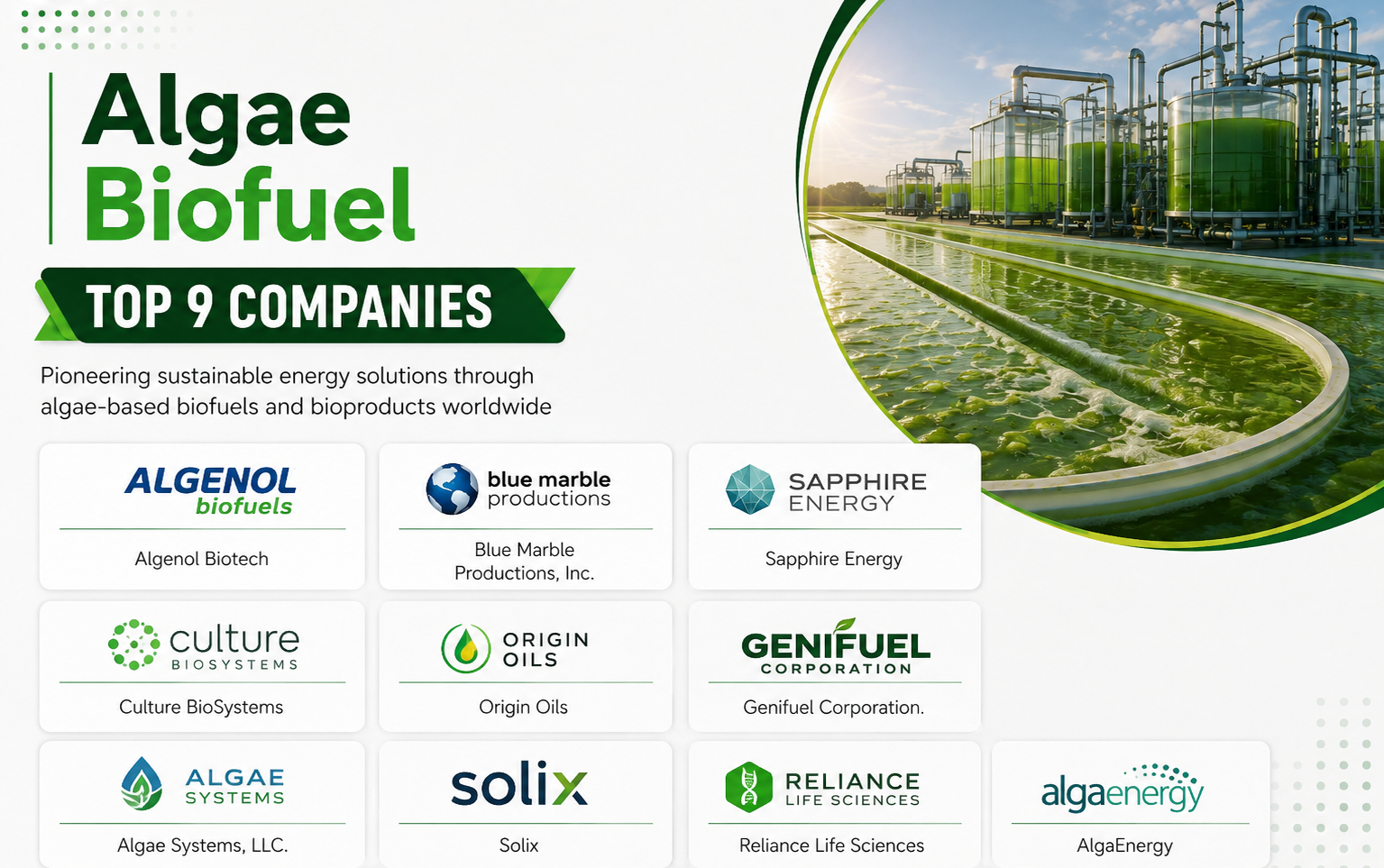
Companies Associated with the Algae Biofuel Market
- Algenol Biotech
- Blue Marble Productions, Inc.
- Sapphire Energy
- Culture BioSystems
- Origin Oils
- Genifuel Corporation
- Algae Systems, LLC
- Solix
- Reliance Industries (Reliance Life Sciences)
- AlgaEnergy
- ExxonMobil Corporation
|
Category |
Details |
|---|---|
|
Company Name |
Exxon Mobil Corporation |
|
Headquarters |
Spring, Texas, United States |
|
Founded |
1999 (as Exxon Mobil, from the merger of Exxon and Mobil; predecessor Standard Oil traces to 1870) |
|
Employees |
Approx. 61,000+ |
|
Revenue |
Approx. USD 340 Billion (group-wide; algae biofuel is a small R&D-stage program within the broader business) |
|
Company Overview |
ExxonMobil is the largest algae-biofuel-focused corporate R&D program among major energy companies, having partnered for over a decade with genetic engineering specialists to improve algae lipid yields toward commercial-scale fuel production. |
|
Key Products |
Research-stage algae-derived biofuel, developed via genetically modified algae strains engineered to significantly increase lipid content and productivity. |
|
Market Position |
The most prominent major oil and gas company still actively pursuing algae biofuel R&D at scale, with a long-term target of producing large daily volumes of algae-based fuel using engineered strains. |
|
Recent Developments |
Continued algae genetic engineering research, building on earlier work using CRISPR-based gene editing to roughly double lipid production in engineered algae strains without compromising growth rates. |
|
Strategic Advantages |
Enormous R&D budget and patience for long-horizon technology bets, deep genetic engineering and biotechnology partnerships, and existing refining infrastructure to eventually process algae-derived biocrude. |
2. Reliance Industries Limited (Reliance Life Sciences)
|
Category |
Details |
|---|---|
|
Company Name |
Reliance Industries Limited |
|
Headquarters |
Mumbai, India |
|
Founded |
1966 |
|
Employees |
Approx. 195,000+ (group-wide) |
|
Revenue |
Approx. USD 115 Billion (group-wide; algae biofuel is a portion of R&D and future-energy investment) |
|
Company Overview |
Reliance Industries operates one of the world's more advanced corporate algae-to-biofuel research programs, running large-scale algae raceway ponds near its Jamnagar refinery complex and developing proprietary hydrothermal liquefaction technology. |
|
Key Products |
Algae-derived bio-oil and biocrude produced via catalytic hydrothermal liquefaction (HTL) technology, alongside algae-based biochemicals and nutritional products. |
|
Market Position |
A leading emerging-market corporate player in algae biofuel R&D, notable for demonstrating multi-year continuous operation of large-scale outdoor algae cultivation facilities. |
|
Recent Developments |
Continued scale-up of its proprietary catalytic HTL technology for converting wet algae biomass directly to fuel without energy-intensive drying, alongside broader synthetic biology research. |
|
Strategic Advantages |
Access to a fully integrated refining and petrochemical infrastructure, substantial in-house R&D capacity, and a multi-year track record operating commercial-scale algae cultivation ponds. |
|
Category |
Details |
|---|---|
|
Company Name |
Algenol Biotech, LLC |
|
Headquarters |
Fort Myers, Florida, United States |
|
Founded |
2006 |
|
Employees |
Approx. 50–130 (varies by source; company has scaled down significantly since its early-2010s peak) |
|
Revenue |
Approx. USD 3 Million (est.) |
|
Company Overview |
Algenol pioneered a direct-to-ethanol algae production process using cyanobacteria, sunlight, carbon dioxide, and saltwater, and partnered with Reliance Industries on an India demonstration facility, though the company scaled back its original fuel-focused ambitions after 2015 to focus more broadly on other algae-derived products. |
|
Key Products |
Direct-to-ethanol algae technology, alongside a broader pivot toward algae-based personal care, nutritional, and industrial products. |
|
Market Position |
One of the best-known early algae biofuel pioneers, though its commercial trajectory illustrates the sector's broader struggle to scale fuel production cost-effectively. |
|
Recent Developments |
Continued operation on a smaller scale following a 2015 strategic pivot away from pure fuel production toward a broader algae-derived product portfolio. |
|
Strategic Advantages |
Patented direct-to-ethanol cyanobacteria technology, an established partnership history with Reliance Industries, and deep institutional experience in algae photobioreactor design. |
4. AlgaEnergy
|
Category |
Details |
|---|---|
|
Company Name |
AlgaEnergy S.A. (now operating primarily as AE Agribiologicals, in partnership with the De Sangosse group) |
|
Headquarters |
Alcobendas, Madrid, Spain |
|
Founded |
2007 |
|
Employees |
Approx. 90–200 |
|
Revenue |
Approx. USD 15 Million (est.) |
|
Company Overview |
AlgaEnergy is a Spanish microalgae biotechnology company that built deep cultivation and strain-development expertise applicable to biofuel research, though it has more recently focused its commercial business on agricultural biostimulants following a restructuring and partnership with De Sangosse. |
|
Key Products |
Microalgae-based agricultural biostimulants, alongside foundational cultivation and strain-development technology with biofuel-relevant applications. |
|
Market Position |
A leading European microalgae biotechnology company, illustrating the broader industry pattern of algae ventures diversifying into higher-margin, faster-to-market applications beyond pure fuel. |
|
Recent Developments |
Completed a strategic restructuring and partnership with the De Sangosse group, refocusing the business on agricultural biological solutions marketed through a newly formed entity, AE Agribiologicals. |
|
Strategic Advantages |
Deep microalgae strain and cultivation science built over nearly two decades, strong institutional shareholder backing, and a global network of research partnerships across universities and public research organizations. |
5. Sapphire Energy (historical profile)
|
Category |
Details |
|---|---|
|
Company Name |
Sapphire Energy, Inc. |
|
Headquarters |
San Diego, California, United States (algae farm in Columbus, New Mexico) |
|
Founded |
2007 |
|
Employees |
N/A (defunct) |
|
Revenue |
N/A (defunct) |
|
Company Overview |
Sapphire Energy was once among the most prominent algae biofuel startups, building a 300-acre "Green Crude Farm" in New Mexico and partnering with Phillips 66 to test algae-derived biocrude in traditional refineries, but the company ceased operations by the late 2010s after failing to achieve commercially viable production costs. |
|
Key Products |
"Green crude" algae-derived biocrude oil, intended as a direct refinery-compatible substitute for petroleum crude. |
|
Market Position |
Historically one of the most closely watched algae biofuel ventures; now widely cited as a case study in the technical and economic challenges facing algae-to-fuel commercialization at scale. |
|
Recent Developments |
No current operations; the company is commonly listed as defunct in market and investment databases, with its research legacy referenced in ongoing academic and industry analysis of algae biofuel economics. |
|
Strategic Advantages (Historical) |
Secured major institutional backing, including a reported $100 million investment from Breakthrough Energy Ventures, and demonstrated large-scale outdoor algae cultivation and refinery co-processing trials before winding down. |
Competitive Landscape
The algae biofuel market's competitive landscape looks markedly different from more mature energy technology sectors. Rather than a small number of dominant global manufacturers, the space is characterized by a mix of large energy company R&D programs, specialized biotechnology ventures, and a notable pattern of pioneering startups that either ceased operations or pivoted toward adjacent, faster-to-commercialize markets.
Energy Majors vs. Specialist Ventures: Companies like ExxonMobil bring enormous R&D budgets and multi-decade patience to algae biofuel research, while specialist ventures such as Reliance Life Sciences and historically Algenol and Sapphire Energy have pursued more focused, singularly dedicated cultivation and conversion technology development.
High Attrition Among Early Pioneers: The sector's history includes several high-profile ventures, most notably Sapphire Energy, that secured substantial early-stage investment but ultimately could not achieve commercially competitive production costs, illustrating the technical and economic difficulty of scaling algae cultivation and conversion.
Diversification as a Survival Strategy: Companies like Algenol and AlgaEnergy that started with fuel-focused ambitions have increasingly diversified into higher-margin, faster-to-market applications such as nutritional products, personal care ingredients, and agricultural biostimulants, using biofuel-relevant cultivation expertise as a foundation for adjacent revenue streams.
Government and Academic Partnership Dependence: Given persistently high production costs, much of the sector's continued technological progress depends on government research funding and academic partnerships rather than pure commercial revenue, a dynamic that shapes which companies can sustain long-term algae biofuel R&D.
Regional Analysis
North America
North America led the market with a 61.2% revenue share in 2023, driven by strong demand for bioethanol production, continued R&D investment to optimize photosynthetic efficiency, and a U.S. government push to shift biofuel production from food-based to microalgae-based sources.
Asia-Pacific
Asia-Pacific is expected to register the fastest CAGR at 10.5% through the forecast period, driven by growing public and private sector investment in renewable and bio-based energy sources across China, Japan, and India, including Reliance Industries' ongoing algae research program.
Europe
Europe is projected to grow at a 10.3% CAGR, driven by demand for algae biofuels in biodiesel production, UK government initiatives promoting biofuels for aviation, and Germany's subsidies and incentives supporting microalgae cultivation research.
Latin America and MEA
These regions represent smaller, developing markets for algae biofuel, with growth tied to gradual expansion of renewable energy policy frameworks and rising interest in non-food-competing biofuel feedstocks.
Emerging Trends in the Algae Biofuel Market
1. Genetic Engineering for Higher Lipid Yields: Continued advances in genetic engineering are targeting algae strains with higher lipid content, faster growth rates, and greater stress tolerance, directly addressing the sector's core cost challenge.
2. Wastewater-Based Cultivation: Growing interest in cultivating algae using wastewater streams is helping reduce input costs for water and nutrients while offering an additional environmental remediation benefit.
3. Hydrothermal Liquefaction Advancement: Continued refinement of hydrothermal liquefaction technology, which converts wet algae biomass directly to biocrude without energy-intensive drying, is improving the economics of algae-to-fuel conversion.
4. Diversification into Co-Products: Companies are increasingly designing algae cultivation platforms to simultaneously produce higher-value co-products, such as nutritional ingredients, biochemicals, and biostimulants, alongside or instead of fuel, to improve overall project economics.
5. Aviation and Jet Fuel Applications: Growing interest in sustainable aviation fuel is creating a distinct, policy-supported application pathway for algae-derived biofuels, particularly in markets like the UK pursuing aviation decarbonization targets.
Future Outlook (2025–2034)
The global algae biofuel market's trajectory toward USD 29.76 billion by 2034 reflects sustained, if gradual, progress in solving the sector's central challenge: reducing production costs enough to compete with both fossil fuels and other established biofuel feedstocks. The 11.1% CAGR forecast through 2034 assumes continued technological improvement in cultivation and conversion processes, sustained government policy support, and growing corporate investment from energy majors pursuing long-term decarbonization strategies.
Key investment themes include continued genetic engineering progress toward commercially viable lipid yields, growth in wastewater-based and co-product cultivation models that improve project economics, and expanding sustainable aviation fuel applications. Corporate R&D programs backed by companies like ExxonMobil and Reliance Industries are likely to remain central to the sector's progress, given their financial capacity to sustain the long development timelines that have proven difficult for smaller, singularly fuel-focused ventures.
Frequently Asked Questions (FAQ)
1. What is the current size of the global algae biofuel market?
The global algae biofuel market was valued at approximately USD 11.51 billion in 2025 and is projected to reach USD 29.76 billion by 2034, growing at a CAGR of 11.1%.
2. Who are the key companies associated with the algae biofuel market?
Companies referenced in the market include Algenol Biotech, Blue Marble Productions, Sapphire Energy (now defunct), Culture BioSystems, Origin Oils, Genifuel Corporation, Algae Systems, Solix, Reliance Industries, AlgaEnergy, and ExxonMobil.
3. Which region dominates the algae biofuel market?
North America led the market with a 61.2% revenue share in 2023, driven by strong bioethanol demand, while Asia-Pacific is expected to be the fastest-growing region.
4. What is the forecast CAGR for the algae biofuel market?
The market is forecast to grow at a CAGR of 11.1% from 2025 to 2034.
5. What are the main growth drivers for this market?
Key drivers include ongoing technological advancements in algae cultivation and conversion, growing government support and policy incentives, and rising R&D funding aimed at improving commercial viability.
6. What challenges does the algae biofuel industry face?
The industry's central challenge is high production costs, driven by the capital- and energy-intensive nature of algae cultivation, harvesting, and conversion, which has led several early pioneers to scale back or exit pure fuel production.
7. Which product type leads the algae biofuel market?
Biodiesel holds a prominent position in the market, given algae's high oil content, rapid growth rates, and ability to be cultivated on non-arable land or in wastewater, though bioethanol and jet fuel applications are also significant.
Conclusion
The global algae biofuel market represents one of renewable energy's most technically ambitious frontiers, an industry still working to translate genuine scientific promise into commercially competitive production economics. With a projected size of USD 29.76 billion by 2034 at a 11.1% CAGR, the sector continues to attract sustained government and corporate investment even as its history includes as many setbacks as breakthroughs.
Corporate R&D programs led by ExxonMobil and Reliance Industries, backed by patient capital and integrated refining infrastructure, appear best positioned to sustain the long development timelines this technology requires, while specialist ventures like Algenol and AlgaEnergy illustrate the broader industry pattern of diversifying into adjacent, faster-to-market applications. The organizations that successfully bring down production costs through genetic engineering, process innovation, and co-product diversification will define whether algae biofuel can move from promising research to mainstream renewable fuel source over the next decade.