
Top Leading Companies in the Global Bioinformatics Services Market Outlook
Author:
Intellectual Market Insights Research
Published Date:
13 Oct 2026
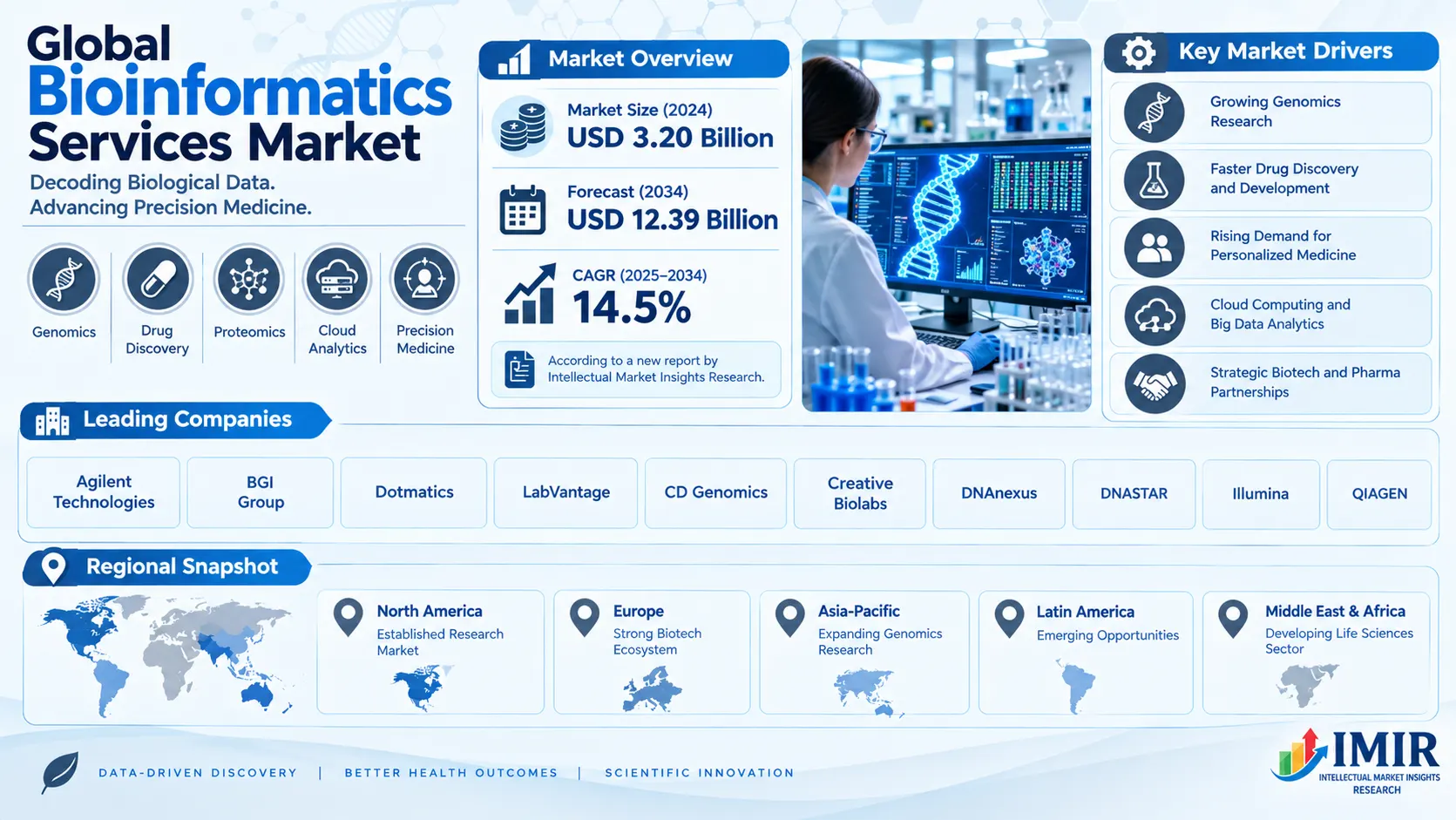
Global Bioinformatics Services Market Trends & Growth (2025–2034)
The global bioinformatics services market is experiencing substantial growth as biotechnology, pharmaceutical, healthcare, and academic research organizations increasingly rely on advanced computational tools to analyze complex biological data. Bioinformatics services play a critical role in genomics, transcriptomics, proteomics, metabolomics, drug discovery, and precision medicine. These services help researchers interpret biological information, identify potential drug targets, understand disease mechanisms, and accelerate the development of innovative therapies.
According to Intellectual Market Insights Research, the global bioinformatics services market was valued at approximately USD 3.20 billion in 2024 and is projected to reach USD 12.39 billion by 2034, growing at a CAGR of 14.5% during the forecast period from 2025 to 2034.
The increasing adoption of next-generation sequencing (NGS), declining sequencing costs, and growing volumes of genomic data are creating new opportunities for bioinformatics service providers. Pharmaceutical and biotechnology companies are increasingly using computational analysis to improve research efficiency, support clinical investigations, and accelerate drug development.
Furthermore, cloud computing, artificial intelligence (AI), and machine learning are transforming biological data processing. Cloud-based platforms enable researchers to store, manage, and analyze large datasets without investing heavily in physical infrastructure. Meanwhile, AI-driven analytical tools are helping researchers identify biological patterns, interpret molecular interactions, and improve the efficiency of scientific research.
Strategic partnerships among biotechnology companies, pharmaceutical manufacturers, research institutions, and technology providers are also contributing to market expansion. As precision medicine and data-driven healthcare continue to advance, bioinformatics service providers are expected to play an increasingly important role in global life sciences research.
Leading Companies in the Bioinformatics Services Market
1. Agilent Technologies, Inc.
Headquarters: Santa Clara, California, USA
Regional Presence: North America, Europe, Asia-Pacific, and other international markets.
Overview: Agilent Technologies is a global provider of analytical instruments, laboratory technologies, and life sciences solutions. The company supports biological research through technologies and software used in genomics, molecular analysis, and laboratory workflows.
Agilent's portfolio includes solutions for genomic analysis, sequencing workflows, gene expression research, and molecular characterization. These capabilities help pharmaceutical companies, biotechnology organizations, clinical laboratories, and academic institutions generate and interpret biological data.
As demand for high-quality genomic information continues to increase, Agilent's life sciences technologies contribute to research workflows that depend on reliable data generation and analysis. The company's presence across multiple laboratory and research applications supports its position in the broader bioinformatics ecosystem.
2. BGI Group
Headquarters: Shenzhen, China
Regional Presence: Asia-Pacific, North America, Europe, and other international markets.
Overview: BGI Group is a biotechnology organization known for its genomics research, sequencing technologies, and large-scale genomic analysis capabilities. The company provides sequencing and bioinformatics-related services for scientific research, healthcare, agriculture, and other life sciences applications.
BGI supports researchers in processing and interpreting complex genomic datasets generated through high-throughput sequencing technologies. Its capabilities are relevant to whole-genome sequencing, transcriptomics, population genomics, and other biological research applications.
The growing demand for large-scale genomic studies and advanced biological data interpretation creates opportunities for organizations offering integrated sequencing and bioinformatics services. BGI's involvement in genomics and computational biology makes it an important participant in this evolving industry.
3. Dotmatics
Headquarters: Boston, Massachusetts, USA
Regional Presence: North America, Europe, and international life sciences markets.
Overview: Dotmatics develops scientific research software that helps life sciences organizations manage scientific information, connect research workflows, and improve collaboration across research teams.
Its scientific informatics solutions support the organization and analysis of complex experimental data. By connecting scientific information across research environments, the company's technologies help researchers improve data accessibility and facilitate more informed scientific decisions.
Bioinformatics and scientific data management are becoming increasingly important as pharmaceutical and biotechnology organizations generate larger volumes of molecular, genomic, and experimental information. Platforms that improve data integration and collaboration can help research teams streamline workflows and support drug discovery activities.
4. LabVantage Solutions
Headquarters: Somerset, New Jersey, USA
Regional Presence: North America, Europe, Asia-Pacific, and other global markets.
Overview: LabVantage Solutions provides laboratory informatics and laboratory information management system (LIMS) technologies that support data management, laboratory operations, and scientific workflows.
The company's solutions help laboratories organize samples, maintain data integrity, manage experimental information, and improve operational efficiency. These capabilities are relevant to life sciences organizations that handle large volumes of biological samples and research data.
As genomics laboratories and biotechnology organizations expand their analytical capabilities, the need for integrated laboratory data management continues to increase. Laboratory informatics solutions can complement bioinformatics workflows by supporting structured data collection, traceability, and efficient access to scientific information.
5. CD Genomics
Headquarters: United States
Regional Presence: North America and international research markets.
Overview: CD Genomics provides genomics-related services supporting academic research, biotechnology development, and pharmaceutical investigations. Its service portfolio includes sequencing technologies and associated analytical capabilities for biological research.
The company supports projects involving genomic data generation and interpretation, helping researchers investigate genetic variation, gene expression, and other molecular characteristics.
The increasing use of next-generation sequencing has created demand for specialized service providers that can help research organizations manage complex sequencing workflows. Bioinformatics analysis is an important component of these workflows because sequencing results must be processed, interpreted, and converted into meaningful biological insights.
As genomics research expands across healthcare, biotechnology, and agricultural applications, providers offering sequencing and data analysis services can benefit from the growing need for specialized scientific expertise.
6. Creative Biolabs
Headquarters: Shirley, New York, USA
Regional Presence: North America and international biotechnology and pharmaceutical markets.
Overview: Creative Biolabs provides specialized contract research and scientific services for biotechnology and pharmaceutical organizations. Its research capabilities cover multiple areas of life sciences, including drug discovery, biological research, and therapeutic development.
Bioinformatics and computational analysis can support drug discovery by helping researchers examine biological targets, interpret molecular information, and evaluate research data.
As pharmaceutical companies increasingly incorporate computational approaches into early-stage research, demand for specialized research partners is expanding. Organizations that combine scientific expertise with analytical capabilities can help researchers address complex development challenges and improve the efficiency of discovery programs.
7. DNAnexus, Inc.
Headquarters: Mountain View, California, USA
Regional Presence: North America and international markets through cloud-based data and analysis platforms.
Overview: DNAnexus provides cloud-based platforms designed to support genomic data management, computational analysis, and collaboration across life sciences research environments.
The company's technology helps organizations manage complex biological datasets and coordinate computational workflows. Its platform-based approach is particularly relevant to research programs involving large-scale sequencing, population genomics, and precision medicine.
As genomic datasets continue to grow in size and complexity, researchers require scalable computing infrastructure capable of supporting data-intensive analysis. Cloud-based bioinformatics environments can reduce the need for dedicated local computing resources and facilitate collaboration among geographically distributed research teams.
The growing adoption of genomics in clinical research and pharmaceutical development is creating opportunities for secure, scalable, and interoperable data analysis platforms.
8. DNASTAR
Headquarters: Madison, Wisconsin, USA
Regional Presence: North America, Europe, and international scientific research markets.
Overview: DNASTAR develops bioinformatics software used for DNA and protein sequence analysis, genomics research, and molecular biology applications.
Its software solutions help researchers analyze biological sequences, compare genetic information, investigate molecular relationships, and interpret genomic datasets. These tools are relevant to academic laboratories, biotechnology organizations, and pharmaceutical research teams.
Sequence analysis remains a fundamental component of bioinformatics because researchers need to process and interpret genetic information generated through modern sequencing technologies.
As next-generation sequencing becomes increasingly common in research and clinical applications, the need for specialized software supporting sequence interpretation, assembly, and comparative analysis continues to expand.
9. Fios Genomics
Headquarters: Edinburgh, Scotland, United Kingdom
Regional Presence: Europe, North America, and international life sciences research markets.
Overview: Fios Genomics provides bioinformatics and statistical analysis services supporting genomics, transcriptomics, and other life sciences research applications.
The company helps organizations interpret complex experimental datasets through computational analysis and statistical methods. Such services are important for researchers investigating gene expression, biological pathways, disease mechanisms, and molecular responses.
Bioinformatics service providers can offer valuable expertise to organizations that generate large datasets but lack sufficient in-house computational resources. Outsourcing specialized analysis can help research teams concentrate on experimental design, scientific interpretation, and development objectives.
With increasing interest in personalized medicine, molecular diagnostics, and advanced biotechnology research, specialized genomic data analysis remains an important component of the bioinformatics services market.
10. Illumina, Inc.
Headquarters: San Diego, California, USA
Regional Presence: Global, with a strong presence in North America, Europe, and Asia-Pacific.
Overview: Illumina is a leading genomics technology company known for its next-generation sequencing platforms, consumables, and associated data analysis solutions.
The company's technologies support genomic research across healthcare, pharmaceutical development, academic research, and population genomics. Sequencing platforms generate substantial volumes of biological data that require computational processing and interpretation.
Bioinformatics is essential to converting sequencing output into useful information for applications such as genetic research, cancer genomics, rare disease investigation, and precision medicine.
The growing adoption of sequencing technologies is creating additional demand for analytical software, data processing capabilities, and specialized bioinformatics expertise. Illumina's position in the genomics ecosystem makes it an important company in the broader market for sequencing-related bioinformatics solutions.
11. PerkinElmer / Revvity
Headquarters: Waltham, Massachusetts, USA
Regional Presence: North America, Europe, Asia-Pacific, and other international markets.
Overview: PerkinElmer has a long history in life sciences, diagnostics, and analytical technologies. Following the separation and rebranding of its former life sciences and diagnostics business, Revvity became an important name in this area.
Revvity provides technologies and solutions supporting life sciences research, genetic testing, laboratory workflows, and biological analysis. These capabilities are relevant to research programs that depend on the generation, management, and interpretation of biological information.
The increasing importance of genomics and molecular diagnostics is creating opportunities for integrated laboratory and data analysis technologies. Bioinformatics tools can help researchers connect experimental findings with genetic information and improve the interpretation of complex biological results.
As biotechnology organizations adopt more data-intensive research methods, solutions that support laboratory analysis and genomic interpretation will continue to contribute to the development of the broader bioinformatics ecosystem.
12. QIAGEN
Headquarters: Hilden, Germany
Regional Presence: Europe, North America, Asia-Pacific, and other international markets.
Overview: QIAGEN is a global provider of sample preparation, molecular diagnostics, and life sciences research solutions. The company also offers bioinformatics software and analytical capabilities through its QIAGEN Digital Insights business.
Its portfolio includes tools supporting genomic data analysis, biological interpretation, molecular diagnostics, and research workflows. These solutions help scientists and healthcare researchers extract meaningful information from complex molecular datasets.
Bioinformatics is increasingly important in clinical research and molecular diagnostics, where the interpretation of genetic information can contribute to disease investigation and precision medicine.
QIAGEN's combination of laboratory technologies and computational analysis solutions supports research workflows across biotechnology, pharmaceutical development, and clinical applications. Continued growth in molecular testing and genomic research provides opportunities for bioinformatics-related products and services.
13. Thermo Fisher Scientific Inc.
Headquarters: Waltham, Massachusetts, USA
Regional Presence: Global, with operations across North America, Europe, Asia-Pacific, and other major markets.
Overview: Thermo Fisher Scientific is a global life sciences company providing scientific instruments, laboratory technologies, reagents, analytical software, and services for research and healthcare applications.
Its portfolio supports molecular biology, genetic analysis, sequencing, and pharmaceutical research. These technologies contribute to workflows that generate and analyze biological information across a wide range of scientific applications.
The increasing adoption of next-generation sequencing and molecular research technologies is driving demand for tools that can process, organize, and interpret complex biological datasets.
Thermo Fisher's broad life sciences portfolio positions the company within the wider bioinformatics ecosystem, particularly where laboratory technologies and computational analysis are used together to support research and diagnostic workflows.
Regional Market Insights (2025–2034)
The global bioinformatics services market is supported by increasing investment in life sciences research, growing genomic data volumes, and the adoption of advanced computational technologies. Regional market performance varies according to research infrastructure, biotechnology investment, healthcare development, and access to skilled professionals.
-
North America: North America holds a leading position in the bioinformatics services market, supported by its established biotechnology and pharmaceutical industries, substantial research investment, advanced genomics infrastructure, and adoption of precision medicine technologies.
-
Europe: Europe represents an important market for bioinformatics services, supported by established pharmaceutical companies, academic research institutions, biotechnology development, and collaborative genomics initiatives. Demand is also supported by growing interest in molecular diagnostics and data-driven healthcare.
-
Asia-Pacific: Asia-Pacific is expected to offer significant growth opportunities as countries such as China, India, and Japan expand their biotechnology capabilities, genomic research programs, and healthcare infrastructure. The region's growing research activity and availability of skilled professionals also support demand for bioinformatics services.
-
Latin America: Latin America offers emerging opportunities through investments in biotechnology, agricultural genomics, clinical research, and healthcare modernization. Greater access to advanced sequencing and computational technologies may support future market development.
- Middle East and Africa: The region presents opportunities associated with healthcare infrastructure development, research investment, genomics initiatives, and increasing interest in advanced diagnostic technologies.
Key Trends Shaping the Bioinformatics Services Market
1. Increasing Adoption of Next-Generation Sequencing
Next-generation sequencing generates large volumes of genetic information that require specialized computational processing. Bioinformatics services help researchers perform sequence alignment, variant analysis, gene expression analysis, and interpretation of genomic findings.
As sequencing technologies become more widely adopted, demand for data analysis and interpretation services is expected to increase.
2. Growing Demand for Precision Medicine
Precision medicine increasingly relies on genomic and molecular information to improve the understanding of diseases and support more individualized approaches to treatment.
Bioinformatics services help researchers interpret genetic variations, investigate molecular pathways, and identify potential biomarkers. These capabilities support applications in oncology, rare disease research, and other areas of healthcare.
3. Integration of Artificial Intelligence and Machine Learning
AI and machine learning are creating new possibilities for analyzing complex biological datasets. These technologies can support pattern recognition, molecular prediction, biological classification, and the identification of potential drug targets.
The integration of AI into bioinformatics workflows is expected to create opportunities for more efficient data processing and advanced research applications.
4. Expansion of Cloud-Based Bioinformatics Platforms
Cloud computing allows research organizations to access scalable computing infrastructure for genomic analysis and biological data management.
Cloud-based platforms can facilitate collaboration, reduce dependence on local computing infrastructure, and support projects involving large and complex datasets.
5. Increasing Pharmaceutical and Biotechnology R&D
Pharmaceutical and biotechnology companies are investing in advanced research approaches to accelerate drug discovery, improve target identification, and strengthen development pipelines.
Bioinformatics services support these objectives by helping researchers analyze biological pathways, investigate molecular interactions, and interpret genomic and proteomic information.
Key Growth Drivers of the Bioinformatics Services Market
The global bioinformatics services market is benefiting from several important growth drivers:
-
Growing biological data volumes: Advances in sequencing and molecular technologies are generating increasing quantities of biological information that require specialized analysis.
-
Rising investment in life sciences research: Government funding, pharmaceutical R&D, and biotechnology investment are supporting demand for bioinformatics expertise.
-
Increasing use of precision medicine: Greater emphasis on genomic information and individualized healthcare is expanding the need for biological data interpretation.
-
Declining sequencing costs: More affordable sequencing technologies are enabling additional research organizations to undertake genomic studies.
-
Cloud computing adoption: Scalable computing environments are improving access to computational resources for research teams of different sizes.
- Expansion of drug discovery applications: Pharmaceutical companies are increasingly using computational approaches to investigate biological targets and support early-stage drug development.
Challenges in the Bioinformatics Services Market
Despite its growth potential, the bioinformatics services market faces several challenges.
Data Security and Privacy
Genomic and clinical datasets can contain sensitive information. Organizations must implement appropriate security controls, access management, and data governance practices to protect research information.
Shortage of Specialized Professionals
Bioinformatics requires a combination of biological knowledge, computational expertise, statistics, and data science. A shortage of professionals with these combined skills can create challenges for organizations seeking to expand their analytical capabilities.
Complex Data Integration
Research organizations frequently use different sequencing technologies, software platforms, and data formats. Integrating information across these systems can require specialized tools and expertise.
In-House Software and Open-Source Alternatives
Some research institutions and pharmaceutical companies develop internal bioinformatics capabilities or use publicly available tools. These alternatives can reduce reliance on external service providers in certain applications.
However, complex research projects may still require specialized expertise, customized analysis, scalable infrastructure, and dedicated technical support.
Future Outlook of the Bioinformatics Services Market
The future of the global bioinformatics services market is closely connected to developments in genomics, precision medicine, biotechnology, and computational biology.
As research organizations generate increasingly complex datasets, the need for specialized data processing, statistical analysis, and biological interpretation is expected to grow. AI-enabled analytics, cloud computing, and integrated research platforms may further improve the accessibility and efficiency of bioinformatics services.
Pharmaceutical companies are also expected to continue exploring computational approaches that support drug discovery, biomarker identification, and the development of targeted therapies. Meanwhile, expanding genomics initiatives and biotechnology investment in emerging markets could create additional opportunities for service providers.
Companies that combine domain expertise with scalable infrastructure, reliable analytical workflows, and strong data management capabilities may be well positioned to benefit from these developments.
According to Intellectual Market Insights Research, the global bioinformatics services market is projected to grow from approximately USD 3.20 billion in 2024 to USD 12.39 billion by 2034, representing a CAGR of 14.5% during 2025–2034.