
Top Leading Companies in the Global Electric Vehicle Supply Equipment Market
Author:
Intellectual Market Insights Research
Published Date:
17 Aug 2026
Introduction
As electric vehicles move from early adoption to the mainstream, the equipment that powers them, chargers, connectors, and the software behind them, has become one of the fastest-growing corners of the automotive and energy technology landscape. Electric Vehicle Supply Equipment (EVSE) spans everything from simple home wall boxes to high-powered public fast-charging stations, and the race to build out this infrastructure is drawing in industrial conglomerates, pure-play charging network operators, and electrical equipment specialists alike.
The global EVSE market was valued at approximately USD 104.04 billion in 2025 and is projected to reach USD 1,311.44 billion by 2034, expanding at a compound annual growth rate (CAGR) of 32.5% over the forecast period, according to Intellectual Market Insights Research. This explosive growth reflects surging EV adoption, aggressive government infrastructure spending, and the rapid buildout of public, workplace, and residential charging networks worldwide.
Unlike more mature automotive component categories, the EVSE market is still being defined: large industrial and electrical equipment conglomerates bring manufacturing scale and grid expertise, while pure-play charging network companies bring software, siting, and network-operations know-how. As charging speeds increase and smart, connected charging becomes standard, competitive advantage is shifting from hardware alone toward integrated hardware-software-service offerings.
Understanding which companies lead this fast-scaling market is essential for automotive and energy infrastructure investors, utilities, and industry analysts. This article provides a research-based analysis of the top companies in the global EVSE market, their positioning, flagship offerings, and the regional and technological forces shaping the competitive landscape.
Market Overview
|
Parameter |
Details |
|---|---|
|
Market Size (2025) |
USD 104.04 Billion |
|
Projected Market Size (2034) |
USD 1,311.44 Billion |
|
CAGR (2025–2034) |
32.5% |
|
Base Year |
2024 |
|
Forecast Period |
2025–2034 |
|
Leading Region |
Asia-Pacific (China, Japan, South Korea) |
|
Fastest-Growing Region |
Latin America |
|
Key Growth Drivers |
Rising EV adoption, environmental regulation, public/private charging network expansion, growth in electric fleets |
|
Key Challenges |
Limited charging availability in rural areas, high infrastructure investment costs |
|
Key Opportunities |
Electric commercial and fleet vehicle charging, smart/IoT-enabled charging, fast-charging network expansion |
Why the EVSE Market Is Growing
1. Rising Environmental Concerns and Government Regulation
Governments worldwide are tightening emissions regulations and offering financial incentives to accelerate the shift from internal combustion engine vehicles to EVs, directly driving demand for supporting charging infrastructure.
2. Expansion of Public and Private Charging Networks
Growing investment in urban public charging (city centers, malls, highways) alongside home and workplace charging is addressing one of the biggest barriers to EV adoption: charging accessibility.
3. Growth in Electric Commercial and Fleet Vehicles
Businesses in logistics, transportation, and public services are increasingly electrifying delivery vans, buses, and trucks, creating fresh demand for dedicated, high-power fleet charging infrastructure.
4. Advances in Fast-Charging Technology
The expansion of Level 3 (DC fast charging) and supercharging networks along highways and in urban hubs is reducing charging times and improving convenience, a critical factor in broader consumer adoption.
5. Integration of Smart and IoT-Enabled Charging
Charging station management systems, mobile charger-locator apps, and dynamic pricing and energy management features are turning EVSE into a connected, software-driven category rather than pure hardware.
6. Renewable Energy Integration
The rise of solar and wind power is reinforcing the link between clean energy generation and EV charging, supporting further infrastructure investment aligned with broader sustainability goals.
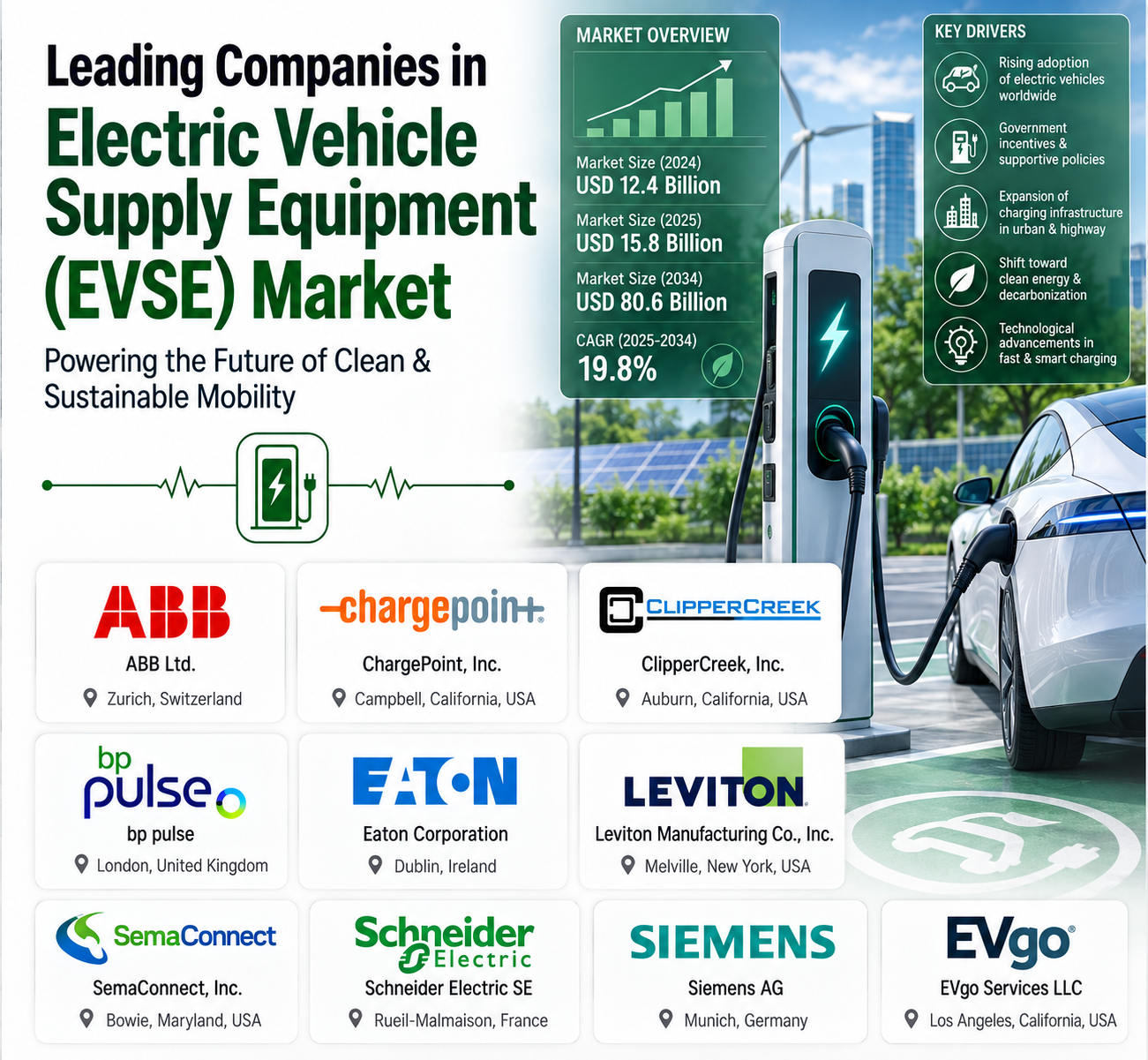
Top 10 Companies in the EVSE Market
- ABB Ltd.
- Siemens AG
- Schneider Electric SE
- Eaton Corporation
- ChargePoint, Inc.
- bp pulse
- EVgo Services LLC
- Leviton Manufacturing Co., Inc.
- ClipperCreek, Inc.
- SemaConnect, Inc.
1. ABB Ltd.
|
Category |
Details |
|---|---|
|
Company Name |
ABB Ltd. |
|
Headquarters |
Zurich, Switzerland |
|
Founded |
1988 (predecessor ASEA founded 1883) |
|
Employees |
Approx. 112,000 |
|
Revenue (2024) |
Approx. USD 33 Billion |
|
Company Overview |
ABB is a global electrification and automation technology leader whose Electrification business unit includes a dedicated EV charging infrastructure portfolio spanning residential, commercial, and fast-charging hardware. |
|
Key Products |
AC and DC EV chargers, including its Terra series of fast chargers, alongside broader electrification and grid infrastructure solutions. |
|
Market Position |
One of the largest global suppliers of DC fast-charging infrastructure, with a strong presence in both public and fleet charging deployments. |
|
Recent Developments |
Continued global expansion of its Terra fast-charger product line alongside broader electrification business investment. |
|
Strategic Advantages |
Deep electrical engineering heritage, global manufacturing scale, and integration with broader grid and electrification infrastructure businesses. |
2. Siemens AG
|
Category |
Details |
|---|---|
|
Company Name |
Siemens AG |
|
Headquarters |
Munich, Germany |
|
Founded |
1847 |
|
Employees |
Approx. 320,000+ |
|
Revenue (2024) |
Approx. USD 85 Billion (group-wide) |
|
Company Overview |
Siemens is a diversified German industrial technology conglomerate whose Smart Infrastructure division supplies EV charging hardware and grid-integration solutions for residential, commercial, and public applications. |
|
Key Products |
Siemens VersiCharge and other AC/DC EV charging systems, alongside grid and energy management software supporting charging networks. |
|
Market Position |
A leading supplier of EV charging infrastructure and grid-integration technology, leveraging its broad industrial automation and energy management capabilities. |
|
Recent Developments |
Continued investment in smart infrastructure and energy management offerings that support scaling EV charging networks. |
|
Strategic Advantages |
Massive global scale, deep grid and automation expertise, and a diversified industrial technology portfolio that spans the full charging infrastructure value chain. |
|
Category |
Details |
|---|---|
|
Company Name |
Schneider Electric SE |
|
Headquarters |
Rueil-Malmaison, France |
|
Founded |
1836 |
|
Employees |
Approx. 160,000+ |
|
Revenue (2024) |
Approx. USD 38 Billion (€38.15 billion) |
|
Company Overview |
Schneider Electric is a global energy management and automation company whose EVlink charging product line supports residential, workplace, and public EV charging deployments. |
|
Key Products |
EVlink AC and DC charging stations, EcoStruxure energy management software, and building/grid automation systems supporting charging infrastructure. |
|
Market Position |
A leading global player in energy management-integrated EV charging, particularly strong in commercial and building-integrated charging deployments. |
|
Recent Developments |
Continued expansion of its EVlink charging portfolio and integration with its broader EcoStruxure digital energy management ecosystem. |
|
Strategic Advantages |
Strong energy management software integration, global manufacturing footprint, and deep relationships across commercial real estate and utility customers. |
|
Category |
Details |
|---|---|
|
Company Name |
Eaton Corporation plc |
|
Headquarters |
Dublin, Ireland (operational headquarters in Beachwood, Ohio, U.S.) |
|
Founded |
1911 |
|
Employees |
Approx. 90,000+ |
|
Revenue |
Approx. USD 24 Billion |
|
Company Overview |
Eaton is a diversified power management company supplying EV charging hardware and grid-connected infrastructure for residential, commercial, and fleet applications. |
|
Key Products |
Eaton Level 2 and DC fast chargers, energy storage and grid integration systems supporting EV charging deployments. |
|
Market Position |
A significant supplier of power management and charging infrastructure, particularly for commercial and fleet electrification projects. |
|
Recent Developments |
Continued investment in electrification and power management solutions supporting the broader EV infrastructure buildout. |
|
Strategic Advantages |
Deep power management and electrical distribution expertise, strong industrial and utility relationships, and integrated grid-to-charger solutions. |
|
Category |
Details |
|---|---|
|
Company Name |
ChargePoint Holdings, Inc. |
|
Headquarters |
Campbell, California, United States |
|
Founded |
2007 |
|
Employees |
Approx. 1,500 |
|
Revenue |
Approx. USD 400–500 Million |
|
Company Overview |
ChargePoint is one of the largest pure-play EV charging network operators, providing charging hardware alongside a cloud-based software platform for network management, payment, and driver access. |
|
Key Products |
Level 2 AC chargers and DC fast chargers for residential, commercial, and fleet use, plus its cloud-based charging network management platform. |
|
Market Position |
A leading independent EV charging network operator, particularly strong in North American commercial and workplace charging deployments. |
|
Recent Developments |
Continued focus on margin improvement and operating leverage as part of a multi-year strategic plan amid a competitive charging network landscape. |
|
Strategic Advantages |
Deep software and network-management expertise, an established charging network footprint, and strong brand recognition among EV drivers and fleet operators. |
Competitive Landscape
The global EVSE market is moderately fragmented, spanning large diversified industrial and electrical equipment conglomerates such as ABB, Siemens, Schneider Electric, and Eaton, alongside pure-play charging network operators such as ChargePoint, EVgo, and bp pulse, and specialist hardware manufacturers such as Leviton, ClipperCreek, and SemaConnect.
Hardware Scale vs. Network Software: Large industrial conglomerates compete on manufacturing scale, grid integration, and global distribution, while pure-play charging network companies compete on software, network uptime, and driver-facing app experience.
Fast-Charging as a Battleground: As DC fast charging and supercharging networks expand along highways and in urban hubs, companies with strong fast-charging hardware and siting capabilities are capturing outsized growth relative to standard Level 2 charging suppliers.
Fleet Electrification as a Growth Vector: Companies able to offer dedicated, high-power fleet charging solutions, including energy management and monitoring systems, are well positioned to capture growing demand from logistics, transit, and delivery fleet operators.
Smart Charging Differentiation: Competitive advantage is increasingly shifting toward IoT-enabled features such as real-time charger availability, dynamic pricing, and remote diagnostics, favoring companies with strong software capabilities alongside hardware manufacturing.
Regional Analysis
Asia-Pacific
Asia-Pacific dominates the global EVSE market, led by China's massive EV adoption and government-backed charging infrastructure investment, alongside strong growth in Japan and South Korea supported by domestic EV manufacturers such as BYD and NIO.
Europe
Europe holds significant market share, with Norway, Germany, and the Netherlands among the highest EV-penetration countries globally, supported by ambitious regulatory frameworks such as the European Green Deal.
North America
The United States and Canada are experiencing strong growth, driven by federal and state incentives and expanding public and private charging network investment.
Latin America
Latin America is expected to be the fastest-growing region, as governments begin implementing EV-supportive policy and incentives, spurring new charging infrastructure investment from a smaller current base.
Emerging Trends in the EVSE Market
1. DC Fast-Charging Network Expansion: Rapid growth in Level 3 and supercharging deployments is reducing charging times and expanding EV usability for long-distance and high-turnover fleet applications.
2. Smart Charging and IoT Integration: Charging station management systems, mobile locator apps, and dynamic pricing features are becoming standard, turning charging stations into connected digital touchpoints.
3. Electric Fleet-Dedicated Infrastructure: Purpose-built charging solutions for buses, trucks, and delivery vans are emerging as a distinct, high-growth sub-segment of the broader EVSE market.
4. Renewable Energy Integration: Charging infrastructure is increasingly being paired with solar, wind, and battery storage systems to reduce the lifecycle carbon footprint of EV charging.
5. Federal Certification and Security Standards: Growing scrutiny of charging infrastructure security, illustrated by recent federal authorization milestones for charging platforms, is raising the bar for compliance among infrastructure providers.
Future Outlook (2025–2034)
The global EVSE market's trajectory toward USD 1,311.44 billion by 2034 reflects an extraordinary scale-up of charging infrastructure investment worldwide. The 32.5% CAGR forecast through 2034, among the highest of any automotive-adjacent infrastructure category, assumes continued rapid EV adoption, sustained government incentive programs, and accelerating buildout of fast-charging and fleet-dedicated networks.
Key investment themes include continued expansion of DC fast-charging networks, growth in electric commercial fleet charging infrastructure, deeper integration of smart and IoT-enabled charging features, and closing the rural charging accessibility gap. Leading companies including ABB, Siemens, Schneider Electric, and ChargePoint are likely to retain leadership, while regional and specialist players continue to compete for share as the charging infrastructure buildout accelerates.
Frequently Asked Questions (FAQ)
1. What is the current size of the global EVSE market?
The global EVSE market was valued at approximately USD 104.04 billion in 2025 and is projected to reach USD 1,311.44 billion by 2034, growing at a CAGR of 32.5%.
2. Who are the top companies in the EVSE market?
Leading companies include ABB, Siemens, Schneider Electric, Eaton Corporation, ChargePoint, bp pulse, EVgo Services, Leviton Manufacturing, ClipperCreek, and SemaConnect.
3. Which region dominates the EVSE market?
Asia-Pacific leads the market, driven by China's large-scale EV adoption and government-backed infrastructure investment, while Latin America is expected to be the fastest-growing region.
4. What is the forecast CAGR for the EVSE market?
The market is forecast to grow at a CAGR of 32.5% from 2025 to 2034.
5. What are the main growth drivers for this market?
Key drivers include rising EV adoption, tightening emissions regulations, expanding public and private charging networks, and growing demand for electric commercial fleet charging.
6. What challenges does the EVSE industry face?
The industry faces limited charging station availability in rural and remote areas, as well as the high upfront investment costs associated with advanced charging infrastructure.
7. Which charging type leads the EVSE market?
Level 2 charging currently leads the market due to its balance of cost-effectiveness and charging speed, making it the preferred choice for home, workplace, and public charging deployments.
Conclusion
The global EVSE market sits at the center of the broader transition to electric mobility, translating rising EV sales into the physical and digital infrastructure needed to keep them running. With a projected size of USD 1,311.44 billion by 2034 at a 32.5% CAGR, the sector represents one of the fastest-growing infrastructure categories tied to the automotive industry.
Companies led by ABB, Siemens, Schneider Electric, and ChargePoint are not just deploying hardware, they are building integrated charging ecosystems combining fast-charging technology, smart software, and grid-level energy management. The companies that successfully balance manufacturing scale, network software capability, and adaptability to fleet and fast-charging demand will define market leadership through 2034 and beyond.