
Top Leading Companies in the Global End-of-Line Packaging Market
Author:
Intellectual Market Insights Research
Published Date:
13 Oct 2026
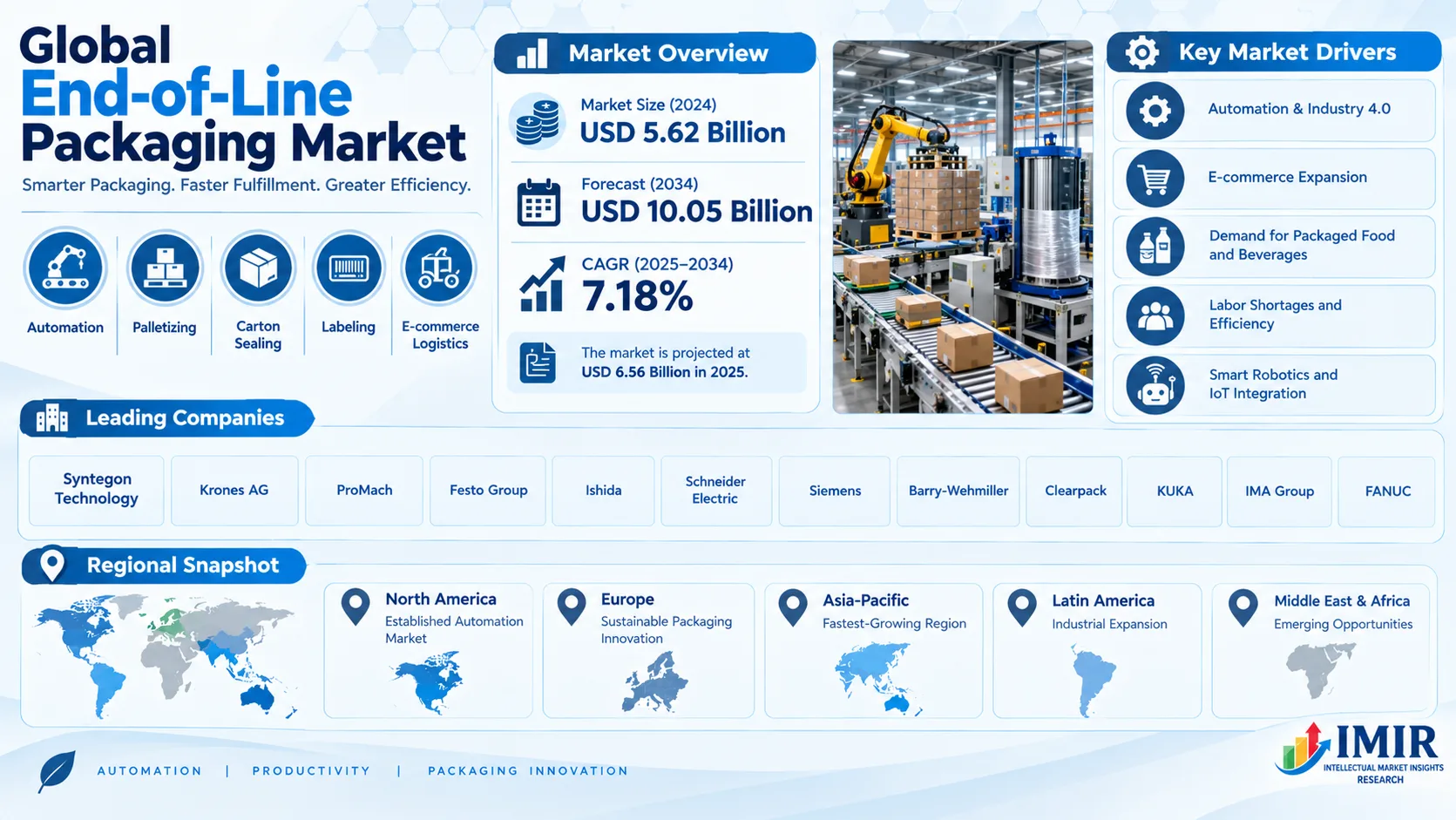
Global End-of-Line Packaging Market: Size, Leading Companies, Trends and Outlook (2025–2034)
Market Overview and Forecast: Market size and CAGR are taken from the Intellectual Market Insights Research (IMIR) End-of-Line Packaging Market report: USD 5.62 billion in 2024, USD 6.56 billion in 2025, USD 10.05 billion by 2034, stated CAGR 7.18% (2025–2034).
Introduction
End-of-line (EOL) packaging covers the last stage of a packaging line, after the product has been filled and sealed. It includes machines that erect and seal cartons, pack cases and trays, label, palletise, stretch-wrap and prepare pallets for shipment. Because this stage is labour-intensive, it is one of the first places factories and warehouses automate.
Demand comes from food and beverage, pharmaceuticals, consumer electronics, automotive and e-commerce and logistics. Rising labour costs, skill shortages, e-commerce order volumes and sustainability rules all push manufacturers toward robotic palletisers, cobots and integrated line controls. In late 2026, though, the machinery makers are also facing a slower investment climate, which is visible in revised forecasts from Krones. This blog covers the size of the market, the forces behind it, the companies named by IMIR, and the outlook to 2034.
Why the End-of-Line Packaging Market Is Growing
1. Labour shortages and rising wages. Palletising and case packing are repetitive and physically demanding. Robots and cobots now handle them more cheaply and flexibly than manual teams.
2. E-commerce and omnichannel logistics. Online retail needs many small, mixed orders, which increases demand for flexible carton, labelling and pallet-building systems.
3. Pharmaceutical growth and regulation. Serialisation, traceability and tamper-evidence rules require integrated labelling, inspection and secondary packaging. Syntegon, for example, reported that its pharma sales rose 22% in 2025.
4. Automation as standard. The packaging-robot market is expanding quickly (one industry estimate puts it at USD 7.57 billion in 2025, growing about 13.6% a year to 2034), with cobots the largest robot type. EOL lines are the most common place for them.
5. Sustainability and material efficiency. Rules such as the EU Packaging and Packaging Waste Regulation push companies to cut empty space, film and filler. This favours right-sized cartons, optimised pallet patterns and thinner stretch film.
6. Product variety and fast changeovers. Brands launch more SKUs and short runs, so lines must change formats quickly. Modular machines and recipe-based controls help.
7. Data and remote service. Connected machines with monitoring and predictive maintenance reduce downtime and increase equipment effectiveness.
Companies Associated with the End-of-Line Packaging Market
IMIR names 17 companies: Bosch Packaging Technology (now Syntegon), Krones, ProMach, Warade PackTech, Festo, Ishida Europe, Schneider Electric, Siemens, Barry-Wehmiller, Clearpack, Technosmart Automation, KUKA, IMA Group, Fanuc, DS Smith, Coesia and Fuji Machinery. IMIR's "leading companies" blog also profiles Sidel, Marchesini Group, Gebhardt Fördertechnik and Douglas Machine. Each is covered below in bullet form and then compared in a table.
| Company | HQ | Role | Latest Verifiable Point |
|---|---|---|---|
| Krones | Neutraubling, Germany | Complete lines incl. EOL | H1 2026 revenue EUR 2.71B; FY26 growth forecast cut to 1–2% |
| Syntegon | Waiblingen, Germany | Pharma and food packaging machines | 2025 sales EUR 1.75B (+10%) |
| ProMach | Covington, USA | Packaging line brands | Private; revenue not disclosed |
| Barry-Wehmiller | St. Louis, USA | Packaging and converting automation | Private; revenue not disclosed |
| IMA Group | Ozzano (Bologna), Italy | Pharma / food packaging machines | Revenue not confirmed |
| Coesia | Bologna, Italy | Packaging solutions | Revenue not confirmed |
| Siemens | Munich / Berlin, Germany | Controls and software | Packaging revenue not disclosed |
| Schneider Electric | Rueil-Malmaison, France | Automation and motion control | Packaging revenue not disclosed |
| Festo | Esslingen, Germany | Pneumatics and handling | Private; revenue not confirmed |
| KUKA | Augsburg, Germany | Robots (Midea-owned) | Packaging revenue not disclosed |
| Fanuc | Oshino, Japan | Robots | Packaging revenue not disclosed |
| Ishida Europe | UK (Ishida, Kyoto) | Weighing and inspection | Revenue not disclosed |
| DS Smith | UK | Corrugated packaging | Acquired by International Paper (Jan 2025) |
| Fuji Machinery | Japan | Packaging machinery | Revenue not disclosed |
| Warade PackTech, Clearpack, Technosmart | Various | Regional machinery | Data not confirmed |
Competitive Landscape
- Three layers of competitors. Packaging-machine builders (Krones, Syntegon, ProMach, IMA, Coesia, Barry-Wehmiller), robot and automation suppliers (KUKA, Fanuc, Festo, Siemens, Schneider Electric) and packaging-material suppliers (DS Smith, Ranpak) all compete for the end-of-line budget.
- Integration versus best-of-breed. Large line builders offer complete, integrated lines with one point of responsibility, while many customers combine a standalone palletiser or wrapper from specialists with their own controls.
- Consolidation. ProMach and Barry-Wehmiller are acquirers of smaller machine brands, and International Paper's purchase of DS Smith consolidated corrugated supply.
- Pharma and e-commerce are the growth pockets. Syntegon's pharma growth and automation suppliers' growth in warehouse robotics show where demand is strongest. Beverage is more cyclical, as Krones' revised forecast shows.
- Service and retrofit revenue. Upgrades, spare parts, remote service and software are higher-margin and more stable than new machines.
- Pricing and lead-time pressure. Competition from regional and Asian machine builders adds price pressure, especially for standard palletisers and wrappers.
Regional Analysis
IMIR's regional percentages are placeholders, so this section is qualitative.
North America is a large, automation-driven market, with e-commerce, food and beverage and pharma customers, and a persistent labour shortage that supports robotic palletising.
Europe is the home of many leading machine builders (Krones, Syntegon, IMA, Coesia). It is mature, regulation-driven and focused on efficiency, sustainability and pharma compliance, though 2026 investment has been cautious.
Asia-Pacific is the fastest-growing region, with expanding food, beverage, electronics and e-commerce sectors in China, India, Japan and ASEAN, and rising local machine-building capacity.
Latin America. Growth in beverage, food and consumer goods in Brazil and Mexico supports demand, with price sensitivity favouring semi-automatic and used equipment.
Middle East & Africa. Food processing, pharma and logistics investment in the Gulf and South Africa supports early-stage automation demand.
Emerging Trends
- Robotics and cobots at the end of the line. Cobots are the largest robot type in packaging, and pick-and-place and palletising are leading applications.
- Modular, flexible lines. Machines with fast, tool-free format changes allow short runs and lower-skilled operators.
- Integrated line control and data. Moving from stand-alone machines to integrated line modules with shared data improves uptime and traceability.
- Predictive maintenance and remote service. Monitoring motor power and other signals helps prevent breakdowns.
- Sustainable secondary packaging. Right-sized boxes, paper-based void fill and thinner film respond to the EU's packaging rules.
- AI vision and inspection. Vision systems check labels, seals and pallet quality in real time.
- Warehouse and EOL convergence. E-commerce blurs the line between packaging machinery and logistics automation.
- Cautious capital spending. Economic uncertainty is delaying large projects, as Krones' October 2026 forecast cut shows, pushing suppliers toward services and retrofits.
Future Outlook (2025–2034)
IMIR's forecast covers 2025–2034: from USD 6.56 billion in 2025 to USD 10.05 billion in 2034, with a stated 7.18% CAGR (see the note above about the mismatch with the endpoints).
- 2025–2027. Mixed conditions: pharma, e-commerce and robotics demand is firm, while beverage and some food customers delay large investments. Service and retrofit sales grow.
- 2028–2030. Broader automation adoption, more modular and integrated lines, and stronger sustainability regulation lift demand. Krones itself still targets about EUR 6.0–6.2 billion revenue by 2028.
- 2031–2034. EOL packaging becomes more software-defined, with connected lines, AI-driven optimisation and greater use of robots, while consolidation among machine builders continues.
Risks: weak industrial investment and geopolitical uncertainty, tariffs, high interest rates, raw-material cost inflation, price competition from regional builders, and long project cycles.
Opportunities: pharma and e-commerce lines, cobots and mobile robots, retrofit and service contracts, sustainable secondary packaging, and growth in Asia-Pacific and Latin America.
FAQ
Q1. How big is the global end-of-line packaging market?
IMIR values it at USD 5.62 billion in 2024 and USD 6.56 billion in 2025, rising to USD 10.05 billion by 2034.
Q2. What is the expected growth rate?
IMIR states a CAGR of 7.18% from 2025 to 2034, though the report's own endpoints imply a lower rate (about 4.9%).
Q3. What does end-of-line packaging include?
Carton erecting and sealing, case and tray packing, labelling, palletising, stretch wrapping and related inspection and conveying.
Q4. Who are the leading companies?
Krones, Syntegon, ProMach, Barry-Wehmiller, IMA Group and Coesia lead among machine builders named by IMIR, supported by automation suppliers such as Siemens, Schneider Electric, Festo, KUKA and Fanuc.
Q5. Which end-use industries drive demand?
Food and beverage, pharmaceuticals, consumer electronics, automotive, and e-commerce and logistics.
Q6. Which region will grow fastest?
Asia-Pacific is generally expected to grow fastest, while Europe is home to many leading machine builders and North America is a large automation market.
Q7. What is the difference between automatic and semi-automatic systems?
Automatic systems run with little operator input and suit high volumes, while semi-automatic systems need manual loading or handling and suit lower volumes and smaller budgets.
Q8. How are machine makers performing in 2026?
Syntegon reported record 2025 sales of about EUR 1.75 billion, while Krones cut its 2026 growth forecast in October 2026 because of market uncertainty.
Q9. What trends matter most?
Cobot palletising, modular lines, connected machines, sustainable secondary packaging and AI-based inspection.
Conclusion
End-of-line packaging is a growing and increasingly automated part of the packaging industry. IMIR projects growth from USD 6.56 billion in 2025 to USD 10.05 billion in 2034. Labour shortages, e-commerce, pharma regulation and sustainability rules all favour automation, though the exact growth rate in IMIR's data should be read with caution.
For machine builders, the best opportunities are in pharma, e-commerce, robotics, service and retrofit work, while beverage-focused suppliers face a slower investment climate. For buyers, the priorities are flexibility, integration with plant data, and total cost over the life of the line rather than purchase price alone.