
Top Leading Companies in the Global High Throughput Screening Market 2025
Author:
Intellectual Market Insights Research
Published Date:
17 Jun 2025
Market Overview:
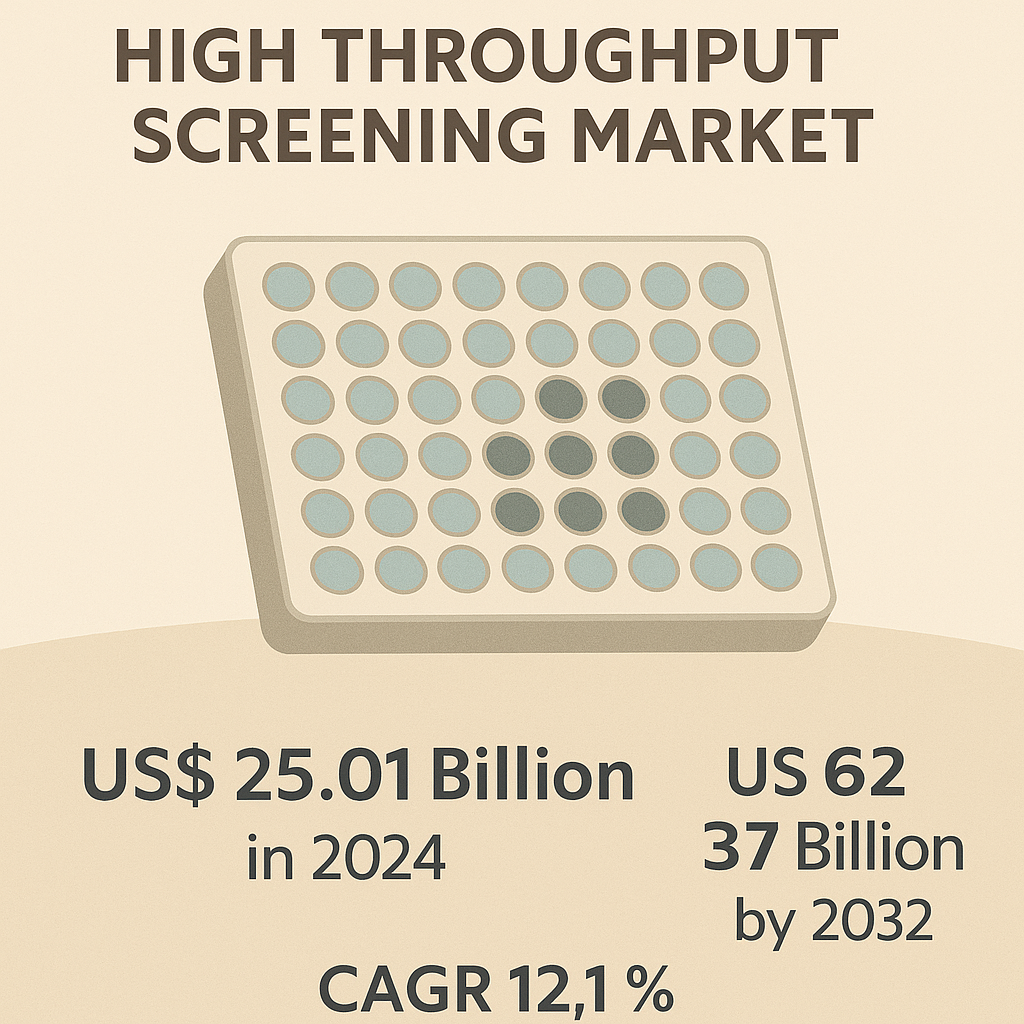
High Throughput Screening Market refers to the automation of experimental processes to quickly analyze biological, chemical, or pharmacological data. The global HTS market is poised to grow from USD 25.01 Billion in 2024 to USD 62.37 Billion by 2032, growing at a CAGR of 12.1% in the forecast period (2024-2032), fueled by increasing demand for rapid drug development and personalized medicine.
The Global High Throughput Screening (HTS) Market is the use of automated technology to conduct an unimaginable amount of chemical, biological, or pharmacological experiments simultaneously. Through this process, scientists are able to screen compound libraries in a highly efficient and cost-effective manner. HTS plays a vital role in drug discovery, particularly in the detection of potential drug candidates and disease biomarkers. It employs robots, liquid handling systems, and sophisticated data analysis software to enable thousands to millions of tests in a matter of time. HTS has numerous applications ranging from basic research to advanced ones like toxicity testing, disease modelling, and therapeutic discovery.
The market has expanded significantly with increasing demands for quick and effective drug discovery and development processes, with support from increasing disease burdens for diseases such as cancer, cardiovascular diseases, and neurodegenerative diseases. Pharmaceutical and biotechnology companies are embracing HTS as a way of fast-tracking drug development, minimizing costs, and maximizing opportunities for success. Besides, the personalized medicine has increased the need for HTS because the process has the capability to identify people who can be cured by individualized therapy, thereby highly relevant in precision medicine.
HTS is a key role throughout all stages of drug discovery, from target discovery, hit discovery, lead optimization, to preclinical development. HTS provides a convenient platform for the identification of hits of lead drug potential through its ability to allow large sets of chemicals or genetic libraries to be screened against target proteins in parallel. This rapidly propels forward lead optimization, which involves structurally differentiating hits found to make them optimal for activity and minimized in toxicity.
Furthermore, the incorporation of emerging technologies such as artificial intelligence, machine learning, and bioinformatics into HTS platforms is transforming the drug discovery model. The technologies discussed above improve upon the processing of gigantic amounts of data generated in screens to make the outcomes more accurate and predictive in nature. In addition, enhanced collaboration between drug companies, research institutions, and academic research organizations has also contributed to the dissemination of HTS technologies, providing valuable insights into polyfactorial diseases and driving drug development innovation.
HTS is also a central element involved in the determination of cellular response as well as gene function process and therefore constitutes the central application in systems biology. With the ability to examine thousands of biological samples as well as compounds within minutes, HTS is able to be used in identifying new biomolecules and therapeutic targets and hence the discovery of new drugs. The market will expand further as advances in technology and science make possible new fields of application of HTS, particularly in personalized medicine and precision therapeutics.
Would you like me to add more details on specific companies or market trends? Let me know! CLICK HERE
Top 10 High Throughput Screening Companies – 2025
Thermo Fisher Scientific

Headquarters: Waltham, Massachusetts, USA
Founded: 1956
Employees: Approx. 125,000
Revenue (2024): $45.8 billion
Key Innovations:
CellInsight High Content Screening platforms
Cloud-based data analytics for HTS
Regional Focus: North America, Europe, Asia-Pacific
PerkinElmer Inc.

Headquarters: Waltham, Massachusetts, USA
Founded: 1937
Employees: Approx. 17,000
Revenue (2024): $5.3 billion
Key Innovations:
Opera Phenix Plus HCS System
AI-driven assay development
Regional Focus: Global presence with a focus on diagnostics and life sciences
Merck KGaA (MilliporeSigma)

Headquarters: Darmstadt, Germany
Founded: 1668
Employees: Approx. 64,000
Revenue (2024): $23 billion
Key Innovations:
Automated screening libraries
CRISPR screening platforms
Regional Focus: Europe, North America, Asia
Agilent Technologies

Headquarters: Santa Clara, California, USA
Founded: 1999 (spun off from HP)
Employees: Approx. 18,000
Revenue (2024): $7.1 billion
Key Innovations:
BioCel Systems for integrated HTS workflows
Advanced microplate readers
Regional Focus: North America, Europe, APAC
Beckman Coulter Life Sciences

Headquarters: Brea, California, USA
Founded: 1935
Employees: Approx. 81,000 (Danaher-wide)
Revenue (2024): $32 billion (Danaher consolidated)
Key Innovations:
Echo Liquid Handlers
Fully automated plate management systems
Regional Focus: Global, with strong North American base
Bio-Rad Laboratories

Headquarters: Hercules, California, USA
Founded: 1952
Employees: Approx. 8,200
Revenue (2024): $3.2 billion
Key Innovations:
Droplet Digital PCR systems
Multiplex assay kits
Regional Focus: U.S., Europe, Asia
Tecan Group Ltd.

Headquarters: Männedorf, Switzerland
Founded: 1980
Employees: Approx. 3,500
Revenue (2024): Approx. $1 billion
Key Innovations:
Fluent Automation Workstation
Freedom EVO for HTS scalability
Regional Focus: Europe, North America
Charles River Laboratories

Headquarters: Wilmington, Massachusetts, USA
Founded: 1947
Employees: Approx. 21,000
Revenue (2024): $4.4 billion
Key Innovations:
Integrated drug screening services
AI-powered preclinical data modeling
Regional Focus: North America, Europe
Aurora Biomed

Headquarters: Vancouver, Canada
Founded: 1990
Employees: Approx. 300
Revenue (2024): Approx. $50 million
Key Innovations:
VERSA automated liquid handlers
Ion channel screening systems
Regional Focus: North America, Asia
BMG LABTECH
Headquarters: Ortenberg, Germany
Founded: 1990
Employees: Approx. 500
Revenue (2024): Approx. $100 million
Key Innovations:
CLARIOstar Plus plate readers
Assay optimization software
Regional Focus: Europe, U.S., APAC
Regional Analysis
North America: Largest market share due to pharma concentration and R&D spending
Europe: Innovation-driven market with strong university-industry collaboration
Asia-Pacific: Fastest-growing region; booming biotech and government funding
Segmentation Analysis
By Products and Services:
Consumables
- Reagents & Assay Kits
- Laboratory Equipment
- Instruments
- Liquid Handling Systems
- Detection Systems
- Other Instruments
- Services
- Software
By Technology:
Cell-based Assays:
- Fluorometric Imaging Plate Reader Assays
- Reporter based Assays
- 3D - Cell Cultures
- 2D - Cell Cultures
- Reporter-based Assays
- Perfusion Cell Culture
- Lab-on-a-chip Technology (LOC)
- Label-free Technology
- Ultra-High Throughput Screening
By Application:
- Drug Discovery Programs
- Chemical Biology Programs
- Biochemical Screening
- Cell & Organ-based Screening
By End-User:
Pharmaceutical & Biopharmaceutical Companies
Biotechnology Firms
Academic and Research Institutions
CROs (Contract Research Organizations)
By Region
- North America (U.S., Canada)
- Europe (Germany, France, UK, Italy, Spain, Russia, Rest of Europe)
- Asia-Pacific (China, India, Japan, ASEAN, Rest of Asia-Pacific)
- Latin America (Brazil, Mexico, Rest of Latin America)
- MEA (Saudi Arabia, South Africa, UAE, Rest Of MEA)
Market Growth & Trends (2025)
Surge in AI and machine learning integration for screening analytics
Growing adoption of miniaturization and microfluidics in assays
Expansion of cloud-based platforms for data analysis
Heightened demand for personalized and precision medicine
Frequently Asked Questions (FAQs)
1. What is High Throughput Screening (HTS)?
HTS is an automated method used to rapidly test large numbers of compounds for biological activity, commonly used in drug discovery.
2. What industries use HTS?
Primarily pharmaceuticals and biotechnology, but also academic research, toxicology, and environmental screening.
3. What are the future trends in HTS?
AI integration, miniaturized systems, cloud analytics, and organ-on-chip platforms are reshaping the HTS landscape.
4. Which region is leading the HTS market?
North America remains the leader due to advanced healthcare infrastructure and pharmaceutical R&D.
5. Why is HTS important in drug discovery?
It allows researchers to test thousands of compounds quickly, identifying potential drug candidates efficiently and cost-effectively.
As demand for faster and more precise drug discovery intensifies, the global HTS market is set for substantial expansion. The leading companies profiled here are not only pioneering innovation but also setting benchmarks in efficiency, scalability, and data-driven decision-making. 2025 will see HTS continue evolving with cutting-edge automation, AI-powered insights, and sustainable solutions.
About US:
IMIR Market Research is a global market intelligence and consulting organization that provides syndicated research reports, customized research reports, and consulting services. We are known for our actionable insights and authentic reports in various domains including, Semiconductor, aerospace, Automation, Agriculture, Food & Beverages, Automotive, Chemicals and Materials, and virtually all domains and an exhaustive list of sub-domains under the sun. We create value for clients through our highly reliable and accurate reports.
Contact Us: IMIR Market Research Pvt. Ltd.
Follow Us: LinkedIn
Email: sales@intellectualmarketinsights.com
Call Us: +1 (814) 487 8486