
Top 20 Companies in the Global Off-Grid Energy Storage Systems Market Driving Industry Growth in 2026
Author:
Intellectual Market Insights Research
Published Date:
22 Jun 2026
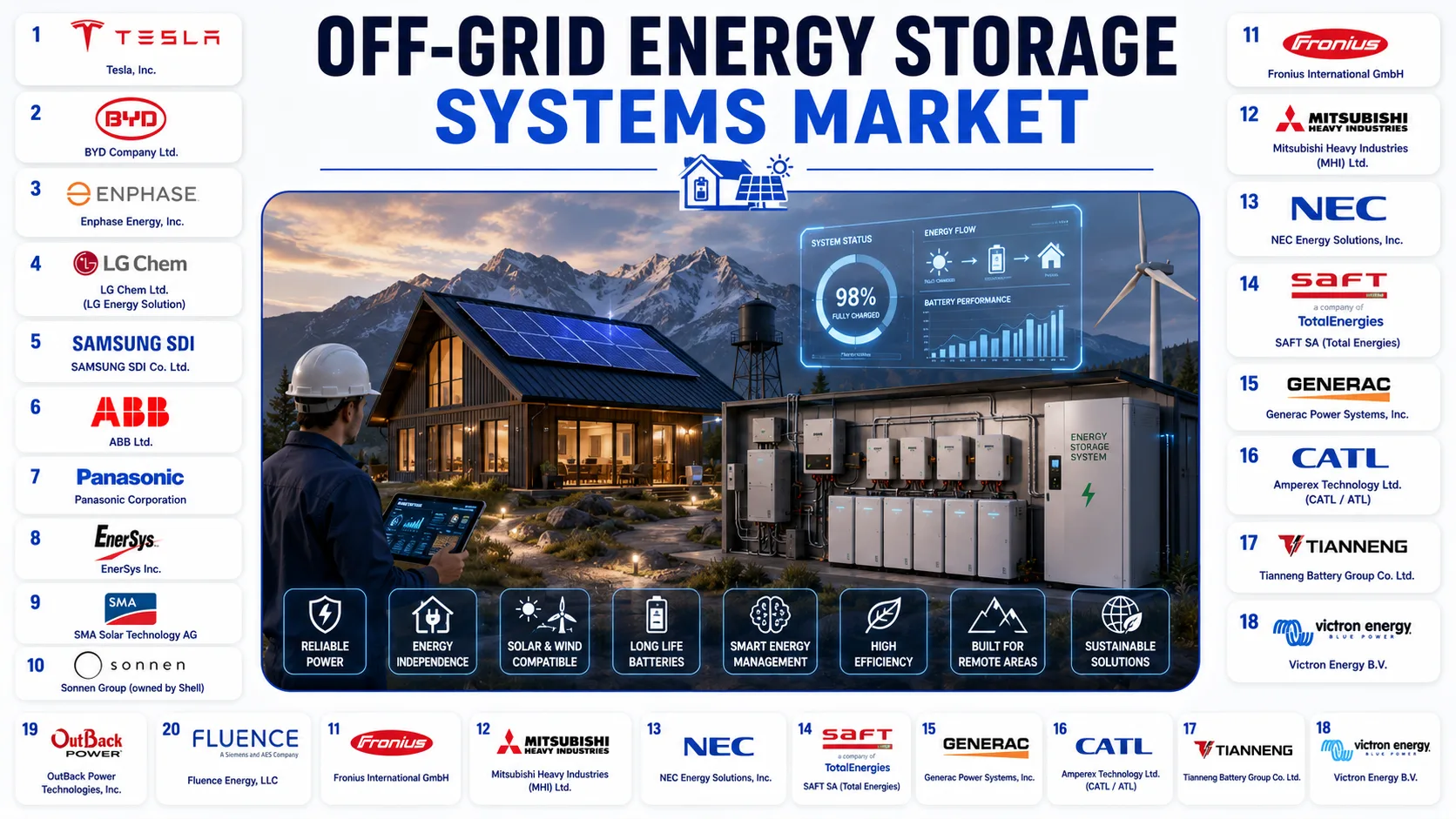
Top 20 Companies in the Global Off-Grid Energy Storage Systems Market Driving Industry Growth in 2026
Introduction
The world is undergoing a profound energy transition, and at the center of this shift lies one of the fastest-growing technology sectors of the decade: off-grid energy storage systems (OGESS). As climate targets tighten, electricity grids in developing nations strain under pressure, and energy independence becomes a geopolitical priority, the demand for robust, scalable, and intelligent off-grid storage solutions has never been higher.
Off-grid energy storage systems are standalone power solutions designed to capture, store, and deliver electricity independently of centralized utility grids. These systems typically pair renewable energy generation—most commonly solar photovoltaic (PV) panels or wind turbines—with advanced battery technology to provide reliable, clean electricity in remote communities, rural homes, commercial facilities, telecom towers, mining operations, and defense installations where grid access is unavailable, cost-prohibitive, or unreliable.
According to cross-referenced data from multiple industry intelligence firms, the global off-grid energy storage systems market was valued at approximately USD 12.6 billion to USD 15.2 billion in 2024, depending on the scope of technologies included. The broader market, encompassing battery energy storage, thermal storage, and hybrid systems, is projected to grow at a compound annual growth rate (CAGR) of 16.7% to 20.2% through 2032, potentially reaching USD 63–72 billion by 2032–2034. This dramatic growth trajectory makes off-grid energy storage one of the most compelling investment and innovation spaces in the global energy sector.
Several powerful macro-forces are converging to accelerate market expansion. Approximately 789 million people globally still lack access to electricity, according to International Energy Agency (IEA) estimates, representing a vast underserved market for off-grid power. At the same time, in developed economies, events such as California wildfires, Texas winter storms, and European energy crises have exposed the vulnerability of centralized grid infrastructure, fueling demand for resilient backup and off-grid solutions among homeowners and enterprises alike.
The rapid cost decline of lithium-ion batteries—prices have fallen by more than 90% over the past decade—has been a game-changing catalyst, making off-grid storage commercially viable across a much wider range of applications. Complemented by government subsidy programs, favorable regulatory frameworks, the rise of microgrids, and growing corporate sustainability mandates, the market presents exceptional growth opportunities for companies positioned across the value chain.
This article profiles the top 20 companies leading the global off-grid energy storage systems market in 2026, analyzing their competitive strengths, key products, strategic moves, and market positioning. It also delivers a comprehensive overview of market dynamics, regional growth patterns, emerging technologies, and the future outlook through 2035.
Market Overview
|
Metric |
Data Point |
|---|---|
|
Market Size (2024) |
USD 12.6 – 15.2 Billion |
|
Market Size Forecast (2032) |
USD 63 – 72 Billion |
|
CAGR (2025–2032) |
16.7% – 20.2% |
|
Forecast Period |
2025 – 2034 |
|
Largest Region (2024) |
Asia-Pacific (~41–52% share) |
|
Fastest Growing Region |
Asia-Pacific & Sub-Saharan Africa |
|
Dominant Technology |
Lithium-ion Batteries (~56.3% share) |
|
Leading Application Segment |
Residential (~38.2% share) |
|
Leading Capacity Segment |
Medium-scale (10–100 kWh, ~44.6% share) |
|
Key Growth Drivers |
Rural electrification, renewable integration, energy independence |
|
Key Challenges |
High upfront CAPEX, supply chain constraints, skilled workforce gaps |
|
Key Opportunities |
Microgrid deployment, telecom tower expansion, AI-powered energy management |
Key Growth Drivers:
- Rising demand for energy independence in residential and commercial sectors
- Rapid scaling of solar and wind generation creating storage demand
- Government incentive programs (e.g., India's PM Surya Ghar Yojana, Denmark's Power-to-X subsidies)
- Declining lithium-ion battery costs making off-grid systems economically viable
- Expanding telecom and remote infrastructure in emerging economies
Key Challenges:
- High initial capital investment remains a barrier in price-sensitive markets
- Supply chain vulnerabilities for critical minerals (lithium, cobalt, nickel)
- Limited skilled workforce for installation and maintenance in remote areas
- Regulatory fragmentation across geographies
Why the Global Off-Grid Energy Storage Market Is Growing
1. Technology Advancements
Lithium-ion battery technology has been the dominant force reshaping economics in this market. In 2024, lithium-ion batteries held more than 56.3% of the off-grid energy storage systems market share, driven by their high energy density, long cycle life, declining per-kWh costs, and compatibility with solar and wind generation. Emerging technologies such as sodium-ion batteries, solid-state batteries, and flow batteries are expected to further broaden the competitive landscape through 2030, offering advantages in safety, longevity, and lower material costs.
AI-driven energy management systems (EMS) are also transforming how off-grid systems operate, enabling predictive load balancing, automated fault detection, and remote diagnostics—significantly improving reliability and reducing operational costs. Companies that integrate intelligent software with their hardware offerings are gaining measurable competitive advantages.
2. Regulatory Support and Government Investment
Governments worldwide are channeling massive investments into energy access and clean energy transition:
India launched the PM Surya Ghar: Muft Bijli Yojana in February 2024, allocating INR 75,021 crore (~USD 9 billion) to install rooftop solar in 10 million households, with household subsidies of INR 30,000–78,000 and 300 units of free electricity monthly.
Denmark launched a DKK 1.25 billion (~USD 180 million) subsidy scheme to promote Power-to-X electrolysis capacity.
The U.S. Inflation Reduction Act (IRA) provides Investment Tax Credits (ITC) for standalone energy storage systems, unlocking billions in private investment.
EU's REPowerEU plan mandates accelerated renewable deployment, indirectly spurring demand for off-grid and resilience storage.
3. Consumer Demand and Energy Resilience
In developed markets, a growing consumer consciousness around energy resilience—driven by increasingly frequent extreme weather events—is pushing homeowners and businesses toward off-grid and hybrid backup systems. In the United States alone, more than 1.2 million solar-battery systems were operating off-grid or in hybrid mode as of 2024, with Alaska maintaining over 90 hybrid microgrids serving remote villages.
4. Investment Trends
Private equity, venture capital, and strategic corporate investment in off-grid energy storage have accelerated markedly. The segment attracted tens of billions of dollars globally in 2023–2025, with significant flows into battery manufacturing gigafactories, software platforms, and project development. India added 341 MWh of battery storage capacity in 2024, a sixfold increase from 51 MWh in 2023, underscoring the pace of deployment acceleration in key emerging markets.
5. Emerging Applications
New and expanding application segments are generating additional demand vectors:
- Remote telecom towers (off-grid BESS replacing diesel generators across Asia and Africa)
- Microgrids for island communities, mining sites, and disaster-resilient campuses
- Agricultural applications (solar-powered irrigation and cold chain storage)
- Defense and military (portable, ruggedized off-grid power for field operations)
- EV charging in remote corridors where grid extension is uneconomical
Top 20 Companies in the Off-Grid Energy Storage Systems Market
- Tesla, Inc.
- BYD Company Ltd.
- Enphase Energy, Inc.
- LG Chem Ltd. (LG Energy Solution)
- Samsung SDI Co. Ltd.
- ABB Ltd.
- Panasonic Corporation
- EnerSys Inc.
- SMA Solar Technology AG
- Sonnen Group (owned by Shell)
- Fronius International GmbH
- Mitsubishi Heavy Industries (MHI) Ltd.
- NEC Energy Solutions, Inc.
- SAFT SA (Total Energies)
- Generac Power Systems, Inc.
- Amperex Technology Ltd. (CATL / ATL)
- Tianneng Battery Group Co. Ltd.
- Victron Energy B.V.
- OutBack Power Technologies, Inc.
- Fluence Energy, LLC
1. Tesla, Inc.
Headquarters: Austin, Texas, USA Founded: 2003 Industry Focus: Electric vehicles, energy storage, solar energy Global Presence: Operations in 40+ countries
Company Overview: Tesla is arguably the most recognized name in the global energy storage market. While best known for its electric vehicles, Tesla's Energy division has become a dominant force in both grid-scale and off-grid storage. The company's deep expertise in battery chemistry, AI-powered software, and vertically integrated manufacturing gives it a differentiated competitive position.
Key Products & Services: Tesla's Powerwall 3 home battery system offers 13.5 kWh of usable energy storage and seamless integration with Tesla solar panels and the Tesla app. For commercial and microgrid applications, the Megapack provides utility-scale storage. Tesla's Virtual Power Plant (VPP) ecosystem enables aggregated distributed storage networks.
Market Position: Tesla consistently ranks among the top three companies globally in residential energy storage. Its brand recognition, software ecosystem, and manufacturing scale at the Nevada Gigafactory provide substantial competitive moats.
Recent Developments: Tesla has continued expanding Megapack production capacity and is deploying large-scale battery projects across Australia, California, and the UK. The company's energy business revenues have grown significantly as a proportion of total revenue, reflecting the market's maturation.
Strategic Advantages: Proprietary battery management software, vertically integrated manufacturing, strong brand loyalty, and a vast installer and distribution network globally.
2. BYD Company Ltd.
Headquarters: Shenzhen, Guangdong, China Founded: 1995 Industry Focus: Electric vehicles, batteries, renewable energy systems Global Presence: 70+ countries
Company Overview: BYD (Build Your Dreams) is one of the world's largest manufacturers of rechargeable batteries and electric vehicles. Its energy storage division has become a global powerhouse, leveraging proprietary lithium iron phosphate (LFP) battery chemistry known for its superior safety profile, long cycle life, and cost efficiency.
Key Products & Services: BYD's Battery-Box series (HV and LV variants) is widely adopted for residential and commercial off-grid applications. The company's BESS containers serve large-scale microgrid projects globally. BYD unveiled its next-generation "Tener" BESS solution, claiming industry-leading technical specifications for large-scale deployment.
Market Position: BYD holds one of the largest global market shares in battery energy storage, supported by an end-to-end supply chain that spans raw materials to finished systems—a critical advantage in cost and delivery reliability.
Recent Developments: BYD has aggressively expanded manufacturing capacity for LFP batteries and is establishing localized production in Europe and South America to reduce logistics costs and meet local content requirements.
Strategic Advantages: Unmatched vertical integration, LFP chemistry advantages (safety, cost, cycle life), massive manufacturing scale, and rapidly growing global distribution network.
3. Enphase Energy, Inc.
- Headquarters:
- Founded:
- Industry Focus:
- Global Presence:
- Company Overview:
- Key Products & Services:
- Market Position:
- Recent Developments:
- Strategic Advantages:
4. LG Chem Ltd. (LG Energy Solution)
- Headquarters:
- Founded:
- Industry Focus:
- Global Presence:
- Company Overview:
- Key Products & Services:
- Market Position:
- Recent Developments:
- Strategic Advantages:
5. Samsung SDI Co. Ltd.
- Headquarters:
- Founded:
- Industry Focus:
- Global Presence:
- Company Overview:
- Key Products & Services:
- Market Position:
- Recent Developments:
- Strategic Advantages:
Competitive Landscape
The off-grid energy storage systems market is moderately concentrated at the top, with Tesla, BYD, LG Energy Solution, Samsung SDI, and CATL accounting for a significant proportion of battery cell and system supply. However, the system integration and application layer is highly fragmented, with hundreds of regional integrators, EPC contractors, and technology-specific specialists competing across geographies.
Key Competitive Dynamics:
- Vertical Integration: BYD and CATL hold structural cost advantages through control of battery cell manufacturing through to complete system assembly. This creates pricing pressure on system integrators dependent on third-party cells.
- Mergers & Acquisitions: The market has seen significant M&A activity. Shell's acquisition of Sonnen (2019), Japan Industrial Partners' takeover of Toshiba for USD 13.5 billion (2023), and TotalEnergies' ownership of SAFT reflect the interest of energy majors in securing strategic positions in storage technology.
- Software Differentiation: As hardware costs commoditize, software and AI-driven energy management become key differentiators. Tesla, Enphase, Sonnen, Fluence, and NEC are investing heavily in proprietary energy management platforms.
- Geographic Consolidation: Chinese players (BYD, CATL, Tianneng) are dominant in Asia-Pacific volume markets, while European and American companies compete on technology sophistication, regulatory compliance, and service quality in premium markets.
Regional Analysis
North America
North America was the largest region by revenue in 2023–2025, driven by strong residential storage adoption in California and Texas, energy resilience demand following extreme weather events, federal IRA incentives for standalone battery storage, and significant rural off-grid communities across Alaska, Canada, and the American West. The U.S. alone operates more than 1.2 million solar-battery systems in off-grid or hybrid modes. Texas and California together contributed approximately 61% of grid-scale storage deployment in several quarters of 2024.
Europe
Europe is advancing primarily through policy-driven clean energy transitions and innovative microgrid projects. Germany leads European adoption driven by deep renewable penetration and energy storage for grid stability. The United Kingdom benefits from island and remote community electrification demand. Following the 2022 energy crisis triggered by the Russia-Ukraine conflict, European energy independence concerns have substantially accelerated off-grid and residential storage investment. Europe accounted for approximately 42.3% of the market in one major industry study segment, highlighting the region's policy-driven maturity.
Asia-Pacific
Asia-Pacific is the largest and fastest-growing region, holding approximately 41–52% of global market share depending on the study scope. China dominates through manufacturing scale and domestic deployment, while India is experiencing explosive growth catalyzed by government programs. India's battery storage capacity additions grew sixfold in 2024 to 341 MWh. Japan and South Korea contribute through technology leadership and domestic deployment programs. Southeast Asian nations (Indonesia, Philippines, Vietnam) represent significant frontier opportunities for rural electrification.
Latin America
Latin America shows steady, accelerating growth driven by solar PV adoption in remote Andean and Amazonian communities, expanding telecom infrastructure, and mining industry off-grid power demand. Brazil and Mexico are the largest markets, with Colombia and Peru showing emerging growth potential. Off-grid solar-battery systems are increasingly displacing diesel generators across the region.
Middle East & Africa
The Middle East contributes through oil-rich nations investing in renewable diversification and energy security, while Sub-Saharan Africa represents one of the most significant long-term growth opportunities globally given that approximately 600 million Africans lack electricity access. Kenya, South Africa, Nigeria, and Ethiopia are focal markets for off-grid electrification, with solar home systems and community microgrids driving deployment.
Emerging Trends
1. AI-Powered Energy Management Artificial intelligence is transforming how off-grid systems operate. Machine learning algorithms enable predictive load forecasting, automated fault detection, optimized charging schedules, and real-time performance monitoring. Companies like Fluence (Mosaic), Tesla (Autobidder), and Enphase (AI-driven app features) are leading this integration.
2. Second-Life Battery Applications Retired electric vehicle battery packs are increasingly being repurposed for stationary off-grid storage, offering a cost-effective supply of storage capacity. This circular economy approach is gaining traction, particularly in Asia and Europe.
3. Vehicle-to-Home (V2H) and Vehicle-to-Grid (V2G) Integration As EV adoption accelerates, bidirectional charging capabilities enable EVs to serve as mobile off-grid backup power sources, blurring the boundary between transportation and stationary storage.
4. Long-Duration Energy Storage (LDES) Flow batteries (vanadium, zinc-bromine), compressed air energy storage, and hydrogen-based storage are gaining investment momentum for applications requiring 8–24+ hours of storage duration, beyond the capabilities of conventional lithium-ion systems.
5. Sodium-Ion Battery Emergence CATL and others are commercializing sodium-ion batteries at scale, offering a lithium-independent alternative that uses abundant, low-cost materials. While energy density is lower than lithium-ion, the cost advantages and material security benefits make sodium-ion a compelling option for off-grid markets.
6. Microgrid-as-a-Service (MaaS) Energy service companies (ESCOs) and utilities are offering off-grid microgrid infrastructure on a subscription or pay-per-use model, eliminating the upfront capital barrier for rural communities and small commercial users.
Future Outlook: 2026–2035
The future of the off-grid energy storage systems market is exceptionally promising. Based on consolidated research projections, the market is expected to grow from approximately USD 12–15 billion in 2024 to USD 63–72 billion by 2032–2034, representing a near five-fold market expansion in under a decade.
Several transformative forces will shape the market through 2035:
Battery Cost Continues to Decline: Analysts project lithium-ion battery pack prices to fall below USD 80/kWh by 2030, down from approximately USD 130/kWh in 2024. Sodium-ion and solid-state technologies will add pricing pressure and performance optionality.
Universal Electrification Mandate: The United Nations Sustainable Development Goal 7 (affordable and clean energy for all by 2030) will continue to channel international development funding into off-grid electrification, particularly across Sub-Saharan Africa and South/Southeast Asia.
Climate Change Drives Resilience Demand: As extreme weather events intensify globally, the value proposition of energy independence and backup power becomes more compelling even in well-electrified markets, sustaining demand in North America, Europe, and Australia.
Regulatory Evolution: Carbon pricing mechanisms, diesel generator phase-out mandates, and favorable storage tariff structures in emerging economies will create favorable conditions for off-grid storage market expansion.
Next-Generation Technologies: Solid-state batteries (targeted for commercialization by the late 2020s), long-duration storage systems, and AI-driven virtual power plants will create new competitive dynamics and expand addressable markets.
Investment Flows: Private capital continues to flow into the sector, with energy transition funds, development finance institutions (World Bank, ADB, AfDB), and corporate venture arms all active in funding both technology development and project deployment.
Frequently Asked Questions (FAQs)
1. What is the global off-grid energy storage systems market size in 2024? The global off-grid energy storage systems market was valued at approximately USD 12.6 to USD 15.2 billion in 2024, with variation depending on the scope of technologies included (battery-only vs. comprehensive energy systems). The broader market including all off-grid storage modalities represents a multi-billion-dollar industry experiencing rapid expansion.
2. Who are the leading companies in the off-grid energy storage systems market? The top companies include Tesla Inc., BYD Company Ltd., Enphase Energy Inc., LG Energy Solution, Samsung SDI, ABB Ltd., Panasonic Corporation, EnerSys Inc., SMA Solar Technology AG, Sonnen Group, Fronius International, Mitsubishi Heavy Industries, NEC Energy Solutions, SAFT SA, Generac Power Systems, Amperex Technology Limited (CATL), Tianneng Battery Group, Victron Energy, OutBack Power Technologies, and Fluence Energy.
3. Which region dominates the off-grid energy storage systems market? Asia-Pacific dominates the global off-grid energy storage systems market, holding approximately 41–52% of global market share depending on the study. China, India, Japan, and South Korea are the primary drivers. However, North America leads in revenue terms across several study scopes, driven by high-value residential and commercial deployments.
4. What is the forecast CAGR for the off-grid energy storage systems market? Multiple research firms project a CAGR of 16.7% to 20.2% for the broader off-grid energy storage market through 2032–2034. Narrower product scope studies (battery systems only) project CAGRs ranging from 11% to 14% over similar periods.
5. What are the primary growth drivers of this market? Key growth drivers include: rising global demand for energy independence, rapid decline in lithium-ion battery costs, government subsidy programs for rural electrification and renewable energy, expansion of telecom infrastructure in emerging markets requiring off-grid power, growing consumer awareness of energy resilience, and corporate sustainability mandates driving commercial off-grid adoption.
6. What technologies dominate the off-grid energy storage systems market? Lithium-ion batteries dominate with approximately 56.3% market share in 2024, driven by high energy density, falling costs, and long cycle life. Lead-acid batteries retain a presence in cost-sensitive markets. Emerging technologies include sodium-ion, flow batteries (vanadium, zinc-bromine), and solid-state batteries.
7. Which application segment holds the largest market share? The residential segment holds the largest application share (approximately 38.2%), driven by homeowners seeking energy independence through solar-plus-storage systems. Commercial and industrial segments are also significant, with telecom towers representing one of the fastest-growing application categories.
8. What is the role of AI in off-grid energy storage systems?
9. How is government policy impacting the off-grid energy storage market?
10. What are the key challenges facing the off-grid energy storage market?
11. What is the forecast market size for off-grid energy storage systems by 2032?
12. How are mergers and acquisitions shaping the competitive landscape?
13. What is the market share of lithium-ion batteries in off-grid energy storage?
14. Which companies are investing most heavily in next-generation battery technology?
15. What is the outlook for off-grid energy storage in Sub-Saharan Africa?
Conclusion
The global off-grid energy storage systems market stands at an inflection point, transforming from a niche technology for remote applications into a mainstream energy solution spanning residential resilience, commercial independence, rural electrification, and industrial self-sufficiency. With a market trajectory toward USD 63–72 billion by 2032, growing at a CAGR exceeding 16%, this sector represents one of the most compelling growth opportunities in the global clean energy economy.
The top 20 companies profiled in this article—from global giants like Tesla, BYD, and LG Energy Solution to innovative specialists like Enphase, Sonnen, and Victron Energy—are driving technological advancement, cost reduction, and market expansion across every geography and application segment. Their strategic investments in AI-powered energy management, next-generation battery chemistry, and innovative business models are collectively reshaping how the world accesses, stores, and manages electricity.
For investors, policymakers, energy professionals, and technology developers, the off-grid energy storage market offers exceptional opportunity. The convergence of declining costs, expanding government support, growing consumer demand for energy independence, and the urgency of global electrification targets makes this one of the defining markets of the clean energy transition decade.