
Top Leading Companies in the Global OSS BSS Market
Author:
Intellectual Market Insights Research
Published Date:
29 Aug 2026
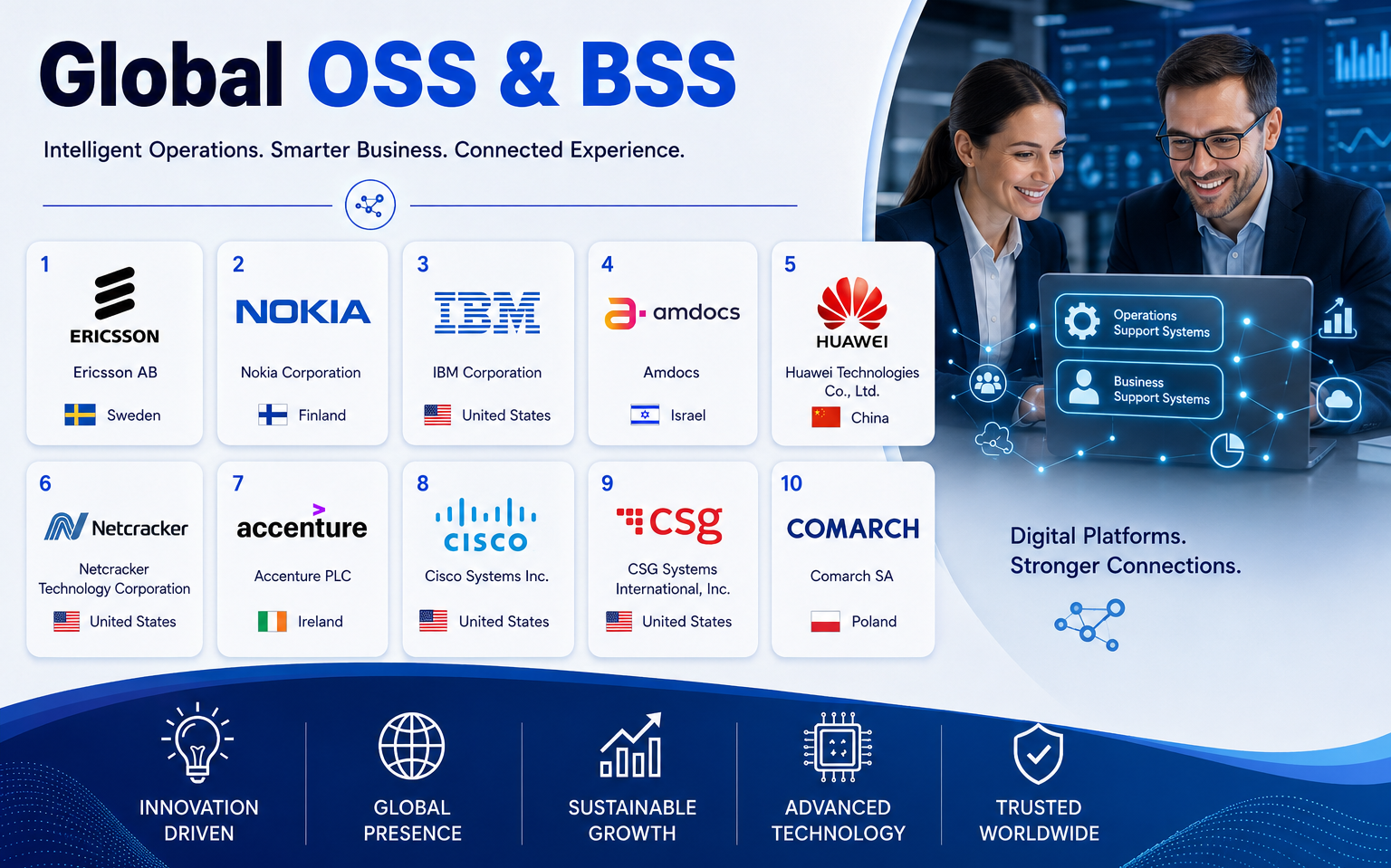
Top Companies in the World Offering OSS & BSS Solutions
Operational Support Systems (OSS) and Business Support Systems (BSS) form the backbone of the modern telecom operator, managing everything from network planning, fault management, and performance monitoring on the OSS side to billing, CRM, and service provisioning on the BSS side. As communication service providers accelerate 5G rollouts, absorb an explosion of connected IoT devices, and shift toward digital-first business models, OSS/BSS platforms have become the critical layer determining how quickly and profitably operators can manage network complexity and monetize new services.
The global OSS and BSS market was valued at USD 85.5 billion in 2025 and is projected to reach USD 95.8 billion in 2026, expanding to USD 259.6 billion by 2034, growing at a compound annual growth rate (CAGR) of 12.4% during the forecast period (2026–2034). Growth is driven by the network complexity introduced by 5G and massive IoT connectivity, the ongoing shift of digital service providers toward cloud-based OSS/BSS platforms, and the increasing use of AI/ML for predictive analytics and automated decision-making within these systems.
The competitive landscape spans telecom-native software specialists such as Amdocs and Netcracker, network infrastructure giants including Ericsson, Nokia, and Huawei, and large enterprise technology and consulting firms such as IBM, Accenture, Cisco, Broadcom, HP Enterprise, and Infosys that bring cloud, AI, and systems-integration expertise to telecom transformation projects. This article provides a research-based analysis of the top companies shaping the global OSS & BSS market, their positioning, flagship offerings, and the regional and technological forces driving the industry forward.
Market Overview
|
Parameter |
Details |
|---|---|
|
Market Size (2025) |
USD 85.5 Billion |
|
Market Size (2026) |
USD 95.8 Billion |
|
Projected Market Size (2034) |
USD 259.6 Billion |
|
CAGR (2026–2034) |
12.4% |
|
Base Year |
2024 |
|
Forecast Period |
2025–2034 |
|
Leading Region |
North America |
|
Fastest-Growing Region |
Asia-Pacific |
|
Key Growth Drivers |
5G deployment, IoT-driven network complexity, cloud-based adoption, AI/ML-powered automation and predictive analytics |
|
Key Restraints |
Complexity of customization for legacy systems and regulatory requirements; limited skilled workforce |
|
Key Challenges |
Complex integration with legacy infrastructure; high upfront licensing, hardware, and customization costs |
|
Key Opportunities |
5G network slicing and ultra-low-latency service management; cloud-based scalability and cost efficiency |
Why the OSS & BSS Market Is Growing
1. Digital Transformation of Telecom Operators
As telecom operators shift toward digital-first business models, advanced OSS and BSS solutions are essential to managing an expanding portfolio of digital services while remaining competitive and responsive to modern consumer expectations.
2. Modernized Online Billing
Traditional billing platforms struggle with rising transaction volumes and complexity in an electronic environment. Sophisticated BSS solutions enable accurate, timely online billing across multiple payment methods.
3. Demand for Customer Self-Service
Customers increasingly expect seamless, on-demand access to their accounts and services. OSS/BSS-enabled self-service platforms let customers manage accounts and resolve issues independently, improving user experience while easing the load on support teams.
4. Automated Service Provisioning
Advanced OSS solutions automate the setup and configuration of new digitized services, shortening rollout timelines, reducing manual intervention, and supporting the scalability operators need to keep pace with market demand.
5. 5G Deployment and Network Complexity
5G's mix of high-frequency millimeter waves and lower-frequency bands, combined with ultra-fast speeds and low-latency requirements, demands sophisticated OSS tools for network planning, real-time monitoring, and capabilities like network slicing that let multiple virtual networks run on shared physical infrastructure.
6. Shift to Cloud-Based Solutions
Cloud-based OSS/BSS platforms offer telecom operators scalability, deployment flexibility, and reduced capital expenditure, converting large fixed hardware costs into variable operational expenses and enabling faster response to evolving market and customer needs.
Market Restraints & Challenges
Despite strong growth, the market faces real headwinds. Customization complexity is significant, since legacy systems, varying business processes, and regional regulatory requirements often demand extensive requirement analysis, iterative development, and testing, delaying rollouts and raising costs, particularly for smaller operators. A limited skilled workforce compounds this, as OSS/BSS implementation requires specialized expertise spanning software development, network engineering, and systems integration, and a shortage of qualified personnel raises the risk of deployment delays and suboptimal system performance. Operators also face complex integration hurdles when connecting new OSS/BSS platforms to outdated legacy infrastructure, and the high upfront costs of software licensing, hardware, and customization can be a significant adoption barrier for smaller telecom operators.
Top 10 Companies in the OSS & BSS Market
- Ericsson AB
- Nokia Corporation
- IBM Corporation
- Amdocs
- Huawei Technologies Co., Ltd.
- Netcracker Technology Corporation
- Accenture PLC
- Cisco Systems Inc.
- CSG Systems International, Inc.
- Comarch SA
1. Ericsson AB
|
Category |
Details |
|---|---|
|
Company Name |
Telefonaktiebolaget LM Ericsson (Ericsson AB) |
|
Headquarters |
Stockholm, Sweden |
|
Founded |
1876 |
|
Company Overview |
Ericsson is one of the key players the market identifies as continually innovating and expanding OSS/BSS offerings to gain share, combining its Business and Operations Support Systems portfolio with its core network infrastructure business. |
|
Key Products |
Ericsson Charging and Ericsson Mediation from its Business and Operations Support Systems portfolio, integrated with Ericsson Dynamic Activation (EDA) from its Network Management portfolio. |
|
Market Position |
A top-tier global OSS/BSS vendor that cross-sells integrated OSS/BSS software to the same carrier base it serves with radio access network and core network infrastructure. |
|
Recent Developments |
Partnered with MTN Group (February 2024) for continued delivery of Ericsson Charging and Ericsson Mediation integrated with Ericsson Dynamic Activation; acquired Cradlepoint (July 2023), integrating enterprise-centric wireless WAN and private 5G capabilities into its Business Area Enterprise Wireless Solutions. |
|
Strategic Advantages |
Deep integration between network infrastructure and OSS/BSS software, strong global carrier relationships, and an expanding enterprise wireless and private 5G portfolio. |
2. Nokia Corporation
|
Category |
Details |
|---|---|
|
Company Name |
Nokia Corporation |
|
Headquarters |
Espoo, Finland |
|
Founded |
1865 |
|
Company Overview |
Nokia is named among the market's key innovators, offering OSS and BSS solutions that help service providers optimize network operations, manage 5G complexity, and enable programmable, digitally transformed enterprise networks. |
|
Key Products |
Nokia's OSS/BSS portfolio spans network operations, service fulfillment, and customer experience management, complemented by programmable network solutions for enterprise digital transformation. |
|
Market Position |
A leading global OSS/BSS vendor with strong market share in Europe and North America, extending into enterprise verticals such as banking, transportation, and life sciences. |
|
Recent Developments |
Partnered with Innova (December 2023) to create and deliver programmable network solutions, accelerating digital transformation for enterprises across banking/financial services, transportation and logistics, technology, life sciences, retail, and industrial sectors. |
|
Strategic Advantages |
Combined strength in network infrastructure and software, strong European carrier relationships, and an expanding footprint in enterprise-focused programmable networking. |
3. IBM Corporation
|
Category |
Details |
|---|---|
|
Company Name |
IBM Corporation |
|
Headquarters |
Armonk, New York, USA |
|
Founded |
1911 |
|
Company Overview |
IBM is specifically named as a key OSS/BSS market player, bringing its expertise in artificial intelligence, hybrid cloud, and automation to help telecom operators manage network operations and monetize technologies such as 5G and IoT. |
|
Key Products |
AI-driven and hybrid-cloud OSS/BSS enablement tools that support network automation, customer experience management, and edge computing use cases for telecom operators. |
|
Market Position |
A major enterprise technology partner for telecom operators pursuing large-scale OSS/BSS modernization and AI-driven automation. |
|
Recent Developments |
Continues to expand its AI-driven automation and hybrid-cloud capabilities as telecom operators accelerate legacy OSS/BSS modernization projects. |
|
Strategic Advantages |
Deep enterprise AI and hybrid-cloud expertise, extensive systems-integration capability, and long-standing relationships with large telecom operators globally. |
4. Amdocs
|
Category |
Details |
|---|---|
|
Company Name |
Amdocs Limited |
|
Founded |
1982 |
|
Company Overview |
Amdocs is a leading dedicated provider of OSS and BSS software for communications, media, and financial service providers, focused on customer management, billing, ordering, and network functions virtualization. |
|
Key Products |
Amdocs' BSS/OSS suite covering customer management, billing, order management, and network functions virtualization, tailored to support digital, cloud, and 5G transformation. |
|
Market Position |
Widely regarded as a leading dedicated OSS/BSS vendor, with deep, long-standing enterprise relationships with major carriers. |
|
Recent Developments |
Continues to expand cloud-native and AI-driven capabilities across its BSS/OSS suite as telecom operators pursue digital transformation and automated billing. |
|
Strategic Advantages |
Deep, telecom-specific domain expertise, high customer switching costs due to deep enterprise integration, and a large managed-services base that provides recurring revenue. |
5. Huawei Technologies Co., Ltd.
|
Category |
Details |
|---|---|
|
Company Name |
Huawei Technologies Co., Ltd. |
|
Headquarters |
Shenzhen, China |
|
Founded |
1987 |
|
Company Overview |
Huawei provides OSS and BSS solutions that leverage AI, big data, and cloud-native technologies to optimize network operations and enable 5G service monetization, alongside its core network infrastructure business. |
|
Key Products |
Huawei's OSS/BSS portfolio covers network management, service provisioning, and customer engagement platforms tailored to operators' 5G and digital transformation needs. |
|
Market Position |
A dominant OSS/BSS and network infrastructure vendor across Asia-Pacific, with an expanding presence in Africa and Latin America. |
|
Recent Developments |
Continues to expand AI- and automation-driven OSS/BSS capabilities as part of its broader ICT infrastructure strategy across fast-growing telecom markets. |
|
Strategic Advantages |
Massive scale, cost-competitive offerings, tight integration with its own network infrastructure business, and a dominant position in fast-growing Asia-Pacific and African telecom markets. |
Competitive Landscape
The global OSS & BSS market brings together several distinct types of competitors. Telecom-native software specialists such as Amdocs, Netcracker, Comarch, and CSG Systems International build their entire business around telecom support systems, giving them deep domain expertise centered on billing, customer management, and network orchestration. Network infrastructure giants Ericsson, Nokia, and Huawei bundle OSS/BSS software with their core radio access network and core network businesses, cross-selling integrated hardware-software solutions to the same carrier customers. Enterprise technology and consulting firms, including IBM, Accenture, Cisco Systems, Broadcom, HP Enterprise, and Infosys, bring broader enterprise cloud, AI, and systems-integration expertise to large-scale telecom modernization projects, often serving as trusted transformation partners for operators migrating away from legacy infrastructure.
Regional Analysis
North America
North America remains a leading region for the OSS/BSS market, supported by mature telecom infrastructure, high technology adoption, and regulatory pressures that push operators toward early deployment of advanced systems integrating AI and 5G.
Europe
Europe is shaped by high regulatory compliance requirements and strong market competition, with operators relying on OSS/BSS solutions to maintain data privacy, billing accuracy, and service quality while investing in IoT and 5G-driven digital transformation.
Asia-Pacific
Asia-Pacific is the fastest-growing region, driven by rapid telecom infrastructure development, surging consumer demand for connectivity, and heavy digital transformation investment in large, growing digital economies such as China and India.
Latin America & Middle East and Africa
Latin America and Middle East & Africa are emerging OSS/BSS markets, with network modernization and improved customer service driving adoption in Latin America, and investment in telecom infrastructure and operational efficiency driving demand across the Middle East & Africa.
Emerging Trends in the OSS & BSS Market
1. Cloud-Based and SaaS Deployment: Cloud-hosted OSS/BSS systems are converting large fixed hardware costs into variable operational expenses, enabling scalable, flexible deployment without significant upfront hardware investment.
2. AI/ML-Powered Automation: Artificial intelligence and machine learning are increasingly embedded in OSS/BSS platforms to deliver predictive analytics, automated decision-making, and greater operational efficiency.
3. 5G Network Slicing and Complexity Management: OSS platforms are evolving to manage the mix of high-frequency and lower-frequency 5G signal types, supporting real-time monitoring and network slicing across shared physical infrastructure.
4. Automated, Real-Time Service Provisioning: Automated provisioning tools are shortening the time needed to set up and configure new digital services, reducing manual intervention and downtime.
5. Customer Self-Service Expansion: Growth in self-service platforms is letting customers manage accounts and resolve issues independently, improving user experience while reducing load on customer support teams.
Key Industry Developments
- February 2024: Ericsson partnered with MTN Group for continued delivery of two flagship products from its Business and Operations Support Systems portfolio, Ericsson Charging and Ericsson Mediation, integrated with Ericsson Dynamic Activation (EDA).
- December 2023: Nokia partnered with Innova to create and deliver programmable network solutions, accelerating digital transformation for enterprises across banking/financial services, transportation and logistics, technology, life sciences, retail, and industrial sectors.
- July 2023: Ericsson acquired Cradlepoint, integrating its enterprise-centric wireless WAN and private 5G network expertise into Ericsson's Business Area Enterprise Wireless Solutions (BEWS).
Future Outlook (2025–2034)
The global OSS & BSS market's trajectory toward USD 259.6 billion by 2034 reflects the scale of the telecom industry's digital and network transformation. The 12.4% CAGR forecast from 2026 to 2034 assumes sustained 5G network expansion, growing IoT device connectivity, continued cloud migration, and deepening integration of AI/ML across both network and customer-facing operations.
Key investment themes include cloud-based deployment overtaking on-premises systems for new implementations, expansion of AI-driven predictive analytics and automated decision-making, and growing demand for automated service provisioning and self-service platforms that reduce operational cost. Network infrastructure giants Ericsson, Nokia, and Huawei are likely to continue leveraging their integrated hardware-software relationships, while telecom-native specialists like Amdocs and Netcracker retain strength in core billing and customer management, and enterprise technology firms such as IBM, Accenture, and Cisco expand their role as trusted partners for large-scale legacy modernization.
Frequently Asked Questions (FAQ)
1. What is the current size of the global OSS & BSS market?
The global OSS and BSS market was valued at USD 85.5 billion in 2025, is expected to reach USD 95.8 billion in 2026, and is projected to reach USD 259.6 billion by 2034, growing at a CAGR of 12.4%.
2. Who are the top companies in the OSS & BSS market?
Key players named in the market include Ericsson, Nokia, and IBM, alongside Amdocs, Huawei, Netcracker, Accenture, Cisco Systems, CSG Systems International, Comarch, BMC Software, Broadcom, HP Enterprise, and Infosys.
3. Which region dominates the OSS & BSS market?
North America remains a leading region due to mature telecom infrastructure and early technology adoption, while Asia-Pacific is the fastest-growing region, driven by rapid telecom infrastructure development in markets like China and India.
4. What is the forecast CAGR for the OSS & BSS market?
The market is forecast to grow at a CAGR of 12.4% from 2026 to 2034.
5. What are the main growth drivers for this market?
Key drivers include digital transformation of telecom operators, 5G deployment and the network complexity it introduces, growing demand for cloud-based solutions, and the increasing use of AI/ML for predictive analytics and automated decision-making.
6. What challenges does the OSS/BSS industry face?
The industry faces complex integration challenges when connecting new solutions to legacy infrastructure, high upfront licensing and customization costs, and a limited pool of skilled professionals capable of implementing and managing these systems.
7. What is the difference between OSS and BSS?
Operational Support Systems (OSS) manage network-facing functions such as network planning, fault management, and performance monitoring, while Business Support Systems (BSS) manage customer-facing functions such as billing, CRM, and service provisioning.
Conclusion
The global OSS & BSS market sits at the center of the telecom industry's ongoing digital and network transformation. With a projected size of USD 259.6 billion by 2034 at a 12.4% CAGR, the market offers strong, sustained growth as 5G deployment, IoT proliferation, and cloud adoption reshape how operators manage networks and customers alike.
Ericsson, Nokia, and IBM continue to be named among the market's leading innovators, while dedicated specialists like Amdocs and Netcracker and network infrastructure leader Huawei round out the competitive top tier. As cloud-based deployment and AI/ML-powered automation become central to the next generation of OSS/BSS platforms, the vendors that successfully combine deep telecom domain expertise with scalable, intelligent systems will define market leadership through 2034 and beyond.