
Top 10 Pet Tech Companies Dominating the Global Market in 2026: AI, Wearables, GPS Tracking & Smart Pet Care Revolution
Author:
Intellectual Market Insights Research
Published Date:
08 Jul 2026
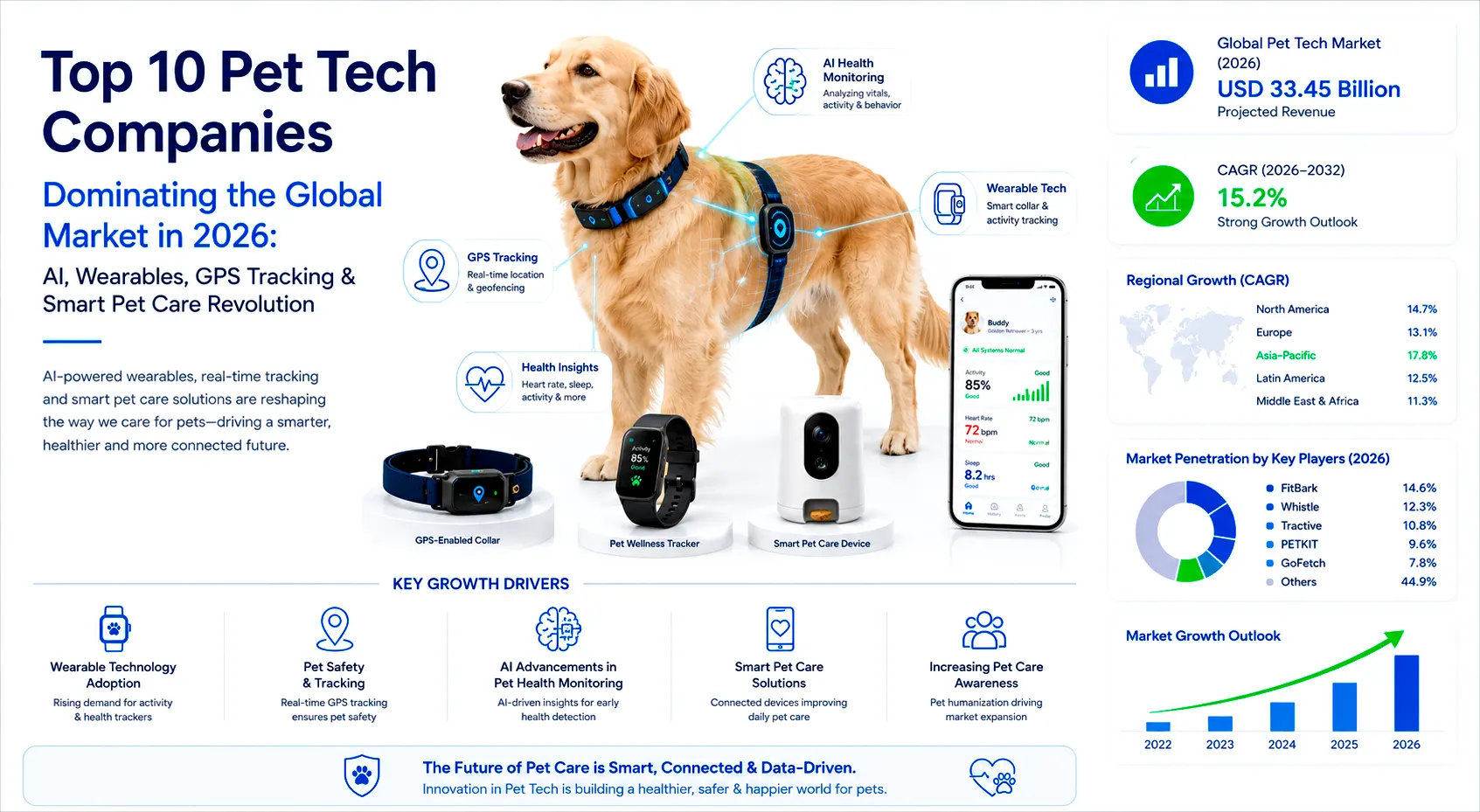
Smart Innovation Transforming Modern Pet Care
As pet ownership continues to rise worldwide, the pet care industry is undergoing a remarkable technological transformation. Pet Tech has emerged as one of the fastest-growing segments within the broader pet care ecosystem, driven by increasing consumer demand for smart devices, AI-powered health monitoring, GPS-enabled tracking systems, automated feeding solutions, and digital veterinary services. Modern pet owners are seeking innovative solutions that enhance convenience, improve pet health, and provide real-time insights into their pets' daily activities
automated pet care tools is currently valued at an estimated $15–25 billion globally (figures vary by scope across research firms), with projections pointing toward $50–80 billion by 2034
The rapid integration of Artificial Intelligence (AI), the Internet of Things (IoT), cloud computing, wearable sensors, and mobile applications has enabled companies to develop connected ecosystems that redefine pet ownership. From smart collars capable of tracking location and health metrics to intelligent cameras that allow remote interaction with pets, technology is transforming how owners care for their companion animals.
This article highlights the Top 10 Leading Companies in the Global Pet Tech Market 2025, profiling organizations that are driving innovation, expanding digital pet care services, and shaping the future of connected pet healthcare.
What is Pet Tech?
Pet Tech refers to the use of advanced digital technologies to improve the health, safety, wellness, and daily care of companion animals. It encompasses a broad range of hardware, software, wearable devices, mobile applications, cloud-based platforms, and AI-driven analytics designed specifically for pets and their owners.
The industry includes smart GPS collars, activity trackers, automated feeders, intelligent water dispensers, interactive pet cameras, tele-veterinary services, health monitoring wearables, smart litter boxes, and behavior analytics platforms. These connected technologies enable pet owners to monitor their pets remotely, receive real-time health alerts, analyze behavioral patterns, and maintain consistent care routines regardless of their location.
As digital transformation accelerates across consumer industries, Pet Tech is becoming an essential component of preventive pet healthcare. The growing trend of pet humanization, where pets are increasingly regarded as family members, is encouraging consumers to invest in premium technologies that improve quality of life and long-term wellness.
Global Pet Tech Market Overview
The global Pet Tech market has experienced significant expansion over the past decade, supported by increasing pet ownership, rising disposable incomes, and the widespread adoption of connected consumer technologies. Pet owners are increasingly investing in intelligent products that provide convenience while enhancing the safety, nutrition, and healthcare of their animals.
Smart pet devices now integrate multiple technologies, including AI-powered analytics, GPS tracking, Bluetooth connectivity, cloud storage, and mobile applications. These capabilities allow owners to monitor health indicators, track physical activity, manage feeding schedules, receive emergency notifications, and consult veterinarians remotely.
The market is also witnessing substantial investments from technology companies, venture capital firms, and established pet care manufacturers. Strategic collaborations between software developers, veterinary organizations, wearable technology providers, and IoT solution companies are accelerating innovation and expanding the range of connected pet care products available to consumers.
North America currently represents one of the largest markets for Pet Tech due to high pet ownership rates, premium spending on companion animals, and strong digital infrastructure. Europe follows closely with growing adoption of connected pet devices and increased awareness of preventive pet healthcare. Meanwhile, Asia-Pacific is expected to witness the fastest growth as urbanization, rising middle-class incomes, and increasing pet adoption fuel demand for smart pet care solutions.
Key Market Drivers
Several factors are contributing to the rapid growth of the global Pet Tech market:
Growing Pet Humanization
Consumers increasingly consider pets as members of the family, leading to higher spending on premium healthcare, wellness, nutrition, and connected technologies.
Rising Adoption of IoT Devices
The widespread availability of Internet of Things (IoT) technologies has enabled manufacturers to develop intelligent pet products capable of real-time communication and remote monitoring.
Increasing Demand for Preventive Healthcare
Pet owners are becoming more proactive in monitoring activity levels, sleep quality, nutrition, and early signs of illness through wearable technologies and digital health platforms.
Expansion of AI and Data Analytics
Artificial Intelligence enables predictive health monitoring, behavioral analysis, and personalized wellness recommendations, significantly improving long-term pet care.
Growth of Mobile Applications
User-friendly smartphone applications provide centralized access to pet health records, GPS tracking, feeding schedules, and veterinary consultations, enhancing customer engagement.
Emerging Trends Shaping the Industry
The Pet Tech industry is evolving rapidly with continuous technological advancements. Some of the most significant trends include:
- AI-powered health monitoring and predictive analytics
- GPS-enabled smart collars with real-time tracking
- Wearable devices for activity and wellness monitoring
- Smart feeding and hydration systems
- Cloud-connected pet management platforms
- Tele-veterinary consultations
- Subscription-based digital pet care services
- Smart pet cameras with two-way communication
- Behavior recognition using computer vision
- Integration of machine learning into pet wellness applications
These innovations are enabling more personalized, data-driven, and convenient pet care experiences while creating new revenue opportunities for technology providers.
Top 10 Leading Companies in the Global Pet Tech Market 2025
- Rover
- Tractive
- Petcube
- Mars Petcare
- Fi
- Sure Petcare
- Dogness
- Pawbo
- FitBark
- Felcana
Company Profile
1. Rover
|
Category |
Details |
|---|---|
|
Company Name |
Rover |
|
Headquarters |
Seattle, Washington, United States |
|
Founded |
2011 |
|
Industry Focus |
Pet Technology, Digital Pet Care Marketplace |
|
Global Presence |
Operations across the United States, Canada, the United Kingdom, and Europe |
|
Company Overview |
Rover is one of the world's largest online marketplaces for pet care services, connecting pet owners with trusted pet sitters, dog walkers, boarding providers, daycare professionals, and house sitters through a secure digital platform. The company leverages advanced mobile technology, online booking systems, secure payment processing, and customer review mechanisms to simplify pet care services while enhancing trust and convenience for both pet owners and caregivers. |
|
Key Products & Services |
Pet Sitting, Dog Walking, Boarding, Dog Day Care, House Sitting, Drop-In Visits, Mobile Booking Platform, GPS Walk Tracking, Secure Online Payments, Customer Review System |
|
Market Position |
One of the largest digital pet care marketplaces globally, serving millions of pet owners through an extensive network of verified caregivers and technology-enabled services. |
|
Recent Developments |
Expanded international operations, enhanced mobile application features, strengthened caregiver verification systems, introduced AI-powered service recommendations, and improved customer safety and payment infrastructure. |
|
Strategic Advantages |
Strong global brand recognition, extensive caregiver network, scalable digital platform, secure payment ecosystem, user-friendly mobile application, high customer trust, and continuous investment in platform innovation. |
2. Tractive
|
Category |
Details |
|---|---|
|
Company Name |
Tractive |
|
Headquarters |
Pasching, Austria |
|
Founded |
2012 |
|
Industry Focus |
GPS Pet Tracking, Pet Wearable Technology, Digital Pet Health |
|
Global Presence |
Products available in more than 175 countries across Europe, North America, Asia-Pacific, and Latin America |
|
Company Overview |
Tractive is a leading developer of GPS-enabled pet tracking and health monitoring solutions. The company designs smart wearable devices that allow pet owners to monitor their pets' location, activity levels, sleep patterns, and overall health through cloud-connected mobile applications. Continuous investment in GPS technology, artificial intelligence, and software development has established Tractive as one of the global leaders in connected pet wearables. |
|
Key Products & Services |
GPS Dog Tracker, GPS Cat Tracker, Activity Monitoring, Health Monitoring, Sleep Tracking, Escape Alerts, Virtual Fence, Mobile Application, Wellness Reports, Subscription Services |
|
Market Position |
One of the world's leading providers of smart GPS tracking and wearable health monitoring solutions for companion animals with a strong subscription-based business model. |
|
Recent Developments |
Introduced next-generation GPS trackers, enhanced AI-powered wellness monitoring, improved battery life, expanded international distribution, and upgraded mobile application capabilities. |
|
Strategic Advantages |
Real-time GPS technology, global coverage, subscription revenue model, advanced health analytics, long battery life, cloud-connected platform, and continuous product innovation. |
3. Petcube
|
Category |
Details |
|---|---|
|
Company Name |
Petcube |
|
Headquarters |
San Francisco, California, United States |
|
Founded |
2012 |
|
Industry Focus |
Smart Pet Cameras, AI-Based Pet Monitoring, Connected Pet Care |
|
Global Presence |
Operations across North America, Europe, Asia-Pacific, and selected international markets |
|
Company Overview |
Petcube develops intelligent pet monitoring solutions that enable pet owners to stay connected with their pets remotely. Its product ecosystem combines HD video streaming, two-way audio communication, artificial intelligence, cloud storage, and tele-veterinary services to improve pet monitoring, safety, and overall wellness. The company continues expanding its digital ecosystem through innovative smart home integration and AI-enabled pet care technologies. |
|
Key Products & Services |
Smart Pet Cameras, Treat Dispensing Cameras, HD Video Monitoring, Two-Way Audio, AI Pet Monitoring, Cloud Video Recording, Pet Telehealth Services, Mobile Applications |
|
Market Position |
A leading innovator in connected pet monitoring technology, recognized for integrating AI, cloud computing, and smart home technologies into pet care solutions. |
|
Recent Developments |
Expanded telehealth services, enhanced AI monitoring capabilities, improved cloud storage services, strengthened smart home integration, and upgraded mobile applications. |
|
Strategic Advantages |
Innovative smart camera technology, AI-powered monitoring, subscription-based services, integrated telehealth platform, strong customer engagement, cloud connectivity, and continuous software innovation. |
4. Mars Petcare
|
Category |
Details |
|---|---|
|
Company Name |
Mars Petcare |
|
Headquarters |
McLean, Virginia, United States |
|
Founded |
1935 |
|
Industry Focus |
Pet Nutrition, Veterinary Healthcare, Digital Pet Health, Pet Technology |
|
Global Presence |
Operations in more than 130 countries worldwide |
|
Company Overview |
Mars Petcare is one of the world's largest pet care organizations, offering a diversified portfolio that includes pet nutrition, veterinary healthcare, diagnostics, pet insurance, and digital pet technologies. Through continuous investment in connected healthcare solutions, AI-powered diagnostics, wearable technologies, and veterinary software, Mars Petcare is transforming traditional pet healthcare into an integrated digital ecosystem focused on preventive care and personalized wellness. |
|
Key Products & Services |
Pet Nutrition, Veterinary Hospitals, Pet Diagnostics, DNA Testing, AI Health Monitoring, Digital Veterinary Platforms, Pet Insurance, Connected Healthcare Solutions |
|
Market Position |
Global leader in pet care with one of the industry's largest integrated ecosystems spanning nutrition, veterinary care, diagnostics, and digital health solutions. |
|
Recent Developments |
Expanded veterinary healthcare services, increased investment in AI-based diagnostics, strengthened digital healthcare platforms, expanded preventive healthcare initiatives, and continued strategic acquisitions. |
|
Strategic Advantages |
Globally recognized brands, extensive veterinary network, strong financial resources, advanced research capabilities, integrated healthcare ecosystem, worldwide distribution, and continuous investment in innovation. |
5. Fi
|
Category |
Details |
|---|---|
|
Company Name |
Fi |
|
Headquarters |
New York, New York, United States |
|
Founded |
2017 |
|
Industry Focus |
Smart Pet Wearables, GPS Tracking, Digital Pet Health |
|
Global Presence |
Primarily North America with expanding international distribution |
|
Company Overview |
Fi develops premium smart dog collars that combine LTE connectivity, GPS tracking, activity monitoring, sleep analysis, and AI-powered health insights. Its connected platform enables pet owners to monitor their dogs' location and overall wellness through cloud-based mobile applications. The company's subscription-driven ecosystem and continuous innovation have established Fi as one of the fastest-growing wearable technology companies in the Pet Tech market. |
|
Key Products & Services |
Smart GPS Dog Collars, LTE Connectivity, Activity Monitoring, Sleep Tracking, Health Insights, Mobile Applications, Escape Alerts, Wellness Reports, Subscription Services |
|
Market Position |
Emerging leader in premium smart dog wearables, recognized for advanced GPS tracking, health analytics, and connected pet monitoring solutions. |
|
Recent Developments |
Introduced next-generation smart collars, enhanced AI-powered health monitoring, improved GPS accuracy, expanded subscription offerings, upgraded mobile applications, and strengthened strategic partnerships. |
|
Strategic Advantages |
Advanced GPS technology, LTE connectivity, AI-powered wellness analytics, premium subscription ecosystem, long battery life, intuitive mobile application, and strong focus on continuous product innovation. |
Competitive Landscape
The global Pet Tech market is highly competitive, with established pet care companies, technology firms, and innovative startups competing to develop intelligent products and digital healthcare solutions. Market participants are increasingly investing in artificial intelligence, IoT-enabled devices, cloud platforms, wearable technologies, and subscription-based business models to strengthen customer engagement and create recurring revenue streams.
Strategic partnerships between veterinary organizations, software developers, and consumer electronics manufacturers are accelerating product innovation. Companies are also pursuing mergers, acquisitions, and international expansion to broaden their product portfolios and strengthen their market positions.
Market Segmentation
By Product
- Smart Collars
- GPS Trackers
- Smart Feeders
- Smart Water Fountains
- Pet Cameras
- Interactive Toys
- Health Monitoring Devices
- Wearable Sensors
- Smart Pet Doors
- Pet Telehealth Platforms
By Pet Type
- Dogs
- Cats
- Birds
- Small Mammals
- Others
By Technology
- Artificial Intelligence (AI)
- Internet of Things (IoT)
- GPS
- Bluetooth
- RFID
- Cloud Computing
- Machine Learning
By Distribution Channel
- Online Retail
- Offline Retail
- Direct-to-Consumer
- Veterinary Clinics
- Specialty Pet Stores
Regional Analysis
North America
North America remains the largest Pet Tech market due to high pet ownership, premium consumer spending, advanced veterinary infrastructure, and rapid adoption of connected technologies.
Europe
Europe continues to experience steady growth driven by increasing demand for preventive healthcare, sustainable pet products, and connected pet monitoring solutions.
Asia-Pacific
Asia-Pacific is expected to register the fastest growth, supported by rising disposable incomes, urbanization, expanding middle-class populations, and increasing pet adoption.
Latin America
Growing awareness of pet wellness and expanding e-commerce channels are creating new opportunities across Latin America.
Middle East & Africa
The region is gradually adopting premium pet care products as veterinary services improve and awareness of companion animal healthcare increases.
Key Market Trends
- AI-powered health monitoring
- Smart GPS collars
- Wearable pet healthcare devices
- Tele-veterinary platforms
- Cloud-connected pet ecosystems
- Subscription-based digital services
- Automated feeding systems
- Personalized pet wellness analytics
- Smart home integration
- Preventive digital healthcare
Future Outlook
The global Pet Tech market is expected to witness significant growth over the coming years as artificial intelligence, wearable technologies, IoT connectivity, and cloud-based analytics continue transforming pet healthcare. Companies are increasingly investing in personalized wellness platforms, remote health monitoring, predictive diagnostics, and integrated digital ecosystems that enable proactive pet care.
Growing consumer awareness, increasing pet humanization, and continuous technological advancements are expected to support long-term industry expansion. Organizations capable of combining innovative hardware with intelligent software platforms and subscription-based services will likely strengthen their competitive positions and capture new growth opportunities.
Frequently Asked Questions (FAQs)
1. What is Pet Tech?
Pet Tech refers to technology-enabled products and digital solutions designed to improve pet health, safety, monitoring, nutrition, and overall care.
2. Which companies are leading the global Pet Tech market?
Leading companies include Rover, Tractive, Petcube, Mars Petcare, Fi, Sure Petcare, Dogness, Pawbo, FitBark, and Felcana.
3. What factors are driving market growth?
Increasing pet ownership, pet humanization, AI adoption, IoT connectivity, wearable technologies, and preventive healthcare are major growth drivers.
4. Which region dominates the Pet Tech market?
North America currently dominates the market, while Asia-Pacific is projected to experience the fastest growth.
5. What are the major products in the Pet Tech market?
Major products include smart collars, GPS trackers, pet cameras, automated feeders, wearable health monitors, telehealth platforms, and AI-powered wellness solutions.
Conclusion
The global Pet Tech market is reshaping the future of companion animal care through continuous innovation in artificial intelligence, wearable technology, cloud computing, and connected devices. The companies featured in this report are playing a critical role in advancing digital pet healthcare by developing intelligent solutions that improve safety, wellness, nutrition, and owner engagement.
As consumer expectations continue to evolve, demand for personalized, data-driven pet care solutions will accelerate. Organizations that invest in research and development, expand their digital ecosystems, and deliver seamless user experiences will remain at the forefront of this rapidly growing industry. With increasing global pet ownership and continuous technological advancement, the Pet Tech market is well positioned for sustained growth, creating significant opportunities for technology providers, investors, manufacturers, veterinary organizations, and other industry stakeholders.