
Global Spirulina Market: Size, Leading Companies, Trends and Outlook (2025–2034)
Author:
Intellectual Market Insights Research
Published Date:
12 Oct 2026
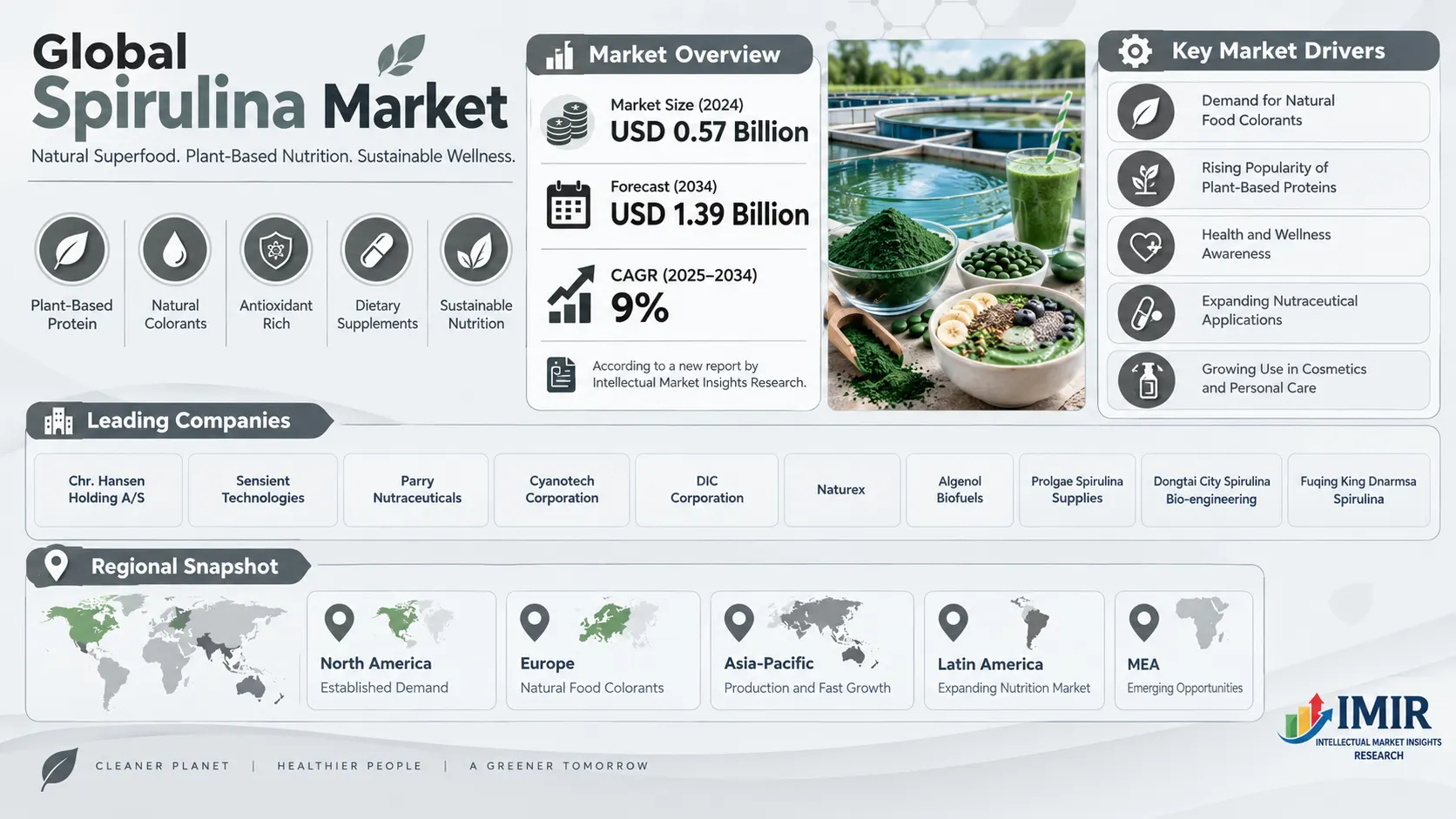
Global Spirulina Market: Size, Leading Companies, Trends and Outlook (2025–2034)
Note on sources: Market size and CAGR are taken from the Intellectual Market Insights Research (IMIR) Spirulina Market report (imi-000011): USD 0.57 billion in 2024, USD 0.63 billion in 2025, USD 1.39 billion by 2034, CAGR 9% (2025–2034). IMIR's regional share figures are placeholders on the report page, so the regional section is qualitative. Company facts were checked against public sources up to October 2026. Where a company does not publish figures, this blog says "Not publicly disclosed."
Introduction
Market Overview and Forecast: According to IMIR, the global spirulina market was valued at USD 0.57 billion in 2024 and USD 0.63 billion in 2025, and is projected to reach USD 1.39 billion by 2034, growing at a CAGR of 9% over 2025–2034.
Spirulina is a blue-green microalga (mainly Arthrospira platensis and Arthrospira maxima) grown in open ponds or controlled systems. It is rich in protein, vitamins and the blue pigment phycocyanin, and it is sold as powder, tablets and liquid extracts for food and beverages, dietary supplements, and cosmetics and personal care.
Two things are driving the industry's growth. Consumers want plant-based protein and "superfood" supplements, and food makers are replacing synthetic dyes with natural ones. In 2026 the second driver became much stronger, because US regulators widened the approved uses of spirulina extract as a natural blue colour and set a goal to remove petroleum-based dyes from the food supply.
This blog covers the size of the market, what is driving growth, the companies named by IMIR, and the outlook to 2034.
Why the Spirulina Market Is Growing
1. Shift from synthetic to natural colours. In February 2026, the US FDA approved beetroot red and widened the permitted use of spirulina extract to most human foods (excluding infant formula and certain USDA-inspected products). The agency has said it wants petroleum-based dyes "eliminated from the US food system by January 2027," and many large food companies have pledged to follow. Spirulina blue is one of the few natural blues that works in confectionery, beverages, dairy and frostings.
2. Plant-based protein and "superfood" demand. Spirulina contains protein and micronutrients and fits vegan, vegetarian and wellness diets.
3. Dietary supplements. Spirulina tablets, powders and blended greens are a mainstream supplement category, supported by online sales.
4. Cosmetics and personal care. Spirulina extracts are used in skincare and as natural colourants in beauty products.
5. Sustainability. Spirulina needs less land and water than many protein crops and can be grown in non-arable regions, which suits sustainability-focused buyers.
6. Capacity expansion. Producers in Asia, the US and Europe are investing in new ponds and extraction plants, and in higher-purity phycocyanin.
7. Regulatory clarity. More approvals in the US, EU and Asia give food makers confidence to reformulate.
Companies Associated with the Spirulina Market
IMIR names 11 companies: Hansen Holding A/S, Sensient Technologies, Parry Nutraceuticals, Cyanotech, DIC Corporation, Naturex, Algenol Biofuels, Prolgae Spirulina Supplies, Dongtai City Spirulina Bio-engineering, Fuqing King Dnarmsa Spirulina and Fraken Biochem. Several of these have changed ownership or name, which is flagged in the profiles. Each is covered below in bullet form and then compared in a table.
| Company | HQ | Role | Latest Verifiable Point |
|---|---|---|---|
| DIC Corporation / Earthrise | Tokyo, Japan / California, USA | Largest spirulina grower; LINABLUE colourant | Part of Sun Chemical Food & Nutrition Group (2021) |
| Sensient Technologies | Milwaukee, USA | Colour formulation and stabilisation | Sources extract; revenue not disclosed |
| Parry Nutraceuticals | Chennai, India | Spirulina and phycocyanin grower | Part of EID Parry; revenue not disclosed |
| Cyanotech | Kailua-Kona, USA | Spirulina and astaxanthin | FQ2 2026 net sales USD 6.98M (+19.3%) |
| Chr. Hansen (Hansen Holding) | Denmark | Former natural colours supplier | Merged into Novonesis (2024); colours now Oterra |
| Naturex | Avignon, France | Plant extracts | Acquired by Givaudan (2018) |
| Algenol Biofuels | Fort Myers, USA | Algae biotechnology | Status unconfirmed |
| Dongtai City Spirulina | Jiangsu, China | Spirulina producer | Revenue not disclosed |
| Fuqing King Dnarmsa | Fujian, China | Spirulina / phycocyanin producer | Revenue not disclosed |
| Prolgae Spirulina Supplies | India | Spirulina supplier | Unverified |
| Fraken Biochem | Not confirmed | Not confirmed | Unverified |
Competitive Landscape
- Two different businesses. Supplement spirulina (powder, tablets) is a competitive, price-driven market with many Asian producers. Phycocyanin extract used as a food colour is a smaller, higher-value, more technical business led by a few companies (DIC/Earthrise, Parry, GNT, Chinese extractors).
- Vertical integration matters. DIC controls farming, extraction and branded products, while others, such as Sensient, add value by stabilising and blending extract bought from growers.
- Asian producers lead on volume. China and India have large pond capacity and low costs, while US and Hawaiian producers compete on quality, traceability and brand.
- Consolidation. Several IMIR-listed companies have been absorbed or restructured: Naturex into Givaudan, Chr. Hansen into Novonesis, and the colour business of Chr. Hansen into Oterra.
- Competing natural blues. Galdieria extract (Fermentalg), butterfly pea flower and gardenia blue were also approved or expanded by the FDA in 2025, so spirulina faces new competitors in the natural-blue space.
- Technical challenge. Phycocyanin is sensitive to heat, light and acidity, which limits some uses. Companies with better stabilisation technology win business.
- Quality and contamination. Buyers insist on certified farms (for example FSSC 22000) and low contaminant levels, particularly microcystins.
Regional Analysis
IMIR's regional percentages are placeholders. The report page describes Asia-Pacific (with China, Indonesia and Korea) and Europe (with France and the UK) as leading markets, with Asia-Pacific the fastest growing and North America currently dominant in value.
North America is the largest market for supplements and a key market for natural colours. The FDA's 2026 decisions on spirulina extract and its push to remove synthetic dyes by January 2027 strongly support demand.
Europe has strong demand for natural colours and organic supplements. The EU already permits spirulina-based colours, and companies such as GNT, Oterra and Döhler are major buyers and suppliers.
Asia-Pacific is the main production base and the fastest-growing consumption region. China and India have large cultivation capacity; Japan has long-established spirulina and phycocyanin use (DIC, San-Ei Gen); and demand is rising in Korea, Indonesia and the rest of ASEAN.
Latin America. Growing interest in supplements and natural foods, with Brazil and Mexico as the main markets, and some cultivation activity.
Middle East & Africa. Small but developing, with interest in sustainable protein and in desert-climate spirulina farming.
Emerging Trends
- Natural blue colour boom. Regulatory pressure on synthetic dyes is pushing spirulina extract into candy, drinks, dairy, cereal and baked goods.
- Better stability. Suppliers develop emulsions, microencapsulation and blends that survive heat, light and low pH.
- Phycocyanin in new uses. Cosmetics, nutraceuticals and diagnostics use high-purity phycocyanin.
- Protein and functional foods. Spirulina is added to bars, smoothies, pasta and plant-based products.
- Clean-label and "no artificial colours" claims. The FDA's 2026 decision allowing "no artificial colors" on products with natural dyes helps brands market the switch.
- Precision fermentation and alternatives. Competitors such as Galdieria blue (grown in bioreactors) and butterfly pea add pressure.
- Certified and traceable supply. Food safety standards, non-GMO and organic labels are procurement requirements.
- Local production. Companies in North America and Europe expand local cultivation to reduce tariffs and supply risk.
Future Outlook (2025–2034)
IMIR's forecast covers 2025–2034: USD 0.63 billion in 2025 to USD 1.39 billion in 2034, at a 9% CAGR.
- 2025–2027. Regulatory changes in the US and growing reformulation by major food brands lift demand for spirulina colour. Supplement sales grow steadily.
- 2028–2030. Capacity expansions in Asia and the US come online. Competition among natural blues intensifies, and stabilisation technology becomes the main differentiator.
- 2031–2034. The market matures around colours, protein ingredients and cosmetics, with larger integrated suppliers and more regional production.
Risks: competition from other natural blues, heat/light/pH limits on phycocyanin, contamination and quality scandals, tariffs and trade barriers, weather and cultivation risk, and price pressure from low-cost producers.
Opportunities: food-colour reformulation, high-purity phycocyanin, protein foods, cosmetics, and regional production for local supply.
FAQ
Q1. How big is the global spirulina market?
IMIR values it at USD 0.57 billion in 2024 and USD 0.63 billion in 2025, rising to USD 1.39 billion by 2034.
Q2. What is the expected growth rate?
A CAGR of 9% from 2025 to 2034, per IMIR.
Q3. Who are the leading companies?
IMIR names Hansen Holding, Sensient, Parry Nutraceuticals, Cyanotech, DIC, Naturex, Algenol Biofuels, Prolgae, Dongtai City Spirulina, Fuqing King Dnarmsa and Fraken Biochem. DIC (with Earthrise) is widely described as the largest producer.
Q4. What is spirulina used for?
Food and beverages (including natural blue colour), dietary supplements, and cosmetics and personal care.
Q5. Which region is growing fastest?
Asia-Pacific, while North America is currently dominant in value.
Q6. Why is spirulina blue in demand?
Food makers are replacing synthetic dyes. The FDA widened permitted uses of spirulina extract in February 2026 and wants synthetic dyes phased out by January 2027.
Q7. What are the main forms?
Powder, tablet and liquid, per IMIR.
Q8. What are the challenges?
Stability of phycocyanin, competing natural blues, contamination risks, and price competition from large Asian producers.
Q9. Have any of the IMIR-listed companies changed?
Yes. Chr. Hansen merged into Novonesis (2024), Naturex was acquired by Givaudan (2018), and Algenol's current status could not be confirmed.
Conclusion
Spirulina is a small but fast-growing market that sits where plant-based nutrition and natural colours meet. IMIR projects growth from USD 0.63 billion in 2025 to USD 1.39 billion by 2034, a 9% CAGR. The strongest near-term driver is the move away from synthetic dyes, supported by the FDA's 2026 decisions, along with steady demand for supplements and protein products.
For producers, the opportunity lies in certified quality, stable phycocyanin and integrated supply from pond to colour. For food and beverage brands, spirulina extract is now one of the most practical natural blues, but it should be tested for stability and compared with alternatives before reformulation.