
Top 20 Companies in the Global Vacuum Packaging Market Driving Industry Growth in 2026
Author:
Intellectual Market Insights Research
Published Date:
23 Jun 2026
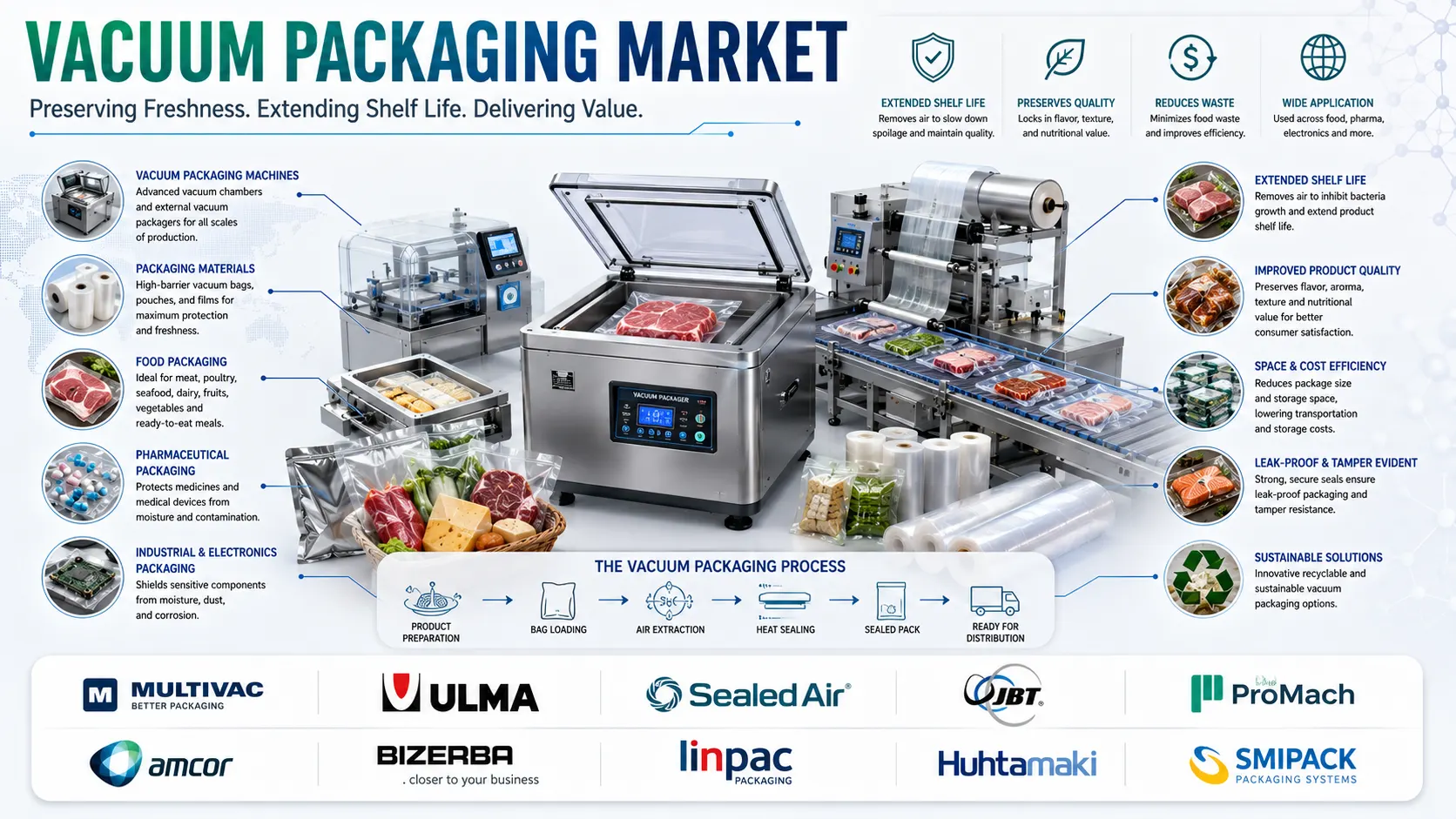
What Is the Vacuum Packaging Market and Why Does It Matter in 2026?
In an era of global supply chains, food safety imperatives, and rising consumer expectations for product freshness, vacuum packaging has become a cornerstone of modern packaging technology. By removing oxygen from within sealed packages before sealing them shut, vacuum packaging dramatically extends product shelf life, inhibits aerobic microbial growth, reduces volume, and enhances the structural rigidity of flexible packages — making it indispensable across the food, pharmaceutical, consumer goods, and industrial sectors.
According to research by Intellectual Market Insights Research, the global vacuum packaging market was valued at USD 28.17 billion in 2021 and is anticipated to reach USD 36.25 billion by 2028, registering a compound annual growth rate (CAGR) of 5.1% from 2021 to 2028. Updated estimates place the 2025 market size at approximately USD 30.38 billion, with forecasts suggesting it will surpass USD 36.49 billion by 2030. Some analysts project even stronger growth trajectories, with the market reaching USD 24.40 billion in a more narrowly defined segment by 2033 at a CAGR of 8.4%.
The industry's importance cannot be overstated. With nearly one-third of all food produced globally lost to spoilage each year — a figure representing both a humanitarian and economic crisis — vacuum packaging technology offers one of the most effective and scalable solutions to food waste reduction. For pharmaceutical manufacturers, vacuum packaging ensures product sterility and regulatory compliance. For electronics companies, it protects sensitive components from humidity and corrosion during long-distance shipping. For consumers, it means fresher food, safer medicines, and longer-lasting products on the shelf.
Key growth drivers powering this market in 2026 include rapid expansion in packaged and processed food consumption, particularly in emerging economies across Asia Pacific and Latin America; tightening food safety regulations worldwide; the e-commerce boom that demands packaging solutions capable of surviving extended transit periods; growing awareness of food waste among consumers and governments; and accelerating investment in automation and smart packaging technologies by both incumbent industry leaders and innovative new entrants.
This article profiles the top 20 companies in the global vacuum packaging market, examines the competitive landscape, regional dynamics, emerging trends, and provides a detailed future outlook through 2035 — giving investors, procurement managers, researchers, and industry professionals the authoritative intelligence they need to navigate this rapidly evolving market.
Market Overview
Global Vacuum Packaging Market at a Glance
|
Market Size (2025) |
$30.4B |
|
CAGR (2021–2028) |
5.1% |
|
Projected Value (2030) |
$36.5B |
|
North America Market Share |
35% |
|
APAC Growth CAGR |
10%+ |
|
Vacuum Pouches Segment Share |
43% |
|
Parameter |
Details |
|---|---|
|
Market Size (2021) |
USD 28.17 Billion |
|
Market Size (2025) |
USD 30.38 Billion |
|
Market Size (2028) |
USD 36.25 Billion (Projected) |
|
CAGR (2021–2028) |
5.1% |
|
Fastest Growing Region |
Asia Pacific (CAGR 10%+) |
|
Largest Regional Market |
North America (~35% share) |
|
Dominant Application |
Food & Beverages (>50% of revenue) |
|
Dominant Pack Type |
Flexible Packaging / Vacuum Pouches (43%) |
|
Dominant Material |
Polyethylene (PE) |
|
Key Growth Driver |
Rising demand for packaged food and food safety regulations |
|
Key Challenge |
High machinery costs and raw material price volatility |
|
Key Opportunity |
Sustainable / recyclable vacuum packaging solutions |
|
Key Emerging Trend |
Smart packaging, IoT integration, automation |
|
Forecast Period |
2022–2028 (base report) / 2026–2035 (extended outlook) |
|
Market Structure |
Highly fragmented; Tier 1 leaders dominate via M&A and R&D |
Why Is the Vacuum Packaging Market Growing So Fast?
1. Soaring Packaged Food Consumption
The global shift toward convenience food — driven by urbanization, dual-income households, and changing dietary habits — is the single most powerful demand engine for the vacuum packaging market. Millennials and Gen Z consumers prefer pre-packaged meals, ready-to-eat products, and processed proteins, all of which require high-performance packaging that preserves taste, texture, and safety. The Food & Beverages sector accounts for more than 50% of total vacuum packaging market revenue.
2. Food Safety Regulations and Standards
Governments worldwide are tightening food safety standards. In May 2023, the U.S. FDA issued a comprehensive guidance document on the use of vacuum packaging for food, including safety, efficacy, and labeling requirements. The EU's Farm-to-Fork Strategy and Extended Producer Responsibility (EPR) mandates are driving simultaneous demand for both high-barrier packaging and sustainable materials. These regulatory tailwinds force the food industry's hand toward technology-forward vacuum packaging solutions.
3. E-Commerce Expansion
With global e-commerce still growing at a double-digit pace, packaging solutions that protect goods across longer, more complex supply chains are in greater demand than ever. Vacuum packaging's ability to reduce volume, prevent breakage, and maintain product integrity over extended transit periods makes it ideally suited to the e-commerce era.
4. Sustainability Investment
Eco-conscious consumers and investors are pushing manufacturers to innovate sustainable vacuum packaging. In August 2024, Mondi unveiled the world's first mono-material vacuum packaging solution for coffee producer Paulig at FACHPACK 2024. Amcor's 2024 launch of its AmPrima™ PE Plus fully recyclable, high-barrier vacuum pouches generated a 16% revenue uplift in Europe in 2025. These developments confirm that sustainability is no longer a niche concern but a core commercial strategy.
5. Asia Pacific Industrialization
Rapid urbanization and rising middle-class incomes across China, India, Southeast Asia, and the broader Asia Pacific region are fueling unprecedented demand for modern food processing and packaging infrastructure. The APAC vacuum packaging market is projected to grow at a CAGR exceeding 10% through 2030, making it the most important growth frontier for industry players.
6. Pharmaceutical and Healthcare Demand
The global pharmaceutical packaging market's ongoing expansion — driven by aging populations, pandemic preparedness investments, and biotechnology breakthroughs — is creating sustained demand for high-integrity vacuum packaging solutions that guarantee sterility, extend drug shelf life, and meet regulatory compliance requirements across multiple jurisdictions.
Top 20 Companies in the Global Vacuum Packaging Market (2026)
|
# |
Company |
HQ |
Founded |
Key Focus |
|---|---|---|---|---|
|
1 |
Sealed Air Corporation |
Charlotte, NC, USA |
1957 |
Food & Industrial Packaging |
|
2 |
Amcor plc |
Zürich, Switzerland |
1860 |
Flexible & Rigid Packaging |
|
3 |
Berry Global Inc. |
Evansville, IN, USA |
1967 |
Consumer & Industrial Packaging |
|
4 |
Multivac Group |
Wolfertschwenden, Germany |
1961 |
Packaging Machinery |
|
5 |
Coveris Holdings S.A. |
Luxembourg |
2013 |
Flexible Food Packaging |
|
6 |
Winpak Ltd. |
Winnipeg, Canada |
1977 |
Food & Medical Packaging |
|
7 |
Mondi Group |
Vienna, Austria |
1967 |
Sustainable Packaging & Paper |
|
8 |
Pactiv Evergreen Inc. |
Lake Forest, IL, USA |
1965 |
Food Packaging Products |
|
9 |
Huhtamaki Oyj |
Espoo, Finland |
1920 |
Consumer Food Packaging |
|
10 |
Schur Flexibles Group |
Vienna, Austria |
1846 |
Flexible Film Packaging |
|
11 |
CVP Systems Inc. |
Wood Dale, IL, USA |
1986 |
Automated Packaging Systems |
|
12 |
ULMA Packaging |
Oñati, Spain |
1961 |
Packaging Machines & Films |
|
13 |
Orics Industries, Inc. |
Farmingdale, NY, USA |
1981 |
Tray-Sealing Machinery |
|
14 |
Linpac Packaging Ltd. |
Leeds, United Kingdom |
1959 |
Trays & Films for Food |
|
15 |
Multisorb Technologies |
Buffalo, NY, USA |
1961 |
Active Packaging / Oxygen Absorbers |
|
16 |
Constantia Flexibles |
Vienna, Austria |
2010 |
Flexible Pharma & Food Packaging |
|
17 |
Clondalkin Group |
Amsterdam, Netherlands |
1951 |
Specialty Packaging Films |
|
18 |
Proseal UK Ltd. |
Adlington, UK |
1998 |
Tray-Sealing Machines |
|
19 |
Printpack Inc. |
Atlanta, GA, USA |
1956 |
Flexible Packaging Materials |
|
20 |
Swiss Pac Pvt. Ltd. |
New Delhi, India |
1994 |
Flexible Pouches & Bags |
1. Sealed Air Corporation
Charlotte, NC, USA Founded: 1957 Global Operations
Sealed Air Corporation is arguably the most iconic name in the global vacuum packaging market, best known for inventing Bubble Wrap and later pioneering the Cryovac® brand of high-performance food packaging. With operations spanning more than 60 countries and annual revenues exceeding USD 5 billion, Sealed Air maintains a commanding position as a Tier 1 market leader. The company's vacuum packaging solutions serve the meat, poultry, seafood, dairy, and produce industries, as well as specialty pharmaceutical and industrial applications.
In 2024, Sealed Air entered a landmark partnership with Plastic Energy to advance circular packaging, focusing on converting used plastic packaging into recycled feedstock for new vacuum packaging products — a strategic pivot that directly addresses rising pressure from regulators and environmentally conscious retail customers. The company's proprietary Cryovac® Darfresh® skin packaging technology extends the shelf life of fresh meat and seafood by up to 15 days compared to conventional packaging.
Sealed Air's strategic advantages include its unrivaled intellectual property portfolio, deep integration across the global food supply chain, and its growing investment in intelligent packaging systems that combine IoT sensors with traditional vacuum sealing capabilities.
Key Product: Cryovac® Vacuum Shrink Bags
2. Amcor plc
Zürich, Switzerland Founded: 1860 50+ Countries
Amcor plc is one of the world's largest packaging companies and a dominant force in the vacuum packaging segment, operating across flexible packaging, rigid containers, and specialty cartons. Headquartered in Switzerland and listed on both the NYSE and ASX, Amcor serves customers in food, beverage, pharmaceutical, medical, home, and personal care end markets. In 2019, Amcor significantly expanded its scale and capabilities through the landmark acquisition of Bemis Company Inc., creating an industry-leading global packaging platform.
Recent innovations include the 2024 launch of AmPrima™ PE Plus, a recycle-ready flexible packaging solution engineered for vacuum packaging applications. This high-barrier material addresses the growing demand for packaging that is both functionally superior and recyclable, generating a reported 16% revenue uplift in European markets in 2025. In May 2023, Amcor acquired New Zealand-based Moda Systems, a specialist in automated modular vacuum packing for meat, poultry, and dairy, further cementing its machinery-to-materials integration strategy.
Amcor's commitment to making all its packaging reusable, recyclable, or compostable by 2025 (now extended to 2030 with enhanced targets) positions it uniquely in an era when sustainability and performance must coexist.
Key Product: AmPrima™ PE Plus Recycle-Ready Vacuum Film
3. Berry Global Inc.
Evansville, IN, USA Founded: 1967 40+ Countries
Berry Global Inc. is a Fortune 500 global manufacturer and marketer of plastic packaging products, generating annual revenues above USD 12 billion. In the vacuum packaging segment, Berry is a significant producer of barrier films, flexible packaging materials, and specialty pouches that serve food, pharmaceutical, and consumer goods applications worldwide. The company's broad product range includes vacuum-barrier films with oxygen-scavenging properties, co-extruded multilayer films, and custom thermoformed trays.
Berry's competitive edge lies in its vertical integration — the company controls raw material compounding, film extrusion, converting, and printing within a unified supply chain, giving it cost advantages and quality consistency that smaller competitors cannot easily replicate. Its global manufacturing network of over 290 facilities in more than 40 countries ensures supply chain resilience and proximity to key customer markets.
In response to sustainability mandates, Berry is investing heavily in recycled-content materials and circular packaging design, including post-consumer recycled (PCR) content integration in vacuum packaging films.
Key Product: Barrier Vacuum Films & Multilayer Flexible Packaging
4. Multivac Group (MULTIVAC Sepp Haggenmüller SE & Co. KG)
Wolfertschwenden, Germany Founded: 1961 85+ Countries
Multivac Group is the world's leading manufacturer of vacuum packaging machinery, specializing in thermoforming packaging machines, tray sealers, chamber machines, and automated packaging lines. Privately held and headquartered in Bavaria, Germany, Multivac serves customers across the food, life science, and industrial sectors with fully integrated packaging solutions that combine machine engineering, packaging materials, labeling, quality inspection, and automation in a single ecosystem.
A landmark moment came in Q1 2024 when Multivac inaugurated a new manufacturing facility in India to meet rising demand in the region's food processing and export sectors — a strategic move that positions the company at the heart of the fastest-growing regional vacuum packaging market. With a presence in over 85 countries and nearly 6,000 employees, Multivac's service and applications network ensures customers in virtually every geography receive local technical support.
Multivac's investment in digital solutions, including its MULTIVAC Pack Pilot® software for packaging optimization and IoT-enabled machine monitoring, makes it a pioneer at the intersection of traditional vacuum packaging machinery and Industry 4.0.
Key Product: MULTIVAC R 535 Thermoforming Packaging Machine
5. Coveris Holdings S.A.
Luxembourg Founded: 2013 Europe & Americas
Coveris Holdings is a major European flexible packaging company with significant operations in North America, manufacturing a wide array of vacuum packaging films, pouches, and barrier laminates for the food industry. The company serves meat, dairy, pet food, produce, and confectionery segments with high-barrier flexible films that combine excellent oxygen and moisture barrier properties with excellent sealability and machinability. Coveris is particularly strong in skin vacuum packaging solutions for fresh meat and seafood.
Coveris differentiates itself through its focus on recyclable monomaterial structures and barrier coating technologies that allow it to reduce plastic use while maintaining equivalent or superior protective properties. The company's European manufacturing base positions it advantageously for customers navigating EU sustainability regulations and Extended Producer Responsibility (EPR) requirements.
Key Product: High-Barrier Skin Packaging Films
6. Winpak Ltd.
7. Mondi Group
8. Pactiv Evergreen Inc.
9. Huhtamaki Oyj
10. Schur Flexibles Group
.
.
20. Swiss Pac Pvt. Ltd.
Competitive Landscape of the Global Vacuum Packaging Market
The global vacuum packaging market is characterized by a highly fragmented structure with intense competition on both price and innovation dimensions. Tier 1 leaders — principally Sealed Air Corporation, Amcor plc, and Berry Global Inc. — leverage superior technology access, massive production scale, global distribution networks, and continuous R&D investment to maintain competitive advantages that smaller players cannot readily replicate.
Tier 2 companies such as Coveris Holdings and Pactiv Evergreen compete by carving out specialized niches, serving specific geographies or product categories with differentiated solutions. Tier 3 consists of regional specialists and custom converters that compete primarily on customization capability, rapid response times, and price.
The merger and acquisition landscape has been active, with Amcor's 2019 acquisition of Bemis Company and 2023 acquisition of Moda Systems being landmark deals. Mondi's strategic investments in sustainable innovations and MULTIVAC's facility expansions into India reflect the broader trend of global players positioning to capture APAC growth.
Innovation strategies center on four axes: (1) sustainable and recyclable material development, (2) smart packaging integration (IoT, freshness sensors), (3) automation and labor efficiency in packaging machinery, and (4) customized solutions for niche end markets including organic food, specialty pharmaceuticals, and high-value electronics. Companies unwilling or unable to invest across these dimensions risk being disrupted by agile innovators.
Regional Market Analysis: Where Is Vacuum Packaging Growing?
North America
The largest regional market, accounting for approximately 35% of global share. The U.S. alone holds around 60% of regional market share. Driven by stringent FDA food safety standards, a mature retail and pharmaceutical ecosystem, and high consumer demand for packaged convenience foods. Key players: Sealed Air, Amcor, Berry Global, Pactiv Evergreen, CVP Systems.
Europe
The second-largest market, characterized by rigorous EU sustainability regulations, EPR mandates, and plastic packaging taxes in countries like the UK. Germany (CAGR 4.8%) and UK (CAGR 4.6%) are leading sub-markets. European players including Mondi, ULMA, Schur Flexibles, and Coveris are pioneering recyclable vacuum solutions.
Asia Pacific
The fastest-growing region, projected to expand at a CAGR exceeding 10% through 2030. Rapid urbanization, rising middle-class incomes, expanding food processing industries, and government food safety modernization in China, India, Japan, South Korea, and ASEAN nations are key growth catalysts. MULTIVAC's new India facility signals the region's strategic importance.
Latin America
A growth market anchored by export-oriented food processing in Brazil (CAGR 4.2%), Argentina, Colombia, and Mexico. Brazil's dominant meat export industry drives significant demand for Cryovac®-type vacuum shrink bags. Growing middle-class food retail adoption is an additional long-term driver.
Middle East & Africa
An emerging but rapidly developing market, particularly in Saudi Arabia, UAE, Egypt, and South Africa. Government modernization programs in food processing, a growing hospitality sector, and rising imports of packaged food are key growth enablers. The halal food sector's strict quality standards make vacuum packaging particularly relevant.
Emerging Trends Reshaping the Vacuum Packaging Industry
- Sustainable & Recyclable Materials: The race to develop fully recyclable, monomaterial vacuum packaging structures is the defining innovation challenge of this decade. Regulatory pressure, retail sustainability commitments, and consumer awareness are driving material scientists and packaging engineers to rethink conventional multilayer barrier laminates that are currently difficult or impossible to recycle.
- Automation & Robotics Integration: Labor shortages in food processing and pharmaceutical manufacturing are accelerating the adoption of automated vacuum packaging systems. CVP Systems, Multivac, and ULMA are all investing in robotic pick-and-place integration, vision systems, and fully automated packaging lines that can operate 24/7 with minimal human intervention.
- Smart Packaging & IoT: Embedded freshness indicators, time-temperature sensors, and QR-code-linked digital product passports are being integrated into vacuum packaging at scale — particularly in premium food and pharmaceutical segments. IoT-enabled machine performance tracking is simultaneously streamlining packaging line maintenance and reducing unplanned downtime.
- Active Packaging Technologies: The combination of vacuum packaging with oxygen absorbers, CO? emitters, and antimicrobial agents — championed by Multisorb Technologies — is delivering dramatic shelf life extensions for bakery, snack, and specialty food products without the need for chemical preservatives.
- Bio-based and Compostable Materials: Although still at early commercialization stages, bio-based polymers such as PLA and PHA are being explored as alternatives to conventional petroleum-based vacuum packaging films for applications where a fully compostable packaging system is needed.
- Digital Supply Chain Integration: Packaging lines are increasingly connected to enterprise resource planning (ERP) and supply chain management systems, enabling real-time packaging optimization, waste reduction, and just-in-time production scheduling — reducing material waste and working capital requirements simultaneously.
Future Outlook: Vacuum Packaging Market 2026–2035
The global vacuum packaging market's trajectory toward 2035 is defined by three converging megatrends: the sustainability imperative, the digital transformation of manufacturing, and the democratization of food processing in emerging economies.
From a market size perspective, conservative estimates project the market surpassing USD 40 billion by 2033, with growth potentially accelerating if circular economy policies drive mandatory adoption of vacuum packaging as a food waste reduction tool. Investments in the sector are expected to intensify, particularly in Asia Pacific, where government-backed modernization of food processing infrastructure creates a once-in-a-generation market opportunity for both equipment manufacturers and materials suppliers.
Technology transformation will be characterized by the convergence of vacuum packaging with AI-driven quality inspection, predictive maintenance systems for packaging machinery, blockchain-backed traceability, and personalized packaging formats driven by on-demand manufacturing. The long-term structural shift away from centralized food processing toward distributed, localized food production models — particularly relevant in emerging markets — will require new generations of smaller, more versatile, and more affordable vacuum packaging solutions suited to small and medium-scale food businesses.
For investors, the vacuum packaging market represents a defensive yet growth-oriented opportunity: defensive because food packaging demand is structurally linked to non-discretionary food consumption, and growth-oriented because massive addressable markets in Asia, Africa, and Latin America remain significantly underpenetrated relative to North American and European standards. The companies best positioned to capture this opportunity will be those that successfully combine materials innovation, digitalization, and emerging-market distribution capabilities.
Frequently Asked Questions — Vacuum Packaging Market 2026
Q1 What is the current size of the global vacuum packaging market?
The global vacuum packaging market was valued at approximately USD 30.38 billion in 2025. It was valued at USD 28.17 billion in 2021 and is projected to reach USD 36.25–36.49 billion by 2028–2030, growing at a CAGR of 5.1%.
Q2 Who are the leading companies in the vacuum packaging market?
The top companies include Sealed Air Corporation, Amcor plc, Berry Global Inc., Multivac Group, Coveris Holdings S.A., Winpak Ltd., Mondi Group, Pactiv Evergreen, Huhtamaki Oyj, Schur Flexibles, CVP Systems, and ULMA Packaging, among others. Sealed Air, Amcor, and Berry Global are recognized as Tier 1 market leaders.
Q3 Which region dominates the vacuum packaging market?
North America holds the largest regional market share, accounting for approximately 35% of global revenue. Within North America, the United States accounts for roughly 60% of regional market share. However, Asia Pacific is the fastest-growing region, with a CAGR exceeding 10%.
Q4 What is the CAGR of the vacuum packaging market?
The vacuum packaging market is growing at a CAGR of 5.1% from 2021 to 2028, according to Intellectual Market Insights Research. Some analyses of specific sub-segments and extended forecast periods project higher CAGRs of up to 8.4%.
Q5 What are the main applications of vacuum packaging?
The primary applications are Food & Beverages (the largest segment, accounting for over 50% of market revenue), Pharmaceuticals, Industrial Goods, and Consumer Goods. Within food, fresh meat, poultry, seafood, dairy, and produce are the dominant product categories.
Q6 What materials are used in vacuum packaging?
Common materials include Polyethylene (PE) (the most widely used), Polyamide (PA/Nylon), Ethylene Vinyl Alcohol (EVOH) for oxygen barrier, Polyester (PET), Polypropylene (PP), Polyvinyl Chloride (PVC), and paper-based materials for sustainable applications.
Q7 What are the key growth drivers of the vacuum packaging market?
Key drivers include rising demand for packaged and convenience food, stricter food safety regulations, expansion of e-commerce requiring transit-durable packaging, the global fight against food waste, pharmaceutical industry growth, and accelerating investment in automation and smart packaging technologies.
Q8 What types of machinery are used in vacuum packaging?
Q9 What challenges does the vacuum packaging market face?
Q10 Which pack type dominates the vacuum packaging market?
Q11 What is the fastest-growing region in the vacuum packaging market?
Q12 What recent innovations have occurred in the vacuum packaging market?
Q13 How is the vacuum packaging market segmented by process?
Q14 What is the market outlook for vacuum packaging through 2035?
Q15 What sustainability trends are shaping the vacuum packaging market?
Conclusion: Vacuum Packaging Is the Future of Preservation
The global vacuum packaging market stands at an inflection point. With a solid market size of USD 30.38 billion in 2025 and a clear trajectory toward USD 36+ billion by 2028, the industry is being simultaneously propelled by the timeless need to preserve food and pharmaceuticals and reshaped by a sustainability revolution that is rewriting the rules of materials science and packaging design.
The top companies profiled in this article — from Sealed Air's iconic Cryovac® technology to Amcor's recyclable AmPrima™ films, Multivac's digitally connected packaging machinery to Mondi's monomaterial breakthroughs — represent the diversity of innovation happening across this market. Companies that successfully navigate the twin mandates of high-performance protection and environmental responsibility will define the next decade of the vacuum packaging industry.
For investors, procurement professionals, food manufacturers, and packaging engineers, the message is clear: vacuum packaging is not just growing — it is transforming. The companies that lead that transformation will shape how the world preserves, distributes, and enjoys its food, medicine, and goods for generations to come.