
Top Leading Companies in the T-Shirt Printing Machines Market
Author:
Intellectual Market Insights Research
Published Date:
03 Sep 2026
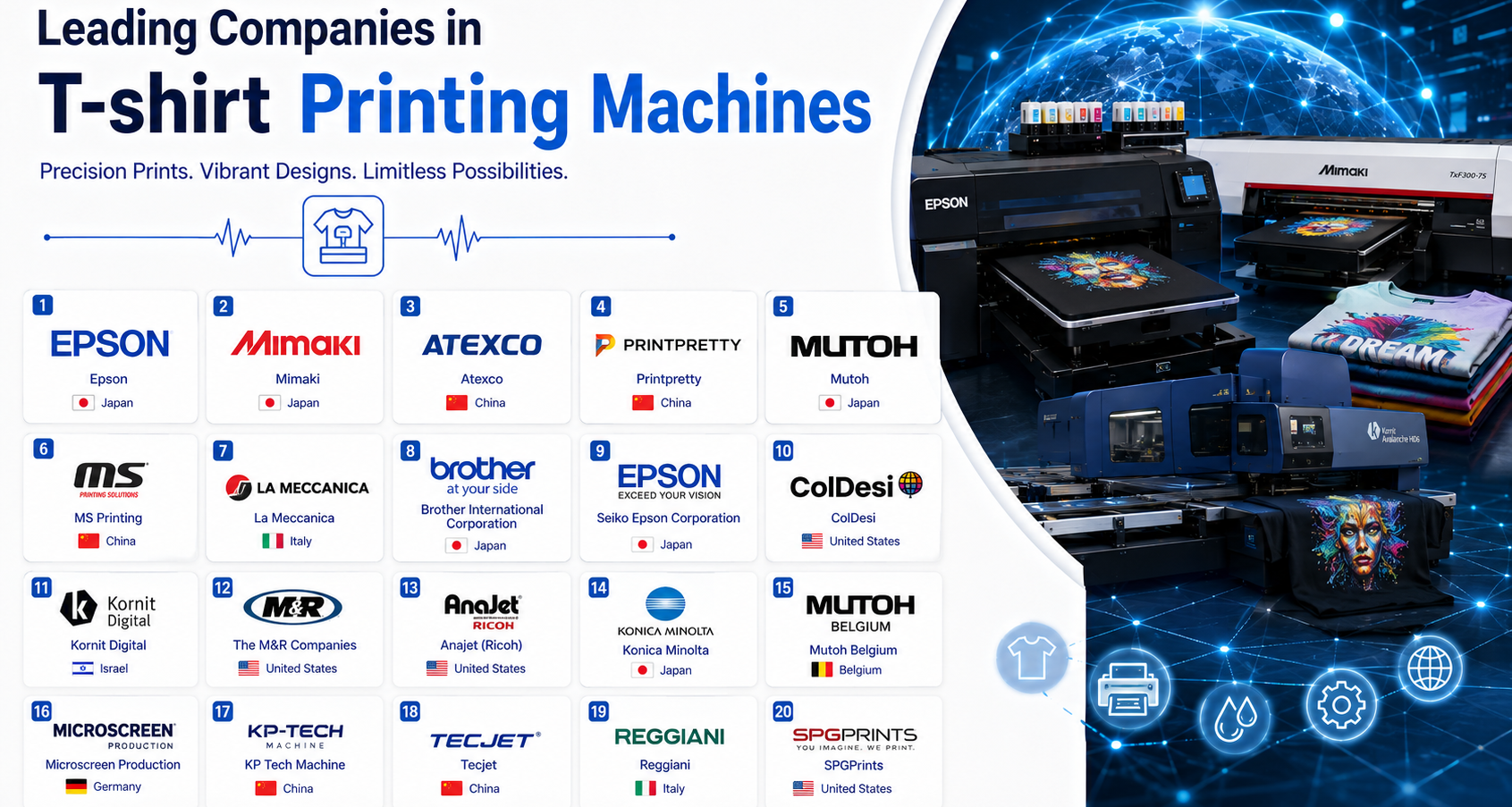
Top Companies in the World Offering T-shirt Printing Machines
T-shirt printing machines have evolved from manual screen presses into a diverse ecosystem of digital direct-to-garment (DTG), direct-to-film (DTF), sublimation, and hybrid printing systems, powering everything from mass-production apparel manufacturing to on-demand, single-unit custom printing for e-commerce sellers. The rise of print-on-demand business models, personalized fashion, and short-run manufacturing has pushed both established imaging giants and specialized digital textile printing companies to expand their garment printing portfolios.
The global T-shirt printing machines market was valued at USD 1.30 billion in 2025 and is projected to reach USD 2.42 billion by 2034, growing at a compound annual growth rate (CAGR) of 7.2% from 2025 to 2034. Growth is being driven by rising demand for customized and on-demand apparel, the continued shift from traditional screen printing toward digital DTG and DTF technologies, and expanding e-commerce and retail channels for personalized merchandise.
The competitive landscape blends large, diversified imaging and printer conglomerates such as Epson, Brother, and Konica Minolta with dedicated digital textile printing specialists like Kornit Digital, Mimaki, and The M&R Companies. This article provides a research-based analysis of the top companies shaping the global T-shirt printing machines market, their positioning, flagship offerings, and the regional and technological forces driving the industry forward.
Market Overview
|
Parameter |
Details |
|---|---|
|
Market Size (2025) |
USD 1.30 Billion |
|
Projected Market Size (2034) |
USD 2.42 Billion |
|
CAGR (2025–2034) |
7.2% |
|
Base Year |
2024 |
|
Historic Year |
2018–2023 |
|
Forecast Period |
2025–2034 |
|
Leading Region |
North America |
|
Fastest-Growing Region |
Asia-Pacific |
|
Key Segments (by Type) |
Desktop Type, Industrial Type, Mobile Type |
|
Key Segments (by Application) |
Manufacturing, Logistics, Retail, Other |
Why the T-shirt Printing Machines Market Is Growing
1. Rise of On-Demand and Personalized Apparel
Growing consumer demand for personalized, short-run, and made-to-order apparel is driving adoption of digital printing technologies that allow single-unit production without the setup costs and minimum order quantities required by traditional screen printing.
2. Shift from Screen Printing to Digital DTG/DTF Technologies
Digital direct-to-garment and direct-to-film printing systems are steadily displacing traditional analog screen printing for shorter production runs, offering faster turnaround, lower waste, and greater design flexibility for print shops and brand owners.
3. E-commerce and Print-on-Demand Business Growth
The expansion of online marketplaces and print-on-demand platforms is fueling demand for industrial-grade garment printing equipment capable of handling variable order volumes efficiently.
4. Industrial Type Adoption for High-Volume Production
Manufacturing and large-scale contract printing operations continue to invest in industrial-type printing machines that combine higher throughput with digital design flexibility, supporting the segment's role as a core driver of market revenue.
5. Advances in Ink and Printhead Technology
Continuous innovation in pigment inks, printhead speed, and automated maintenance systems is improving print quality, durability, and production efficiency, encouraging upgrade cycles among existing print shop operators.
6. Retail and Logistics Channel Expansion
Growing retail and logistics applications for on-site and near-site garment decoration, from promotional merchandise to branded uniforms, are broadening the addressable market beyond traditional apparel manufacturers.
Top 10 Companies in the T-shirt Printing Machines Market
- Seiko Epson Corporation (Epson)
- Kornit Digital
- Mimaki Engineering
- Brother International Corporation
- The M&R Companies
- Konica Minolta
- Mutoh
- Atexco
- SPGPrints
- Zimmer
1. Seiko Epson Corporation (Epson)
|
Category |
Details |
|---|---|
|
Company Name |
Seiko Epson Corporation |
|
Headquarters |
Suwa, Nagano, Japan |
|
Founded |
1942 |
|
Employees |
Approx. 75,000 |
|
Revenue |
Approx. USD 9.1 Billion (total company revenue across Printing Solutions, Visual Communications, and Manufacturing-Related and Wearables segments) |
|
Company Overview |
Epson is one of the world's largest printing technology companies, offering digital textile and garment printing systems as part of its broader Printing Solutions segment, which generates the majority of its revenue. |
|
Key Products |
Epson SureColor F-Series direct-to-garment printers, alongside its broader digital textile printing systems built on Epson's inkjet print head technology. |
|
Market Position |
A leading global player in digital garment and textile printing, leveraging its deep inkjet technology heritage and vast global distribution network. |
|
Recent Developments |
Continues to expand its printing solutions portfolio through targeted acquisitions such as Fiery, strengthening workflow and color-management software across its industrial and commercial printing lines. |
|
Strategic Advantages |
Proprietary inkjet print-head technology, an extensive global sales and service network, and deep integration between hardware, ink consumables, and workflow software. |
|
Category |
Details |
|---|---|
|
Company Name |
Kornit Digital Ltd. |
|
Headquarters |
Rosh HaAyin, Israel (global); Englewood, New Jersey, USA (corporate/Americas) |
|
Founded |
2002 |
|
Employees |
Approx. 700 |
|
Revenue |
Approx. USD 204 Million (2024) |
|
Company Overview |
Kornit Digital is a dedicated leader in sustainable, on-demand direct-to-garment and roll-to-roll digital textile printing, serving decorators, brand owners, and mass-production print-on-demand fulfillers. |
|
Key Products |
Atlas MAX Plus and Presto MAX digital printing systems, NeoPigment ink and consumables, and the Apollo mass-production platform with integrated K-RIP raster image processing. |
|
Market Position |
Widely regarded as the global leader in sustainable, industrial-scale DTG and print-on-demand textile printing, particularly for fast-growing on-demand and mass-customization business models. |
|
Recent Developments |
Acquired PrintFactory to accelerate digital, on-demand textile production capabilities and expand its production workflow software offering. |
|
Strategic Advantages |
Deep specialization in sustainable, on-demand textile printing technology, an integrated hardware-ink-software ecosystem, and strong brand recognition among mass-customization and print-on-demand operators. |
|
Category |
Details |
|---|---|
|
Company Name |
Mimaki Engineering Co., Ltd. |
|
Headquarters |
Tomi, Nagano, Japan |
|
Founded |
1975 |
|
Revenue |
Approx. USD 555 Million (trailing twelve months); consolidated net sales of approximately JPY 83.7 billion |
|
Company Overview |
Mimaki is a global leader in industrial inkjet printers, cutting plotters, and functional inks, operating across Sign Graphics, Industrial Products, and Textile & Apparel markets through a network of 29 group companies. |
|
Key Products |
Direct-to-garment and direct-to-film textile printers, alongside its broader wide-format inkjet printer and cutting plotter lineup used across the sign, graphics, and apparel industries. |
|
Market Position |
A top-tier global manufacturer of industrial inkjet printing technology, with particular strength in the Textile & Apparel segment across Japan, Asia-Pacific, and international markets. |
|
Recent Developments |
Completed a new development building (Building F) at its Nagano manufacturing base in February 2026 and launched 22 new printer models across FY2024–FY2026, achieving record operating profit in FY2026. |
|
Strategic Advantages |
Deep in-house expertise spanning mechanical design, ink technology, and firmware, a global network of 29 group companies, and a strong patent portfolio supporting continuous product innovation. |
4. Brother International Corporation
|
Category |
Details |
|---|---|
|
Company Name |
Brother Industries, Ltd. (Brother International Corporation, U.S. subsidiary) |
|
Headquarters |
Nagoya, Aichi, Japan |
|
Founded |
1908 (as Yasui Sewing Machine Co.) |
|
Employees |
Approx. 42,800 |
|
Revenue |
Approx. USD 5.7 Billion (JPY 876.56 Billion, FY2024, total company revenue) |
|
Company Overview |
Brother is a diversified Japanese manufacturer whose Machinery segment includes garment and wide-format printers alongside industrial sewing machines, complementing its larger Printing & Solutions business. |
|
Key Products |
The GTX series of direct-to-garment printers, including the GTXpro and GTX600, and Brother's direct-to-film printing and adhesive-application ecosystem for garment decoration. |
|
Market Position |
A leading global garment printer manufacturer, leveraging its industrial print-head technology and long-standing textile machinery heritage. |
|
Recent Developments |
Continues expanding its DTF ecosystem, integrating printing, adhesive application, and infrared curing into complete, scalable garment-decoration production solutions. |
|
Strategic Advantages |
Deep industrial print-head engineering expertise, an integrated hardware-ink-workflow ecosystem, and a century-plus manufacturing heritage spanning printing and textile machinery. |
|
Category |
Details |
|---|---|
|
Company Name |
The M&R Companies (M&R Printing Equipment, Inc.) |
|
Headquarters |
Roselle, Illinois, USA |
|
Founded |
1985 |
|
Revenue |
Estimated in the range of USD 130–500 Million |
|
Company Overview |
M&R describes itself as the world's largest manufacturer of digital and screen printing equipment, offering direct-to-garment digital printers, hybrid digital printing systems, and a broad range of textile and graphics presses and dryers. |
|
Key Products |
The Gauntlet 4 automatic screen-printing press, the QUATRO direct-to-film transfer printing system, and the i-Image ST computer-to-screen imaging system. |
|
Market Position |
The dominant global manufacturer of screen printing equipment, with an expanding digital and hybrid printing portfolio serving startups through large contract printers for major apparel brands. |
|
Recent Developments |
Unveiled a new eye image system for real-time print-defect detection to reduce waste and downtime, and formed a technology partnership with Xaar on its POLA direct-to-film print bar. |
|
Strategic Advantages |
Manufactures over one hundred distinct equipment types entirely in-house, a broad customer base spanning startups to major apparel brands, and deep patented innovation across both screen and digital printing. |
Competitive Landscape
The global T-shirt printing machines market brings together three distinct types of competitors. Diversified imaging conglomerates such as Epson, Brother, and Konica Minolta offer garment printing as one part of a much broader printing and imaging technology portfolio, leveraging deep inkjet print-head engineering and global distribution networks built for their core office and commercial printing businesses. Dedicated digital textile specialists including Kornit Digital and Mimaki focus specifically on industrial-scale digital garment and textile printing, differentiating through sustainability, ink chemistry, and mass-customization workflow software. Screen and hybrid printing equipment manufacturers like The M&R Companies, Atexco, SPGPrints, and Zimmer compete on traditional analog screen-printing equipment as well as newer hybrid digital-analog systems, serving high-volume manufacturing and contract printing operations.
Regional Analysis
North America
North America accounts for the highest market share by revenue in the T-shirt printing machines market, driven by growing adoption of digital garment printing technologies and a well-established print-on-demand and custom apparel ecosystem.
Europe
Europe represents an established market for both traditional screen printing and newer digital garment printing technologies, supported by strong textile and apparel decoration industries across the region.
Asia-Pacific
The Asia-Pacific region is expected to witness significant growth, driven by the presence of key T-shirt printing machine manufacturers in economies such as Japan and China, alongside expanding apparel manufacturing capacity across the region.
Latin America & Middle East and Africa
Latin America and the Middle East & Africa represent emerging markets for T-shirt printing machines, with growth tied to expanding retail, custom apparel, and small-scale manufacturing activity across the regions.
Emerging Trends in the T-shirt Printing Machines Market
1. Growth of Direct-to-Film (DTF) Printing: DTF technology is rapidly gaining adoption alongside DTG for its versatility across fabric types and lower per-unit cost for smaller production runs, prompting major manufacturers to expand dedicated DTF product lines.
2. Hybrid Digital-Analog Systems: Manufacturers are increasingly integrating digital printing capabilities into traditional screen-printing equipment, enabling print shops to combine the strengths of both technologies within a single production line.
3. Automation and Defect Detection: Real-time print-defect detection systems and automated maintenance features are reducing waste and downtime, improving production efficiency for high-volume printing operations.
4. Sustainable and On-Demand Production: Growing emphasis on sustainable, on-demand manufacturing is driving demand for digital printing systems that reduce water usage, chemical waste, and excess inventory compared to traditional bulk production methods.
5. Consolidation Through Acquisition: Established players are acquiring specialized software and technology firms, such as Kornit Digital's acquisition of PrintFactory, to strengthen digital workflow and production-management capabilities.
Future Outlook (2025–2034)
The global T-shirt printing machines market's trajectory toward USD 2.42 billion by 2034 reflects the continued shift from traditional bulk apparel manufacturing toward flexible, on-demand, and personalized production models. The 7.2% CAGR forecast through 2034 assumes sustained growth in e-commerce-driven custom apparel, continued adoption of digital DTG and DTF technologies, and ongoing innovation in ink, print-head, and automation technology.
Key investment themes include the continued displacement of traditional screen printing by digital and hybrid systems, expansion of sustainable and on-demand production capabilities, and growing integration of software and workflow automation into hardware platforms. Diversified imaging leaders Epson and Brother are likely to retain strong positions leveraging their inkjet technology and global distribution scale, while dedicated specialists Kornit Digital and Mimaki continue to lead on digital textile innovation, and The M&R Companies maintains its dominant position in screen and hybrid printing equipment.
Frequently Asked Questions (FAQ)
1. What is the current size of the global T-shirt printing machines market?
The global T-shirt printing machines market was valued at USD 1.30 billion in 2025 and is projected to reach USD 2.42 billion by 2034, growing at a CAGR of 7.2%.
2. Who are the top companies in the T-shirt printing machines market?
Leading companies include Seiko Epson Corporation, Kornit Digital, Mimaki Engineering, Brother International Corporation, The M&R Companies, Konica Minolta, Mutoh, Atexco, SPGPrints, and Zimmer.
3. Which region dominates the T-shirt printing machines market?
North America accounts for the highest market share by revenue, while the Asia-Pacific region is expected to witness significant growth due to the presence of key manufacturers in economies such as Japan and China.
4. What is the forecast CAGR for the T-shirt printing machines market?
The market is forecast to grow at a CAGR of 7.2% from 2025 to 2034.
5. What are the main growth drivers for this market?
Key drivers include rising demand for personalized and on-demand apparel, the ongoing shift from analog screen printing to digital DTG and DTF technologies, e-commerce and print-on-demand business growth, and continued advances in ink and printhead technology.
6. What are the main types of T-shirt printing machines?
The market is segmented by type into Desktop Type, Industrial Type, and Mobile Type machines, catering to needs ranging from small-scale custom printing to high-volume industrial production.
7. What is the difference between DTG and DTF printing?
Direct-to-garment (DTG) printing applies ink directly onto the fabric surface, while direct-to-film (DTF) printing prints a design onto a special film that is then heat-transferred onto the garment, offering greater flexibility across fabric types and lower setup costs for smaller runs.
Conclusion
The global T-shirt printing machines market sits at the intersection of the shift toward personalized, on-demand apparel and continued innovation in digital printing technology. With a projected size of USD 2.42 billion by 2034 at a 7.2% CAGR, the market offers steady, technology-driven growth as digital DTG and DTF systems continue displacing traditional screen printing for shorter production runs.
Epson and Brother continue to leverage their deep inkjet and print-head engineering heritage, while dedicated specialists Kornit Digital and Mimaki lead on sustainable, industrial-scale digital textile printing innovation, and The M&R Companies maintains its position as the world's largest screen and hybrid printing equipment manufacturer. As on-demand production, automation, and hybrid digital-analog systems become central to the industry, the companies that successfully combine hardware innovation with integrated software and sustainable production will define market leadership through 2034 and beyond.


