
Top Leading Companies Shaping the Global Biofungicides Market 2025-26
Author:
Intellectual Market Insights Research
Published Date:
08 Aug 2026
Introduction
Biofungicides have moved from a niche, sustainability-driven add-on to a mainstream tool in modern crop protection. Formulated from naturally occurring microorganisms, plant extracts, and beneficial microbial strains, biofungicides suppress plant pathogens through mechanisms like competitive colonization, antibiosis, and induced host resistance, offering growers a residue-conscious alternative and complement to synthetic chemical fungicides at a time when regulators, retailers, and consumers are all pushing for lower-residue, more sustainable food production.
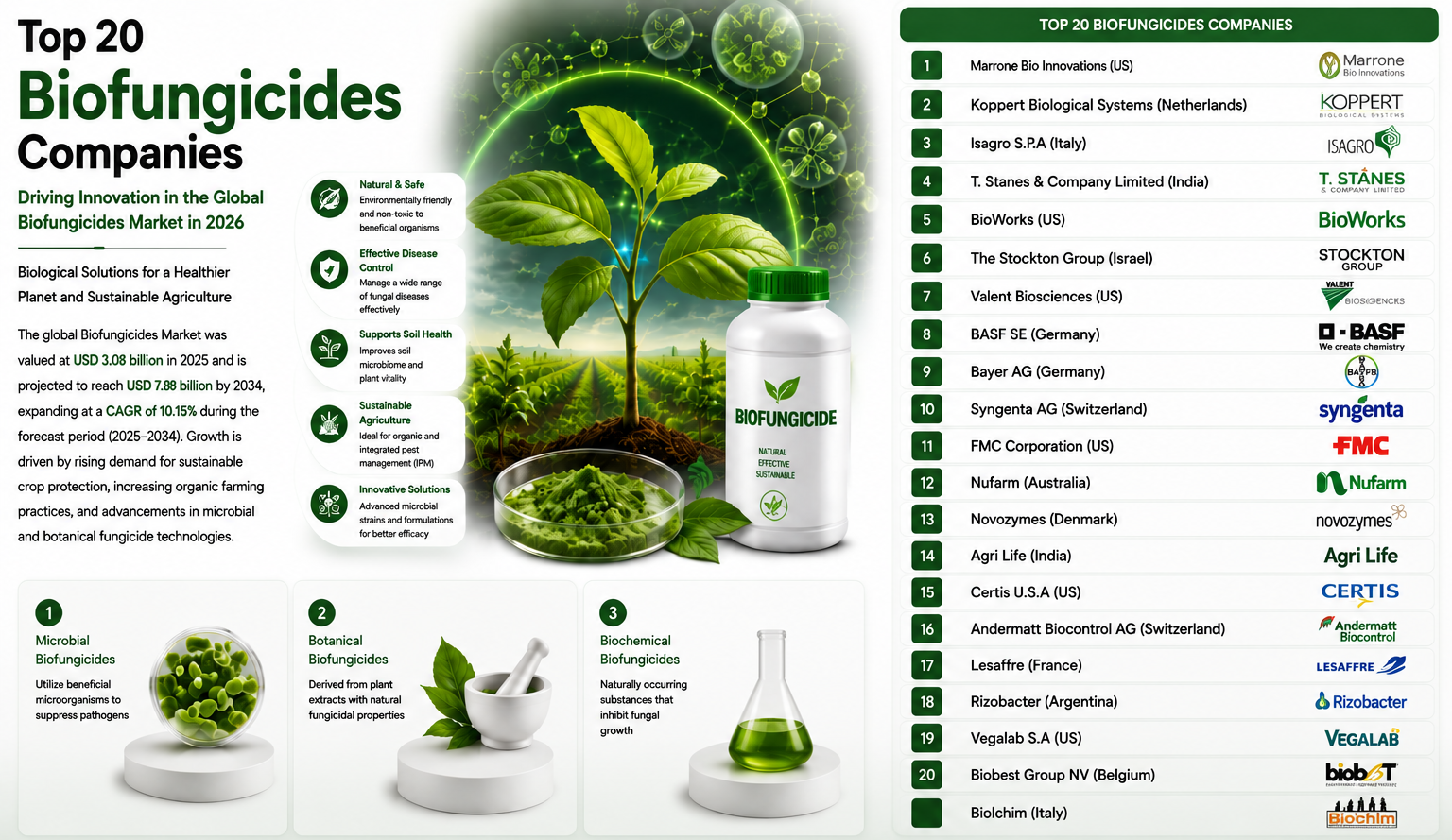
According to a new report from Intellectual Market Insights Research, the global biofungicides market was valued at approximately USD 3.08 billion in 2025 and is projected to reach USD 7.89 billion by 2034, growing at a compound annual growth rate (CAGR) of 10.15% between 2025 and 2034. That represents more than a doubling of the market in under a decade, driven by tightening pesticide residue regulations, rising organic and export-oriented farming, and sustained investment from both specialized biologicals companies and the world's largest crop protection majors.
In this article, we break down what's driving this growth, the challenges holding the market back, where the biggest opportunities lie, how the market is segmented, which regions are leading adoption, and who the major players are. Whether you're an agribusiness investor, a crop protection formulator, a grower advisor, or simply curious about where biological crop protection is headed, this guide will give you a clear, structured view of the biofungicides market landscape through 2034.
Market Overview
What Are Biofungicides?
Biofungicides are crop protection products derived from naturally occurring organisms, most commonly bacteria such as Bacillus and Pseudomonas species, fungi such as Trichoderma, and actinomycetes such as Streptomyces, or from botanical extracts, that control plant diseases through mechanisms distinct from conventional synthetic chemistry. Rather than acting as a single-target toxin, most microbial biofungicides work through multiple modes of action at once: physically outcompeting pathogens for space and nutrients on the plant surface, producing antifungal metabolites, and in some cases triggering the plant's own induced systemic resistance.
Biofungicides broadly fall into two categories: microbial species, which include bacterial and fungal strains formulated as living or spore-based products, and botanical biofungicides, which are derived from plant-based compounds and extracts. These products are formulated in several forms, including aqueous solutions, granules, and wettable powders, and are applied across the crop cycle via seed treatment, foliar spray, soil treatment, and other specialized methods such as post-harvest dips, root dipping, and drip or sprinkler irrigation. Because many microbial actives are exempt from strict maximum residue level (MRL) classification, biofungicides are increasingly used both as standalone tools in organic production and as rotation or tank-mix partners within integrated conventional disease management programs.
Current Market Landscape
The biofungicides space today sits at the intersection of agricultural biotechnology, sustainable farming policy, and traditional agrochemical manufacturing. What began as a specialty offering for organic and high-value horticultural growers has expanded into mainstream row-crop and export-oriented agriculture, as large-scale buyers and food retailers increasingly demand lower pesticide residue levels. Diversified crop protection majors have steadily built out dedicated "biologicals" or "biosolutions" divisions alongside their conventional chemistry portfolios, while specialized biocontrol companies continue to bring new microbial strains and fermentation-based actives to market, widening the addressable customer base from niche organic growers to mainstream commercial fruit, vegetable, and row-crop operations.
Industry Background
The use of naturally occurring organisms for plant disease suppression dates back decades within organic and biodynamic farming circles, but the modern biofungicides industry began taking shape in the 1980s and 1990s as fermentation technology matured and the first commercial Bacillus- and Trichoderma-based products reached the market. Over the past two decades, tightening pesticide residue regulations in major export markets, mounting fungicide resistance in conventional chemistry, and growing consumer demand for sustainably produced food have accelerated adoption. Large-scale investment from major agrochemical companies, through in-house R&D, licensing deals, and acquisitions of specialized biologicals firms, has further professionalized the sector, setting the stage for biofungicides' expansion from a niche organic-farming tool into a mainstream component of integrated crop management programs.
Key Market Trends
- Growing integration of biofungicides into conventional IPM programs: Rather than being used only in organic production, biofungicides are increasingly tank-mixed or rotated with synthetic chemistry within integrated pest management (IPM) programs to manage resistance and extend the effective life of conventional fungicides.
- Precision fermentation and next-generation actives: Companies are investing in advanced fermentation platforms to scale production of novel protein-based and microbial actives, improving cost-competitiveness and enabling faster commercialization of new biofungicide chemistries.
- Strategic partnerships between biologicals specialists and agrochemical majors: Specialized biocontrol innovators are increasingly partnering with large crop protection companies and fermentation technology providers to access global distribution networks, regulatory expertise, and manufacturing scale.
- Expansion beyond high-value horticulture into row crops: While fruits, vegetables, and specialty crops remain the core application base, biofungicide adoption is expanding into cereals, grains, oilseeds, and pulses as formulations and cost structures improve.
- Rising M&A and licensing activity in agricultural biologicals: Major agrochemical companies continue to acquire, license, and co-develop biological crop protection technologies, treating biologicals as a structural growth engine rather than a niche adjunct to conventional chemistry.
Market Growth Drivers
Tightening Pesticide Residue Regulations: Stricter maximum residue level (MRL) requirements in major export markets, particularly across Europe, are pushing growers toward biofungicides as a way to meet retailer and regulatory residue thresholds without sacrificing disease control.
Rising Fungicide Resistance in Conventional Chemistry: As plant pathogens develop resistance to widely used synthetic fungicide classes, biofungicides offer growers an additional, differentiated mode of action to rotate into their disease management programs and preserve the effectiveness of existing chemistry.
Growth in Organic and Sustainable Farming: Expanding consumer demand for organic and sustainably grown produce continues to widen the addressable market for biofungicides, which are frequently compatible with organic certification standards.
Increasing Investment from Major Agrochemical Companies: Sustained R&D spending, licensing deals, and acquisitions by large crop protection companies are accelerating the pace of new biofungicide product launches and expanding commercial reach into mainstream row-crop agriculture.
Advances in Fermentation and Formulation Technology: Improvements in microbial fermentation, strain stability, and shelf-life have made biofungicides more consistent and field-reliable, addressing a historical barrier to broader grower adoption.
Market Challenges
Efficacy Variability Under Field Conditions: Unlike synthetic chemistry, the performance of living microbial biofungicides can be more sensitive to environmental conditions such as UV exposure, temperature, and rainfall, which can create inconsistent results and slow grower confidence.
Shorter Shelf Life and Cold-Chain Requirements: Many microbial formulations require careful storage and have shorter shelf lives than conventional fungicides, adding cost and logistical complexity across the distribution chain.
Regulatory and Registration Complexity: Biofungicide registration pathways vary significantly by country, and clearing region-specific approval requirements can slow product launches, particularly for smaller specialized biologicals companies.
Higher Per-Unit Cost Relative to Conventional Fungicides: Biofungicides can carry a cost premium over established synthetic chemistry, which remains a barrier for cost-sensitive, large-acreage row-crop applications.
Limited Grower Awareness and Application Know-How: Effective use of biofungicides often requires different timing and application practices than conventional chemistry, and building grower familiarity and trust remains an ongoing industry challenge.
Market Opportunities
Untapped Emerging Markets: Expanding export-oriented horticulture, growing organic farming adoption, and rising regulatory pressure on conventional chemistry in parts of Asia-Pacific, Latin America, and the Middle East are opening new territory for biofungicide adoption as local distribution and grower education expand.
Expansion Beyond Fruits and Vegetables: While fruits, vegetables, and specialty crops remain the largest application base, growing use in cereals, grains, oilseeds, and pulses represents a significant white-space opportunity as cost structures continue to improve.
Precision Fermentation and Novel Actives: Continued advancement in precision fermentation platforms offers a path toward more cost-competitive, higher-efficacy microbial and protein-based biofungicides, a significant growth opportunity for both specialized innovators and large-scale manufacturers.
Integrated Biologicals-Plus-Chemistry Portfolios: As agrochemical majors build out combined conventional-and-biological product portfolios, there is room for companies to capture greater value through bundled disease management programs rather than standalone biological products.
Investment and M&A Activity: As the technology matures, there is ongoing opportunity for strategic investment, licensing, and consolidation among specialized biocontrol innovators, fermentation technology providers, and diversified agrochemical companies serving the biofungicides ecosystem.
Market Segmentation
By Type
- Microbial species
- Botanical
By Form
- Aqueous solution
- Granules
- Wettable powder
By Species
- Pseudomonas
- Streptomyces
- Bacillus
- Trichoderma
- Other species
- Saccharomyces
- Aureobasidium
- Coniothyrium
By Application
- Seed treatment
- Foliar spray
- Soil treatment
- Other modes of application
- Post-harvest
- Root dipping
- Drip & sprinkler irrigation
By Crop Type
- Fruits & vegetables
- Cereals & grains
- Oilseeds & pulses
- Other crops
- Turf & ornamentals
Microbial species represents the largest and fastest-growing type segment, given the breadth of commercially proven Bacillus-, Trichoderma-, and Pseudomonas-based products already registered across major markets, while botanical biofungicides continue to serve as a complementary category for organic and specialty applications. On the crop-type side, fruits and vegetables are expected to remain the largest application segment given high per-acre value and stringent residue requirements in export markets, while cereals, grains, oilseeds, and pulses represent the segment with the greatest long-term volume upside as formulations scale into mainstream row-crop agriculture.
Regional Analysis
North America: North America holds a leading share of the global biofungicides market, supported by strong adoption among specialty crop growers, a dense concentration of biologicals innovators and fermentation capacity, and growing integration of biofungicides into conventional IPM programs.
Europe: Europe represents a mature and fast-growing market, underpinned by some of the world's strictest pesticide residue and maximum residue level (MRL) regulations, well-established organic farming demand, and continued phase-out pressure on conventional fungicide active ingredients across the European Union.
Asia-Pacific: Asia-Pacific is expected to be among the fastest-growing regions over the forecast period, driven by the presence of key biofungicide manufacturers and expanding export-oriented horticulture in economies such as China, Japan, and India, alongside rising domestic demand for sustainably produced food.
Latin America: Latin America remains a significant and expanding market, with Brazil and Argentina leading regional demand as large-scale export agriculture increasingly adopts biologicals to meet international residue standards.
Middle East & Africa: The Middle East & Africa region is an emerging opportunity area, with growth concentrated in countries expanding irrigated and export-oriented agriculture, alongside gradual uptake in South Africa.
Competitive Landscape
The global biofungicides market features a mix of diversified crop protection majors and specialized biologicals innovators. Key players identified in the market include:
- BASF SE
- Bayer AG
- Syngenta AG
- FMC Corporation
- Nufarm
- Novozymes (Novonesis)
- Marrone Bio Innovations
- Koppert Biological Systems
- Isagro S.P.A
- T. Stanes & Company Limited
- BioWorks
- The Stockton Group
- Valent Biosciences
- Agri Life
- Certis U.S.A
- Andermatt Biocontrol AG
- Lesaffre
- Rizobacter
- Vegalab S.A
- Biobest Group NV
- Biolchim
Competition in this space centers on expanding registered strain and product portfolios, improving field consistency and shelf-life, and scaling fermentation manufacturing capacity to compete on cost. Diversified agrochemical majors such as BASF and Bayer benefit from established grower relationships and the ability to bundle biofungicides into broader integrated disease management programs, while specialized biologicals companies and fermentation technology providers compete on strain innovation, speed to market, and partnership-driven commercialization. As the market matures, continued licensing deals, strategic partnerships between biologicals innovators and agrochemical distributors, and new product launches targeting row-crop expansion are expected to shape the competitive landscape through 2034.
1. BASF SE
|
Category |
Details |
|---|---|
|
Company Name |
BASF SE |
|
Headquarters |
Ludwigshafen, Germany |
|
Industry Focus |
Agricultural Solutions, Crop Protection, and BioSolutions |
|
Global Presence |
Global agricultural solutions operations serving growers across dozens of countries |
|
Company Overview |
BASF's Agricultural Solutions division has built out a dedicated BioSolutions portfolio spanning both biofungicides and bioinsecticides, positioning biologicals as a complementary and alternative tool alongside its established conventional chemistry business. |
|
Key Products & Services |
Serifel, a preventative biofungicide based on Bacillus amyloliquefaciens strain MBI600 offering broad-spectrum, multiple-mode-of-action disease control on crops including grapes, strawberries, lettuce, and peppers; Velifer, a complementary microbial bioinsecticide based on Beauveria bassiana. |
|
Market Position |
A leading diversified supplier with one of the broadest proprietary biofungicide portfolios among major agrochemical companies, positioned to bundle biologicals with conventional fungicide chemistry within integrated disease management programs. |
|
Recent Developments |
Continues to expand regulatory approvals and crop-use registrations for Serifel across additional international markets, building on its position as BASF's first proprietary biological fungicide, while extending its BioSolutions portfolio to help growers manage residue-level and sustainability requirements. |
|
Strategic Advantages |
Deep integration between conventional and biological crop protection portfolios, established global distribution and grower relationships, and dedicated in-house fermentation and formulation R&D capability. |
2. Bayer AG
|
Category |
Details |
|---|---|
|
Company Name |
Bayer AG |
|
Headquarters |
Leverkusen, Germany |
|
Industry Focus |
Crop Science, Biologicals, and Agricultural Solutions |
|
Global Presence |
Global crop science operations with nearly 350 crop protection registrations and more than 470 new seed products introduced in 2025 alone |
|
Company Overview |
Bayer's Crop Science division operates a dedicated Biologicals business spanning biofungicides, biostimulants, and bioinsecticides, with the company positioning biocontrols as a core pillar of its regenerative agriculture strategy alongside conventional crop protection. |
|
Key Products & Services |
Serenade, a Bacillus subtilis strain QST 713-based biofungicide providing broad-spectrum disease control across specialty and row crops; broader Biologicals by Bayer portfolio including nematicide and biostimulant products integrated into conventional pest management programs. |
|
Market Position |
One of the largest diversified crop science companies globally, with a growing biologicals pipeline supported by external licensing and partnership deals to expand its biocontrol portfolio. |
|
Recent Developments |
Signed a partnership agreement with Aphea.Bio in mid-2026 to advance next-generation biological crop protection technologies, part of a broader industry-wide trend of major agrochemical companies materially increasing investment in agricultural biologicals as a structural growth engine. |
|
Strategic Advantages |
Extensive global grower relationships and distribution infrastructure, substantial annual R&D investment, and an increasingly active biologicals licensing and partnership strategy that supplements in-house development. |
3. Novonesis (formerly Novozymes)
|
Category |
Details |
|---|---|
|
Company Name |
Novonesis |
|
Headquarters |
Bagsværd, Denmark |
|
Industry Focus |
Biosolutions, Industrial Biotechnology, and Agricultural Biologicals |
|
Global Presence |
Global biosolutions operations, including a significant North American presence anchored by its Franklinton, North Carolina headquarters and Research Triangle R&D facility |
|
Company Overview |
Novonesis is a global biosolutions leader whose agricultural portfolio spans bioyield and biocontrol products, including a family of OMRI-listed microbial biocontrol solutions that provide an alternative to chemical fungicides for soil and foliar disease protection. |
|
Key Products & Services |
Actinovate and a broader biocontrol product family targeting soil and foliar diseases in fruit, vegetable, and row crops; bioyield microbial inoculant portfolio including Optimize, Cell-Tech, and JumpStart for nutrient availability and yield support. |
|
Market Position |
A leading fermentation technology and biosolutions supplier, positioned as a manufacturing and commercialization partner for emerging biocontrol innovators as well as a direct supplier of its own branded biocontrol portfolio. |
|
Recent Developments |
Entered a distribution agreement with Rovensa Next in mid-2026 to commercialize select U.S. agricultural biosolutions beginning with the 2027 growing season, and continues its long-term collaboration with Biotalys to scale production of the EVOCA NG biofungicide through licensed precision fermentation technology. |
|
Strategic Advantages |
Industry-leading fermentation platform and manufacturing scale, a dual role as both product owner and contract manufacturing partner for other biocontrol innovators, and deep R&D infrastructure supporting new strain development. |
4. Marrone Bio Innovations
|
Category |
Details |
|---|---|
|
Company Name |
Marrone Bio Innovations |
|
Headquarters |
Davis, California, USA |
|
Industry Focus |
Biopesticides and Biological Crop Protection |
|
Global Presence |
Operations serving specialty crop and row-crop growers primarily across North and South America |
|
Company Overview |
Marrone Bio Innovations is a pioneering specialized biopesticide company with a portfolio of microbial biofungicide, bioinsecticide, and bionematicide products, built around proprietary strain discovery and fermentation technology developed over more than a decade in the biologicals space. |
|
Key Products & Services |
A portfolio of microbial biofungicide products used for soil and foliar disease management across specialty and row crops, alongside complementary bioinsecticide and bionematicide offerings developed through the company's proprietary strain discovery platform. |
|
Market Position |
A long-established specialized biopesticide innovator recognized as one of the pioneering commercial biocontrol companies, with a track record of new active ingredient discovery and registration. |
|
Recent Developments |
Continues to expand registrations and grower adoption of its microbial biofungicide portfolio across specialty crop markets, while pursuing new strain discovery partnerships as competition intensifies from both larger agrochemical majors and newer biologicals entrants. |
|
Strategic Advantages |
Deep proprietary strain discovery expertise built over more than a decade of commercial biopesticide development, an established registered product portfolio, and long-standing specialty crop grower relationships. |
5. Koppert Biological Systems
|
Category |
Details |
|---|---|
|
Company Name |
Koppert Biological Systems |
|
Headquarters |
Berkel en Rodenrijs, The Netherlands |
|
Industry Focus |
Biological Crop Protection and Pollination Solutions |
|
Global Presence |
Operations across more than 30 countries, serving greenhouse, open-field, and specialty crop growers worldwide |
|
Company Overview |
Koppert is a privately held pioneer in biological crop protection, offering an integrated portfolio spanning biofungicides, beneficial insects, and pollination solutions built around natural pest and disease control principles for sustainable growing systems. |
|
Key Products & Services |
A range of microbial biofungicide products used for soil and foliar disease suppression, integrated within Koppert's broader biological crop protection and integrated pest management (IPM) offering for greenhouse and open-field growers. |
|
Market Position |
A leading independent biological crop protection specialist with deep roots in greenhouse horticulture, recognized for pairing biofungicide offerings with its established beneficial-insect and pollination businesses. |
|
Recent Developments |
Continues to expand its biological crop protection portfolio and grower education programs internationally, supporting broader industry momentum toward integrated, biology-first disease and pest management systems. |
|
Strategic Advantages |
Decades of specialized biological control expertise, an integrated portfolio combining biofungicides with beneficial insects and pollination products, and strong relationships within the global greenhouse and protected-cropping sector. |
Future Outlook
The biofungicides market is on a clear upward trajectory, with the forecasted CAGR of 10.15% through 2034 reflecting sustained demand across specialty horticulture, export-oriented agriculture, and increasingly, mainstream row-crop production. Growth is expected to be increasingly driven by tightening residue regulations and integration into conventional IPM programs, as biofungicides shift from a niche organic-farming tool to a standard component of mainstream disease management.
Looking ahead, expect continued investment in precision fermentation and novel microbial actives, deeper partnership activity between specialized biologicals innovators and large agrochemical distributors, expanding adoption in cereals, grains, oilseeds, and pulses, and sustained M&A and licensing activity as diversified crop protection majors treat biologicals as a structural growth priority rather than a niche adjunct. Consolidation among fermentation technology providers and closer collaboration between biotech innovators, agrochemical majors, and regional distributors are also likely as the industry continues to scale through 2034.
Frequently Asked Questions (FAQ)
Q1: How big is the biofungicides market currently?
The global biofungicides market was valued at approximately USD 3.08 billion in 2025.
Q2: How fast is the biofungicides market expected to grow?
The market is projected to grow at a CAGR of 10.15% from 2025 to 2034, reaching an estimated USD 7.89 billion by 2034.
Q3: What is the difference between microbial and botanical biofungicides?
Microbial biofungicides are formulated from living or spore-based bacterial and fungal strains, such as Bacillus, Pseudomonas, Streptomyces, and Trichoderma species, that suppress disease through competition, antibiosis, or induced resistance, while botanical biofungicides are derived from plant-based extracts and compounds.
Q4: What are the main applications of biofungicides?
Key application methods include seed treatment, foliar spray, and soil treatment, alongside other modes such as post-harvest treatment, root dipping, and drip or sprinkler irrigation.
Q5: Which region leads the biofungicides market?
North America currently holds a leading market share, supported by strong specialty crop adoption and biologicals innovation, while Asia-Pacific is expected to see some of the fastest growth over the forecast period.
Q6: Who are the major companies in the biofungicides market?
Leading players include BASF SE, Bayer AG, Syngenta AG, FMC Corporation, Nufarm, Novozymes (Novonesis), Marrone Bio Innovations, Koppert Biological Systems, Isagro, T. Stanes & Company, BioWorks, The Stockton Group, and Valent Biosciences, among others.
Q7: What are the biggest challenges facing the biofungicides market?
Field-condition efficacy variability, shorter shelf life and cold-chain requirements, regulatory and registration complexity across regions, higher per-unit cost relative to conventional fungicides, and limited grower awareness are among the primary challenges.
Q8: What crop types use biofungicides?
The main crop-type segments are fruits and vegetables, cereals and grains, oilseeds and pulses, and other crops including turf and ornamentals.
Q9: Are biofungicides only used in organic farming?
No. While biofungicides remain a core tool in organic production, they are increasingly used within conventional integrated pest management (IPM) programs, where they are tank-mixed or rotated with synthetic chemistry to manage resistance and meet residue-level requirements.
Q10: What opportunities exist in the biofungicides market going forward?
Opportunities include expansion into cereals, grains, oilseeds, and pulses beyond the traditional fruit and vegetable base, advancement of precision fermentation and novel microbial actives, deeper integration of biologicals into conventional disease management programs, and continued investment, licensing, and consolidation among agrochemical majors and specialized biocontrol innovators.
Conclusion
Biofungicides have evolved from a specialty tool for organic and high-value horticultural growers into a mainstream component of modern crop protection, and the numbers reflect that shift. With the market projected to grow from USD 3.08 billion in 2025 to USD 7.89 billion by 2034, the opportunity spans diversified agrochemical majors, specialized biologicals innovators, fermentation technology providers, and regional distributors alike. While field-condition variability, shelf-life logistics, and registration complexity remain real challenges, the underlying demand drivers, namely tightening residue regulations, rising fungicide resistance, and growing sustainable farming adoption, show no signs of slowing. For stakeholders across the value chain, understanding regional dynamics, segmentation trends, and the competitive landscape will be key to capturing this growth.


