
Top Leading Identity Verification Market Companies in 2025
Author:
Intellectual Market Insights Research
Published Date:
09 Oct 2026
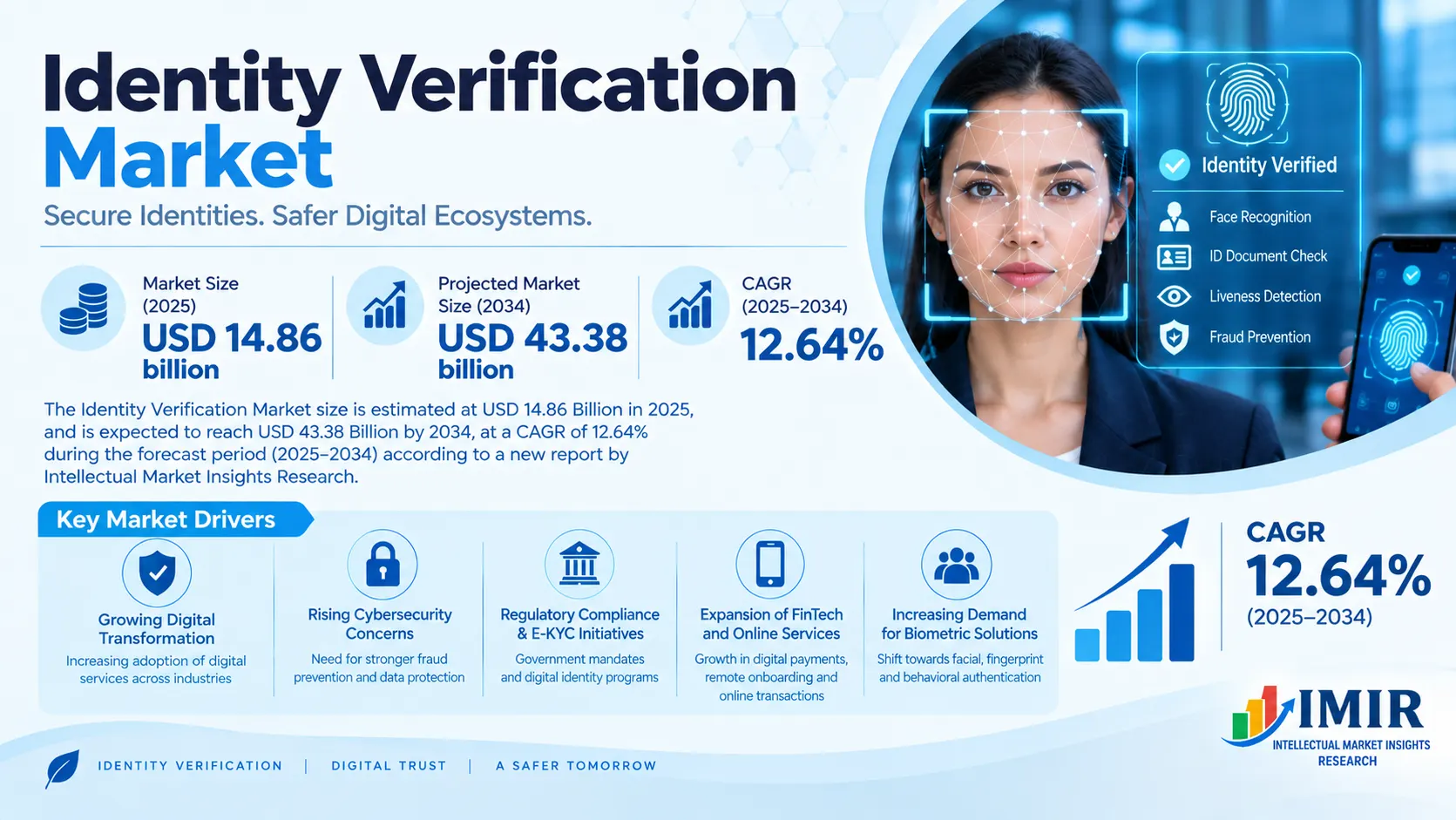
Global Identity Verification Market: Size, Leading Companies, Trends and Outlook (2025–2034)
Introduction
Market Overview and Forecast
According to IMIR, the global identity verification market is valued at USD 14.86 billion in 2025 and is projected to reach USD 43.38 billion by 2034, growing at a CAGR of 12.64% from 2025 to 2034 (historic period 2020–2023, base year 2024).
Why estimates differ. Other research firms publish lower or higher numbers, because some count only software for document and biometric checks, while others include background screening, credit-bureau identity data and government ID programmes. MarketsandMarkets, for example, projects a market of about USD 33.4 billion by 2031 on its own definition. This blog uses the IMIR figures.
Why the Identity Verification Market Is Growing
1. Rising online fraud. Entrust's 2026 Identity Fraud Report, based on more than 1 billion verification events across 195 countries, says deepfakes now account for about 1 in 5 biometric fraud attempts, deepfaked-selfie attempts rose 58% in a year, and injection attacks rose 40%. Every new attack type forces companies to buy stronger verification.
2. Tighter KYC, AML and age-verification rules. Financial regulators, gambling regulators and online-safety laws in the UK, EU, US, Australia and elsewhere now require identity or age checks. In the EU, the eIDAS 2.0 framework is bringing digital identity wallets, which creates new demand for verification services.
3. Digital onboarding is the default. Neobanks, fintech apps, crypto exchanges, gig platforms and online marketplaces cannot onboard customers at a branch, so they need fast remote verification with low drop-off.
4. Biometrics and AI are getting better and cheaper. Face matching, liveness detection and document forensics are now accurate enough for automated approval in seconds, which lowers cost per check and opens the market to SMEs.
5. Cloud delivery. API-based verification lets small firms integrate in days. Pay-per-check pricing makes it easy to start small and scale.
6. Government digital ID programmes. National digital ID and mobile driver's licence projects in India, the EU, the UK, the US and the Gulf create adjacent demand for verification infrastructure.
7. Platform and sector expansion. Healthcare telemedicine, car sharing, online gaming, remote hiring and e-signature workflows are all adding identity checks.
Companies Associated with the Identity Verification Market
| Company | HQ | Core Offering | Latest Verifiable Point |
|---|---|---|---|
| GB Group (GBG) | Chester, UK | Identity, location data, fraud; owns Idology and Acuant | FY26 revenue £285.0M; Identity ~£175M |
| IDEMIA | Courbevoie, France | Biometrics, public security, secure transactions | Sold Smart Identity unit to IN Groupe (Jul 2025) |
| Jumio | Palo Alto, USA | AI identity verification, KYC/AML | Gartner-named leader; revenue not disclosed |
| Onfido (Entrust) | London, UK | Document and facial biometric verification | Acquired by Entrust (2024) |
| Mitek Systems | San Diego, USA | Mobile deposit, ID verification | FQ2 2026 revenue USD 50.2M; FY guidance USD 190–196M |
| Trulioo | Vancouver, Canada | Global identity and business verification | Revenue not disclosed |
| AU10TIX | Hod HaSharon, Israel | Document authentication, fraud detection | Revenue not disclosed |
| Thales Group | Paris, France | Digital identity, biometrics, security | Identity revenue not disclosed |
| Experian | Dublin, Ireland | Credit bureau plus identity and fraud | Identity revenue not disclosed |
| Equifax | Atlanta, USA | Credit bureau plus identity and fraud | Identity revenue not disclosed |
| LexisNexis Risk Solutions | Alpharetta, USA (RELX, UK) | Identity intelligence, fraud scoring | Identity revenue not disclosed |
| Shufti Pro | London, UK | AI KYC, AML screening | Revenue not disclosed |
| Signicat | Trondheim, Norway | European eID and e-signatures | Revenue not disclosed |
| Innovatrics | Bratislava, Slovakia | Biometric algorithms and onboarding | Revenue not disclosed |
Competitive Landscape
The market is split into several groups that overlap in practice:
- Specialist IDV platforms (Jumio, Trulioo, AU10TIX, Shufti Pro, Veriff, Sumsub, Persona, Incode): compete on accuracy, conversion rate, global document coverage and speed.
- Credit bureaus and data providers (Experian, Equifax, LexisNexis Risk Solutions, GBG): compete using proprietary data assets, existing bank relationships and fraud networks.
- Biometrics and government-identity vendors (IDEMIA, Thales, Innovatrics, IN Groupe): compete in national ID, border control and public-sector projects.
- Security and software platforms (Entrust, Mitek): bundle IDV with authentication, encryption and deposit or payment products.
- Regional specialists (Signicat in Nordics, IDnow and WebID in Germany, PXL Vision in Switzerland, Idfy and Veri5Digital in India): compete on local ID formats and regulation.
Competitive dynamics to note:
- Consolidation. GBG bought Acuant and Idology (2021), Entrust acquired Onfido (2024) and IN Groupe acquired IDEMIA Smart Identity (2025). Standalone mid-sized vendors are increasingly being bought or are bundling with larger security platforms.
- Deepfake defence is the new battleground. Vendors compete on liveness detection, injection-attack detection and device-level signals, not just document OCR.
- Pricing pressure. Commodity document checks are getting cheaper, so vendors move toward orchestration platforms (such as GBG Go), fraud networks and ongoing monitoring.
- Mixed financial momentum. Mitek reports double-digit growth, while GBG's identity revenue was roughly flat in FY2026, which shows that growth is uneven across business models.
Regional Analysis
IMIR's report leaves regional percentage shares as placeholders, so this section is qualitative.
North America is the largest market by spending. Banks, fintechs and crypto exchanges drive demand, supported by KYC/AML rules, the growth of mobile driver's licences and a high level of identity fraud.
Europe is shaped by regulation: GDPR, the AML directives and the eIDAS 2.0 digital identity wallet. Strong regional vendors (Signicat, IDnow, PXL Vision, Veriff, Onfido heritage) compete with global players.
Asia-Pacific is the fastest-growing region in most forecasts, thanks to digital banking, large unbanked and under-banked populations, national ID systems such as India's Aadhaar-based eKYC, and fast-growing e-commerce and gaming sectors. Local players like Idfy and Veri5Digital are active in India.
Middle East & Africa. Gulf countries invest in national digital ID and smart-government services, and African fintech and mobile money expansion create demand for low-cost remote verification.
Latin America. Instant-payment systems and fintech growth in Brazil and Mexico, together with rising fraud, are increasing demand for remote onboarding checks.
Emerging Trends
- Deepfake and injection-attack detection. Vendors are adding passive liveness, camera-injection detection and device-integrity checks to counter generative-AI fraud.
- Reusable and decentralised identity. Digital wallets, verifiable credentials and mobile driver's licences let users verify once and reuse the proof, which lowers cost and friction.
- Orchestration platforms. Instead of one provider, companies use a single layer that routes each customer to the best check and combines data, document, biometric and device signals.
- Continuous verification. Identity is checked again at login, at high-risk transactions and across the customer lifecycle, not only at onboarding.
- Age assurance. Online-safety laws are creating a distinct category of age-estimation and age-verification services.
- Regulation-driven demand. KYC/AML tightening, eIDAS 2.0 and national digital ID programmes shape product roadmaps.
- Privacy-preserving technology. Zero-knowledge proofs and on-device matching reduce the data that vendors must store.
- Verification of AI agents and businesses. KYB (know your business) and identity for non-human actors are emerging adjacent needs.
Future Outlook (2025–2034)
IMIR's forecast covers the full period: USD 14.86 billion in 2025 to USD 43.38 billion in 2034 at a 12.64% CAGR.
- 2025–2027. Growth is driven by fraud-driven upgrades, orchestration platforms, and age and KYC mandates. Vendors invest heavily in deepfake detection.
- 2028–2030. Digital identity wallets and reusable credentials start to reshape how verification is delivered, shifting some revenue from one-time document checks to credential issuance and ongoing risk services.
- 2031–2034. The market matures around continuous, multi-signal identity assurance. Consolidation continues, and large security, data and cloud companies hold larger shares.
Risks and challenges:
- Privacy concerns and data-protection fines around biometric data.
- Fraudsters keep evolving, so detection cost rises.
- Price compression of basic document checks.
- User drop-off if verification is too slow or intrusive.
- Government wallets could reduce commercial verification volumes in some markets.
Opportunities: deepfake-resistant liveness, age assurance, KYB, financial-crime orchestration, emerging-market onboarding and managed services for mid-sized firms.
FAQ
Q1. How big is the identity verification market? IMIR values it at USD 14.86 billion in 2025, rising to USD 43.38 billion by 2034.
Q2. What is the growth rate? A CAGR of 12.64% from 2025 to 2034, according to IMIR.
Q3. Who are the leading companies? GBG, IDEMIA, Jumio, Onfido (Entrust), Mitek, Trulioo, AU10TIX, Thales, Experian, Equifax and LexisNexis Risk Solutions are among those named by IMIR, along with Shufti Pro, Signicat and Innovatrics.
Q4. What is driving growth? Rising online fraud including deepfakes, stricter KYC/AML and age-verification rules, digital onboarding, better biometrics and cloud delivery.
Q5. Which segment is largest? Solutions lead over services, and cloud deployment and BFSI are the largest adoption areas in most analyses; IMIR's page does not publish segment shares.
Q6. Which region will grow fastest? Asia-Pacific is generally expected to grow fastest, while North America remains the largest by spending.
Q7. How are deepfakes affecting the market? Entrust's 2026 report says deepfakes account for about 1 in 5 biometric fraud attempts, which pushes buyers toward liveness and injection-attack detection.
Q8. Is the market consolidating? Yes. Onfido joined Entrust, Acuant and Idology joined GBG, and IDEMIA sold its Smart Identity unit to IN Groupe.
Q9. Biometric or non-biometric verification? Biometric methods are growing faster because they are harder to spoof and give a smoother user experience, but non-biometric checks (documents, data and knowledge) remain widely used.
Conclusion
Identity verification is moving from a compliance step to a core part of digital trust. IMIR projects the market to grow from USD 14.86 billion in 2025 to USD 43.38 billion by 2034, a CAGR of 12.64%. The drivers are strong and clear: fraud that uses AI, stricter regulation, digital onboarding and digital identity programmes.
For vendors, the winners will combine accurate biometrics, deepfake defence, data assets and easy integration. For businesses buying verification, the best approach is to choose a layered, orchestrated setup that balances fraud prevention, user experience and privacy, and to plan for reusable digital identity as it spreads.