
Top Leading Meal Kit Companies in the Globally
Author:
Intellectual Market Insights Research
Published Date:
09 Oct 2026
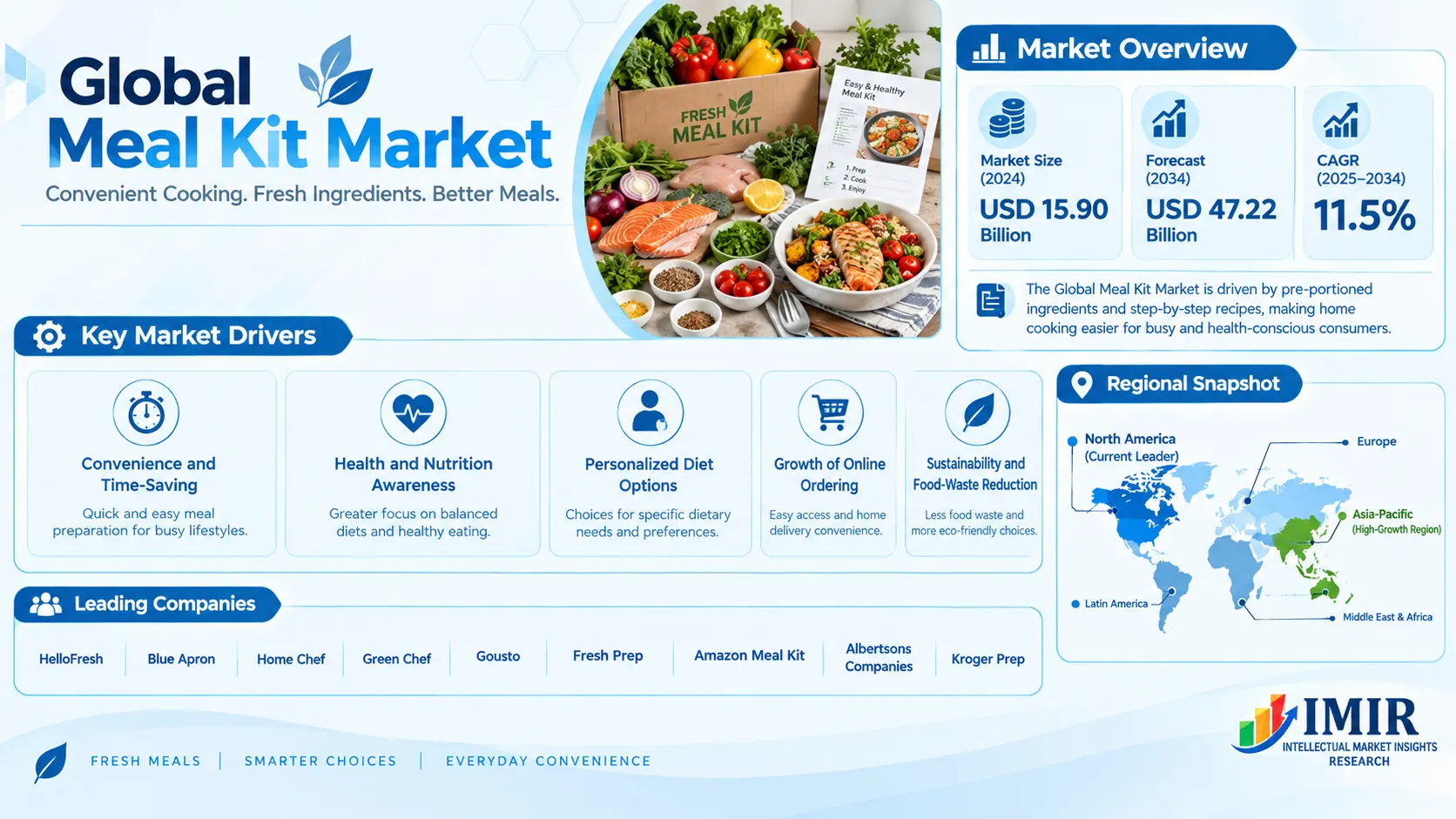
Global Meal Kit Market: Size, Leading Companies, Trends and Outlook (2025–2034)
Note on sources: Market size and CAGR are taken from the Intellectual Market Insights Research (IMIR) Meal Kit Market report (imi-000020): about USD 15.90 billion in 2024 to USD 47.22 billion by 2034, CAGR 11.5% (base year 2024, forecast period 2025–2034). IMIR's regional share figures are placeholders on the report page, so the regional section is qualitative. Company facts were checked against public sources up to October 2026. Where a company does not publish figures, this blog says "Not publicly disclosed."
Introduction
A meal kit is a box of pre-portioned ingredients and a recipe, delivered to the customer's home or sold in a store, so that people can cook a fresh meal without planning or shopping. The category started with subscription services such as HelloFresh, Blue Apron and Gousto and has since widened to supermarket-sold kits, ready-to-heat meals and diet-specific ranges.
The market went through a pandemic boom, then a hard correction as customers returned to restaurants and cut back on subscriptions. In 2026 the leaders are focused on profit rather than growth, and the category is shifting toward flexibility, health-focused menus and ready-to-eat formats. This blog covers the size of the market, what drives it, the companies named by IMIR, and the outlook to 2034.
Market Overview and Forecast
According to IMIR, the global meal kit market was valued at about USD 15.90 billion in 2024 and is projected to reach USD 47.22 billion by 2034, growing at a CAGR of 11.5% over 2025–2034.
Why the Meal Kit Market Is Growing
1. Convenience and time saving. Busy households and single professionals value skipping meal planning and shopping, which is the core meal-kit promise.
2. Retailers entering the category. Supermarkets sell kits in-store (Kroger's Home Chef kits are one example), which brings meal kits to shoppers who avoid subscriptions.
3. Flexibility replacing subscriptions. Subscription fatigue pushed brands to add skip-anytime options and no-commitment ordering. Blue Apron introduced a subscription-free ordering option in 2026.
4. Health and diet-specific menus. Gousto reported that demand for its healthy recipe ranges rose 144% in 2025. High-protein, plant-based and low-calorie kits attract new customers.
5. Ready-to-eat expansion. HelloFresh's Factor brand and Gousto's Heat & Eat range (launched August 2026) show that the category is extending into prepared meals.
6. Food-waste reduction. Pre-portioned ingredients reduce household waste, which appeals to sustainability-minded buyers.
7. Data and personalisation. Recipe recommendation engines, dynamic menus and demand forecasting help reduce costs and increase repeat orders.
8. New regions and channels. Growing online grocery and delivery infrastructure in Asia-Pacific and Latin America opens new markets.
Companies Associated with the Meal Kit Market
IMIR names 16 players: Fuud Canada, Global Belly, Goodness Me, Gousto, Green Chef, Amazon Meal Kit, Blue Apron, Chefs Menu, Fit Foods Club, Fresh Prep, Gym Food Australia, HelloFresh, Home Chef, Homemade, Kroger Prepx and Albertsons Companies. IMIR's separate "leading companies" blog also profiles Factor, Marley Spoon, Gobble, Dinnerly and Sunbasket. The companies below are profiled in bullet form and then compared in a table.
| Company | HQ | Model | Latest Verifiable Point |
|---|---|---|---|
| HelloFresh | Berlin, Germany | Subscription kits and ready meals | Q2 2026 revenue about EUR 1.5B (down 7.8%); FY26 EBITDA guide EUR 375–425M |
| Blue Apron | New York, USA | Kits, subscription-free option (2026) | Owned by Wonder Group since Nov 2023 (USD 103M) |
| Home Chef (Kroger) | Chicago, USA | Online and in-store kits | Owned by Kroger since 2018 |
| Gousto | London, UK | Subscription kits, Heat & Eat | 2025 revenue GBP 342M (+10%); EBITDA GBP 45M |
| Green Chef (HelloFresh) | Boulder, USA | Organic, diet-specific kits | Part of HelloFresh since 2018 |
| Amazon Meal Kit | Seattle, USA | Online grocery kits | Current scale not confirmed |
| Kroger | Cincinnati, USA | Grocery retail, kits via Home Chef | Meal-kit revenue not disclosed |
| Albertsons | Boise, USA | Grocery retail, in-store kits | Meal-kit revenue not disclosed |
| Fresh Prep | Vancouver, Canada | Regional kits | Current status not confirmed |
| Fuud, Global Belly, Goodness Me, Chefs Menu, Fit Foods Club, Gym Food Australia, Homemade | Various | Regional / diet-focused | Data not publicly confirmed |
Other notable players outside IMIR's main list include Factor (HelloFresh), Marley Spoon and Dinnerly, Sunbasket and Gobble. Some of these have been restructured or have changed their business since the pandemic peak, so check current status before partnering.
Competitive Landscape
- One global leader, many smaller rivals. HelloFresh is far larger than any competitor, followed by regional leaders such as Gousto in the UK and Home Chef in US retail.
- Profit over growth. HelloFresh cut marketing spend and is guiding to lower revenue in 2026 while protecting profit. Gousto's record EBITDA in 2025 shows the same push toward profitability.
- Consolidation and failures. Blue Apron's sale at a fraction of its IPO value, the closure of earlier players such as Plated (2019), and the restructuring of fulfilment partners show how hard the economics are.
- Retailers as competitors. Grocers sell kits without subscription costs, which pressures online-only brands.
- Format expansion. Ready-to-eat meals, high-protein menus and add-ons (meat, seafood, pet food) are the main route to new revenue.
- Cost pressure. Food inflation, last-mile delivery and customer acquisition costs remain the main margin risks.
Regional Analysis
IMIR's regional percentages are placeholders, so this section is qualitative.
North America is the largest market, with a mix of subscription brands (HelloFresh, Blue Apron) and retailer-led kits (Home Chef at Kroger, Albertsons). Competition is intense, and growth now depends on flexibility and value.
Europe is a mature market led by HelloFresh and Gousto (UK), with strong activity in Germany, the Netherlands and the Nordics. Gousto has recently expanded into Ireland.
Asia-Pacific is the main growth region, helped by online grocery adoption, urbanisation and rising incomes. Australia is a developed market (HelloFresh, Marley Spoon, local diet-focused providers such as Gym Food Australia), while China, Japan and India offer long-term potential.
Latin America. Early-stage but growing, led by urban centres in Brazil and Mexico where online grocery and delivery networks are expanding.
Middle East & Africa. Small but developing, with interest from higher-income urban consumers in the Gulf states and South Africa.
Emerging Trends
- Flexible ordering. Skip-anytime plans and subscription-free options respond to subscription fatigue.
- Ready-to-eat and "heat and eat". Prepared meals reduce effort further and widen the customer base.
- Health and protein focus. Menus built around high-protein, lower-calorie and plant-based diets are growing fastest.
- AI in menus and operations. HelloFresh has said it is using generative AI in recipe development, and brands use data to personalise offers and cut waste.
- Retail partnerships. In-store kits and partnerships with grocers extend reach without paid subscription marketing.
- Sustainable packaging. Recyclable and reduced packaging is a purchase factor in Europe and North America.
- Adjacent categories. Premium meat, seafood, pet food and snacks are added to existing delivery networks.
- Operational consolidation. Companies are closing or merging factories (for example Gousto's planned Clay Lake consolidation) to improve margins.
Future Outlook (2025–2034)
IMIR's forecast covers 2025–2034: from about USD 15.90 billion in 2024 to USD 47.22 billion in 2034, at an 11.5% CAGR.
- 2025–2027 (reset phase). Leaders focus on profitability, customer quality and format changes. Growth is uneven across regions.
- 2028–2030 (diversification). Ready-to-eat, health-led and retail-based kits gain share. Asia-Pacific and other emerging regions add volume.
- 2031–2034 (maturity). Consolidated, data-driven players with efficient fulfilment and broader food offers hold most of the market, and in-store plus online channels operate together.
Risks: weak customer retention, food and delivery cost inflation, competition from grocery delivery and takeaway, further bankruptcies among fulfilment partners, and the gap between IMIR's growth view and the recent decline of the largest operator.
Opportunities: ready-to-eat and high-protein ranges, retailer partnerships, Asia-Pacific expansion, automation in fulfilment, and personalised nutrition.
FAQ
Q1. How big is the global meal kit market? IMIR values it at about USD 15.90 billion in 2024, rising to USD 47.22 billion by 2034.
Q2. What is the expected CAGR? 11.5% from 2025 to 2034, per IMIR.
Q3. Who are the leading meal kit companies? HelloFresh, Blue Apron, Home Chef, Gousto and Green Chef lead among those named by IMIR, along with Amazon Meal Kit, Kroger, Albertsons and several smaller regional providers.
Q4. Which product type leads? IMIR says Full Kits lead the product-type segment, and non-vegetarian kits lead by application.
Q5. Is the meal kit market still growing? IMIR projects steady growth. The largest operator, HelloFresh, reported declining revenue in Q2 2026 while improving profitability, so growth is coming from new formats and regions rather than from every incumbent.
Q6. What is happening with Blue Apron? It has been owned by Wonder Group since late 2023 and in 2026 introduced subscription-free ordering and a larger menu.
Q7. Which region will grow fastest? Asia-Pacific is generally expected to grow fastest, while North America is the largest market.
Q8. What are the main challenges? Customer retention, food and delivery costs, subscription fatigue and competition from retailers and delivery apps.
Q9. What trends matter most? Flexible ordering, ready-to-eat meals, health-focused menus, retailer partnerships and AI-driven personalisation.
Conclusion
The meal kit market is moving from a fast-growth subscription story to a more mature, profit-focused industry. IMIR projects the market to grow from about USD 15.90 billion in 2024 to USD 47.22 billion by 2034, an 11.5% CAGR, as meal kits expand into ready-to-eat meals, retail channels and new regions.
For operators, the winning approach is to combine flexible ordering, health-led menus, efficient fulfilment and retail partnerships. For investors and partners, the 2026 results show a split picture: Gousto is growing with record profit, HelloFresh is shrinking while improving margins, and some fulfilment partners have failed. A careful look at unit economics and customer retention matters more than headline forecasts.