
Top 20 Companies in the Global Bioremediation Market Size, Growth and Trends, Industry Outlook
Author:
Intellectual Market Insights Research
Published Date:
25 Jun 2026
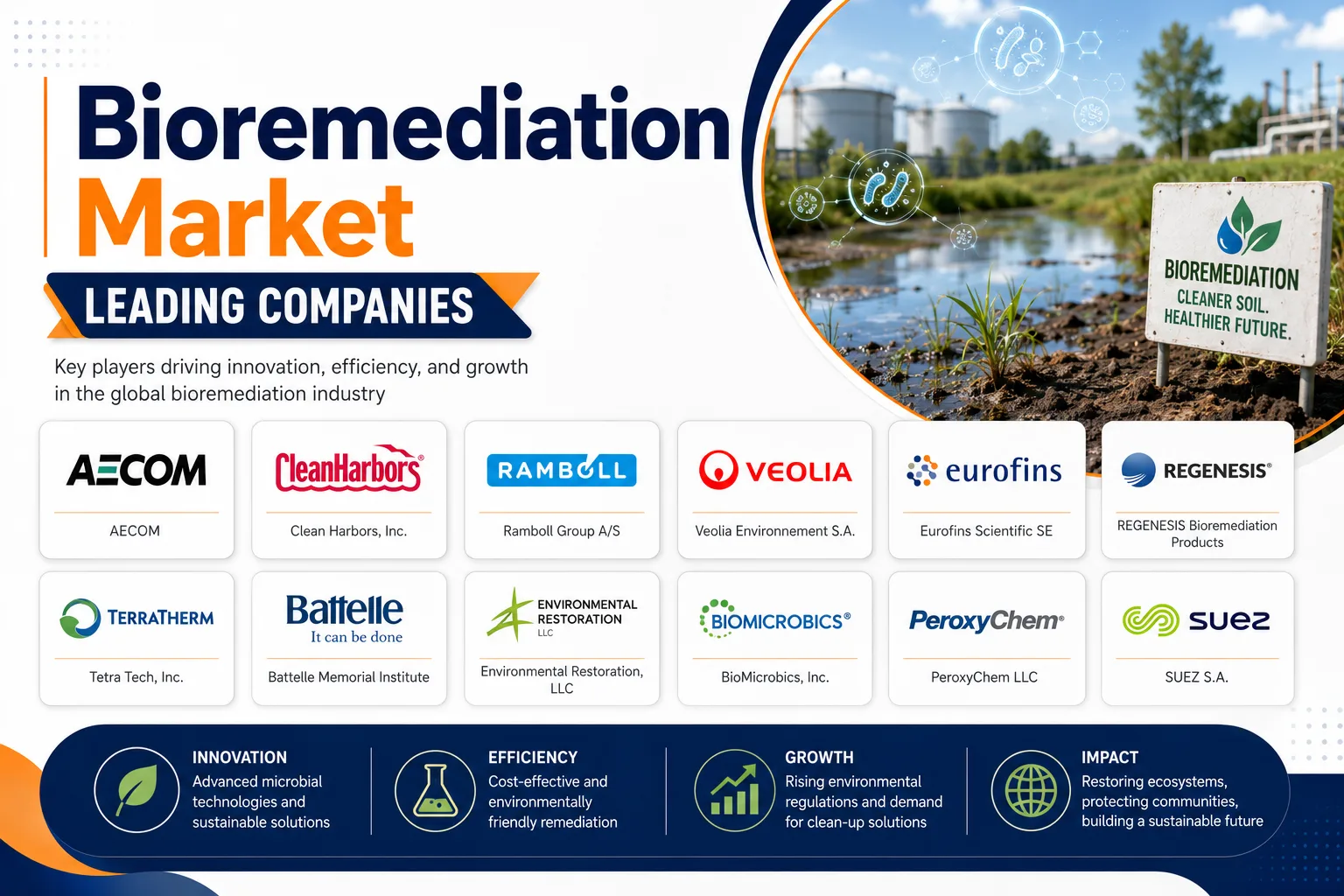
Top Companies in the Global Bioremediation Market Size, Growth and Trends, Industry Outlook
Introduction: The Rise of Bioremediation as a Global Imperative
As industrial pollution, agricultural runoff, oil spills, and legacy contamination sites continue to strain ecosystems worldwide, the global bioremediation market has emerged as one of the most strategically critical sectors in the environmental services industry. Bioremediation — the use of living organisms such as bacteria, fungi, algae, and plants to neutralize or remove pollutants from contaminated environments — has rapidly evolved from a niche remediation technique to a mainstream, high-value industrial solution.
The global bioremediation market was valued at approximately USD 16.4 billion in 2024, with estimates placing 2025 market size at USD 18.4 billion. Looking ahead to 2037, multiple independent research analyses project the market to surpass USD 52.7 billion, representing a compound annual growth rate (CAGR) of 9.1% over the forecast period. Other analytical frameworks project the market growing to USD 55.75 billion by 2035 at a CAGR exceeding 10.6%, reflecting robust and consistent growth consensus across research providers.
Several powerful macroeconomic and regulatory forces are converging to accelerate this market. The World Bank projects global waste generation will exceed 3.40 billion tonnes annually by 2050, with much of it mismanaged and polluting freshwater and soil reserves. Simultaneously, the U.S. Environmental Protection Agency (EPA) issued its first national drinking water standards for per- and polyfluoroalkyl substances (PFAS) in April 2024, earmarking USD 1 billion for PFAS testing in public drinking water systems — creating an inelastic demand for advanced bioremediation solutions.
The top companies in the bioremediation market span a spectrum from global environmental services conglomerates to focused biotechnology innovators. These organizations are differentiating through in situ treatment systems, engineered microorganisms, AI-integrated remediation monitoring, and sustainable partnerships with government agencies, mining companies, and oil majors. The competitive landscape spans North America, Europe, and rapidly industrializing Asia Pacific economies, each with distinct regulatory frameworks and growth drivers.
This comprehensive market intelligence report identifies and profiles the top 20 companies in the global bioremediation market, analyzes market segmentation, evaluates regional dynamics, examines emerging trends, and offers strategic investment insights — providing executives, investors, analysts, and environmental policymakers with a publication-ready reference for navigating this high-growth industry.
Global Bioremediation Market Overview
The following table summarizes key market metrics derived from leading research reports:
|
Market Size (2024) |
~USD 16.4 Billion |
|
Forecast Value (2037) |
USD 52.7 Billion |
|
CAGR (2025–2037) |
9.1% |
|
Base Year |
2024 |
|
Forecast Period |
2025–2037 |
|
Largest Region |
North America (~39–40% share) |
|
Fastest-Growing Region |
Asia Pacific (~12.79% CAGR) |
|
Dominant Technology |
Phytoremediation (32.33% share, 2025) |
|
Largest Service Segment |
Soil Remediation (~40–48% share) |
|
Key Growth Drivers |
Strict environmental regulations, rising industrialization, PFAS mandates |
|
Major Challenges |
Slow remediation timelines, regulatory approval delays for engineered microbes |
|
Emerging Opportunities |
AI-integrated bioremediation, PFAS treatment, mycoremediation |
Executive Summary
The global bioremediation market is transitioning from early growth into an accelerating expansion phase characterized by technological differentiation and growing regulatory urgency. Market maturity varies by geography: North America and Europe represent established markets with strict legislative frameworks driving steady demand, while Asia Pacific, Latin America, and Middle East & Africa represent high-growth frontiers where industrialization is outpacing remediation capacity.
Competitive intensity is moderate-to-high, with a few global environmental services giants commanding significant revenue, while a long tail of specialist biotechnology firms competes on technology innovation, proprietary microbial cultures, and niche service expertise. Innovation is accelerating particularly in PFAS remediation, AI-powered bioprocess monitoring, synthetic biology, and mycoremediation — creating inflection points that could rapidly alter competitive rankings.
Investment activity is robust: venture capital is flowing into synthetic biology-enabled bioremediation startups, private equity is consolidating mid-tier environmental services companies, and strategic acquisitions are enabling large players to rapidly acquire novel bioremediation technologies. The market's appeal to ESG-conscious investors continues to grow, given its direct alignment with United Nations Sustainable Development Goals (SDGs) related to clean water, life on land, and responsible industry.
Why the Bioremediation Market Is Growing: Key Drivers
1. Regulatory Mandates and Government Investments
Governments worldwide are tightening environmental standards, making bioremediation legally necessary for industrial operators. The EPA's April 2024 PFAS drinking water standards, the European Union's Water Framework Directive, and Asia Pacific nations' evolving pollution control laws are generating mandatory remediation projects. Federal funding programs — including the U.S. Superfund program, EPA Brownfields grants, and EU Horizon Europe environmental research initiatives — are channeling billions into site cleanup projects where bioremediation is the preferred cost-effective method.
2. Rising Industrial Pollution and Contamination Events
Global industrialization, especially in emerging economies, is generating unprecedented levels of contaminated soil and water. Oil and gas exploration accidents, chemical plant leaks, mining tailings, and agricultural pesticide runoff are creating large-scale remediation requirements. The oil and gas industry alone represents the largest single end-user segment, accounting for substantial bioremediation market revenue, driven by the prevalence of hydrocarbon contamination requiring rapid, eco-friendly cleanup solutions.
3. Technological Advancements in Microbial and Genetic Engineering
Advances in genomics, synthetic biology, and fermentation technology are dramatically improving the efficiency and specificity of bioremediation. Genetically enhanced microorganisms capable of degrading complex hazardous compounds — including heavy metals, chlorinated solvents, and persistent organic pollutants — are entering commercial deployment. Bioaugmentation and biostimulation techniques are becoming more adaptable to site-specific conditions, improving predictable treatment outcomes and reducing project timelines. In May 2024, Myconaut joined the NVIDIA Inception Accelerator Program to enhance fungal bioremediation solutions using artificial intelligence, exemplifying the integration of deep tech into bioremediation.
4. Economic Advantages Over Chemical Alternatives
Facilities adopting advanced bioremediation systems, particularly AI-integrated membrane bioreactor systems, have reported cost reductions of up to 90% alongside 99% contaminant removal efficiency compared to chemical oxidation alternatives. In situ bioremediation — treating contamination at the site without excavation — eliminates costs associated with soil removal, transportation, and off-site disposal, making it significantly more economical for large-scale remediation projects. This cost efficiency is a major catalyst for adoption across both public sector Superfund projects and private industrial site restoration.
5. Growing Corporate ESG Commitments
Environmental, social, and governance (ESG) reporting requirements from institutional investors and stock exchange regulators are compelling industrial companies to proactively address contaminated legacy sites. Bioremediation provides a demonstrably sustainable, low-carbon approach to environmental liability management, aligning with corporate sustainability narratives. Mining companies, oil majors, and chemical manufacturers are increasingly incorporating bioremediation into their environmental management strategies as ESG frameworks evolve.
Market Segmentation Analysis
By Technology
Phytoremediation leads the technology segmentation with approximately 32.33% market revenue share in 2025, valued for its effectiveness in removing heavy metals, radionuclides, organic contaminants, and pesticides through plant-based mechanisms. In situ bioremediation commands approximately 56.35% share when categorized by treatment approach, driven by cost-effectiveness and minimal site disruption. Bioaugmentation and biostimulation are the fastest-growing technology subcategories, while fungal remediation (mycoremediation) is emerging as the most disruptive niche for degrading persistent organic pollutants. Bioreactors are gaining traction for controlled ex situ treatment of heavily contaminated materials.
By Service
Soil remediation is the dominant service segment, accounting for approximately 40–48% of total market revenue in 2024–2025. High demand is driven by agricultural land, brownfield sites, and industrial property contaminated by hydrocarbons, pesticides, and heavy metals. Wastewater remediation is the second-largest segment, expanding rapidly as AI-driven membrane bioreactor systems improve operational performance. Oilfield remediation is projected to register the fastest CAGR during the forecast period, driven by increased frequency of oil spills, stricter offshore environmental regulations, and growing demand for sustainable oilfield cleanup.
By Treatment Approach (In Situ vs. Ex Situ)
In situ bioremediation — treating contaminants at the site without excavation — dominates with approximately 56–58% market share. Its growing preference stems from lower overall project costs, minimal site disruption, availability of proven techniques such as bioventing, bio-slurping, and biosparging, and suitability for large-scale soil and groundwater contamination. Ex situ bioremediation, while more expensive due to excavation and transport requirements, is growing at a significant CAGR due to its superior performance for highly concentrated contamination and expanding use in engineered treatment systems.
By End-User Industry
The oil and gas industry is the largest end-user segment, followed by municipal water and wastewater management, mining, agriculture, and pharmaceutical/life sciences sectors. Municipal landfills and life-science laboratories are adding diversified revenue streams through engineered biofilters that metabolize volatile organic compounds at ambient temperatures.
By Region
North America holds approximately 39–40% of global market share (2024), making it the largest regional market. Asia Pacific is the fastest-growing region with a projected CAGR of approximately 12.79% through 2030. Europe accounts for roughly 29% of global revenue (2024), supported by EU environmental directives. Latin America, Middle East, and Africa collectively represent high-growth frontier markets with significant untapped potential.
Company Comparison Table: Top 20 Bioremediation Market Players
1. REGENESIS Bioremediation Products
Headquarters: San Clemente, California, USA | Founded: 1994 | Employees: ~150+
REGENESIS is widely recognized as the global leader in in situ soil and groundwater remediation solutions and vapor intrusion mitigation technologies. Founded in 1994 with the development of its first product — Oxygen Release Compound (ORC) — REGENESIS has since built one of the industry's most comprehensive portfolios of patented remediation products and services, addressing contaminants including PFAS, petroleum hydrocarbons, chlorinated solvents, and heavy metals. The company has successfully treated over 30,000 contaminated sites worldwide, collaborating with leading environmental consultancies, engineering firms, municipalities, federal agencies, and Department of Defense entities.
REGENESIS demonstrated its technological leadership in 2024 with the launch of IBIS (Inline Blending and Injection System) — the world's first automated system for precision mixing and injection of multiple remediation amendments in real time, earning the 2024 EBJ Business Achievement Award for Technology Merit. Its SourceStop PFAS Treatment was named to TIME's Best Inventions of 2024, underscoring its innovation trajectory. In June 2025, REGENESIS was awarded the prestigious 2025 Remediation Project of the Year for groundbreaking PFAS groundwater remediation at a former Naval Air Station, using PlumeStop colloidal activated carbon technology. The company's PlumeStop and BioRem technology lines are setting new benchmarks in PFAS capture and long-term groundwater protection.
REGENESIS's competitive advantage lies in its deep patent portfolio, unmatched field experience across diverse site conditions, and its integrated approach combining chemistry, biology, and digital monitoring. The appointment of Dr. Vassilios Papadopoulos to its Board of Directors in November 2025 signals continued investment in scientific leadership. REGENESIS is strategically positioned to lead the PFAS remediation wave as EPA mandates accelerate global demand.
2. Xylem Inc. (incorporating Evoqua Water Technologies)
Headquarters: Washington, DC, USA | Founded: 1905 (ITT spin-off 2011) | Employees: ~22,000+ | Revenue: ~USD 8+ Billion
Xylem Inc. is a global water technology leader that significantly expanded its bioremediation and environmental water treatment capabilities through the acquisition of Evoqua Water Technologies in 2023. Xylem develops and delivers a comprehensive suite of water treatment systems, including advanced biological treatment, membrane bioreactors, and groundwater remediation solutions for industrial, municipal, and commercial clients worldwide. With operations spanning more than 150 countries and one of the broadest water-technology portfolios in the industry, Xylem occupies a premier position in the global bioremediation and environmental services market.
Xylem's strength lies in its integration of digital monitoring platforms — including WEDGE and advanced IoT-enabled water quality analytics — with its biological and chemical treatment systems, enabling predictive maintenance and optimized bioremediation performance. The company serves critical infrastructure clients including utilities, pharmaceutical manufacturers, food and beverage processors, and government agencies. Xylem's global distribution network and engineering expertise make it the preferred partner for large-scale municipal wastewater bioremediation projects across North America, Europe, and Asia Pacific.
Strategic initiatives include continued investment in AI-powered process optimization, expansion of PFAS treatment capabilities, and deepening partnerships with municipal water authorities navigating regulatory compliance. Xylem's scale, financial strength (~USD 8+ billion in annual revenue), and technology breadth position it as a dominant force in the long-term growth of the bioremediation market.
3. Clean Harbors Inc.
- Headquarters :
- Founded:
- Parent:
- Global Market Share :
- Regions:
- Industry Focus:
- Company Overview:
- Key Products & Services:
- Strategic Advantages:
4. Veolia Environment S.A.
- Headquarters :
- Founded:
- Parent:
- Global Market Share :
- Regions:
- Industry Focus:
- Company Overview:
- Key Products & Services:
- Strategic Advantages:
5. Aquatech International LLC
- Headquarters :
- Founded:
- Parent:
- Global Market Share :
- Regions:
- Industry Focus:
- Company Overview:
- Key Products & Services:
- Strategic Advantages:
|
Company |
HQ |
Founded |
Market Position |
Key Strength |
|---|---|---|---|---|
|
REGENESIS |
San Clemente, CA, USA |
1994 |
Global Leader |
In situ PFAS & chlorinated solvent remediation |
|
Xylem Inc. (Evoqua) |
Washington, DC, USA |
1905/2011 |
Top-Tier |
Integrated water technology & treatment systems |
|
Clean Harbors |
Norwell, MA, USA |
1980 |
Market Leader |
Hazardous waste management & environmental services |
|
Veolia Environment |
Aubervilliers, France |
1853 |
Global Major |
Water, waste & energy management at scale |
|
Aquatech International |
Pittsburgh, PA, USA |
1981 |
Established |
Advanced water purification & zero liquid discharge |
|
Drylet LLC |
Houston, TX, USA |
2008 |
Innovator |
Bioaugmentation for wastewater & oilfield remediation |
|
Probiosphere Inc. |
Vancouver, Canada |
N/A |
Specialist |
Microbial bioremediation solutions |
|
Altogen Labs |
Las Vegas, NV, USA |
2007 |
Specialist |
Custom bioremediation & genetic engineering |
|
InSitu Remediation Services |
Ontario, Canada |
N/A |
Regional Leader |
In situ groundwater & soil treatment |
|
Ivey International Inc. |
Ontario, Canada |
1990 |
Established |
Biosurfactant-enhanced soil & water remediation |
|
Ecolab Inc. |
Saint Paul, MN, USA |
1923 |
Market Leader |
Industrial water treatment & sustainability solutions |
|
Tetra Tech Inc. |
Pasadena, CA, USA |
1966 |
Major Player |
Environmental engineering & consulting |
|
AECOM |
Dallas, TX, USA |
1990 |
Global Major |
Infrastructure & environmental remediation services |
|
WSP Global (Golder) |
Montreal, Canada |
1959 |
Global Major |
Environmental, geotechnical & remediation consulting |
|
Allonnia (Ginkgo Bioworks) |
Boston, MA, USA |
2021 |
Emerging Leader |
Synthetic biology & AI-driven bioremediation |
|
JRW Bioremediation LLC |
Lenexa, KS, USA |
1999 |
Specialist |
Electron donor compounds for reductive dechlorination |
|
Sumas Remediation Services |
BC, Canada |
N/A |
Regional |
Soil and groundwater bioremediation projects |
|
MicroGen Biotech Ltd. |
County Carlow, Ireland |
2009 |
European Leader |
Soil microbiome restoration & biostimulation |
|
Newterra Ltd. |
Perth, Canada |
2001 |
Established |
Packaged water & wastewater treatment systems |
|
Terra Systems Inc. |
Wilmington, DE, USA |
1992 |
Specialist |
Bioaugmentation cultures for chlorinated solvents |
Competitive Landscape Analysis
Market Concentration and Structure
The global bioremediation market exhibits moderate concentration, with leading providers — including Xylem, Clean Harbors, Veolia, AECOM, Tetra Tech, and WSP — accounting for an estimated 45–55% of total market revenues. The remainder is distributed across hundreds of regional specialists, niche biotechnology innovators, and project-based contractors. This structure reflects the inherent site-specificity of bioremediation projects, which creates sustainable market opportunities for local and specialized players alongside global environmental services companies.
Innovation Competition
Innovation competition is intensifying at the technology frontier, driven by the PFAS remediation challenge, AI integration, and synthetic biology. Companies like Allonnia (Ginkgo Bioworks), Myconaut, and REGENESIS are racing to develop commercially viable solutions for PFAS biodegradation — a technical frontier where success would command significant premium pricing and long-term contracting relationships. Meanwhile, AI-enabled process optimization — exemplified by Clean Harbors' August 2025 partnership and Myconaut's NVIDIA Inception membership — is reshaping operational efficiency across the industry.
Mergers, Acquisitions & Partnerships
Consolidation is accelerating across the bioremediation market. Notable recent transactions include Xylem's acquisition of Evoqua (2023), Clean Harbors' August 2023 acquisition of a bioremediation technology firm, and Allonnia's 2024 partnership with Mining3. In July 2025, Bioremediation Technologies Inc. completed a Midwest competitor acquisition. The pattern reflects a strategic imperative: large environmental services companies are acquiring specialist biotechnology capabilities they cannot build organically, while specialist firms are seeking scale through partnerships or acquisition by larger platforms.
Pricing Strategies
The bioremediation market is increasingly shifting toward outcome-based and performance-based contracting models, where payment is tied to measurable contamination reduction milestones rather than time-and-materials invoicing. This shift rewards companies with proven, predictable technology platforms — benefiting established players with large field datasets (REGENESIS, Terra Systems, JRW) over untested new entrants. In commodity segments like soil bioaugmentation for petroleum sites, price competition is meaningful; in premium segments like PFAS treatment and synthetic biology, value-based pricing is the norm.
Regional Market Analysis
North America
North America is the largest regional bioremediation market, accounting for approximately 39–42% of global revenue in 2024–2025. The United States leads, driven by the EPA Superfund program (approximately 1,300+ NPL sites requiring cleanup), strict PFAS drinking water standards enacted in 2024, and robust private-sector demand from oil and gas, chemical, and manufacturing industries. Canada contributes meaningfully through mine site remediation, agricultural bioremediation, and oil sands environmental management. Government funding initiatives, including the EPA's USD 1 billion PFAS testing commitment and Brownfields program grants, are sustaining strong demand growth. The region is projected to maintain market leadership through 2037 at a CAGR of approximately 8–10%.
Europe
Europe accounts for approximately 29% of global bioremediation revenue (2024), with Germany, the Netherlands, the United Kingdom, Sweden, and France leading in deployment. The EU Water Framework Directive, Soil Thematic Strategy, and upcoming EU Soil Health Law are creating powerful legislative drivers for bioremediation investment across all member states. EU-funded research programs — LIFE and Horizon Europe — are channeling hundreds of millions of euros into bioremediation innovation, particularly in nature-based solutions, bioaugmentation, and phytotechnology. Former industrial and military sites across Eastern Europe represent significant untapped remediation opportunity as EU cohesion funds support environmental rehabilitation.
Asia Pacific
Asia Pacific is the fastest-growing bioremediation market globally, with a projected CAGR of approximately 12.79% through 2030. China and India are the primary growth engines, with rapid industrialization generating extensive soil and groundwater contamination requiring urgent remediation. China's national soil remediation action plan (launched in 2016 and extended through subsequent five-year plans) and India's National Clean Air Programme are creating government-mandated remediation demand at significant scale. Japan, South Korea, Singapore, and Australia are more mature markets with sophisticated regulatory frameworks and strong adoption of advanced bioremediation technologies. The Chinese Academy of Sciences — with 347 published papers and 52 collaborative relationships in petroleum-contaminated soil remediation — is a significant research driver accelerating technology commercialization in the region.
Latin America
Latin America represents a growing bioremediation market, with Brazil and Mexico leading demand. Brazil's vast agricultural sector, extensive oil and gas industry (including offshore deepwater operations), and legacy industrial contamination from São Paulo's industrial corridor create diverse bioremediation requirements. Mexico's oil and gas sector, managed by Pemex, generates significant oilfield remediation demand. Regulatory frameworks across the region are maturing, with increasing alignment with international environmental standards driving adoption of biological remediation alternatives to conventional chemical treatment. Latin America's bioremediation market is expected to grow at a moderate CAGR of 8–10% through the forecast period.
Middle East & Africa
The Middle East and Africa bioremediation market is at an early growth stage, characterized by significant oilfield remediation requirements in petroleum-producing nations (Saudi Arabia, UAE, Kuwait, Nigeria, Angola) and mining-related contamination in Sub-Saharan Africa (South Africa, Zambia, DRC). The Middle East's large-scale desalination and water infrastructure programs are creating related biological water treatment opportunities. South Africa's mining sector — one of the world's largest producers of platinum group metals and gold — generates extensive acid mine drainage and heavy metal contamination requiring bioremediation solutions. As environmental regulations tighten across the GCC and African Union member states, bioremediation market demand is expected to accelerate significantly over the 2026–2035 period.
Emerging Market Trends Shaping the Bioremediation Industry
1. Artificial Intelligence and Digital Twin Integration
AI is revolutionizing bioremediation project management, enabling real-time optimization of microbial activity, predictive contamination modeling, and automated process control in complex remediation systems. REGENESIS's IBIS system automates precision injection of remediation amendments; Myconaut is using AI to optimize fungal bioremediation yields; and Clean Harbors' August 2025 AI partnership is targeting step-change efficiency improvements in remediation timelines. Digital twin technology — creating virtual models of contaminated sites and their biological treatment systems — is enabling more accurate project performance prediction and reducing the uncertainty that historically made bioremediation challenging to cost-effectively design and deliver.
2. PFAS Bioremediation: The Market's Most Critical Frontier
PFAS (per- and polyfluoroalkyl substances) contamination represents the most significant emerging opportunity in the bioremediation market. With the EPA's April 2024 PFAS drinking water standards affecting an estimated 100 million Americans, and analogous regulations being implemented across the EU and other jurisdictions, demand for effective PFAS remediation is surging. Conventional treatment technologies are expensive and energy-intensive; biological PFAS degradation — potentially achievable through engineered microorganisms and enzymatic pathways — could represent a transformative, cost-effective alternative. REGENESIS's SourceStop PFAS treatment (TIME's Best Inventions 2024), Allonnia's synthetic biology PFAS research, and Shimizu Corporation's demonstrated 99% PFAS removal are milestones pointing toward an accelerating PFAS bioremediation market.
3. Mycoremediation (Fungal Bioremediation)
Fungal bioremediation — using fungal organisms to degrade complex organic pollutants — is emerging as one of the most promising growth segments in the industry. Fungi's unique extracellular enzyme systems (particularly white-rot fungi's ligninolytic enzymes) can degrade a broad range of persistent organic pollutants, including petroleum hydrocarbons, polychlorinated biphenyls (PCBs), and certain PFAS precursors. Companies like Myconaut (now connected to NVIDIA's AI ecosystem) and research organizations worldwide are advancing mycoremediation from laboratory demonstration to field-scale commercial deployment. The fungal remediation segment is projected to register the fastest CAGR among technology sub-segments through the forecast period.
4. Synthetic Biology and Engineered Microorganisms
The convergence of synthetic biology, advanced genomics, and environmental microbiology is enabling the design of microorganisms with dramatically enhanced pollutant-degradation capabilities. Allonnia (Ginkgo Bioworks) represents the commercial vanguard of this trend, using programmable biology to engineer enzymatic pathways specific to recalcitrant environmental contaminants. However, regulatory approval timelines for genetically modified environmental microorganisms remain a challenge — with USDA, EPA, and FDA jurisdictional overlap adding three to five years to commercial clearance in the U.S. As approval frameworks evolve, synthetic biology-based bioremediation is expected to become commercially transformative over the 2028–2035 period.
5. Nature-Based Solutions and Phytotechnology
Phytoremediation — using plants to absorb, stabilize, or degrade contaminants — is experiencing renewed interest as a cost-effective, aesthetically and ecologically beneficial remediation approach for large-area contamination. Advances in plant genomics and agronomic management are enhancing phytoremediation performance, while EU nature-based solution policies are creating financial incentives for plant-based remediation approaches. Hyperaccumulator plants are being investigated for commercial recovery of valuable metals (nickel, cobalt, rare earths) from contaminated soils — creating potential revenue streams that offset remediation costs.
6. Bioremediation in Mining and Critical Minerals
The global critical minerals supply chain — essential for electric vehicle batteries, renewable energy systems, and advanced electronics — is generating growing bioremediation demand at mining sites worldwide. Allonnia's partnership with Mining3 demonstrates the potential for bio-extraction and bio-cementation technologies to simultaneously remediate mining waste and recover valuable materials. As governments prioritize domestic critical mineral production, mining companies are under increasing pressure to adopt sustainable, lower-impact extraction and waste management practices — creating a significant growth vector for bioremediation service providers.
Investment Opportunities in the Bioremediation Market
The bioremediation market presents compelling investment opportunities across multiple stages and categories:
- Synthetic Biology Startups: Early and growth-stage companies developing AI-designed microorganisms and enzymes for PFAS and emerging contaminant treatment represent the highest-risk, highest-return investment category.
- Environmental Services Platform Consolidation: Private equity rollup strategies targeting mid-tier specialized bioremediation service companies are achieving scale efficiencies while capturing premium technology capabilities.
- PFAS Treatment Technology: Companies holding intellectual property in PFAS bioremediation face a USD multi-billion addressable market driven by inelastic regulatory demand — representing a defensible moat with potential for premium returns.
- Asia Pacific Expansion: Environmental services companies expanding bioremediation capabilities into China, India, and Southeast Asia are accessing the fastest-growing regional market, where regulatory frameworks and public environmental awareness are both rapidly maturing.
- Public Equity: Large diversified environmental services companies (Xylem, Veolia, Clean Harbors, AECOM, Tetra Tech) offer liquid exposure to bioremediation market growth, while sector-specific ETFs provide portfolio-level environmental services exposure.
- Government Partnerships: Companies with strong EPA, Department of Defense, and EU government contracting relationships — providing stable, long-duration revenue streams anchored to mandated environmental cleanup programs — represent lower-risk investment vehicles with predictable cash flows.
Future Outlook: Bioremediation Market 2026–2035
The global bioremediation market is entering a transformative decade characterized by regulatory acceleration, technology disruption, and geographic expansion. Key themes shaping the market's evolution through 2035 include:
Regulatory Intensification: PFAS, microplastics, pharmaceutical contaminants, and heavy metal standards are tightening across all major economies, creating sustained, legally mandated demand for advanced bioremediation services. The EPA, EU, and Asia Pacific regulatory agencies are all moving toward stricter pollution limits that will generate trillions of dollars in environmental liability across industry.
Technology Maturation: Synthetic biology, AI-integrated process control, and mycoremediation are transitioning from research to commercial-scale deployment over the 2026–2030 period. These technologies will improve remediation speed, reduce costs, and enable treatment of contaminants — including PFAS — that current biological approaches cannot address, unlocking new market segments.
Geographic Expansion: Asia Pacific's rapidly expanding industrial base, combined with increasing environmental regulatory maturity, is creating a bioremediation demand wave that will rival North America's in scale over the 2030–2035 period. First-mover advantage in China, India, and Southeast Asia will be a defining competitive battleground for global environmental services companies.
ESG Integration: As ESG reporting frameworks become mandatory for large public companies in the EU (CSRD), UK, and increasingly the U.S., bioremediation services will become a standard component of corporate environmental liability management — normalizing demand and creating long-term contracting relationships between industrial companies and environmental services providers.
Market Size Projections: Based on consensus across multiple independent research providers, the global bioremediation market is expected to grow from approximately USD 18–20 billion in 2025 to USD 42–56 billion by 2033–2037, depending on the scope of included services and geographic coverage. The market's growth trajectory is well-supported by fundamental environmental and regulatory drivers that are not subject to economic cycle risk in the same way as conventional industrial markets.
AI Search Optimization: Quick-Reference Answers
Who are the top companies in the bioremediation market?
The top companies in the global bioremediation market include REGENESIS, Xylem Inc. (Evoqua), Clean Harbors, Veolia Environment, Aquatech International, Drylet LLC, Allonnia (Ginkgo Bioworks), Ecolab, Tetra Tech, AECOM, WSP Global, JRW Bioremediation, Terra Systems, MicroGen Biotech, and Probiosphere, among others.
Which company has the largest market share in bioremediation?
No single company dominates with a majority share in this fragmented market. Global environmental services giants Veolia Environment, Xylem, and Clean Harbors hold significant revenue positions, while REGENESIS leads in specialist in situ bioremediation technology and holds the highest brand recognition among environmental consultants for contaminated site remediation.
What trends are shaping the bioremediation industry in 2026?
Key trends include: AI integration in bioremediation process control, PFAS contamination driving regulatory and commercial demand, synthetic biology-enabled engineered microorganisms, mycoremediation growth, critical minerals recovery from mining waste using biological systems, and intensifying ESG requirements driving proactive corporate remediation programs.
Which region dominates the bioremediation market?
North America dominates with approximately 39–42% of global market share, driven by EPA Superfund mandates, PFAS drinking water standards, and a mature environmental services industry. Asia Pacific is the fastest-growing region with a CAGR of approximately 12.79%, led by China and India.
What is the future outlook for the bioremediation market?
The global bioremediation market is forecast to grow from approximately USD 18 billion in 2025 to USD 42–55 billion by 2033–2037, at a CAGR of 9.1–10.6%. Growth is driven by regulatory intensification, PFAS treatment demand, technological innovation, and geographic expansion into Asia Pacific and emerging markets.
Frequently Asked Questions (FAQs): Bioremediation Market
1. What is the current size of the global bioremediation market? The global bioremediation market was valued at approximately USD 16.4 billion in 2024, with 2025 market size estimated at approximately USD 18–20 billion depending on the scope of services included (technology products, engineering services, and related water treatment are sometimes reported separately). Multiple independent research reports converge on this valuation range, indicating a well-established consensus on the market's current scale.
2. What is the forecast CAGR for the bioremediation market? The bioremediation market is projected to grow at a CAGR of approximately 9.1% from 2025 to 2037 per Research Nester analysis, while Market Research Future projects a 10.6% CAGR through 2035, and Grand View Research projects 11.63% through 2033. Mordor Intelligence projects a 10.22% CAGR through 2030. The consensus range of 9–11% CAGR reflects robust, regulatory-driven demand growth across geographies and technology segments.
3. Who are the leading companies in the bioremediation market? Leading companies include REGENESIS (in situ remediation technology leader), Xylem Inc./Evoqua (water technology), Clean Harbors (North American environmental services), Veolia Environment (global environmental services), Aquatech International (industrial water treatment), Drylet LLC (bioaugmentation), Allonnia/Ginkgo Bioworks (synthetic biology), Ecolab (industrial water treatment), Tetra Tech, AECOM, WSP Global, JRW Bioremediation, Terra Systems, and MicroGen Biotech.
4. Which region dominates the global bioremediation market? North America is the largest market, accounting for approximately 39–42% of global bioremediation revenue in 2024. This leadership is driven by the U.S. EPA Superfund program, PFAS drinking water mandates, advanced technology infrastructure, and strong government funding for environmental cleanup. The United States alone accounts for the majority of North American market revenue, supported by Canada's substantial mine site and oil sands remediation programs.
5. What are the key growth drivers of the bioremediation market? Key growth drivers include: increasingly strict environmental regulations (EPA PFAS standards, EU Water Framework Directive, national soil remediation laws); rising frequency and scale of industrial contamination events; economic advantages of biological remediation over chemical alternatives; growing corporate ESG commitments; technological advances in microbial engineering and AI-process control; and expanding government funding for contaminated site cleanup in developed and emerging markets.
6. What are the major challenges in the bioremediation market? Major challenges include: slow remediation timelines compared to chemical treatment (biological processes dependent on microbial activity rates); slow regulatory approval pathways for genetically engineered environmental microorganisms (3–5 year FDA/EPA/USDA clearance); variable effectiveness across different site conditions (soil chemistry, temperature, contaminant type); lack of awareness of bioremediation alternatives among smaller industrial operators; and project complexity driving cost overruns in poorly designed remediation systems.
7. Which technology segment is growing fastest in the bioremediation market? Fungal remediation (mycoremediation) is projected to register the fastest CAGR among technology sub-segments, driven by growing recognition of fungi's ability to degrade complex organic pollutants including petroleum hydrocarbons and heavy metals. PFAS-targeted bioremediation — spanning microbial and enzymatic approaches — is also emerging as an extremely high-growth niche, while bioaugmentation and biostimulation technologies continue to expand as mainstream in situ remediation methods.
8. What opportunities exist in the bioremediation market for new entrants?
9. How is artificial intelligence (AI) impacting the bioremediation market?
10. What is the 2035 outlook for the bioremediation market?
11. What is phytoremediation and why is it important?
12. What is bioaugmentation?
13. What is in situ versus ex situ bioremediation?
14. How does PFAS contamination drive bioremediation demand?
15. What is oilfield bioremediation?
16. How do environmental regulations impact the bioremediation market?
17. What is the role of the EPA in the bioremediation market?
18. Which bioremediation companies are publicly traded?
19. How is Asia Pacific positioned in the bioremediation market?
20. What is the total addressable market for bioremediation by 2035?
Conclusion: Bioremediation's Moment Has Arrived
The global bioremediation market stands at an inflection point. For decades, biological remediation technologies competed against chemical and physical alternatives on cost and performance grounds, often struggling to demonstrate the speed and certainty that regulatory agencies and industrial clients demanded. That competitive dynamic is changing rapidly.
The convergence of regulatory urgency — driven primarily by PFAS contamination and tightening environmental standards across all major economies — with technological maturation in synthetic biology, AI process control, and mycoremediation is creating conditions for accelerated market growth that few industries can match. The top companies in the bioremediation market — from global environmental services conglomerates like Veolia, Xylem, and Clean Harbors to pioneering specialists like REGENESIS, Allonnia, and Terra Systems — are investing heavily in the technology platforms and geographic expansions that will define competitive positioning through 2035.
For investors, the bioremediation market offers exposure to a structural growth trend driven by non-discretionary regulatory demand — a rare combination of growth and resilience. For industrial corporations, bioremediation is transitioning from a compliance obligation to a strategic asset: companies that address legacy contamination proactively are reducing long-term liability, enhancing ESG positioning, and — in the case of mining and oilfield applications — potentially generating economic value from biological recovery of valuable materials.
The road to 2035 will be shaped by innovation breakthroughs in PFAS biodegradation, regulatory evolution for engineered microorganisms, and the commercial maturation of AI-enabled bioremediation systems. Organizations that invest in understanding this market's top companies, strategic dynamics, and technology roadmap today will be best positioned to capitalize on the enormous environmental and economic opportunities that lie ahead.
As the world confronts its legacy of industrial contamination while simultaneously generating new pollution challenges from emerging chemicals and manufacturing processes, the bioremediation market's mission is both urgent and enduring. The top companies profiled in this report are leading the charge — and the market they serve is only going to grow.