
Top 20 Companies in the Global Last Mile Delivery Market Driving Industry Growth
Author:
Intellectual Market Insights Research
Published Date:
09 Jul 2026
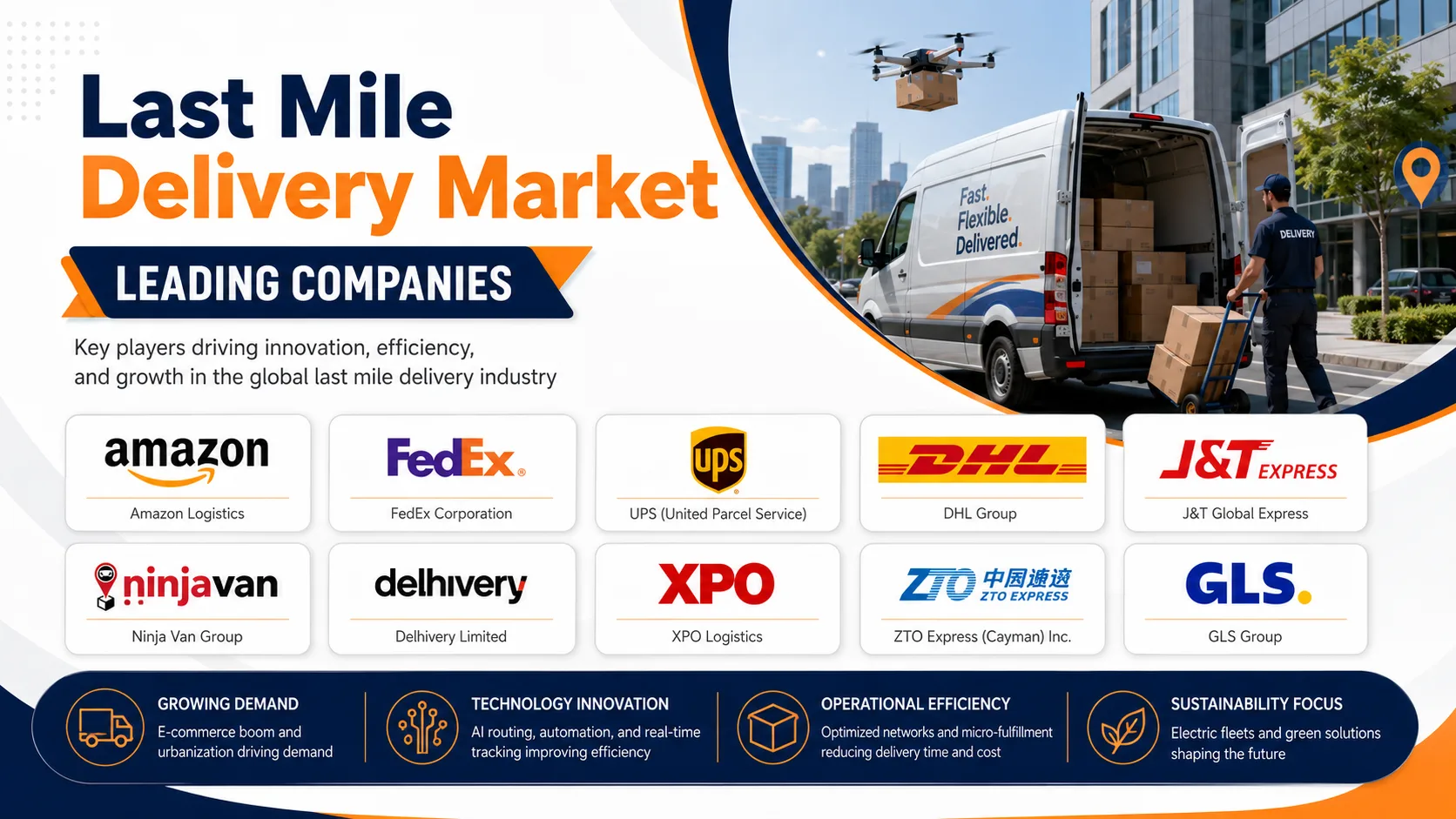
Top 20 Leading Players in the Global Last Mile Delivery Market 2026
In the modern age of e-commerce, consumers expect their purchases to arrive faster than ever sometimes within hours of placing an order. The infrastructure that makes this possible is the last mile delivery market: the final, most complex, and most costly stage of the supply chain, where packages travel from a distribution hub or fulfillment center directly to a customer's doorstep. Rising parcel volumes, AI-driven route optimization, electric vehicle fleets, and autonomous delivery technologies are reshaping how goods reach consumers worldwide.
The Global Last Mile Delivery Market size was valued at USD 167.1 Billion in 2025 to USD 388 Billion by 2034, growing at a CAGR of 9.7% in the forecast period (2025–2034).
The rapid integration of Artificial Intelligence (AI), electric vehicles (EVs), drones, autonomous robots, and cloud-based logistics platforms has enabled carriers to build faster, cheaper, and greener delivery networks. From AI route-optimization engines that shave millions of miles off delivery routes to sidewalk robots and delivery drones, technology is redefining how packages move through the final and most expensive leg of their journey.
This article highlights the Top 20 Leading Companies in the Global Last Mile Delivery Market 2025, profiling the organizations driving innovation, expanding delivery networks, and shaping the future of e-commerce fulfillment.
What is Last Mile Delivery?
Last mile delivery refers to the final leg of the supply chain the movement of goods from a distribution center, warehouse, or fulfillment hub directly to the end consumer's doorstep, locker, or pickup point. It is broadly defined as the "final mile," yet in practice it can span dozens of miles in rural areas, where delivery costs can reach approximately $50 per package, compared to roughly $10 per package in dense urban zones.
The last mile delivery ecosystem includes traditional parcel carriers, e-commerce-owned delivery fleets, regional couriers, freight forwarders, gig-economy delivery platforms, and a fast-growing set of autonomous technology providers building drones, sidewalk robots, and self-driving delivery vehicles. Because it involves the highest number of stops, the most variable routes, and the most direct interaction with the customer, the last mile typically accounts for the largest share of total shipping cost and the greatest influence on customer satisfaction.
As e-commerce adoption accelerates and consumers reset their expectations around speed and visibility, last mile delivery has become one of the most strategically important and fiercely competitive segments of the global logistics industry.
Global Last Mile Delivery Market Overview
The Global Last Mile Delivery Market size was valued at USD 167.1 billion in 2025. According to market research by Intellectual Market Insights, it is forecasted to reach USD 388 billion by 2034, registering a compound annual growth rate (CAGR) of 9.7% during the 2025–2034 forecast period.
Global e-commerce parcel volumes reached an estimated 121 billion shipments in 2025, driven by the mainstreaming of mobile commerce, subscription retail models, and the continued shift toward digital shopping. In the United States alone, 22.37 billion parcels were shipped in 2024. Consumer expectations have reset dramatically: roughly 68–80% of consumers now expect a same-day delivery option, and around 90% of buyers expect real-time shipment tracking as standard.
Market participants from legacy parcel giants to technology-native disruptors are investing heavily in AI-powered route optimization, electric vehicle fleets, drone and robot delivery, micro-fulfillment centers, and smart packaging to meet these expectations while controlling costs.
|
Parameter |
Details |
|---|---|
|
Market Size (2025) |
USD 167.1 Billion |
|
Forecast (2034) |
USD 388 Billion |
|
CAGR (2025–2034) |
9.7% |
|
Dominant Region |
North America (31–37% share) |
|
Dominant Service Type |
B2C (Business-to-Consumer) ~69.6% market share |
|
Dominant Technology |
Non-Autonomous (conventional vehicle-based delivery) |
|
Top Application |
Retail & E-commerce |
North America currently represents the largest market for last mile delivery, supported by a mature e-commerce ecosystem, dense carrier infrastructure, and high consumer spending on fast shipping. Europe follows closely, driven by strong sustainability regulation and dense urban delivery networks. Meanwhile, Asia-Pacific is expected to witness the fastest growth as e-commerce penetration, urbanization, and rising middle-class incomes fuel parcel volumes across China, India, and Southeast Asia.
Key Market Drivers
Several factors are contributing to the rapid growth of the global last mile delivery market:
The E-Commerce Explosion
Global e-commerce parcel volumes reached approximately 121 billion shipments in 2025, driven by mobile commerce, subscription retail such as Amazon Prime, and the post-pandemic shift toward digital shopping.
Consumer Demand for Speed and Visibility
Today's consumers expect same-day or next-day delivery as the baseline standard, and near-universal real-time tracking has become a non-negotiable feature of the online shopping experience.
AI and Route Optimization
Artificial intelligence and machine learning now underpin modern delivery operations, from AI-powered route optimization systems that save carriers millions of miles annually to computer-vision tools that map complex urban addresses with precision.
Autonomous Delivery Technologies
Drones, sidewalk robots, and self-driving delivery vehicles are moving rapidly from pilot programs to real-world commercial deployment across multiple markets.
Electric Vehicle Adoption and Sustainability
Rising operating costs and tightening emissions regulations are pushing carriers toward electric vans, cargo bikes, and route optimization software that reduces fuel consumption and environmental impact.
Emerging Trends Shaping the Industry
The last mile delivery industry is evolving rapidly with continuous technological advancement. Some of the most significant trends include:
- AI-powered route optimization and predictive logistics
- Autonomous delivery robots and sidewalk droids
- Drone-based parcel delivery
- Electric vehicle (EV) delivery fleets
- Micro-fulfillment centers embedded in retail stores
- Smart, IoT-enabled packaging and tracking
- Out-of-home delivery via parcel lockers and pickup points
- Gig-economy and crowd-sourced delivery networks
- Carrier partnerships and cross-network handoffs
- Hyperlocal and same-day delivery services
These innovations are enabling faster, cheaper, and more sustainable delivery experiences while reshaping competitive dynamics across the logistics industry.
Top 20 Leading Companies in the Global Last Mile Delivery Market 2025
- United Parcel Service, Inc. (UPS)
- FedEx Corporation
- Deutsche Post AG (DHL Group)
- Amazon Logistics
- XPO Logistics, Inc.
- Kerry Logistics Network Limited (KLN)
- Drone Delivery Canada Corp.
- A2Z Drone Delivery, Inc.
- A1 Express Services Inc.
- Power Link Expedite
- Onfleet
- GoBolt
- Starship Technologies
- Delhivery
- SF Express (SF Holding)
- DB Schenker
- Aramex
- Yango
- Royal Mail Group
- USPS (United States Postal Service)
Company Profile
1. United Parcel Service, Inc. (UPS)
|
Category |
Details |
|---|---|
|
Company Name |
United Parcel Service, Inc. (UPS) |
|
Headquarters |
Atlanta, Georgia, United States |
|
Founded |
1907 |
|
Industry Focus |
Parcel Delivery, Supply Chain Management, Freight Forwarding |
|
Global Presence |
Operations in 220+ countries and territories |
|
Company Overview |
UPS is one of the world's largest package delivery and supply chain management companies, processing millions of packages daily across six continents, with revenues exceeding $90 billion. |
|
Key Products & Services |
UPS Ground, UPS Next Day Air, UPS SurePost, UPS Express Critical, UPS My Choice, UPS Freight, healthcare logistics, reverse logistics |
|
Market Position |
A dominant force in B2B and residential last mile delivery, powered by its ORION AI-driven route optimization system, which saves an estimated 100 million delivery miles annually. |
|
Recent Developments |
Completed acquisition of MNX Global Logistics (Nov 2023); restored its last-mile delivery partnership with USPS in January 2026 for cost-efficient Ground Saver handoffs; announced plans to reduce Amazon delivery volume by more than 50% by 2026 as part of a pivot toward higher-margin business. |
|
Strategic Advantages |
Deeply entrenched global infrastructure, proprietary AI routing technology, broad portfolio of delivery speed tiers, and a growing sustainability program. |
2. FedEx Corporation
|
Category |
Details |
|---|---|
|
Company Name |
FedEx Corporation |
|
Headquarters |
Memphis, Tennessee, United States |
|
Founded |
1971 |
|
Industry Focus |
Express Delivery, Freight, Logistics, E-commerce Solutions |
|
Global Presence |
220+ countries and territories |
|
Company Overview |
FedEx is a global leader in transportation, e-commerce, and business services, operating one of the world's largest cargo airlines alongside ground and freight networks. |
|
Key Products & Services |
FedEx Express, FedEx Ground, FedEx Home Delivery, FedEx SameDay, FedEx SmartPost, FedEx Logistics, temperature-controlled and dangerous-goods shipping |
|
Market Position |
Competes directly with UPS for enterprise and e-commerce last mile contracts, with particular strength in time-sensitive and express deliveries. Its Network 2.0 consolidation is projected to generate $2 billion in annual savings by 2027. |
|
Recent Developments |
Renewed its delivery agreement with Amazon in 2025–2026, focused on high-margin and rural shipments; continued rollout of the Network 2.0 restructuring initiative. |
|
Strategic Advantages |
Integrated air-and-ground network, time-definite delivery capabilities, and global customs expertise spanning small parcels to heavy freight. |
3. Deutsche Post AG (DHL Group)
|
Category |
Details |
|---|---|
|
Company Name |
Deutsche Post AG (DHL Group) |
|
Headquarters |
Bonn, Germany |
|
Founded |
1969 (DHL); 1995 (Deutsche Post as a stock corporation) |
|
Industry Focus |
Parcel & Express Delivery, Freight Forwarding, Contract Logistics, Mail Services |
|
Global Presence |
Operations in 220+ countries and territories |
|
Company Overview |
DHL Group is one of the world's largest logistics companies, combining Deutsche Post's domestic mail and parcel network with DHL's international express, freight forwarding, and supply chain divisions. |
|
Key Products & Services |
DHL Express, DHL Parcel, DHL eCommerce, DHL Global Forwarding, DHL Supply Chain, Packstation lockers |
|
Market Position |
A global leader in cross-border parcel and express delivery, with an especially strong footprint across Europe through its dense Packstation locker network and postal infrastructure. |
|
Recent Developments |
Continued expansion of sustainable delivery fleets and Packstation locker density across European cities; ongoing investment in automated sortation and cross-border e-commerce logistics. |
|
Strategic Advantages |
Unmatched international network scale, strong European postal heritage, integrated express-and-freight capabilities, and an extensive parcel locker infrastructure. |
4. Amazon Logistics
|
Category |
Details |
|---|---|
|
Company Name |
Amazon Logistics |
|
Headquarters |
Seattle, Washington, United States |
|
Founded |
2015 (as Amazon's in-house delivery arm; Amazon.com founded 1994) |
|
Industry Focus |
E-commerce Fulfillment, Last Mile Parcel Delivery |
|
Global Presence |
Operations across North America, Europe, and parts of Asia-Pacific |
|
Company Overview |
Amazon Logistics is Amazon's proprietary delivery network, built to reduce reliance on third-party carriers and support the speed demands of Amazon Prime. It coordinates delivery stations, Amazon Flex drivers, and Delivery Service Partners. |
|
Key Products & Services |
Amazon Prime same-day and next-day delivery, Amazon Flex, Delivery Service Partner (DSP) program, Amazon Hub Lockers, Wellspring AI address-mapping technology |
|
Market Position |
One of the fastest-growing last mile networks globally, increasingly handling a majority of Amazon's own U.S. parcel volume and reducing dependence on UPS and FedEx. |
|
Recent Developments |
Continued expansion of same-day delivery to rural U.S. towns via a multi-billion-dollar infrastructure investment; expanded use of Wellspring AI, which maps millions of apartment addresses for precise urban delivery. |
|
Strategic Advantages |
Direct integration with Amazon's e-commerce platform, vast fulfillment center network, proprietary routing AI, and a flexible gig-driver model through Amazon Flex. |
5. XPO Logistics, Inc.
|
Category |
Details |
|---|---|
|
Company Name |
XPO Logistics, Inc. |
|
Headquarters |
Greenwich, Connecticut, United States |
|
Founded |
1989 (rebranded XPO in 2011) |
|
Industry Focus |
Less-Than-Truckload (LTL) Freight, Final-Mile Logistics |
|
Global Presence |
Operations across North America and Europe |
|
Company Overview |
XPO is a major North American freight transportation provider with a dedicated last mile division supporting heavy goods and big-and-bulky final-mile delivery for retail and e-commerce customers. |
|
Key Products & Services |
LTL freight transportation, final-mile delivery for heavy/bulky goods (furniture, appliances), freight brokerage, managed transportation |
|
Market Position |
A leading provider of final-mile delivery for large, bulky items a segment distinct from small-parcel delivery and increasingly important as e-commerce expands into big-ticket categories. |
|
Recent Developments |
Continued network densification and investment in technology-driven freight matching and route planning across its LTL network. |
|
Strategic Advantages |
Deep expertise in heavy and bulky final-mile delivery, an extensive North American terminal network, and proprietary freight-optimization technology. |
Competitive Landscape
The global last mile delivery market exhibits a moderately consolidated competitive structure, where a handful of global giants UPS, FedEx, DHL Group, and Amazon Logistics command significant market share, while regional specialists, technology platforms, and emerging autonomous delivery players compete vigorously for growth segments.
Market Concentration: The B2C parcel delivery segment is dominated by three to four major carriers in each key geography, though platform disruptors such as Amazon Logistics and Delhivery have rapidly eroded incumbent market share.
Mergers and Acquisitions: The market has seen significant M&A activity, including DSV's completed acquisition of DB Schenker from Deutsche Bahn (April 2025) for an enterprise value of approximately EUR 14.3 billion, SF Holding's majority acquisition of Kerry Logistics Network, and Volatus Aerospace's acquisition of Drone Delivery Canada.
Partnerships: Carrier collaboration is reshaping the landscape, most notably UPS and USPS restoring their residential last mile partnership in January 2026, allowing UPS to hand off select residential packages to USPS for cost-efficient final delivery.
Innovation Strategies: Leading companies are investing in AI routing, EV fleet electrification, micro-fulfillment centers, drone delivery, autonomous robots, and smart packaging to strengthen customer engagement and control rising delivery costs.
Market Segmentation
By Service Type
- Business-to-Consumer (B2C)
- Business-to-Business (B2B)
- Consumer-to-Consumer (C2C)
By Technology
- Non-Autonomous (Conventional Vehicles)
- Autonomous Delivery Robots
- Delivery Drones
- Electric Vehicle Fleets
By Application
- Retail & E-commerce
- Healthcare & Pharmaceuticals
- Food & Grocery Delivery
- Industrial & Manufacturing
By Delivery Speed
- Same-Day Delivery
- Next-Day Delivery
- Standard/Scheduled Delivery
Regional Analysis
North America
North America commands the largest share of the global last mile delivery market, accounting for approximately 31–37% of global market revenue in 2025–2026. The region is home to a mature e-commerce ecosystem anchored by Amazon and Walmart, alongside a sophisticated network of national and regional logistics providers. The U.S. is also a global leader in autonomous delivery pilots, EV fleet deployment, and AI-driven logistics innovation.
Europe
Europe represents the second-largest last mile delivery market, led by Germany, France, the UK, and the Netherlands. The region is distinguished by strong regulatory emphasis on sustainability, driving EV adoption among postal operators and private carriers alike, alongside dense parcel-locker infrastructure such as DHL's Packstation network.
Asia-Pacific
Asia-Pacific is the fastest-growing region for last mile delivery, driven by China's massive e-commerce volumes, India's rapidly expanding digital consumer base, and Southeast Asia's surging mobile commerce adoption. China alone is served by SF Express, Kerry Logistics, and other major domestic carriers, while India's market is led by Delhivery and regional peers.
Latin America
Latin America represents a high-growth, underpenetrated market for last mile delivery, driven by growing e-commerce platforms and rising smartphone adoption, though infrastructure gaps and complex customs procedures continue to shape delivery models.
Middle East & Africa
The Middle East and Africa represent emerging high-potential markets, led regionally by Aramex, with rapid urbanization and young, tech-savvy populations driving e-commerce growth across the Gulf states and beyond.
Key Market Trends
- AI-powered route optimization
- Autonomous delivery robots and drones
- Electric vehicle delivery fleets
- Micro-fulfillment centers
- Smart, IoT-connected packaging
- Out-of-home delivery via parcel lockers
- Gig-economy delivery platforms
- Cross-carrier partnerships and network handoffs
- Same-day and hyperlocal delivery services
- Sustainability-driven fleet electrification
Future Outlook
The global last mile delivery market is poised for sustained, technology-driven growth through 2034. The market is forecast to grow from USD 167.1 billion in 2025 to USD 388 billion by 2034, representing a compound annual growth rate of 9.7%. This growth will be driven primarily by Asia-Pacific and North America, with Latin America and the Middle East & Africa emerging as high-growth secondary markets.
The most attractive investment areas include autonomous delivery technology (drones and robots), EV fleet infrastructure, AI-powered logistics software, micro-fulfillment center operators, and cross-border e-commerce logistics in emerging markets. Traditional postal operators are expected to continue transitioning from mail-first to parcel-first business models, while retail stores increasingly double as local fulfillment centers. Autonomous delivery via drones, robots, and self-driving vans is expected to capture a growing share of urban and suburban deliveries as regulatory frameworks mature.
Organizations capable of combining operational scale, technological agility, sustainability credentials, and customer experience excellence will likely define the next decade of last mile logistics.
Frequently Asked Questions (FAQs)
1. What is the global last mile delivery market size in 2025?
The global last mile delivery market was valued at approximately USD 167.1 billion in 2025, according to Intellectual Market Insights Research. It is projected to grow to USD 388 billion by 2034.
2. What is the CAGR of the last mile delivery market?
The market is expected to grow at a CAGR of 9.7% during the 2025–2034 forecast period.
3. Who are the top companies in the last mile delivery market?
Leading companies include UPS, FedEx, DHL Group, Amazon Logistics, XPO Logistics, Kerry Logistics Network, Drone Delivery Canada, A2Z Drone Delivery, A1 Express Services, Power Link Expedite, Onfleet, GoBolt, Starship Technologies, Delhivery, SF Express, DB Schenker, Aramex, Yango, Royal Mail, and USPS.
4. Which region dominates the last mile delivery market?
North America dominates the global last mile delivery market with approximately 31–37% of total revenue in 2025–2026, driven by Amazon, Walmart, FedEx, UPS, and USPS. Asia-Pacific is projected to register the fastest growth.
5. What are the key growth drivers of the last mile delivery market?
Key drivers include the explosive growth of e-commerce, consumer demand for same-day and next-day delivery, AI-powered route optimization, electric vehicle adoption, autonomous delivery technology, and the expansion of micro-fulfillment centers.
6. What is the B2C segment's share in the last mile delivery market?
The B2C (Business-to-Consumer) segment is the dominant service type, accounting for approximately 69.6% of the global last mile delivery market in 2025, reflecting the surge in direct-to-consumer e-commerce.
7. Which technology segment leads the last mile delivery market?
Non-autonomous technology (conventional human-driven vehicles) currently dominates the market, as autonomous systems remain in early commercial deployment. The autonomous segment is projected to grow significantly through 2034.
8. What are the major challenges in the last mile delivery market?
Key challenges include high per-package delivery costs (especially in rural areas), weather-related disruptions, rising fuel and labor costs, urban traffic congestion, and infrastructure gaps in emerging markets.
Conclusion
The global last mile delivery market stands at an inflection point, evolving from a cost center into a defining competitive differentiator for retailers, logistics providers, and technology innovators alike. From USD 167.1 billion in 2025 to a projected USD 388 billion by 2034, the market's 9.7% CAGR reflects both the robustness of e-commerce demand and the accelerating pace of technological innovation reshaping delivery operations.
The companies profiled in this article from legacy giants like UPS, FedEx, and DHL Group to disruptive technology leaders like Amazon Logistics, Starship Technologies, and Drone Delivery Canada represent the vanguard of an industry undergoing profound transformation. Those that invest in AI, electrification, autonomy, and customer experience will define the next decade of last mile logistics.
For investors, strategists, and logistics professionals, the last mile delivery market offers extraordinary opportunities particularly in autonomous delivery technology, sustainable fleet infrastructure, micro-fulfillment operations, and cross-border e-commerce in high-growth emerging markets. The final mile is no longer just the last step in the supply chain it is the first moment of truth in the customer relationship.