
Top Leading Quantum Computing Companies Globally
Author:
Intellectual Market Insights Research
Published Date:
08 Oct 2026
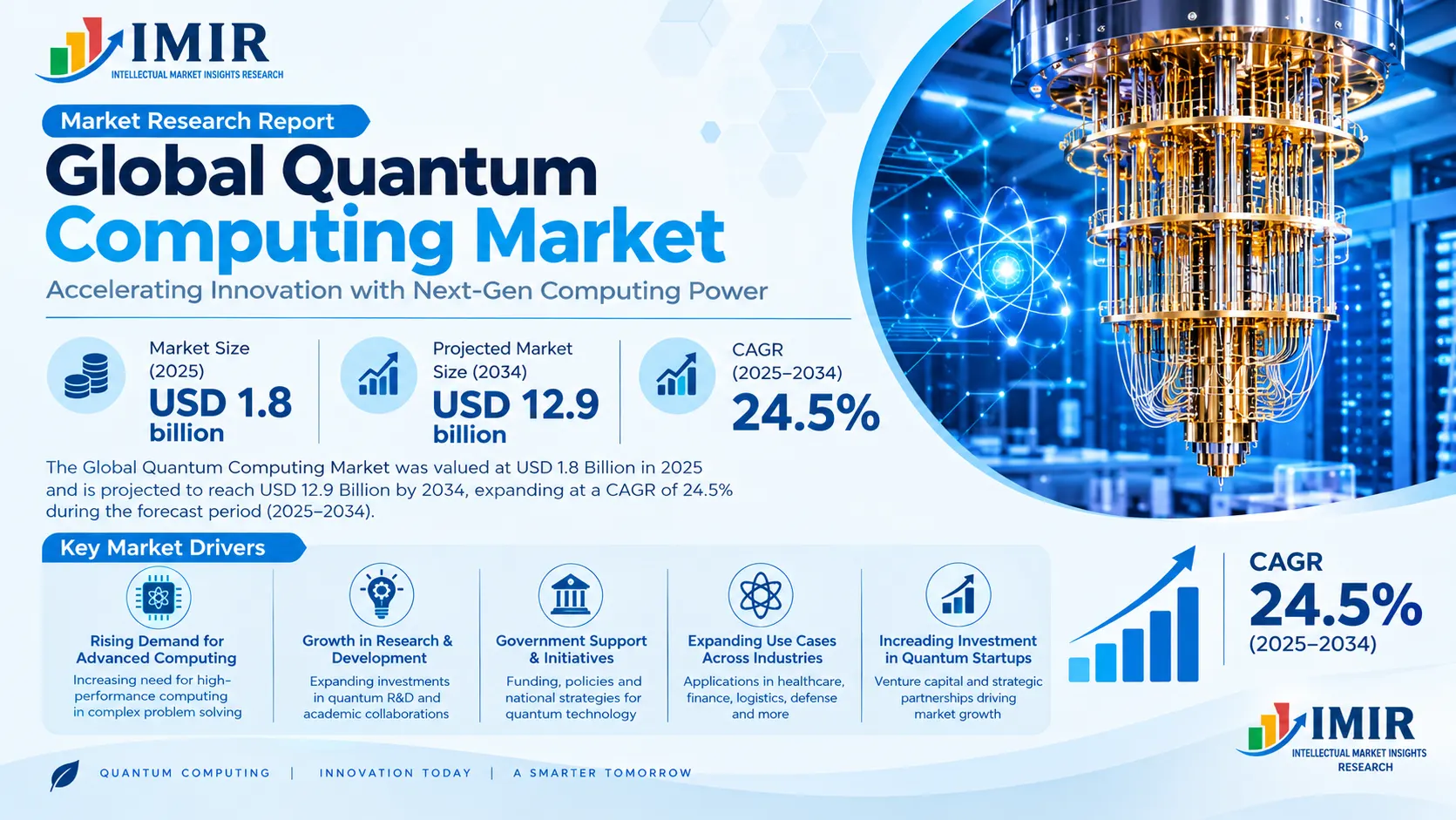
Global Quantum Computing Market: Size, Leading Companies, Trends and Outlook (2025–2034)
Introduction
In 2025 and 2026 the industry hit several milestones in quick succession. Google showed below-threshold error correction on its Willow chip and later claimed verifiable quantum advantage. IBM published a clear path to a fault-tolerant system by 2029. Quantinuum, Infleqtion, IQM and Xanadu all reached public markets within months of each other in 2026. On the policy side, the US signed executive orders in June 2026 that set post-quantum cryptography migration deadlines for federal systems.
For buyers, investors and technology vendors, quantum computing is now a market with real revenue, real competition and real procurement decisions. This blog covers the size of the market, what is driving it, who the main companies are, and where it is heading.
Market Overview and Forecast
According to IMIR, the global quantum computing market was valued at USD 1.8 billion in 2025 and is projected to reach USD 12.9 billion by 2034, growing at a CAGR of 24.5% from 2025 to 2034.
Why published estimates differ. Quantum market numbers vary widely between research firms because they define the market differently. Some count only computing hardware and cloud access, while others add software, services, quantum sensing and communication. IMIR's own "Top Leading Quantum Computing Companies" blog uses a different base (about USD 1.09 billion in 2024, rising to USD 16.22 billion by 2034 at 30.9%). McKinsey's 2026 Quantum Technology Monitor puts 2025 quantum computing company revenue at more than USD 1 billion and projects USD 4.4 billion by 2028. All of these point the same way: strong double-digit growth from a small base. This blog uses the figures from the IMIR report page.
Why the Quantum Computing Market Is Growing
1. Record investment. McKinsey reports about USD 12.6 billion of investment into quantum technology companies in 2025, a 6.3-fold jump over the year before. Private capital supplied roughly 97% of it. Money on this scale pays for chip fabrication, error-correction research and hiring.
2. Hardware milestones are building credibility. Google's Willow (105 qubits) demonstrated below-threshold error correction in December 2024, and in October 2025 Google reported a verifiable quantum-advantage result. IonQ reported 99.99% two-qubit gate fidelity in 2025. Microsoft reported progress on its Majorana topological-qubit prototype in 2026. Each result lowers the perceived risk for enterprise buyers.
3. Cloud access lowers the entry barrier. IBM Quantum, Amazon Braket and Microsoft Azure Quantum let companies run quantum workloads without owning a machine. This is why the cloud-based deployment segment attracts the most pilot projects.
4. Cybersecurity pressure. On 22 June 2026 the US signed executive orders directing federal agencies to move high-value systems to NIST-approved post-quantum cryptography, with key-establishment targets by end-2030 and digital-signature targets by end-2031. Banks, telecom operators and defence contractors are planning similar migrations. This drives demand for quantum-safe products as well as quantum computers.
5. Government programmes. The US, EU, UK, Japan, China, India, Canada and Australia all run national quantum programmes. A second June 2026 US order updates the national quantum strategy and funds work on quantum computers for science.
6. Industry use cases. Drug discovery, materials design, battery chemistry, portfolio optimisation, logistics and fraud detection are the most common early targets. Pharma, finance and aerospace firms have moved from reading about quantum to running paid pilots.
7. Public-market funding. The 2026 listings of Quantinuum, IQM, Infleqtion, Xanadu and Horizon Quantum gave the sector fresh capital and a way to value it.
Companies Associated with the Quantum Computing Market
The IMIR report names these key players: IBM, Google, Microsoft, D-Wave, Rigetti, IonQ, Honeywell Quantum Solutions (now Quantinuum), PsiQuantum, Xanadu, Intel, Atos, Amazon Web Services, ColdQuanta (now Infleqtion), Zapata Computing and Toshiba.
| Company | HQ | Founded | Core Quantum Approach | Latest Verifiable Financial / Status Point |
|---|---|---|---|---|
| IBM | Armonk, USA | 1911 | Superconducting qubits | Starling fault-tolerant target 2029; quantum revenue not disclosed |
| Google (Alphabet) | Mountain View, USA | 1998 | Superconducting qubits | Willow; quantum-advantage claim Oct 2025 |
| Microsoft | Redmond, USA | 1975 | Topological qubits; Azure Quantum cloud | Majorana prototype update Jun 2026; target 2029 |
| D-Wave Quantum | Burnaby, Canada / Palo Alto, USA | 1999 | Quantum annealing | Q2 2026 revenue USD 3.1M |
| Rigetti Computing | Berkeley, USA | 2013 | Superconducting chiplets | Q2 2026 revenue USD 5.1M |
| IonQ | College Park, USA | 2015 | Trapped ions | Q2 2026 revenue USD 80.1M; 2026 guidance USD 280–290M |
| Quantinuum | Broomfield, USA / Cambridge, UK | 2021 | Trapped ions | IPO Jun 2026; Q2 revenue USD 8M |
| PsiQuantum | Palo Alto, USA | 2016 | Photonic | USD 1B raise at USD 7B valuation (Sep 2025) |
| Xanadu | Toronto, Canada | 2016 | Photonic | Listed via SPAC, Mar 2026 |
| Intel | Santa Clara, USA | 1968 | Silicon spin qubits | Tunnel Falls (12 qubits) |
| AWS | Seattle, USA | 2006 | Braket cloud; Ocelot cat-qubit chip | Quantum revenue not disclosed |
| Infleqtion (ex-ColdQuanta) | Boulder, USA | 2007 | Neutral atoms; sensing | Q2 2026 revenue USD 12.63M |
| Zapata Quantum | Boston, USA | 2017 | Quantum software | USD 15M Series D (Apr 2026); no revenue reported |
| Atos (Eviden) | Bezons, France | 1997 | Quantum simulation; quantum-safe | Restructuring; confirm current ownership of quantum unit |
| Toshiba | Tokyo, Japan | 1875 | Quantum key distribution | Quantum revenue not disclosed |
Beyond the IMIR list, other notable players include IQM (Finland, listed July 2026), Pasqal (France), QuEra and Atom Computing (USA), Alice & Bob (France), Alibaba's quantum lab (China, reportedly scaled back), Origin Quantum (China) and Horizon Quantum (listed March 2026).
Competitive Landscape
The competition is mainly a contest between qubit technologies, and no single approach has clearly won.
- Superconducting (IBM, Google, Rigetti, IQM): fast gates and mature fabrication, but they need extreme cooling and face wiring challenges at scale.
- Trapped ion (Quantinuum, IonQ): very high fidelity and all-to-all connectivity, but slower gate speeds.
- Neutral atom (Infleqtion, Pasqal, QuEra, Atom Computing): good scaling to hundreds of qubits.
- Photonic (PsiQuantum, Xanadu): compatible with semiconductor manufacturing and networking, but need large numbers of components.
- Silicon spin (Intel): leverages existing chip factories.
- Topological (Microsoft): potentially lower error rates, but still unproven at scale.
- Annealing (D-Wave): commercially available for optimisation today, though not a general-purpose computer.
Competitive dynamics to note:
- Scale gap. IonQ's USD 80 million quarterly revenue is far ahead of most pure-play peers, helped by acquisitions. Others are still in single-digit millions per quarter, which shows how early commercial demand is.
- Consolidation. IonQ's purchases of Oxford Ionics and (pending) SkyWater show hardware makers buying up the supply chain.
- Big Tech vs pure plays. IBM, Google, Microsoft and AWS can fund research for years without quantum profits; pure plays rely on public markets and customer contracts.
- Capital advantage. Quantinuum (USD 2.1 billion), IonQ (about USD 3 billion) and several others hold cash balances large enough to fund multi-year roadmaps.
- Full-stack versus specialist. Some companies build hardware, software and cloud together; others focus on software (Zapata, Xanadu's PennyLane) or sensing/security (Toshiba, Infleqtion).
Regional Analysis
North America leads the market. The US hosts most of the major hardware companies, the biggest private funding, and federal programmes such as the National Quantum Initiative and the June 2026 executive orders. Canada adds D-Wave and Xanadu.
Europe has strong research and a growing company base: Quantinuum (UK), IQM (Finland), Pasqal and Alice & Bob (France), and AQT (Austria). The EU Quantum Strategy and national programmes in Germany, France, the Netherlands and the UK fund pilot lines and supercomputer-integrated quantum systems.
Asia-Pacific is the fastest-growing region in most forecasts. China invests heavily in quantum computing and communication; Japan (RIKEN, Fujitsu, Toshiba) and South Korea run national programmes; India's National Quantum Mission targets domestic superconducting, photonic and trapped-ion systems; Australia is hosting PsiQuantum's Brisbane build.
Middle East & Africa. Gulf states, especially the UAE and Saudi Arabia, are investing in quantum research centres and partnering with global vendors. Adoption elsewhere in the region is at an early stage.
Latin America. Activity is small but growing, mostly through university research, cloud access and the finance sector (notably Brazil).
Emerging Trends
- From qubit count to error correction. Progress is now measured in logical qubits and error rates, not raw qubit counts. IBM, Google, Quantinuum and others are all targeting fault tolerance by the end of the decade.
- Quantum plus AI and HPC. Quantum processors are being connected to GPUs and supercomputers. PsiQuantum is working with Nvidia, and hybrid workflows are becoming the usual way to run applications.
- Post-quantum cryptography migration. Federal deadlines in the US, and parallel guidance in Europe and Asia, create immediate demand for crypto-inventory and migration services.
- Public-market wave. Five or more quantum companies listed in 2026. Expect more IPOs, SPACs and acquisitions.
- Quantum networking and sensing. Quantum communication, clocks and sensors are closer to revenue than large computers, and they are a large part of the US defence interest.
- Quantum-as-a-service. Cloud delivery and usage-based pricing are the main way enterprises buy access.
- Industry-specific pilots. Pharma, banking, automotive and energy firms are running application-specific proofs of concept with measurable targets.
- Workforce and supply chain. Dilution refrigerators, lasers, cryogenic electronics and specialised talent are bottlenecks, which is pushing governments to fund domestic supply chains.
Future Outlook (2025–2034)
IMIR's forecast runs from 2025 to 2034, so the full period is covered by the report: USD 1.8 billion in 2025 to USD 12.9 billion in 2034 at 24.5% CAGR.
- 2025–2027 (pilot phase). Revenue comes mostly from cloud access, research contracts, government programmes and early enterprise pilots. Annealing and small gate-model systems carry most commercial use.
- 2028–2030 (early fault tolerance). The leading roadmaps (IBM Starling 2029, Microsoft's 2029 target, PsiQuantum's first utility-scale sites around 2027–2028) point to the first machines with logical qubits useful for chemistry and materials. Post-quantum migration for federal systems peaks around the 2030–2031 deadlines.
- 2031–2034 (commercial scaling). If error-corrected machines arrive on schedule, spending shifts from experiments to production workloads in pharma, finance and logistics, and the hardware, software and services segments all grow. IMIR's upper-range figure of USD 12.9 billion in 2034 assumes this transition happens gradually.
Risks to the forecast:
- Technical delays in error correction or manufacturing yield.
- High valuations of listed pure plays against small revenue, which can lead to funding shocks.
- Uncertain claims (for example around topological qubits) that may not hold up.
- Classical algorithms improving and narrowing the advantage in some use cases.
Opportunities: services and consulting, quantum-safe security, software and tooling, cryogenic and photonic components, and region-specific national programmes.
FAQ
Q1. How big is the global quantum computing market? IMIR values it at USD 1.8 billion in 2025, rising to USD 12.9 billion by 2034.
Q2. What is the expected CAGR? 24.5% from 2025 to 2034, per the IMIR report.
Q3. Which companies lead the market? IBM, Google, Microsoft, D-Wave, Rigetti, IonQ, Quantinuum, PsiQuantum, Xanadu, Intel, AWS, Infleqtion, Zapata, Atos and Toshiba are named by IMIR. By reported revenue among pure plays, IonQ is currently the largest.
Q4. Which technology is most promising? No single one. Superconducting and trapped-ion systems are the most mature, photonic and neutral-atom systems scale well, and topological qubits are still being proven.
Q5. Which region leads? North America leads in revenue and investment. Asia-Pacific is expected to grow fastest.
Q6. What are the main applications? Drug discovery, materials science, financial modelling, logistics optimisation, aerospace and defence, and cybersecurity.
Q7. Why do market-size estimates differ so much? Firms define the market differently: some include only computers, others add software, services, sensing and communication.
Q8. When will quantum computers become practical? Leading roadmaps target fault-tolerant systems around 2029–2030; widespread commercial use is expected in the early 2030s, though timelines may slip.
Q9. Should businesses worry about quantum threats to encryption? Yes. US federal agencies must move to post-quantum cryptography with key-establishment targets by the end of 2030 and signature targets by the end of 2031. Private firms are advised to start inventories now.
Conclusion
The quantum computing market is small but moving fast. IMIR sizes it at USD 1.8 billion in 2025 and projects USD 12.9 billion by 2034, a 24.5% CAGR. Record funding, hardware milestones, new public listings and government mandates are all pulling in the same direction, while competition between qubit technologies keeps the field open for new leaders.
For vendors, the opportunity lies in picking a clear position (hardware, software, security or services) and building partnerships with cloud platforms and industry customers. For enterprises, the sensible step today is to run focused pilots, build quantum-ready skills, and begin post-quantum cryptography planning. Companies that start early will be better placed when the technology reaches production scale.