
Top 10 Leading Companies in the Global UAV Propulsion System Market Driving Industry Growth in 2026
Author:
Intellectual Market Insights Research
Published Date:
24 Jun 2026
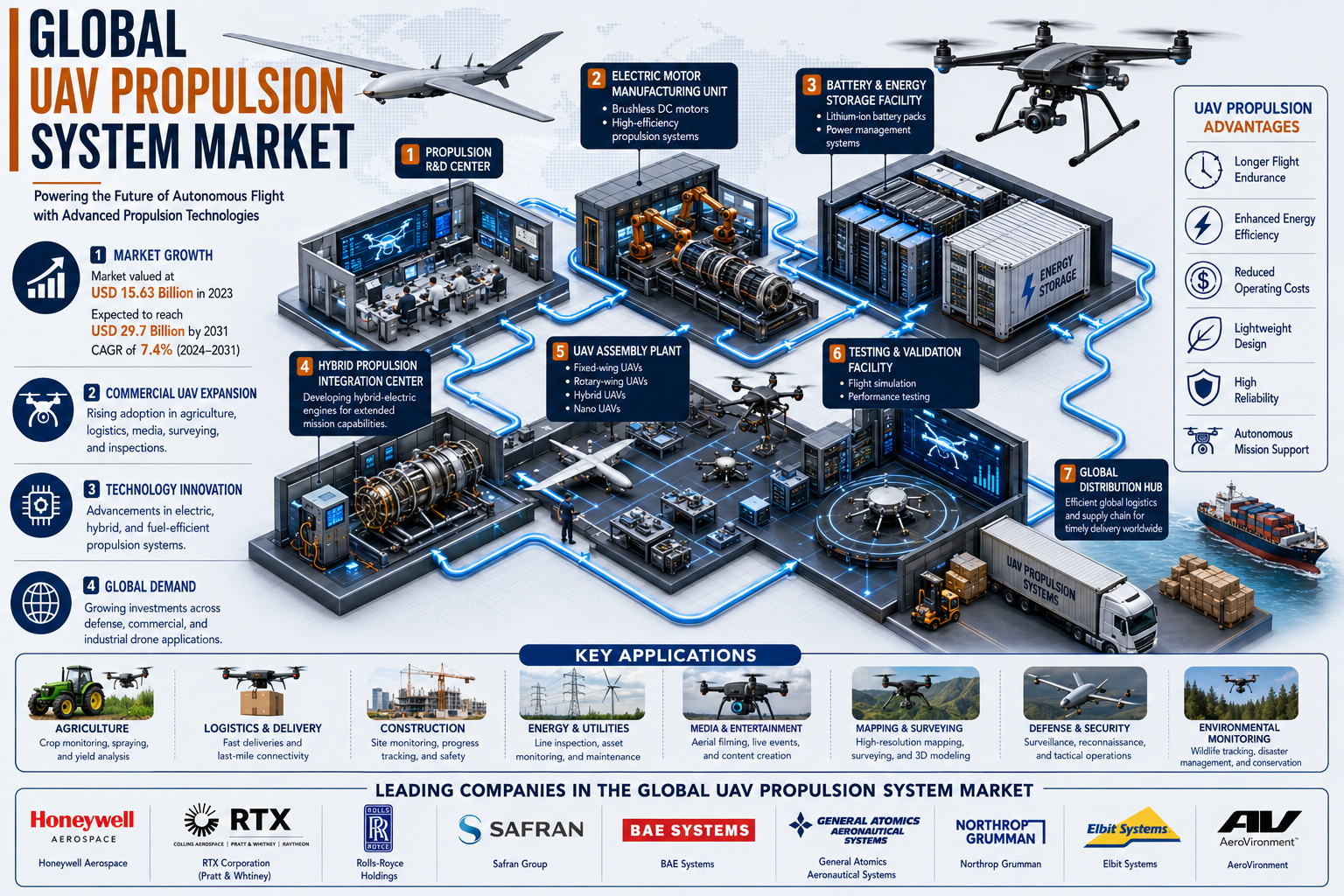
Top 10 Leading Companies in the Global UAV Propulsion System Market Driving Industry Growth in 2026
The global UAV Propulsion System market has evolved from a niche defence technology into one of the most strategically important sectors at the intersection of aerospace, commercial aviation, and emerging technology. As military forces modernize, commercial drone applications proliferate, and sustainability mandates reshape propulsion engineering, the UAV propulsion systems industry stands at a defining growth inflection point entering 2026.
According to Intellectual Market Insights Research, the UAV Propulsion System market was valued at approximately USD 10.85 Billion in 2025 and is projected to grow at a CAGR of 9.87%, reaching USD 25.30 Billion by 2034. This robust trajectory is anchored by surging military investments, the rapid expansion of commercial UAV use cases, and the accelerating transition toward electric and hybrid propulsion architectures.
North America led the market with a revenue share of 32.7% in 2022, driven by advanced defence programmes and a rapidly growing commercial drone ecosystem. As of May 2022, the FAA reported 855,860 registered drones in the United States alone. Meanwhile, Asia Pacific is forecast to register an outstanding CAGR of 21.7% from 2023 to 2030, propelled by favourable government initiatives and massive investments in emerging aviation technology.
Market Overview
|
Parameter |
Details |
|
Market Size (2025) |
USD 10.85 Billion |
|
Projected Market Size (2034) |
USD 25.30 Billion |
|
CAGR (2025–2034) |
9.87% |
|
Leading Region (2022) |
North America (32.7% share) |
|
Fastest-Growing Region |
Asia Pacific (CAGR 21.7%) |
|
Leading Product Segment |
Rotary Blade UAV (68%+ share) |
|
Fastest-Growing Product |
Hybrid UAV (CAGR 23.3%) |
|
Leading Application Segment |
Media & Entertainment (25.5% share) |
|
Key Growth Drivers |
Military demand, commercial expansion, electric propulsion |
|
Key Challenges |
Regulatory hurdles, airspace integration |
|
Major Players |
AeroVironment, Boeing, BAE Systems, DJI, General Dynamics, Textron |
|
Forecast Period |
2025–2034 (IMIR Research) |
Why the UAV Propulsion System Market Is Growing
1. Increasing Demand in Military Applications
Defence agencies worldwide are intensifying UAV procurement for ISR (Intelligence, Surveillance, and Reconnaissance), target acquisition, and strike missions. Modern propulsion systems offering high thrust-to-weight ratios and extended endurance are critical enablers of these programmes. UAVs with advanced propulsion can achieve greater mission flexibility, longer flight periods, and heavier payloads, directly driving market growth.
2. Rapid Expansion of Commercial UAV Applications
Commercial sectors including agriculture, infrastructure inspection, aerial photography, mapping, and delivery logistics are driving unprecedented UAV adoption. Each application requires purpose-built propulsion architectures to meet varied endurance and payload needs, creating strong and diversified demand across the electric and hybrid propulsion segments.
3. Shift Towards Electric Propulsion Systems
Electric propulsion offers significant advantages over traditional combustion engines lower operating costs, reduced emissions, quieter operation, and higher precision control. As battery energy density continues to improve, electric UAV propulsion is becoming the default architecture for short-to-medium range commercial applications, with adoption expected to accelerate significantly through 2034.
4. Integration of Hybrid Propulsion Systems
Hybrid propulsion combining internal combustion engines with electric motors allows UAVs to achieve longer range, heavier payloads, and mission flexibility while reducing fuel consumption and emissions. The hybrid UAV segment is registering a CAGR of 23.3% from 2023 to 2030, making it the fastest-growing product segment in the market.
5. Growth of the Global Construction Industry
The global construction industry is deploying UAVs for 3D mapping, site surveys, and project progress monitoring. Collaborative autonomous drone fleets such as those developed by Imperial College London and Empa represent a frontier expansion of propulsion requirements, with drones operating collectively as Aerial Advanced Manufacturing systems.
6. Supportive Government Initiatives
Governments across Asia Pacific and beyond are investing directly in emerging aviation technologies. Australia's USD 23.6 million Emerging Aviation Technology Partnerships Program exemplifies the public-sector catalyst effect driving UAV propulsion market expansion, supporting R&D projects and experimental deployments of novel propulsion technologies.
Top 10 Companies in the Global UAV Propulsion System Market
- AeroVironment, Inc. (U.S.)
- The Boeing Company (U.S.)
- BAE Systems plc (United Kingdom)
- General Dynamics Corporation (U.S.)
- Textron Inc. (U.S.)
- Elbit Systems Ltd. (Israel)
- DJI Innovations (China)
- EHang Holdings Ltd. (China)
- Israel Aerospace Industries (Israel)
- Turkish Aerospace Industries Inc. (Turkey)
Company Profiles
1. AeroVironment, Inc. (U.S.)
Headquarters: Simi Valley, California, U.S.
Industry Focus: Small & Tactical UAV Systems
Global Presence: North America, NATO allies, international defence markets
Company Overview: AeroVironment is one of the world's most established small UAV manufacturers, delivering tactical unmanned aircraft systems to the U.S. military and allied defence forces. The company is renowned for its Raven, Puma, Wasp, and Switchblade product families battlefield-proven platforms for ISR and precision strike missions. Its propulsion systems are optimised for silent operation, rapid deployment, and extended endurance at low altitudes.
Key Products and Services: AeroVironment produces a wide range of small UAV platforms with electric propulsion architectures, including the RQ-11 Raven tactical reconnaissance drone, the AV-30 fixed-wing endurance platform, and the Switchblade 300 and 600 loitering munition systems.
Market Position: AeroVironment dominates the small tactical UAV segment in North America, with strong recurring revenue from military contracts, spares, and training services. Its Switchblade loitering munition brought significant strategic attention to its propulsion capabilities during 2022-2024.
Strategic Advantages: Deep U.S. DoD relationships, proven battlefield product portfolio, strong R&D pipeline in electric propulsion, and increasing expansion into commercial and agricultural UAV markets.
2. The Boeing Company (U.S.)
Headquarters: Arlington, Virginia, U.S.
Industry Focus: Large & Medium Altitude UAV Systems
Global Presence: Global defence and commercial aviation markets worldwide
Company Overview: Boeing is a global aerospace and defence giant with a significant stake in the UAV propulsion market through its MQ-25 Stingray autonomous tanker drone, the MQ-28 Ghost Bat autonomous combat aircraft, and its Insitu subsidiary producing the ScanEagle and Integrator tactical UAVs. Boeing's scale, systems integration expertise, and deep U.S. military relationships make it a dominant force in large and medium-altitude UAV propulsion programmes.
Key Products and Services: Boeing's UAV propulsion portfolio spans autonomous aerial refuelling (MQ-25 turbofan), loyal wingman combat drones (MQ-28), and small tactical surveillance platforms (ScanEagle) through its Insitu division.
Market Position: Boeing occupies a unique position as both a prime defence contractor and an innovation leader in autonomous aviation, with the MQ-25 representing a multi-billion dollar propulsion programme defining the future of carrier-based UAV operations.
Strategic Advantages: Unmatched systems integration capability, global supply chain, strong government relations, advanced turbofan propulsion expertise, and expanding autonomous vehicle R&D programmes.
3. BAE Systems plc (United Kingdom)
Headquarters: London, United Kingdom
Industry Focus: Advanced Combat UAV & UCAV Systems
Global Presence: UK, Europe, U.S., Middle East, Australia
Company Overview: BAE Systems is a premier global defence contractor with deep expertise in advanced UAV propulsion through its Taranis stealth combat drone demonstrator and participation in the GCAP (Global Combat Air Programme). BAE's propulsion engineers have pioneered low-observable engine inlet and exhaust technologies critical to next-generation stealth UAV development.
Market Position: BAE Systems is a tier-1 prime contractor in the UK and a key partner across NATO allied UAV development programmes, with expanding influence in the Indo-Pacific through Australian defence partnerships.
Strategic Advantages: Stealth propulsion expertise, advanced electronic integration capabilities, long-standing sovereign defence partnerships, and strong investment in next-generation combat UAV architecture.
4. General Dynamics Corporation (U.S.)
Headquarters: Reston, Virginia, U.S.
Industry Focus: UAV Mission Systems & Propulsion Integration
Global Presence: U.S., NATO allies, international defence markets
Company Overview:
Market Position:
Strategic Advantages:
5. Textron Inc. (U.S.)
Headquarters: Reston, Virginia, U.S.
Industry Focus: UAV Mission Systems & Propulsion Integration
Global Presence: U.S., NATO allies, international defence markets
Company Overview:
Market Position:
Strategic Advantages:
Competitive Landscape
The global UAV Propulsion System market in 2026 is characterised by a moderately concentrated structure at the high-value defence tier, and intensely fragmented dynamics in commercial and prosumer segments.
Market Concentration
A handful of major Western defence primes compete for billion-dollar military programmes, while a larger ecosystem of commercial innovators led by Chinese manufacturers DJI and EHang drives volume growth in civilian applications. Chinese manufacturers dominate by volume in commercial segments, while North American and European players hold premium positions in defence-grade propulsion.
Electric vs. Conventional Propulsion Race
The accelerating shift toward electric and hybrid propulsion is reshaping competitive advantage. Companies investing earliest in high-density battery technology, high-efficiency electric motor design, and intelligent power management systems are establishing technology moats that will prove durable through the 2034 forecast period.
Autonomy as a Propulsion Requirement
Next-generation UAV propulsion systems must increasingly support AI-driven autonomous flight envelopes including variable-regime thrust management, fault-tolerant multi-rotor redundancy, and energy-optimised mission profiles. Propulsion and autonomy are converging as a unified capability domain.
Geopolitical Supply Chain Fragmentation
Western governments are increasingly mandating domestic or allied propulsion supply chains for sensitive UAV programmes, creating structural demand for U.S., European, and Israeli-sourced propulsion systems. This is creating barriers for lower-cost Chinese alternatives in certain markets.
Regional Analysis
North America 32.7% Revenue Share (2022)
North America leads the global UAV propulsion market, anchored by the United States' unmatched military R&D investment and rapidly growing commercial drone ecosystem. As of May 2022, the FAA reported 855,860 registered drones in the U.S., with 316,075 serving commercial purposes including mapping, inspection, photography, spraying, and delivery. The presence of Boeing, General Dynamics, AeroVironment, and Textron makes the region the global hub for high-value propulsion programmes.
Asia Pacific Fastest Growing (CAGR 21.7%)
Asia Pacific is the fastest-growing UAV propulsion region, driven by China's industrial dominance, Japan's precision engineering ecosystem, and government-supported investment programmes. Australia's USD 23.6 million Emerging Aviation Technology Partnerships Program exemplifies the public-sector commitment accelerating commercial UAV propulsion development across the region. The Asia Pacific market is projected to grow at a remarkable CAGR of 21.7% between 2023 and 2030.
Europe Strategic Growth Region
Europe represents a significant and growing UAV propulsion market driven by major defence programmes including GCAP and FCAS, NATO modernisation requirements, and a strong commercial drone regulatory framework under EASA. BAE Systems, Airbus, Leonardo, and Safran are key European players investing in next-generation propulsion for both military and civil UAV applications.
Middle East, Africa & Latin America (LAMEA)
The Middle East is a significant UAV importer with Gulf states investing heavily in defence drone fleets. Turkey's TAI and Israel's IAI and Elbit are primary propulsion technology exporters serving this region. Africa is an emerging market for commercial agricultural and logistics UAV applications, while Latin America presents opportunities driven by agricultural drone adoption across Brazil, Mexico, and Argentina.
Emerging Trends
1. Electric Propulsion Maturation
As battery energy density improves and costs decline, electric propulsion is becoming the default architecture for short-to-medium range commercial UAVs. The performance gap between electric and combustion-powered systems continues to narrow, enabling electric UAVs to take on increasingly demanding missions.
2. Hybrid Propulsion Adoption
Hybrid propulsion systems combining ICE reliability with electric efficiency are registering the fastest growth in the market at a CAGR of 23.3% between 2023 and 2030. Their ability to balance range, endurance, payload capacity, and emissions compliance is driving adoption across agriculture, logistics, and long-range surveillance.
3. Autonomous Flight Integration
Propulsion systems are being redesigned around AI-managed flight envelopes. Autonomous power management, real-time thrust vector adjustment, and fault-tolerant multi-motor architectures are becoming standard requirements in new UAV programmes.
4. Urban Air Mobility (UAM) & eVTOL
The emergence of type-certified passenger eVTOL platforms exemplified by EHang's EH216-S signals a new and high-value propulsion sub-market. Urban air taxi services, emergency medical UAVs, and short-haul cargo networks all require highly reliable, low-noise electric propulsion systems purpose-built for dense urban environments.
5. BVLOS and High-Altitude Propulsion
Beyond Visual Line of Sight (BVLOS) regulatory approvals are expanding the addressable market for high-endurance propulsion systems. Long-range delivery, border surveillance, and communications relay missions are driving investment in turboprop and turbofan UAV engines capable of sustained medium-to-high altitude operation.
6. Sustainable Aviation & Hydrogen Propulsion
Environmental pressures and regulatory mandates are pushing UAV propulsion engineers toward Sustainable Aviation Fuel compatibility and hydrogen fuel cell research. Several programmes across Europe and North America are actively developing hydrogen-powered UAV demonstrators, signalling a longer-term propulsion shift that could reshape competitive dynamics by the mid-2030s.
Future Outlook 2025–2034
The global UAV Propulsion System market is on track to more than double in value from USD 10.85 Billion in 2025 to USD 25.30 Billion by 2034, driven by converging forces across military modernisation, commercial drone proliferation, and propulsion technology transformation.
Growth Projections
Military demand will sustain strong baseline growth, while commercial applications particularly agriculture, construction, media, and logistics will drive volume expansion in electric and hybrid propulsion segments. The hybrid UAV sub-segment is projected to be the fastest-growing product category at a CAGR of 23.3%.
Investment Opportunities
The highest-value opportunities lie in: high-efficiency electric motor and battery system development; hybrid propulsion platform manufacturing; eVTOL and Urban Air Mobility certified propulsion systems; AI-integrated autonomous power management; and BVLOS-capable long-endurance engine programmes for border security and surveillance applications.
Industry Transformation
The UAV propulsion industry is transitioning from specialist defence technology toward mass-market commercial enabler. Manufacturers that combine systems integration scale with propulsion innovation and regulatory navigation capability will be best positioned to lead through 2034 and beyond.
FAQ Section
Q1: What is the current size of the global UAV Propulsion System market?
The global UAV Propulsion System market was valued at approximately USD 10.85 Billion in 2025 and is projected to grow at a CAGR of 9.87%, reaching USD 25.30 Billion by 2034, according to Intellectual Market Insights Research.
Q2: Which companies are the top leaders in the global UAV Propulsion System market?
The top UAV Propulsion System companies include AeroVironment Inc., The Boeing Company, BAE Systems plc, General Dynamics Corporation, Textron Inc., Elbit Systems Ltd., DJI Innovations, EHang Holdings Ltd., Israel Aerospace Industries (IAI), Turkish Aerospace Industries Inc. (TAI), Parrot SA, Draganfly Inc., SAIC, and Aurora Flight Sciences.
Q3: Which region dominates the global UAV Propulsion System market?
North America dominated the UAV Propulsion System market in 2022 with a revenue share of approximately 32.7%, driven by the U.S. military's massive UAV investment programme. However, Asia Pacific is forecast to be the fastest-growing region, with a projected CAGR of 21.7% from 2023 to 2030.
Q4: What is the forecast CAGR for the UAV Propulsion System market?
The global UAV Propulsion System market is projected to grow at a CAGR of 9.87% during the forecast period from 2025 to 2034, according to Intellectual Market Insights Research.
Q5: What are the primary growth drivers of the UAV Propulsion System market?
Key growth drivers include: increasing defence demand for tactical ISR and strike UAVs; rapid expansion of commercial UAV applications in agriculture, construction, delivery, and media; the accelerating shift toward electric propulsion; integration of hybrid propulsion systems for extended-range missions; and government investment programmes supporting emerging aviation technology development.
Q6: Which product segment holds the largest share in the UAV Propulsion System market?
The Rotary Blade UAV segment dominated the market with a leading revenue share of over 68.0% in 2022. Their ability to hover and manoeuvre in confined spaces makes them ideal across a vast range of applications including inspection, photography, agricultural monitoring, and search and rescue. However, Hybrid UAVs represent the fastest-growing segment at a CAGR of 23.3%.
Q7: What is the role of electric propulsion in the UAV market's future?
Electric propulsion is rapidly becoming the defining technology of the commercial and consumer UAV segment. It offers lower operational costs, reduced emissions, quieter flight, and higher precision control. As battery energy density continues to improve, electric propulsion is expected to extend its addressable mission range from short-range commercial applications toward medium-endurance tactical and logistics missions through 2034.
Q8: What are the key regulatory challenges facing the UAV Propulsion System market?
The UAV propulsion market faces a complex regulatory landscape. Civil aviation authorities including the FAA and EASA impose strict requirements governing UAV registration, pilot certification, altitude restrictions, flight zone limitations, and airspace coordination. Emerging applications such as BVLOS operations, autonomous flight, and Urban Air Mobility present additional certification challenges that remain a significant constraint on market growth.
Q9: How does the construction industry contribute to UAV propulsion market growth?
The global construction industry is deploying drones for site surveys, 3D mapping, and project progress monitoring. Advanced applications include autonomous construction drone fleets such as those developed by Imperial College London and Empa under the Aerial Advanced Manufacturing concept which require robust propulsion systems capable of sustained payload-bearing operations in complex built environments.
Q10: What is Urban Air Mobility and how does it relate to UAV propulsion systems?
Urban Air Mobility (UAM) refers to the emerging ecosystem of passenger-carrying autonomous aerial vehicles designed to operate in and around cities. EHang's EH216-S becoming the world's first type-certified autonomous passenger drone in 2023 marks a watershed moment. UAM propulsion must meet high reliability, low noise, zero-emission operation, and rapid recharge requirements, making it one of the highest-value propulsion development sub-markets within the broader UAV industry.
Q11: Which application segment leads the UAV Propulsion System market?
The Media and Entertainment segment held the largest commercial application revenue share of approximately 25.5% in 2022, driven by UAVs' transformative impact on aerial cinematography. Sony Corporation's Airpeak AI-driven filmmaking drone, debuted at CES 2021 with built-in image stabilization and flight AI, exemplifies continued propulsion innovation in this high-value segment.
Q12: What role do hybrid propulsion systems play in the UAV market?
Hybrid propulsion systems combining internal combustion engines with electric motors are among the most strategically important technology developments in the market. They enable UAVs to carry heavier payloads, operate over longer distances, and sustain missions in adverse conditions while minimising fuel burn through intelligent power switching. Regenerative braking during descent further extends endurance. The hybrid UAV segment is the fastest-growing product category at a CAGR of 23.3%.
Conclusion
The global UAV Propulsion System market is at a defining inflection point in 2026. What began as a niche defence technology has evolved into a multi-sector, multi-billion dollar industrial ecosystem spanning military operations, commercial logistics, precision agriculture, urban air mobility, and construction. With a projected market value of USD 25.30 Billion by 2034, UAV propulsion represents one of the most dynamic and strategically consequential growth opportunities in the global aerospace and defence landscape.
The top companies profiled in this article represent the full spectrum of this evolving ecosystem from established U.S. defence giants like Boeing and General Dynamics to agile commercial innovators like DJI and EHang, and emerging sovereign players like Turkey's TAI. What unites them is a shared recognition that propulsion technology is the decisive enabler of UAV capability, and that companies investing early in electric, hybrid, and autonomous propulsion architectures will define the competitive frontier through 2034 and beyond.
For businesses, investors, and defence planners seeking to understand where the UAV propulsion industry is headed, the message from 2026's competitive landscape is clear: the propulsion systems that will dominate this market by 2034 are being engineered today and the companies building them are already shaping the future of aviation.