
Leading Companies in the Global Ultraviolet Disinfection Equipment Market
Author:
Intellectual Market Insights Research
Published Date:
04 Jul 2026
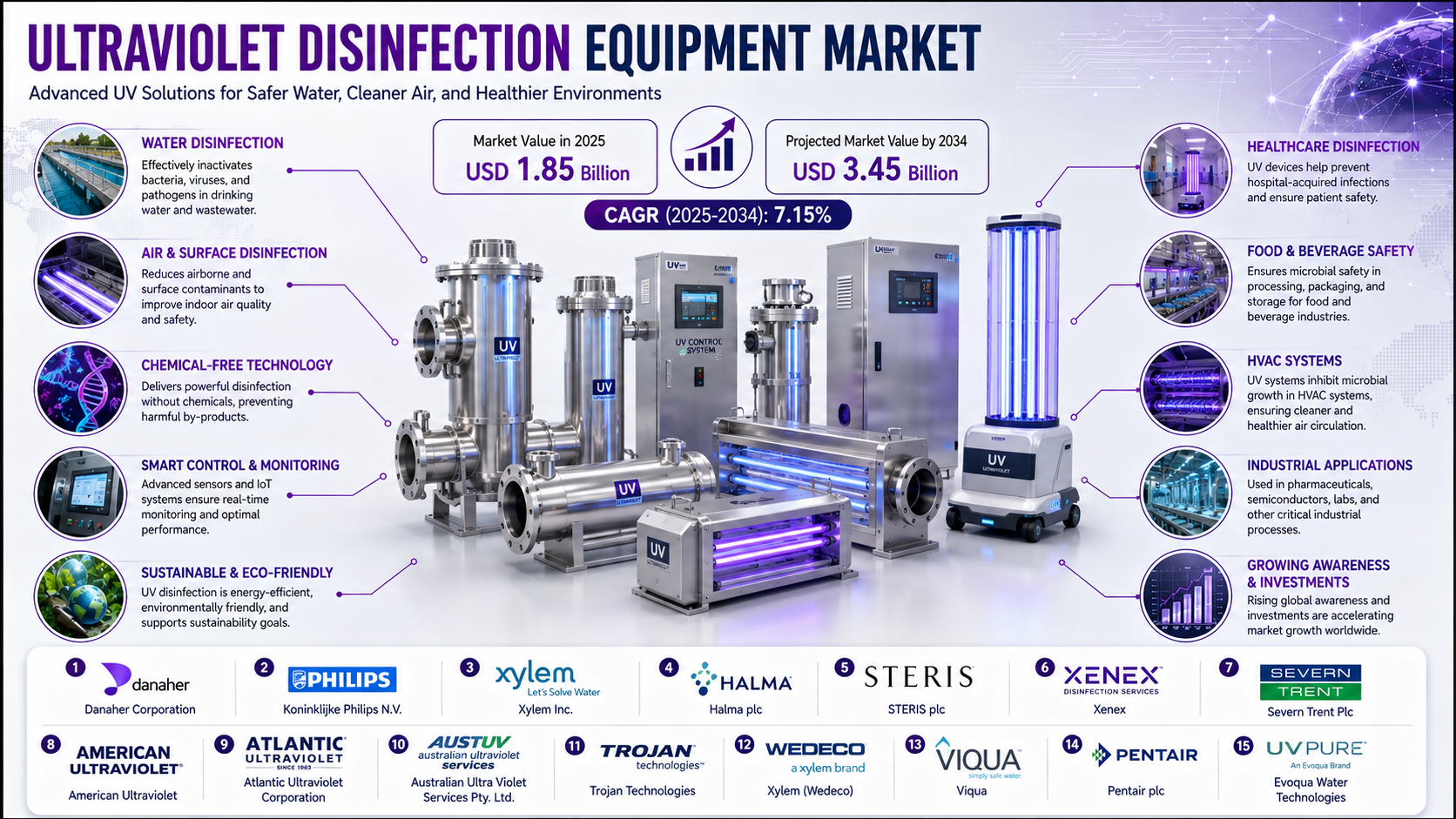
Leading Companies in the Global Ultraviolet Disinfection Equipment Market: Chemical-Free Sterilization Goes Mainstream
There's a quiet but decisive shift happening in how the world disinfects its water, air, and surfaces. Chlorine tablets, chemical sprays, and fumigation cycles are gradually giving way to something far less visible: a beam of ultraviolet light strong enough to shred the DNA of bacteria, viruses, and protozoa in seconds, without leaving behind a single chemical residue. That shift quiet, invisible, but accelerating fast is exactly why UV disinfection has become one of the more compelling growth stories in industrial and healthcare equipment today.
According to a new report by Intellectual Market Insights Research, the global Ultraviolet (UV) Disinfection Equipment Market was valued at approximately USD 2.84 Billion in 2025 and is projected to reach USD 8.98 Billion by 2034, growing at a CAGR of 13.64% during the forecast period (2025–2034). That's more than a threefold increase in under a decade an unusually steep growth curve for a technology that, on the surface, is simply "light that kills germs."
The story behind that number is a convergence of several pressures at once: rising concern over healthcare-associated infections, tightening water and air quality regulations, and a broad institutional and consumer shift toward disinfection methods that don't rely on chemicals at all. What used to be a niche, industrial water-treatment technology has expanded into hospitals, offices, transportation hubs, food processing plants, and even residential air and water systems turning UV disinfection from a specialized utility purchase into a mainstream infrastructure category.
The rest of this report breaks the market down by application, component, and end-use industry; walks through the technology and regulatory trends reshaping the competitive landscape; profiles the companies leading the space; and looks region by region at where the next decade of growth is likely to concentrate.
Market Overview by Segment
By Application: Water Treatment, Waste Water Treatment, Air Treatment, Food & Beverage Disinfection, and Surface Disinfection
Water treatment spanning municipal, residential, and commercial water treatment remains the largest application segment, driven by tightening drinking water standards and growing concern over waterborne pathogens and chemical byproducts from traditional chlorine-based treatment. Waste water treatment continues to be a steady contributor as municipalities and industrial operators seek non-chemical alternatives for effluent disinfection, a dynamic closely tied to the broader push captured in the Environmental Testing Market, which tracks compliance-driven demand for water and environmental quality verification. Air treatment covering healthcare facilities, residential and commercial buildings, and bioterror-agent mitigation has expanded rapidly as UV-equipped HVAC systems become a standard hygiene feature rather than a specialty add-on, a trend that runs parallel to the Air Pollution Control Systems Market, which addresses the broader category of technologies used to manage air quality. Food & beverage disinfection and surface disinfection round out the segment, with surface disinfection in particular benefiting from heightened institutional hygiene awareness in hospitals, offices, and public transport.
By Component: UV Lamp, Controller Unit, Quartz Sleeve, Reactor Chamber, and Others
UV lamps represent the core revenue-generating component of most systems, though the underlying lamp technology itself is undergoing a significant transition from traditional low- and medium-pressure mercury vapor lamps toward mercury-free UV-C LED alternatives. Controller units, quartz sleeves, and reactor chambers round out the remaining components, each becoming more sophisticated as manufacturers integrate sensors, IoT connectivity, and automated dosage control into what were once purely mechanical assemblies.
By End Use Industry: Residential, Commercial, and Industrial
Industrial and municipal end users water utilities, wastewater authorities, and manufacturing facilities remain the largest and most established end-use category. The commercial segment, spanning offices, hospitality, retail, and healthcare facilities, is growing quickly as businesses invest in visible hygiene infrastructure to reassure customers and staff. The residential segment, while still the smallest, is expanding steadily as compact UV water purifiers and portable air/surface sanitizing devices become more affordable and accessible to individual consumers a trend that connects to the broader consumer health and safety themes explored in the Infection Control Market.
By Marketing Channel: Direct Marketing and Indirect Marketing
Large municipal and industrial contracts are typically negotiated through direct sales relationships with manufacturers, given the scale and customization involved, while smaller commercial and residential purchases increasingly move through indirect channels distributors, e-commerce platforms, and specialty retailers as UV disinfection products become more standardized and consumer-accessible.
Key Industry Trends Shaping the UV Disinfection Equipment Market
The shift from mercury lamps to UV-C LEDs. The market is in the middle of a genuine technology transition, moving away from conventional mercury vapor lamps toward mercury-free UV-C LED systems. LEDs offer instant-on operation, lower energy consumption, and better suitability for intermittent, room-by-room disinfection cycles a meaningful advantage over lamps that require warm-up time and continuous operation.
Regulatory pressure is becoming a genuine growth engine. Stricter water quality standards, including PFAS and disinfection-byproduct limits in several major markets, are pushing utilities toward UV-based and UV-advanced-oxidation treatment combinations capable of addressing contaminants that traditional chemical treatment struggles with.
Healthcare is emerging as a high-value growth vertical. Hospitals are documenting measurable reductions in healthcare-associated infections following UV deployment, which is turning what was once a discretionary purchase into a data-backed procurement decision tied directly to patient safety and cost savings.
Automation and smart monitoring are becoming standard. Manufacturers are increasingly embedding sensors, AI-powered dosage controls, and remote monitoring into UV systems, enabling real-time performance tracking, predictive maintenance, and automatic detection of lamp degradation or system faults reducing the need for manual oversight.
Expansion beyond water treatment into everyday hygiene infrastructure. UV technology has moved well past its original water-treatment roots into air disinfection within HVAC systems, mobile UV robots for hospital room turnover, and portable UV devices for both commercial and residential use broadening the market's addressable base considerably.
Sustainability positioning as a competitive differentiator. Because UV disinfection eliminates the need for chemical disinfectants and their associated storage, transport, and disposal concerns, manufacturers are increasingly marketing it as the more sustainable option relative to legacy chemical treatment methods a positioning that resonates with both regulators and environmentally conscious commercial buyers.
Top Companies in the UV Disinfection Equipment Market
1. Danaher Corporation
2. Koninklijke Philips N.V.
3. Xylem Inc.
4. Halma plc
5. STERIS plc
6. Xenex
7. Severn Trent Plc
8. American Ultraviolet
9. Atlantic Ultraviolet Corporation
10. Australian Ultra Violet Services Pty. Ltd.
1. Danaher Corporation
Headquarters: Washington, D.C., USA
Company Overview: Danaher is a global science and technology conglomerate whose water quality segment, through brands such as Trojan Technologies, includes some of the most established names in UV water disinfection.
Core Products / Services: UV water and wastewater disinfection systems, UV-based advanced oxidation process (AOP) equipment, and water quality monitoring instrumentation.
Market Position: Through its water platform brands, Danaher is one of the largest suppliers of municipal and industrial UV water treatment systems globally, with an extensive installed base across North America and Europe.
Technology & Innovation: The company continues to invest in UV-AOP combination systems designed to address emerging contaminants such as PFAS, alongside digital monitoring platforms for large-scale municipal water infrastructure.
Sustainability Initiatives: Danaher's water quality businesses position UV and chemical-free treatment technologies as core to reducing the environmental footprint of municipal and industrial water treatment.
Competitive Advantages: Deep municipal water treatment expertise, a large global installed base, and the scale and R&D resources of a diversified science and technology parent company.
Recent Developments: Continued expansion of UV-AOP treatment offerings in response to tightening PFAS and disinfection-byproduct regulations across North America and Europe.
2. Koninklijke Philips N.V.
Headquarters: Amsterdam, Netherlands
Company Overview: Philips is a diversified Dutch health technology company with a UV-C disinfection product line spanning air and surface disinfection for both healthcare and consumer applications.
Core Products / Services: UV-C air purification units, surface disinfection devices, and UV-C components used in healthcare and commercial hygiene applications.
Market Position: Philips leverages its broader health technology brand recognition and healthcare distribution channels to maintain a meaningful presence in the UV-C disinfection space, particularly in hospital and healthcare settings.
Technology & Innovation: The company draws on its lighting and semiconductor heritage to develop UV-C LED technology, positioning it at the intersection of its health technology and lighting expertise.
Sustainability Initiatives: Philips has emphasized mercury-free UV-C LED development as part of its broader sustainability commitments across its health technology portfolio.
Competitive Advantages: Strong global brand recognition, established relationships with hospitals and healthcare systems, and cross-portfolio expertise spanning lighting, health technology, and semiconductors.
Recent Developments: Continued development of UV-C LED-based air and surface disinfection products aimed at healthcare and commercial hygiene markets.
3. Xylem Inc.
Headquarters: Washington, D.C., USA
Company Overview: Xylem is a global water technology company whose portfolio includes UV disinfection systems for municipal water and wastewater treatment, developed in part through its acquisition of established UV treatment brands.
Core Products / Services: UV water and wastewater disinfection systems, water quality monitoring, and broader water infrastructure equipment and services.
Market Position: Xylem is one of the leading suppliers of municipal and industrial UV water treatment systems globally, with deep expertise in large-scale water infrastructure projects.
Technology & Innovation: The company continues to invest in UV-C LED technology and smart water infrastructure, including sensor-enabled UV systems for real-time treatment monitoring.
Sustainability Initiatives: Xylem positions UV disinfection as central to its broader water sustainability mission, emphasizing chemical-free treatment as part of its environmental commitments.
Competitive Advantages: Extensive municipal water infrastructure relationships, broad product portfolio spanning the full water treatment value chain, and global project delivery capability.
Recent Developments: Continued integration of UV disinfection into broader smart water infrastructure and digital monitoring offerings for municipal utilities.
4. Halma plc
Headquarters:
Company Overview:
Core Products / Services:
Market Position:
Technology & Innovation:
Sustainability Initiatives:
Competitive Advantages:
Recent Developments:
5. STERIS plc
Headquarters:
Company Overview:
Core Products / Services:
Market Position:
Technology & Innovation:
Sustainability Initiatives:
Competitive Advantages:
Recent Developments:
Market Drivers, Restraints, and Opportunities
Growth drivers:
- Increasing demand for chemical-free water and air treatment across municipal, industrial, and commercial sectors
- Rising concern over healthcare-associated infections driving hospital adoption of UV disinfection technology
- Stricter environmental and water quality regulations, including PFAS and disinfection-byproduct limits
- Expanding adoption of UV disinfection across municipal, industrial, healthcare, and commercial end markets
- Falling costs and improving performance of UV-C LED technology
Market restraints:
- Higher upfront equipment costs compared to conventional chemical disinfection methods
- Limited awareness and technical expertise in some developing markets
- Maintenance requirements, including lamp replacement and quartz sleeve cleaning, that add to total cost of ownership
- Competition from well-established, lower-cost traditional chemical disinfection methods
Emerging opportunities:
- Continued transition from mercury lamps to mercury-free UV-C LED systems
- Expansion of UV-based advanced oxidation processes (UV-AOP) to address emerging contaminants like PFAS
- Growth of mobile and robotic UV disinfection systems in healthcare settings
- Increasing integration of IoT-enabled monitoring and AI-powered dosage optimization into UV systems
- Expansion into decentralized and residential water and air treatment applications
Regional Analysis
North America is expected to lead the global UV disinfection equipment market, supported by robust regulatory frameworks particularly from the U.S. Environmental Protection Agency that encourage adoption of non-chemical disinfection technologies, along with strong demand from municipal water utilities and healthcare facilities.
Europe represents a mature and steadily growing market, driven by strict environmental standards and high adoption across municipal and industrial water treatment in countries such as Germany, France, and the UK.
Asia-Pacific is expected to register significant growth, supported by the presence of key UV disinfection technology companies and manufacturing bases in economies such as Japan and China, alongside rising healthcare and water infrastructure investment across the region.
Latin America and the Middle East & Africa represent smaller but emerging markets, with growth driven by water scarcity concerns, expanding healthcare infrastructure, and rising investment in modern water treatment technology.
(Note: IMIR's own report leaves precise regional percentage shares as customizable/on-request figures rather than fixed published data the directional regional leadership above reflects the report's stated positioning.)
Related Markets
The UV disinfection equipment market sits within a broader ecosystem of environmental, healthcare, and infection-control technology categories. The following related reports from Intellectual Market Insights Research (IMIR) are worth tracking for anyone researching this space:
- Sterilization Equipment Market the broader category of sterilization technologies used alongside or in place of UV disinfection across healthcare and industrial settings.
- Infection Control Market covers the wider infection prevention ecosystem that UV disinfection equipment is part of, spanning equipment, services, and consumables.
- Air Pollution Control Systems Market a closely related category for the air treatment segment of the UV disinfection market.
- Environmental Testing Market relevant to the water and wastewater treatment compliance context driving UV adoption.
- You can browse the complete catalog of related studies across the Equipment & Machinery industry reports category and the Environment industry reports category on Intellectual Market Insights.
Frequently Asked Questions
What is the UV disinfection equipment market?
It's the market for equipment that uses ultraviolet light primarily UV-C wavelengths to disinfect water, air, surfaces, and food/beverage products without the use of chemical disinfectants.
How big is the UV disinfection equipment market?
The market was valued at approximately USD 2.84 Billion in 2025 and is projected to reach USD 8.98 Billion by 2034, according to Intellectual Market Insights Research.
What is the growth rate (CAGR) of the UV disinfection equipment market?
The market is projected to grow at a CAGR of 13.64% during the forecast period (2025–2034).
What is driving growth in the UV disinfection equipment market?
Growth is driven by increasing demand for chemical-free water treatment, rising concerns about healthcare-associated infections, stricter environmental regulations, and expanding adoption across municipal, industrial, healthcare, and commercial sectors.
Which segment holds the largest share of the market?
Water treatment is the largest application segment, while industrial and municipal end users represent the largest end-use category.
Which region leads the UV disinfection equipment market?
North America is expected to lead, supported by strong regulatory frameworks and high adoption across municipal and healthcare applications, with Asia-Pacific projected to see significant growth.
Who are the leading companies in the UV disinfection equipment market?
Danaher, Koninklijke Philips, Xylem, Halma, STERIS, Xenex, Severn Trent, American Ultraviolet, Atlantic Ultraviolet Corporation, Australian Ultra Violet Services, Kuraray, and LIT Company are identified as key players by IMIR.
Are UV-C LEDs replacing traditional mercury lamps?
Yes the market is transitioning toward mercury-free UV-C LED systems, which offer instant-on operation and lower energy consumption, though traditional mercury lamps remain in wide use, particularly in large-scale municipal installations.
What are the biggest restraints on market growth?
Higher upfront equipment costs compared to chemical disinfection, limited awareness in some developing markets, and ongoing maintenance requirements are the primary restraints.
Future Outlook (2025–2034)
Over the next decade, the UV disinfection equipment market is likely to keep compounding at a strong double-digit rate as the technology continues its migration from a specialized water-treatment tool into mainstream hygiene infrastructure across nearly every sector. The transition from mercury lamps to UV-C LEDs will likely define the next phase of product development, as falling semiconductor costs make LED-based systems increasingly competitive on price as well as performance.
Regulatory pressure particularly around PFAS and disinfection byproducts is likely to become an even stronger growth driver than it is today, pushing utilities toward UV-based advanced oxidation processes as a core rather than supplementary treatment technology. In healthcare, expect continued growth in both fixed installations and mobile/robotic UV disinfection systems, supported by a growing body of clinical evidence linking UV deployment to measurable reductions in healthcare-associated infections.
Regionally, North America and Europe will likely continue leading on regulatory maturity and installed base, while Asia-Pacific's combination of manufacturing capacity and rising healthcare and water infrastructure investment positions it for the fastest growth. For manufacturers, investors, and facility managers, the combination of clear regulatory tailwinds, an evolving technology roadmap, and steadily broadening end-use applications makes the UV disinfection equipment market one of the more durable growth stories in environmental and healthcare technology to watch over the next decade.
Conclusion
The UV disinfection equipment market's growth story is built on a simple but powerful premise: a chemical-free way to kill pathogens that keeps getting cheaper, smaller, and smarter. That combination regulatory tailwinds pushing utilities and healthcare systems toward non-chemical treatment, falling costs from the shift to UV-C LEDs, and expanding use cases from water treatment into air, surfaces, and everyday consumer products is why the market is projected to more than triple in value between 2025 and 2034.
For manufacturers, the competitive edge is increasingly about more than just the UV lamp itself it's about the software, sensors, and data that turn a UV system into a monitored, verifiable, and increasingly automated piece of infrastructure. That's why companies spanning diversified conglomerates (Danaher, Philips, Xylem, Halma) and pure-play specialists (Xenex, American Ultraviolet, Atlantic Ultraviolet) are all racing to add automation, connectivity, and mercury-free technology to their product lines.
North America and Europe will likely continue leading on regulatory maturity and adoption, but the real growth story over the next decade is the technology's continued expansion beyond its water-treatment origins into hospitals, offices, food processing, and homes as UV disinfection completes its journey from a specialized utility purchase to a mainstream expectation of modern hygiene infrastructure.