
US Vitamin Supplements Market Size, Share, Growth & Top 25 Companies Report 2035
Author:
Intellectual Market Insights Research
Published Date:
24 Jul 2026
US Vitamin Supplements Market
US Vitamin Supplements Market Size, Share, Growth & Top 25 Companies (2023–2031)
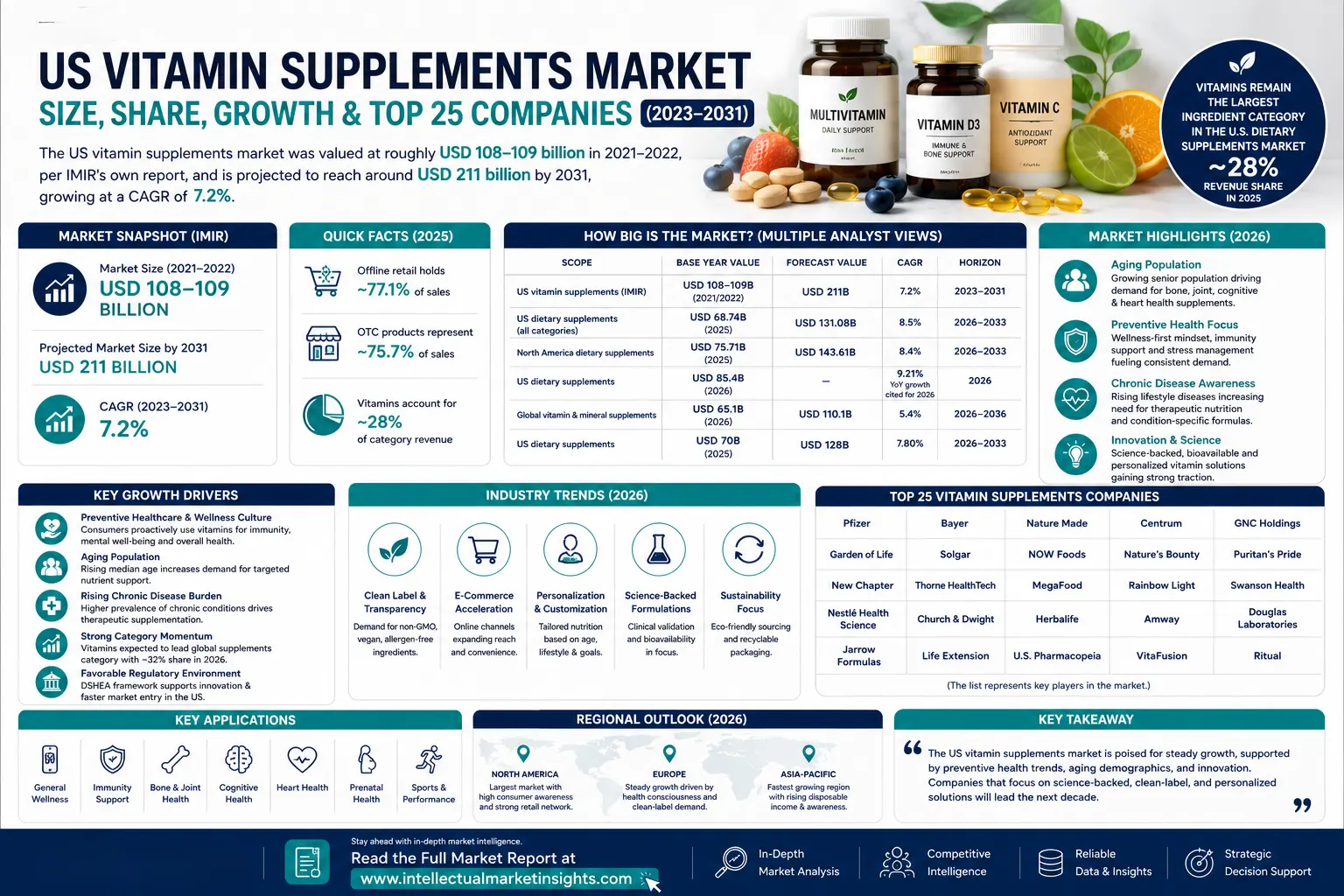
The US vitamin supplements market was valued at roughly USD 108–109 billion in 2021–2022, per IMIR's own report, and is projected to reach around USD 211 billion by 2031, growing at a CAGR of 7.2%. Independent 2026 analyst estimates for the broader US dietary/vitamin supplements category range more conservatively — roughly USD 68–85 billion in 2025/2026, growing at 7.8–9.5% CAGR through the early 2030s — a reminder that "market size" varies significantly by scope (vitamins-only vs. all dietary supplements) and methodology across research firms.
Vitamins remain the single largest ingredient category inside the broader US dietary supplements market, holding roughly 28% of category revenue in 2025, with tablets as the leading format and offline retail still commanding over three-quarters of sales — even as e-commerce and personalization reshape how the category grows.
The story of this market in 2026 isn't just growth — it's consolidation and repositioning. Three of the best-known VMS (vitamins, minerals, supplements) brand owners in the US — Nestlé, Church & Dwight, and several private-equity-backed retailers — have all announced brand divestitures or ownership changes in the past 18 months, signaling that legacy players are narrowing focus toward premium, science-backed brands while offloading mass-market lines to specialist operators.
Market Overview
The US vitamin supplements market covers tablets, capsules, powders, and liquids formulated with vitamins and minerals, sold through retail stores, pharmacies, health food stores, and online platforms, and marketed to children, adults, seniors, pregnant women, and athletes. It sits inside the larger US dietary supplements market — which also includes botanicals, probiotics, and protein/amino acids — where, per Grand View Research, vitamin supplements accounted for about 28.1% of category revenue in 2025, with OTC products representing roughly 75.7% of sales and offline channels accounting for around 77.1% of distribution.
How big is the market, really? (Multiple analyst views)
Because "vitamin supplements," "dietary supplements," and "vitamins & minerals" are scoped differently by different research firms, headline numbers vary widely. Rather than picking one figure and presenting it as gospel, here's the honest spread as of mid-2026:
|
Scope |
Base Year Value |
Forecast Value |
CAGR |
Horizon |
|---|---|---|---|---|
|
US vitamin supplements |
USD 108–109B (2021/2022) |
USD 211B |
7.2% |
2023–2031 |
|
US dietary supplements (all categories) |
USD 68.74B (2025) |
USD 131.08B (2033) |
8.5% |
2026–2033 |
|
North America dietary supplements |
USD 75.71B (2025) |
USD 143.61B (2033) |
8.4% |
2026–2033 |
|
US dietary supplements |
USD 85.4B (2026) |
— |
9.21% YoY growth cited for 2026 |
2026 |
|
Global vitamin & mineral supplements |
USD 65.1B (2026) |
USD 110.1B (2036) |
5.4% |
2026–2036 |
|
US dietary supplements |
USD 70B (2025) |
USD 128B (2033) |
7.80% |
2026–2033 |
Why the spread exists: definitional scope (vitamins alone vs. all supplements), whether the figure is US-only or North America, and whether estimates are built bottom-up from retail scanner data or top-down from category surveys. For content and citation purposes, treat the IMIR figure as the primary market-sizing anchor for this report and use the independent ranges above as directional corroboration, not a contradiction to resolve.
Market Drivers
Growth is driven primarily by preventive-health behavior, an aging population, and rising chronic-disease awareness.
The two most durable drivers — aging demographics and preventive-health spending — are structural, not cyclical, which is why most analyst firms converge on high-single-digit CAGRs despite very different base numbers.
Detailed Explanation
- Preventive healthcare and wellness culture. Consumers are proactively seeking ways to boost immunity, improve mental well-being, manage stress, and support overall health, especially after the COVID-19 pandemic, a behavior shift that has outlasted the pandemic itself and is now embedded in everyday routines.
- Aging population. Older adults require targeted nutrient support (bone, joint, cardiovascular, cognitive), and the US population's median age continues to climb, expanding the addressable base for condition-specific formulations.
- Rising chronic disease burden. Aging population demographics and chronic disease burden requiring therapeutic supplementation supportare cited across multiple forecasting models as core structural drivers, alongside preventive healthcare adoption trajectories.
- Category-level momentum inside the wider supplement basket. In the global dietary supplements market, vitamins are expected to lead with roughly 32% share in 2026 due to their role in nutritional immunity and supporting antibody, protein, and enzyme production, reinforcing vitamins' position as the anchor category retailers build shelf space around.
- Regulatory environment favorable to innovation. The US market benefits from the DSHEA regulatory framework, which supports product innovation and relatively fast market entry compared to pharmaceutical-grade products — a structural advantage that keeps the US ahead of most other geographies on new-product velocity.
Market Trends
The three trends reshaping the category are personalization, ingredient transparency, and channel consolidation around D2C and e-commerce.
Personalization is moving from marketing language to actual product architecture — DNA-informed dosing, biomarker-linked bundles, and subscription-based reformulation are now live programs at major players, not concepts.
Detailed Explanation
- Personalized and condition-specific nutrition. Consumers increasingly reject one-size-fits-all multivitamins in favor of formulations matched to age, sex, and health goals. In June 2025, The Vitamin Shoppe partnered with nutrigenomics firm GenoPalate to launch an at-home DNA collection kit offering personalized dietary insights and tailored supplement recommendations based on genetic makeup— a concrete example of personalization moving from concept to retail shelf.
- Category rebalancing beyond immune support. Post-pandemic, the immune-support super-cycle has cooled, but non-immunity portfolios are now showing the strongest performance for major brands, with growth shifting toward women's health, sleep, cognitive, and healthy-aging formulations.
- Format diversification. Growth is fastest outside classic tablets: gummies and chewables are expanding at a 12.6% CAGR within functional supplements broadly, while protein and amino-acid-adjacent products (often cross-marketed alongside vitamins) are growing even faster.
- Brand consolidation and portfolio pruning. Several legacy owners are narrowing focus rather than expanding it — see the Competitive Landscape section below for specifics on Nestlé, Church & Dwight, and retail ownership changes.
- Natural, clean-label, and sustainably sourced formulations. Manufacturers continue investing in organic certification, recyclable packaging, and traceable sourcing as baseline expectations rather than premium differentiators.
Market Challenges
- Consumer skepticism and efficacy concerns. Questions about product purity, third-party testing, and interactions with medications continue to create friction, particularly for higher-priced or condition-specific claims.
- Competition from functional food and beverage. Fortified foods, functional beverages, and GLP-1-adjacent nutrition products compete directly for the same "preventive health" spending, forcing supplement brands to continuously differentiate.
- Regulatory and legislative scrutiny. Ongoing debate among medical and public-health bodies about the adequacy of supplement oversight adds reputational and compliance pressure across the category — a topic worth monitoring for anyone building long-term content strategy in this space.
- Retail and ownership volatility. As detailed below, multiple household-name brands changed hands or exited the category in 2025–2026, creating short-term distribution and supply-continuity questions for retailers stocking those SKUs.
US Vitamin Supplements Market Segmentation
By Product Type
Tablets · Capsules · Powders · Liquids — with tablets historically dominant on cost and shelf-stability grounds, while gummies/chewables and powders are the fastest-growing formats among adult and sports-nutrition-adjacent consumers.
By Consumer Demographics
Children · Adults · Seniors · Pregnant women and athletes — seniors and women's-health-focused adults represent the fastest-expanding demographic cohorts as condition-specific formulation deepens.
By Distribution Channel
Retail stores · Pharmacies · Health food stores · Online platforms — offline channels still account for roughly 77% of US dietary supplement sales, though direct-to-consumer and subscription e-commerce continue gaining share, especially among younger, personalization-driven buyers.
By Health Concern
Bone health · Heart health · Immune support · Digestive health — with women's health (PCOS, fertility, peri-menopause support using ingredients like myo-inositol and maca root) emerging as a fast-growing sub-segment inside the broader functional supplement space.
By Ingredient Type
Natural or synthetic vitamins and minerals · Supplements containing herbal or botanical extracts — natural/organic positioning continues to command premium pricing and brand loyalty, particularly among Gen Z and millennial buyers.
|
Segment Dimension |
Leading Sub-Segment |
Directional Share/Signal |
|---|---|---|
|
Product Type |
Tablets |
Largest installed base; gummies fastest-growing |
|
Distribution Channel |
Offline retail |
~77% of sales in 2025 |
|
Ingredient Category (within dietary supplements) |
Vitamins |
~28% of category revenue in 2025 |
|
Regional Demand (North America) |
United States |
World's largest dietary supplement market, ~8.8% CAGR through 2036 |
Competitive Landscape: What's Actually Changing in 2025–2026
Before profiling individual companies, it's worth flagging the structural shifts reshaping who owns what in this category right now — this is the kind of "why it matters" context that generic company lists miss.
- Nestlé Health Science is narrowing its VMS portfolio. Nestlé announced it will focus its vitamins, minerals & supplements business on "premium" brands — Garden of Life, Solgar, and Pure Encapsulations — while putting Nature's Bounty, Osteo Bi-Flex, Puritan's Pride, and its US private-label VMS business up for review. This follows Nestlé's original 2021 $5.75 billion acquisition of those brands (plus the US private-label business) from The Bountiful Company, in a deal also involving private-equity firm KKR.
- Church & Dwight has exited vitamins entirely. In December 2025, Church & Dwight agreed to sell its VitaFusion and L'il Critters brands — along with related trademarks, licenses, and its Vancouver and Ridgefield, Washington manufacturing/distribution facilities — to Piping Rock Health Products, concluding a strategic review of its vitamins, minerals and supplements (VMS) business. CEO Rick Dierker framed the move as strengthening the company's focus on its core personal-care and household "power brands," which represent roughly 70% of net sales.
- Retail ownership is shifting toward private equity and specialty operators. The Vitamin Shoppe was sold to private equity firms Kingswood Capital Management and Performance Investment Partners in May 2025, while GNC Holdings operates today as a subsidiary of China's Harbin Pharmaceutical Group.
These moves matter for content strategy and for readers evaluating "top companies" lists: several legacy brand names are now owned by different, less-recognized parent entities than a year or two ago, and some (Nature's Bounty, Osteo Bi-Flex, Puritan's Pride) are actively for sale as of this writing.
Need country-level, company-level, or segment-level insights on the US Vitamin Supplements Market? IMIR's comprehensive report delivers detailed market forecasts, historical data from 2019, in-depth segmentation, competitive benchmarking, and continuous market monitoring through 2031. Request a free sample or connect with our analysts to explore customized regional, company, or investment-focused insights.
Top 25 Companies in the US Vitamin Supplements Market
Companies are profiled using verified public information (SEC filings, company newsrooms, and reputable trade press) wherever available. Figures and ownership details reflect the most recent confirmed data as of mid-2026; private companies that don't disclose financials are noted as such rather than estimated. Sahil — flag any of these for a deeper fact-check pass before publishing, especially the ownership/divestiture items, since those are moving targets right now.
- Amway Corporation
- Herbalife Nutrition Ltd.
- Nestlé Health Science
- Pharmavite LLC
- Bayer AG — Consumer Health Division
- Church & Dwight Co., Inc. — Historical VMS Player
- GNC Holdings, LLC
- The Vitamin Shoppe (Vitamin Shoppe Industries, Inc.)
- Archer Daniels Midland Company (ADM)
- DSM-Firmenich
- Glanbia plc
- NOW Foods
- Nutraceutical International Corporation (Solaray, KAL, Natural Balance)
- Pharmavite's MegaFood (profiled separately due to distinct brand
- Solgar Inc. (Nestlé Health Science)
- The Himalaya Drug Company (Himalaya Wellness)
- Haleon plc (Centrum, Emergen-C)
- USANA Health Sciences, Inc.
- Thorne HealthTech, Inc.
- Ritual (Ritual Vitamins / The Ritual Company)
- Piping Rock Health Products, Inc.
- 21st Century HealthCare, Inc.
- Standard Process Inc.
- Nature's Way Products, LLC
- New Chapter (Procter & Gamble)
1. Amway Corporation (Nutrilite)
Headquarters: Ada, Michigan, United States · Founded: 1959 CEO: Milind Pant · Parent: Alticor
Amway's Nutrilite brand is the world's best-known direct-selling vitamin and supplement line, built on vertically integrated, certified-organic farms the company controls directly — a supply-chain model few competitors replicate. Amway is investing roughly $127.6 million through 2026 to upgrade its Michigan headquarters, including manufacturing and quality-control improvements, and operates certified-organic farms covering roughly 6,000 acres, applying regenerative practices like soil restoration, pollinator habitats, and water conservation. Despite an overall company revenue decline of about 3% in 2024, Nutrilite-branded nutrition sales actually grew, and nutrition now represents roughly 64% of Amway's total global sales— evidence that even as direct-selling as a model faces headwinds, the underlying supplement category remains resilient. Amway is also expanding into personalized nutrition, piloting biomarker-testing bundles and digital health-assessment tools for its distributor network.
Why it leads: unmatched vertical integration from farm to finished product, plus a global distributor network spanning 100+ countries that few pure-play brands can match.
2. Herbalife Nutrition Ltd.
Headquarters: Los Angeles, California (legal domicile: Cayman Islands · Founded: 1980· CEO: Stephan Gratziani · Revenue: ~USD 5.06 billion (2023 · Employees: 8,900+ (2023)
Herbalife is a publicly traded (NYSE: HLF) multi-level marketing company built around meal-replacement shakes, protein products, and targeted vitamin/mineral formulations sold through roughly 4.5 million independent distributors across 95 countries. Its scale and distributor-driven model make it one of the few supplement companies with truly global reach outside conventional retail. The company has weathered leadership transitions in recent years and continues to invest in reformulation and digital tools for its distributor base to keep pace with younger, e-commerce-native competitors. Why it leads: distributor network scale and international diversification reduce reliance on any single retail channel or geography.
3. Nestlé Health Science (Garden of Life, Solgar, Pure Encapsulations)
Headquarters: Vevey, Switzerland (global parent) · VMS Leadership: Greg Behar, CEO, Nestlé Health Science
Nestlé Health Science is repositioning around science-led, practitioner-channel brands rather than mass-market scale. The company has said its VMS business will now focus on global premium brands — Garden of Life, Solgar, and Pure Encapsulations — citing science, innovation, and brand-building as its distinct competitive edge, while reported VMS sales dipped slightly (down 0.4% to CHF 3.2 billion) in the first half of fiscal 2025, with weaker performance concentrated in mainstream brands like Puritan's Pride. The wider Nestlé Health Science US portfolio also includes Nature's Bounty, Vital Proteins, Orgain, Nuun, BOOST, and American Health, though several of these are under strategic review for divestiture.
Why it leads: deep R&D resources as part of a $100B+ global parent, plus practitioner-channel credibility through Solgar and Pure Encapsulations that mass-market competitors can't easily replicate.
4. Pharmavite LLC (Nature Made, MegaFood)
Headquarters: West Hills, California · Founded: 1971, by Barry Pressman and Henry Burdick · CEO: Jeffrey Boutelle · Parent: Otsuka Pharmaceutical· Employees: ~2,200
Nature Made is one of the most recognized and clinically referenced vitamin brands in US pharmacy and grocery retail, and Pharmavite has diversified well beyond it. Pharmavite's brand portfolio spans Nature Made, Nature Made Wellblends, Bonafide, Equelle, MegaFood, and Uqora, and it acquired premium whole-food supplement brand MegaFood in 2014. CEO Jeff Boutelle has described the company's evolution toward serving "the historically underserved area of women's health" through Equelle, Uqora, and Bonafide Health.
Why it leads: Nature Made's USP-verification program and pharmacist/physician trust give it category-leading credibility, while Otsuka's pharmaceutical-grade backing supports long-term R&D investment.
5. Bayer AG — Consumer Health Division (One A Day, Berocca)
Headquarters: Leverkusen, Germany · Founded: 1863
Bayer operates through three main divisions — Pharmaceuticals, Consumer Health, and Crop Science — with its century-plus history in scientific research supporting a reputation for product efficacy and regulatory trust globally. In the US, Bayer's Consumer Health arm markets One A Day multivitamins, among the best-distributed mass-market vitamin lines in American pharmacies and grocery stores. The division is also extending into personalized supplementation internationally, rolling out digital assessment tools and partnering with local labs, with particular retail strength in pharmacy channels across Asia.
Why it leads: pharma-grade R&D infrastructure applied to a mass-market consumer price point, plus one of the widest retail distribution footprints of any vitamin brand in the US.
6. Church & Dwight Co., Inc. — Historical VMS Player (Exited 2025)
Headquarters: Ewing Township, New Jersey · CEO: Rick Dierker Ticker: NYSE: CHD
Church & Dwight is included here not as a current vitamin-market competitor but as an important recent case study: in December 2025, the company sold its VitaFusion and L'il Critters gummy-vitamin brands — plus its Vancouver and Ridgefield, Washington manufacturing and distribution facilities — to Piping Rock Health Products, completing a strategic review of its vitamins, minerals and supplements business. The brands represented less than 5% of Church & Dwight's anticipated 2025 net sales, and the divestiture lets the company concentrate on its seven "power brands" (Arm & Hammer, OxiClean, Trojan, and others). For content and competitive-analysis purposes, treat VitaFusion and L'il Critters as Piping Rock Health Products brands going forward, not Church & Dwight.
7. GNC Holdings, LLC
Headquarters: Pittsburgh, Pennsylvania· Founded: 1935, by David Shakarian· Parent: Harbin Pharmaceutical Group Co., Ltd. · Revenue: ~USD 2.0 billion (FY2022)
GNC remains one of the most recognized specialty-retail brands in US vitamins and sports nutrition, built on a 90-year retail heritage. The company operates in the US, Canada, Ireland, the UK, and China, selling vitamins, minerals, herbal supplements, and sports nutrition under GNC's own brands as well as third-party names like Barebells and GHOST, distributed through company-owned stores, domestic and international franchises, third-party contract manufacturing, and e-commerce. Since being acquired out of Chapter 11 by Harbin Pharmaceutical Group in 2020, GNC has focused on rebuilding its franchise footprint and specialty-store positioning against both mass retail and D2C challengers.
Why it leads: category-defining brand recognition in specialty vitamin/sports-nutrition retail, plus a multi-channel model spanning stores, franchising, and e-commerce.
Comparison Snapshot: Selected Companies
A revenue and market-capitalization comparison table was intentionally scoped down here: most companies on this list are privately held or operate as divisions of larger conglomerates and do not publicly disclose vitamin-specific revenue. The table below includes only the figures independently verifiable from public filings, company statements, or reputable trade press — no estimated or invented numbers.
|
Company |
HQ |
Founded |
Ownership |
Publicly Disclosed Revenue (Company-wide or Segment) |
|---|---|---|---|---|
|
Amway Corp. |
Ada, MI |
1959 |
Private (Alticor) |
~USD 8.1B (2022, company-wide) |
|
Herbalife Nutrition |
Los Angeles, CA |
1980 |
Public (NYSE: HLF) |
~USD 5.06B (2023) |
|
GNC Holdings |
Pittsburgh, PA |
1935 |
Private (Harbin Pharma) |
~USD 2.0B (FY2022) |
|
Pharmavite LLC |
West Hills, CA |
1971 |
Private (Otsuka) |
~USD 522.6M (recent, third-party estimate) |
|
Nestlé Health Science VMS |
Vevey, CH |
— |
Public parent (Nestlé) |
CHF ~3.2B H1 FY2025 (VMS segment) |
|
Herbalife, Amway, GNC |
— |
— |
— |
(see above; largest disclosed-revenue companies in this list) |
For the remaining 20 companies profiled, revenue is either not publicly disclosed (private, independently owned) or not broken out separately from a much larger parent company's consolidated financials — flagging this honestly rather than presenting invented figures.
Regulatory Environment
The US vitamin supplements market operates under the Dietary Supplement Health and Education Act (DSHEA), administered by the FDA, which classifies supplements as a category distinct from conventional food and drugs. This framework supports faster product innovation and market entry compared to pharmaceutical products, but it also places the burden of safety substantiation primarily on manufacturers rather than requiring pre-market FDA approval — a structural feature that periodically draws scrutiny from medical and consumer-advocacy organizations questioning whether oversight is adequate for a market of this size. Manufacturers must still comply with Good Manufacturing Practice (GMP) requirements, and several companies profiled above (NOW Foods, Thorne) use third-party certifications like NSF and UL as a trust signal that goes beyond the regulatory minimum.
Regional Snapshot (US)
East Coast: Dense urban population, established manufacturer and distributor base, strong health-food-store and pharmacy networks, home to several leading clinical-research institutions studying supplement efficacy.
West Coast: Strong wellness and fitness culture, concentration of natural/organic retailers, and a hub for challenger D2C brands (Ritual and similar companies are disproportionately West Coast-founded).
Midwest: Access to agricultural raw materials supports ingredient manufacturing (NOW Foods and Nature's Way are both Midwest-headquartered), alongside growing consumer demand.
South: Large, diverse, and growing health-conscious population with well-established specialty and pharmacy retail networks.
Frequently Asked Questions
How big is the US vitamin supplements market? Per IMIR Market Research, the US vitamin supplements market was valued at USD 109 billion in 2022 and is projected to reach USD 211 billion by 2031, growing at a 7.2% CAGR. Independent 2026 estimates for the broader US dietary supplements category range from roughly USD 68–85 billion, reflecting differences in scope.
What is driving growth in the vitamin supplements market? Preventive-healthcare behavior, an aging population, rising chronic-disease awareness, and a supportive DSHEA regulatory framework that enables faster product innovation than pharmaceutical categories.
Who are the major players in the US vitamin supplements market? Amway (Nutrilite), Herbalife Nutrition, Nestlé Health Science (Garden of Life, Solgar, Pure Encapsulations), Pharmavite (Nature Made, MegaFood), Bayer (One A Day), GNC, and The Vitamin Shoppe are among the largest and most recognized. Note that Church & Dwight exited the category in December 2025, selling VitaFusion and L'il Critters to Piping Rock.
Which vitamin brands changed ownership recently? Several notable shifts occurred in 2025: Church & Dwight sold VitaFusion and L'il Critters to Piping Rock Health Products (December 2025); Nestlé Health Science put Nature's Bounty, Osteo Bi-Flex, and Puritan's Pride under strategic review for possible sale; and The Vitamin Shoppe was acquired by Kingswood Capital Management and Performance Investment Partners (May 2025).
What is the leading distribution channel for vitamin supplements? Offline retail (pharmacies, grocery, and specialty health-food stores) still accounts for roughly three-quarters of US dietary supplement sales, though e-commerce and subscription/D2C models are growing faster than the category average.
Which product format is growing fastest? Gummies and chewables are the fastest-growing format within functional supplements broadly, though tablets remain the largest format by overall volume and revenue.
Is personalized nutrition a real trend or just marketing? It's increasingly real: The Vitamin Shoppe's DNA-based recommendation partnership with GenoPalate and Thorne's testing-linked personalization platform are concrete, live examples — not just messaging.
What regulatory framework governs US vitamin supplements? The Dietary Supplement Health and Education Act (DSHEA), enforced by the FDA, which treats supplements as distinct from conventional drugs and places most safety-substantiation responsibility on manufacturers.
Why do different research firms report such different market-size figures? Because "vitamins," "dietary supplements," and "vitamin & mineral supplements" are scoped differently — some figures cover vitamins only, others cover the full dietary-supplement category including probiotics and botanicals, and some are US-only versus North America-wide.
What health concerns drive the most vitamin supplement purchases? Immune support, bone health, heart health, and digestive health remain the four core segments identified in IMIR's own segmentation, with women's health (PCOS, fertility, peri-menopause) emerging as a fast-growing adjacent category.
Conclusion
The US Vitamin Supplements Market is poised for sustained growth through 2031, driven by increasing consumer awareness of preventive healthcare, an aging population, and the growing demand for personalized nutrition solutions. While market size estimates vary depending on the scope of analysis, the industry continues to demonstrate strong long-term potential, supported by innovation in product formulations, clean-label ingredients, and expanding e-commerce channels.
At the same time, the competitive landscape is undergoing significant transformation. Leading companies are streamlining their product portfolios, investing in science-backed and premium brands, and embracing digital health technologies to strengthen customer engagement. As consumer preferences shift toward transparency, sustainability, and personalized wellness, manufacturers that combine clinical credibility, high-quality ingredients, and omnichannel distribution strategies will be best positioned to capture future market opportunities.
Overall, the US vitamin supplements market remains one of the most dynamic segments within the broader dietary supplements industry. Businesses that focus on innovation, regulatory compliance, and evolving consumer needs are expected to maintain a competitive advantage and drive the market's continued expansion over the forecast period.