
Analysis by Imir Pvt Ltd | Energy & Geopolitical Risk Division
Author:
Intellectual Market Insights Research
Published Date:
15 Mar 2026
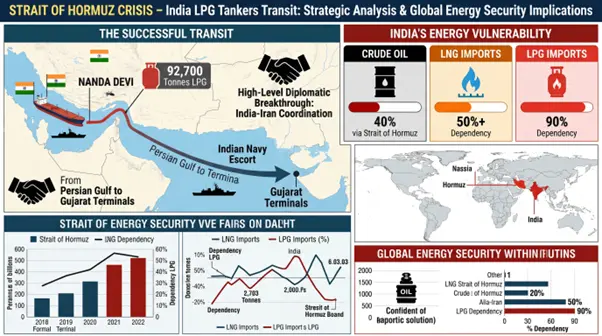
The fact that two Indian-flagged tankers of liquefied petroleum gas sailed through the Strait of Hormuz that is of much strategic importance to the world is not only a diplomatic victory but also an eye-opener as to how the world energy security is not on very solid grounds. With the situation in West Asia becoming increasingly strained between Iran, Israel and the United States, the case of the transit of vessels Shivalik and Nanda Devi provides some essential perspectives on the dynamic nature of energy geopolitics and resilience of the supply chain.
Strategic Diplomacy in Solution of Crises
A total of 92,700 tonnes of liquefied petroleum gas loaded LPG tankers were able to sail through the Strait of Hormuz after the diplomacy between New Delhi and Tehran was on high level. Iran allowed special permission of transit although larger disruptions were to commercial shipping across the Persian Gulf region, according to confirmed reports by Reuters, The Hindu, Indian Express, NDTV and The Sunday Guardian.
This was a diplomatic breakthrough that was accompanied by strong naval coordination. The Transit was accompanied by active survey and protection measures by the Indian Navy with maritime security capabilities, which were used to guarantee the safety of transit through waters that were becoming more and more militarized and security threats posed. The ships will be planned to release their cargo at Gujarat terminals, which will supply the Indian families with crucial gas supplies necessary to cook in case of potential deficits.
The successful transit reflects the paramount significance of managing relations in the diplomatic relationships in the contemporary process of energy security. It, however, also highlights the extent to which the normal business processes have become reliant on geopolitical bargains and military escorted undertakings.
The Structural Energy Vulnerability of India Revealed
The importance of such transit is much greater than the prompt delivery of the cargo. The energy import profile of India has shown a worrying level of the concentration of risk via the Strait of Hormuz chokepoint:
- About 40 percent of the Indian crude oil imports.
- Provides more than 50 percent of the liquefied natural gas.
- Nearly 90% of LPG imports
The 92,700 tonnes that these two ships will carry shows that only 0.28% of the total 33 million tonnes demand of LPG in India is met by this. This calculation brings out the point that although the successful transit is a temporary relief, it is a short run buffer as opposed to a permanent solution to the underlying supply vulnerability.
The crisis has already necessitated the emergency measures to be adopted, with the governmental authorities putting LPG deliveries as the household cooking fuel priority over the industrial usage. Several Indian-flagged ships are said to be still in waters in Persian Gulf without clearance to proceed, which means that the effects of supply chain disruption are far beyond these two successful transits.
Flood of Market Impact Analysis
The economic impacts of the geopolitical situation in the Strait of Hormuz are already being felt in several economic sectors:
Short-Term Financial Indirect Costs:
- Rise in Insurance Premium: War risk insurance of ships that pass through the strait has gone up significantly and the high premiums cannot but pass on to the final consumers through high landed costs of energy.
- Freight Rate Volatility: The lack of vessels that will accept to pass through the area has imposed artificial limits to the supply of shipping capacity which in turn has increased transportation costs of all energy cargoes.
- Supply chain Reconfiguration Costs: India Energy firms are expediting supplies with alternative suppliers like the United States, Norway and Russia but this diversification comes at a greater transit distance and increased logistical costs.
Extended Economic Consequences:
- The disruption causes inflationary pressures all over the Indian economy when transportation and manufacturing costs get increased. In the case of a country that subsidizes the use of LPG in households, higher global prices have a direct impact on raising government fiscal expenditures and either necessitating more budget deficits or cost cuts elsewhere.
Implications in the Global Energy Markets
The crisis in Strait of Hormuz is one of the events that has a lot of implications that go beyond the borders of India. Being a maritime choke point facilitating about 20% of the oil streams in the world in addition to large amounts of LNG, any long-term unavailability produces instant instability in the global energy markets. The perception of increased risk all adds to price premiums which influence the cost of fuel in the world.
There are operational issues in the shipping sector that are being experienced across the borders. Greater insurance demand, longer delivery times, and other requirements to use alternative routes not only impact energy cargoes but all products moving through the area. These issues help to increase the cost of freight and uncertainty in the supply chain in various industries.
Global energy importing countries are reviewing their supply chain resilience and looking at diversification approaches. Nevertheless, there are practical constraints to quick transformations because other suppliers might not have enough surplus capacity and the larger the shipping distances, the higher costs and delivery time will be.
Strategies and Business Implications
The Shivalik and Nanda Devi transit is instructive in a number of key lessons to businesses and policymakers in this changing environment:
Immediate Considerations:
- Improved Risk Management: Geopolitical risk evaluation and maritime security should be factored in the operations planning and the financial hedging scheme of companies in energy-intensive industries.
- Supply Chain Diversification: Crisis increases the business cases that focus on the minimization of concentration risks by alternative supplier relationships and strategic inventory positioning.
- Integration of Naval Security: The integrating aspect of maritime security operations is becoming an element of commercial energy logistics, which needs to be coordinated with the private operators and the military forces.
Medium-term Strategic Change:
- Diplomatic Relationship Management: The concept of energy security relies more and more on the maintenance of operational relationships in various spheres of geopolitical relationships, and this necessitates complex diplomatic engagement policies.
- Strategic Reserve Development: The volatility reflects the importance of increased strategic petroleum and LPG storage capacity to create buffer capacity in case of a supply disruption.
- Alternative Energy Acceleration: The legacy of uncertainty in the established energy supply chains further reinforces the economic argument in favor of renewable energy financing and national capacity to produce energy.
Conclusion and Recommendations
The last event where India LPG tankers sailed across the Strait of Hormuz is a tactical win which was a result of good diplomacy and naval organization. Nevertheless, the event throws light on the overall susceptibility of the global energy infrastructure to the geopolitical shocks and the growing complexity of ensuring energy security in a changing global environment.
To companies and policy makers this incident is an indicator that they should develop holistic risk management policies that will go beyond the usual business factors. Energy security has now become a frontline strategic concern and needs to be constantly monitored, strategized and risk mitigated through multi-dimensional strategies.
With regional tensions ever-changing, Strait of Hormuz will still be a focal point of tension to the international energy markets. To succeed in such an environment, organizations will have to incorporate into their basic operational strategies the ability to plan scenarios, have flexible sourcing frameworks and effective financial risk management tools.
Inquiries on strategic advice on energy security and geopolitical risk management: Imir Pvt Ltd.
Disclosure: The following analysis is meant to be informational and strategic planning. Market situation and geopolitics are very dynamic and prone to shifts of looking up and down