
Dizal's Zegfrovy Shows Strong Phase 3 Results for Resistant Lung Cancer Mutations
Author:
Intellectual Market Insights Research
Published Date:
25 Mar 2026
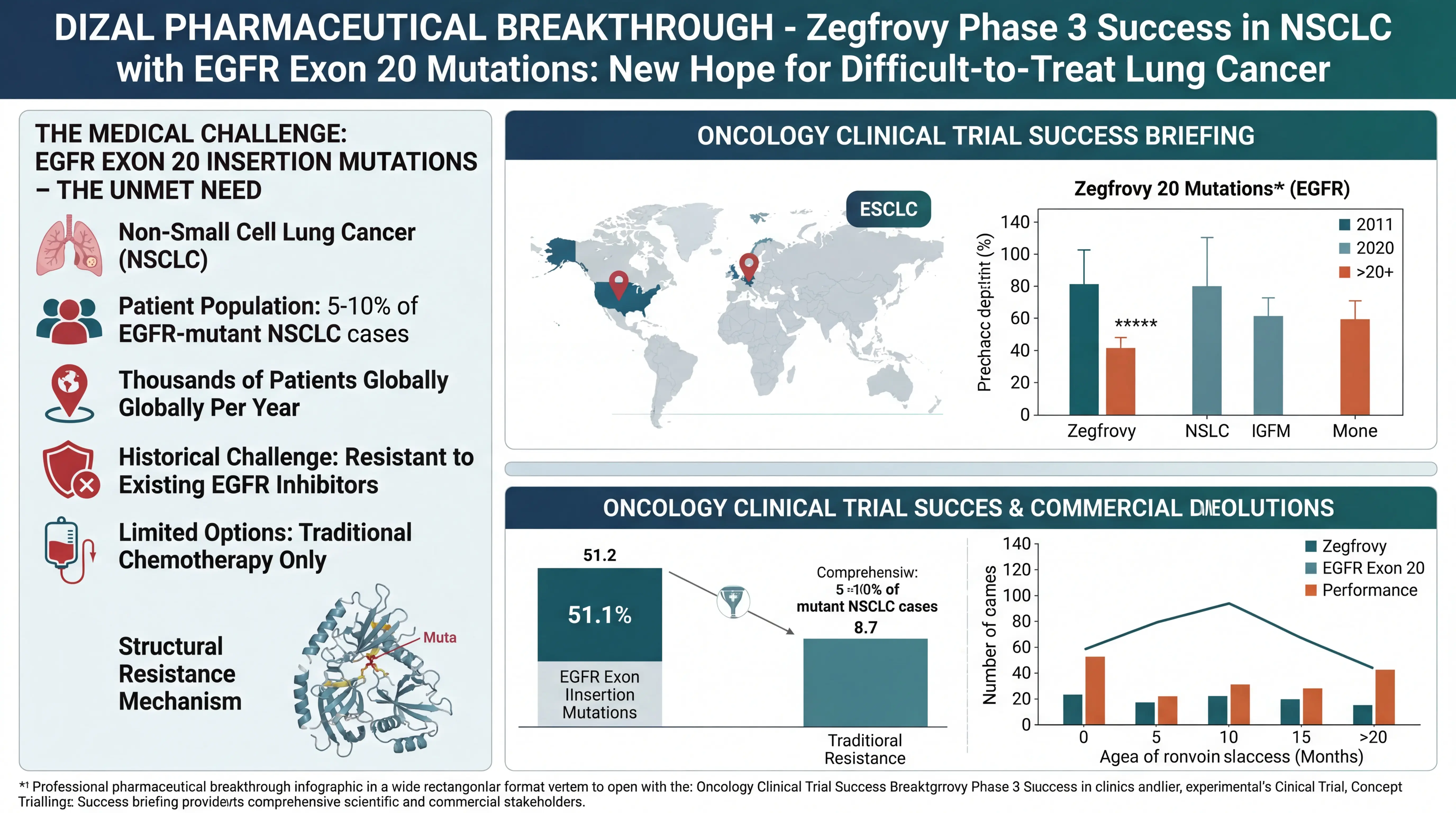
Dizal Pharmaceutical's Zegfrovy demonstrates impressive Phase 3 efficacy in NSCLC patients with EGFR exon 20 mutations, offering new hope for difficult-to-treat lung cancer cases
Dizal Pharmaceutical has reached a powerful achievement in the targeted therapy of lung cancer with remarkable results of Phase 3 clinical trial of Zegfrovy, which sets the potential game-changer of the treatment of non-small cell lung cancer (NSCLC) patients with EGFR exon 20 insertion mutations.
Advancement is a positive step in overcoming one of the most intractable problems in the field of oncology genetic mutations that do not respond to standard targeted therapeutic methods. To the patients whose mutation type has not been successfully treated in large numbers and others responded to specific treatments, the success of Zegfrovy gives real hope.
Understanding the EGFR Exon 20 Challenge
EGFR exon 20 insertion mutations are present in between 5-10 percent of EGFR-mutant NSCLC cases, and the mutation represents thousands of patients annually around the world. Although the proportion is small, given that the condition has no effective targeted treatment options, there is a high research interest in the field, and a high medical need remains unmet.
The mutations have been incredibly resistant to the current EGFR inhibitors because of their structural properties. Whereas exon 20 insertion patients have been relatively confined to conventional chemotherapy with more modest benefit and with more significant side effects, targeted therapy has been able to boost the survival of patients with other EGFR mutations by several years.
The mechanism of resistance is associated with the place and position of exon 20 insertions on the EGFR protein. Majority of the available EGFR inhibitors were created to bind to common mutation forms, and their molecular structure does not enable them to bind and inhibit EGFR proteins that have exon 20 insertions.
Zegfrovy's Clinical Performance
The Phase 3 trial of Dizal tested Zegfrovy as the initial treatment on patients with NSCLC who had EGFR exon 20 insertion mutations. The research between Zegfrovy and the conventional platinum-based chemotherapy proved that the experimental drug was far more effective than chemotherapy in progression-free survival, which is the duration of the time when patient has his disease not getting worse.
The value of gain is reportedly clinically significant, and industry pundits believe the efficacy surpassing that of chemotherapy is substantial enough that Zegfrovy could become a new standard of care to use to first line treat EGFR exon 20 insertion-positive NSCLC, in the event of approval.
Competitive Landscape and Market Implications
The success of Zegfrovy places Dizal in the position to compete with other already established pharmaceutical giants in the market of EGFR-targeted therapies. Firms such as Johnson and Johnson that sell EGFR exon 20 blockers already have a foothold in this area, although the competitive environment is dynamic with several firms working on next-generation blockers.
The possible efficacy of Zegfrovy as a primary monotherapy would make the difference between it and rival strategies. When Zegfrovy is successful in establishing itself as a good one-agent first-line solution, it may have a large market share in a market that has been projected to have several billion dollars yearly.
The Rise of Chinese Biopharma Innovation
The example of Dizal represents a more general shift in the pharmaceutical industry of the world: the Chinese biopharmaceutical companies appear as serious players in the development of oncology drugs. This trend is indicative of a massive investment in research infrastructure, a rising scientific pool of talent, and an improvement in drug development capacity.
In the case of the established pharmaceutical firms, the emergence of the Chinese biopharma is a source of both competition and collaborators. Pharmaceutical innovation with geographic diversification can eventually be a beneficiation of patients as more companies will attempt to find solutions to complex medical problems.
Regulatory Pathway and Global Expansion
The strong Phase 3 outcomes put Dizal in a position to seek regulatory filings in various markets. Approval to the company is likely to be submitted in China, then to the U.S. FDA and European Medicines Agency. Analysts in the industry are projecting that the regulatory approvals may take 12-24 months if there is a smooth process of review.
The international expansion is expected to incorporate a cooperation or a license deal to facilitate commercialization in the markets other than China since the introduction of specialty oncology drugs will involve a large commercial base in terms of specialized sales teams and patient support systems.