
Insulin Market Transformation: Billion-Dollar Investments Drive Industry Overhaul Amid Pricing Pressure and Biosimilar Surge
Author:
Intellectual Market Insights Research
Published Date:
20 May 2026
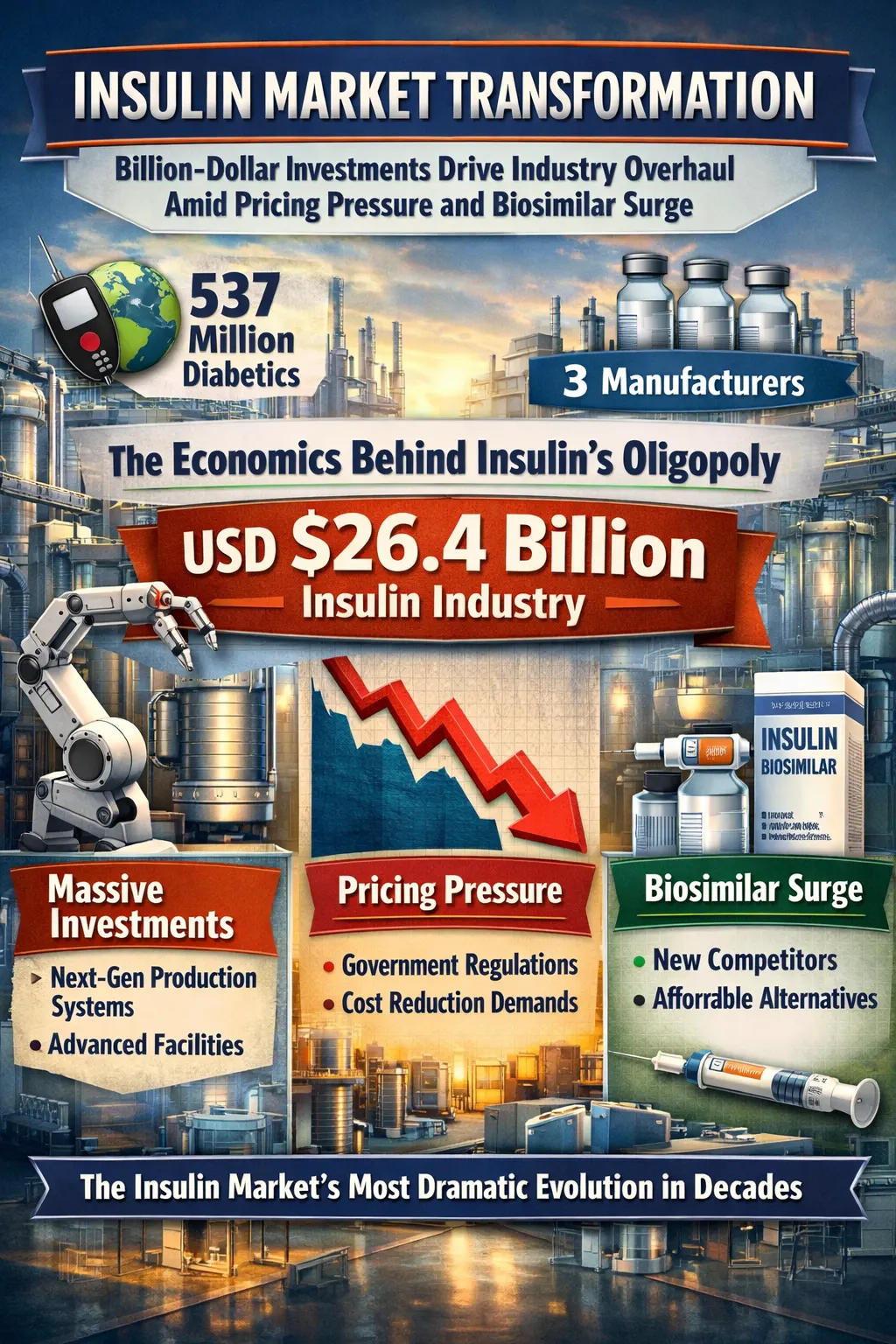
Insulin Market Transformation: Billion-Dollar Investments Drive Industry Overhaul Amid Pricing Pressure and Biosimilar Surge
Insulin Market, 537 million Diabetics, 3 Manufacturers: The Economics Behind Insulin's Oligopoly
The USD 26.4 billion insulin industry is witnessing its most dramatic evolution in decades, as pharmaceutical leaders pour billions into next-generation production systems amid fierce pricing pressures driven by new government regulations and intense biosimilar competition.
Investment Surge: Big Pharma Doubles Down on Capacity
The major companies are investing historic amounts of money to establish themselves firmly in the market considering the expected diabetes incidence worldwide to rise to an estimated 783 million cases by 2045.
For instance, Novo Nordisk, that accounts for 47% of the global production of insulin, has invested billions of dollars in building capacities in various factories throughout Europe and North America. The Denmark-based pharmaceutical company is ramping up manufacturing capacity in its factories based in Kalundborg, Denmark and Chartres, France while at the same time investing heavily in modern biologics manufacturing capabilities in the United States. Such investments are geared towards increasing insulin production and the production of the blockbuster GLP-1 receptor agonists that have been successful in cross-selling.
Like Eli Lilly, Sanofi is equally aggressive in its expansion efforts, pledging more than USD 3 billion for ramping up insulin and diabetes-related biologics production in its Indiana facilities.
Sanofi is focusing more on creating digital management platforms and insulin production. The firm integrates its insulin delivery systems with smart glucose management AI platforms for use among high-end premium customers where profit margins are still high despite pricing pressures.
Even the biosimilars are receiving increased investment funds. One such biosimilars company is India's Biocon Biologics, which is the world leader in developing biosimilars insulin. It is currently expanding its manufacturing capacity in India and Malaysia for use in both regulated Western markets and rapidly growing emerging markets.
A strategic partnership with Viatris has made it possible to have global distribution of Semglee. This biosimilar insulin glargine is recognized as the first interchangeable FDA-approved insulin in the US market.
Development Focus: Smart Technology and Access Innovation
Investment in research and development is drastically moving away from analog insulins to diabetes management systems and advanced insulin delivery systems.
Smart insulin technology will be the most important future development, since there are several pharmaceutical companies supporting the development of glucose-responsive insulin formulations through late-stage clinical trials. The molecules will remain inert until the glucose level in the blood increases. Smart insulin can change the paradigm of the treatment completely, even at premium pricing levels due to reduced margins currently experienced.
There is rapid growth in digital health solutions through investments in closed loop systems that increase by approximately 12% annually. Closed loop systems combine the use of continuous glucose monitors with automatic insulin pumps. They form diabetes management systems which can provide recurring revenue besides traditional revenue from selling drugs.
Biosimilar development remains increasingly competitive for branded products. The biosimilar insulin market is estimated to be worth around USD 1.5 billion and is growing at an annual rate of 8-9%, much faster than the 5.8-6.2% rate in the insulin market. An example of a biosimilar product is Civica Rx's biosimilar insulin glargine product priced at only USD 30 per vial; that is, 90% discount from the previous branded price.
There has been increasing research interest in emerging formulations of insulins, including thermally stable forms. These insulins will not require cold chain logistics during storage and transport. There is potential for huge gains in such markets since there would be access to hundreds of thousands of diabetic patients in developing countries without cold chain infrastructure.
Pricing Revolution: Government Intervention Reshapes Economics
Insulin pricing scenario has witnessed a complete transformation after effective governmental efforts and competition from biosimilar companies.
The changes that occurred due to pricing policies of United States have been the most significant ones. The USD 35 per month cap placed on Medicare insulin due to the Inflation Reduction Act in 2023 caused voluntary extensions to commercially insured customers made by all major players. All three largest producers of insulin have decreased their prices by 70-78%, including Novo Nordisk, Eli Lilly and Sanofi.
Global pricing variations remain significant but are converging downward:
European countries have stringent reference pricing and tendering programs, with some countries also adopting mandatory biosimilar substitution policies.
India has set a ceiling price of USD 3-8 per vial for insulin, which is being regulated by India’s National Pharmaceutical Pricing Authority.
Both Brazil and Mexico are also adopting pricing policies, squeezing margins of multinational companies in fast growing economies.
Pricing pressure from biosimilars continues to mount in all markets. Biosimilar interchangeable insulins provide a price discount of 60-70% of branded reference insulin brands.
Market Outlook: Volume Growth Amid Margin Compression
Structural demand growth remains strong amid pricing headwinds. With 537 million people living with diabetes today forecast to grow to 783 million by 2045, structural demand growth will be assured. Building more healthcare infrastructure and reimbursement coverage in Asia Pacific, Latin America, and Africa will bring millions of new insulin users into the market.
Market dynamics change creates an advantage for companies capable of making the shift from purely pricing-based competition to creating comprehensive diabetes ecosystems. Companies who have invested in intelligent delivery technologies, digital health solutions, and outcome-driven care are poised to win in biosimilar commoditization of conventional insulins.
Resilience in the supply chain is a crucial investment after disruptions caused by coronavirus disease. There is need for geographical diversification and investments in regional manufacturing capabilities to be less dependent on highly concentrated European production capabilities.
Convergence in technology presents the greatest potential for future gains because the merging of insulin delivery with continuous glucose monitoring creates marginally valuable service revenues.