
Multi-Agent AI Market Set to Hit $155 Billion by 2032
Author:
Intellectual Market Insights Research
Published Date:
16 Jun 2026
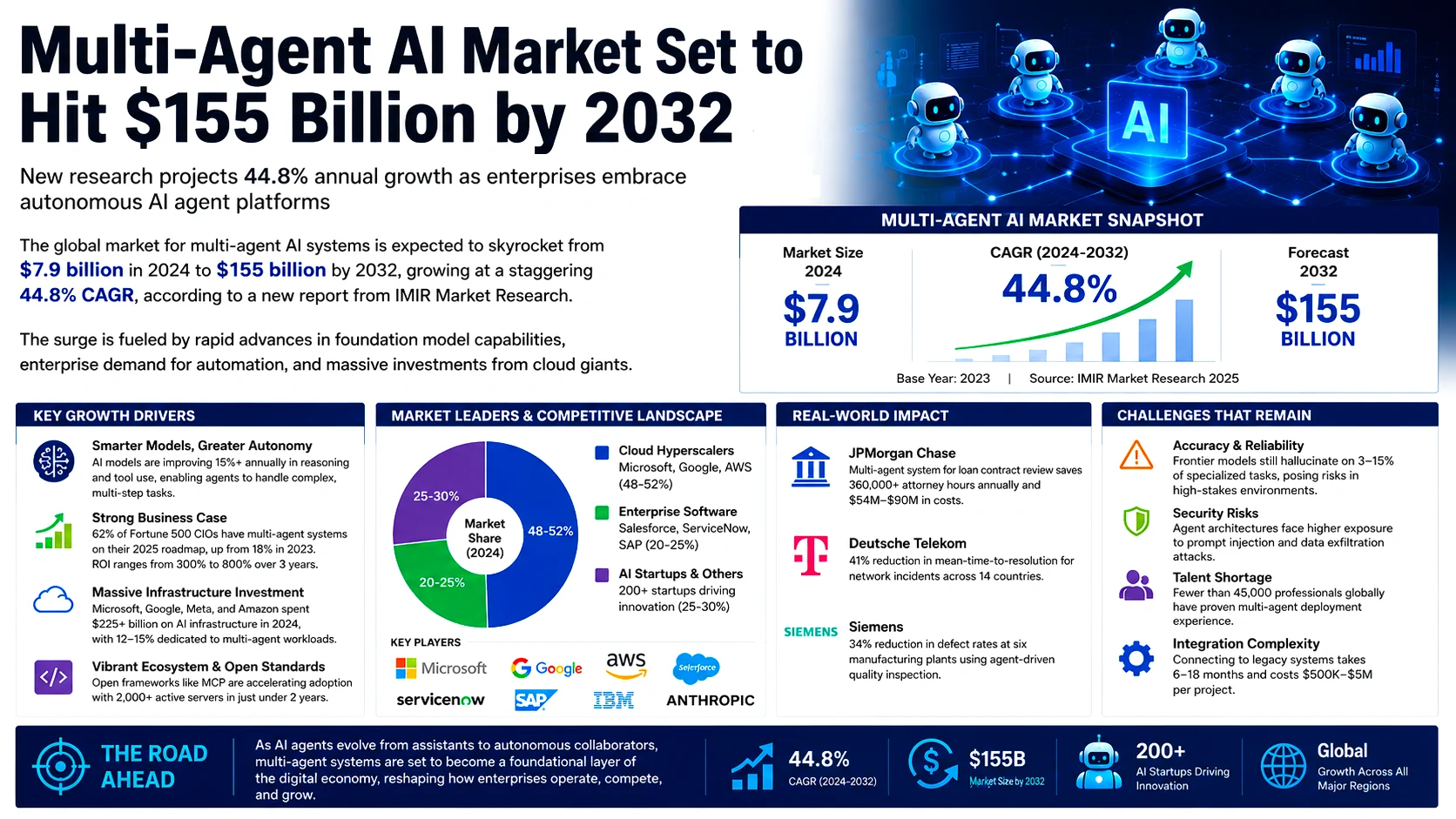
Multi-Agent AI Market Set to Hit $155 Billion by 2032
New market research projects a 44.8% compound annual growth rate for autonomous AI agent platforms, as Microsoft, Google, Amazon, and Salesforce race to lead enterprise adoption
The global market for multi-agent AI systems — software in which networks of autonomous AI agents plan, reason, and act together to complete complex business tasks — is on track to grow nearly twentyfold by 2032, according to a new industry report from IMIR Market Research.
The market was valued at approximately $5.1 billion in 2023 and grew to an estimated $7.9 billion in 2024. It is forecast to reach $155 billion by 2032, a compound annual growth rate (CAGR) of roughly 44.8% over the eight-year period, the report found.
That trajectory would make multi-agent systems, often described as a core piece of the broader "agentic AI" movement, one of the fastest-growing categories in enterprise software this decade.
What's Driving the Growth
Smarter Models Are Making Autonomy Practical
The report attributes much of the surge to rapid gains in foundation model reasoning and tool-use capability. Benchmark performance on tasks like MMLU and HumanEval has improved by more than 15% annually, according to the data, steadily expanding the range of tasks AI agents can complete without constant human supervision.
That shift is what separates the current wave of "agentic AI" from earlier single-model chatbots: agents can now plan multi-step tasks, call external tools and APIs, retain memory across sessions, and coordinate with other agents to divide up work — closer to how a team of specialized employees might operate than a single assistant.
The Business Case Is Already Measurable
Enterprise appetite is also rising sharply. Consulting firm Deloitte found that 62% of Fortune 500 chief information officers had multi-agent systems on their 2025 technology roadmap, up from just 18% in 2023, the report noted.
The economics behind that shift are stark. The average knowledge worker in advanced economies costs an employer between $85,000 and $150,000 a year, the report states, while comparable AI agent-driven task automation can run between $3,000 and $25,000 annually. Early enterprise deployments have documented returns on investment of 300% to 800% over three years.
Hyperscalers Are Betting Billions
Cloud providers are underwriting much of the buildout. Microsoft, Google, Meta and Amazon collectively spent more than $225 billion on AI-related capital expenditure in 2024, with multi-agent infrastructure accounting for an estimated 12% to 15% of new AI workload investment, the report found.
Venture capital is following a similar pattern: roughly $6.9 billion flowed into multi-agent-adjacent startups between 2023 and 2024, including large funding rounds for Cohere, Cognition AI, and Imbue.
Who's Leading the Market
No single company controls the category yet. Cloud hyperscalers — Microsoft, Google, and Amazon Web Services — together hold an estimated 48% to 52% of enterprise multi-agent platform revenue through bundled cloud offerings, according to the report. Enterprise software incumbents such as Salesforce, ServiceNow, and SAP account for roughly 20% to 25%, while more than 200 specialized AI startups make up the rest — the fastest-growing slice of the market.
Several vendors have moved aggressively in the past year. Salesforce launched Agentforce 2.0 in September 2024 and reported more than 1,000 customer deployments within 90 days, building on a base of 200,000-plus CRM customers. Microsoft rolled out Copilot Studio and continues to develop AutoGen, its open-source agent framework, while leaning on its $13 billion OpenAI partnership. Google released its Agent-to-Agent (A2A) communication protocol and brought Vertex AI Agent Builder to general availability. Amazon's Bedrock Agents added multi-agent collaboration features in November 2024, backed by a $4 billion investment in Anthropic.
Anthropic itself has emerged as a standards-setter through the Model Context Protocol (MCP), an open framework for connecting AI agents to external tools and data sources. The report counted more than 2,000 active MCP servers by the second quarter of 2025, less than two years after the protocol's debut — a sign of rapid ecosystem adoption.
Real Deployments, Real Numbers
The report's case studies suggest the technology has moved well past the pilot stage. JPMorgan Chase deployed a multi-agent system for commercial loan contract review that the bank says has cut attorney review time by 360,000 hours a year, with 97.2% accuracy on clause identification and estimated annual savings of $54 million to $90 million. Deutsche Telekom said a multi-agent network operations system cut mean-time-to-resolution for network incidents by 41% across 14 countries, while Siemens reported a 34% reduction in defect rates at six manufacturing plants using agent-driven quality inspection.
Roadblocks Slowing Adoption
The growth story is not without friction. Frontier language models still hallucinate on 3% to 15% of specialized tasks, the report found, and errors can compound across multi-step autonomous workflows — a serious concern in zero-tolerance domains like healthcare and financial services.
Security is another emerging pressure point. The OWASP Foundation's 2024 list of top large-language-model risks flagged autonomous agent architectures as carrying elevated exposure to prompt injection and data exfiltration attacks compared with simpler chatbot deployments.
Talent is scarce. LinkedIn data cited in the report found fewer than 45,000 professionals worldwide with demonstrated multi-agent systems deployment experience as of late 2024, even as demand for AI agent engineering roles grew 340% year-over-year. Integration costs are steep too: connecting agent systems to legacy enterprise software typically takes six to 18 months and costs between $500,000 and $5 million per project, according to Gartner figures referenced in the report.
Perhaps most strikingly, McKinsey research cited in the report found that 67% of enterprise AI projects fail due to organizational change-management issues rather than technical shortcomings — a reminder that software capability alone doesn't guarantee adoption.
Where the Next Wave of Growth Is Coming From
Regionally, North America remains the largest market, generating an estimated $3.4 billion in 2024 revenue, or 43% of the global total, on the strength of its concentration of platform vendors and enterprise buyers. But Asia-Pacific is growing fastest, at an estimated 49.4% CAGR, led by China (52.1% CAGR) and India (51.3% CAGR), where domestic AI ecosystems and government-backed digitization programs are accelerating deployment.
By market segment, orchestration platforms remain the largest category, projected to grow from $3.2 billion in 2024 to $63.1 billion by 2032. Cloud-based deployment dominates overall, expected to expand from roughly 65% to 69% of the market by 2032 as hyperscaler bundling lowers the barrier to entry, while regulated industries continue to favor hybrid and on-premise architectures for data sovereignty reasons.
The report also points to several untapped opportunities: a largely unaddressed small-and-midsize-enterprise market worth an estimated $25 billion to $40 billion by 2030; an emerging "agent economy" of cross-organizational AI collaboration that could be worth $50 billion to $100 billion by 2030; and healthcare administrative automation, given that U.S. healthcare administrative costs alone total an estimated $812 billion annually.
Key Takeaways
- The global multi-agent AI systems market is projected to grow from $7.9 billion in 2024 to $155 billion by 2032, a CAGR of approximately 44.8%.
- Cloud hyperscalers (Microsoft, Google, AWS) collectively hold 48–52% of enterprise platform revenue, with no single vendor exceeding 25% market share.
- Orchestration platforms are the largest market segment, forecast to reach $63.1 billion by 2032; observability and simulation tooling are growing fastest at nearly 49% CAGR.
- Asia-Pacific is the fastest-growing region (49.4% CAGR), led by China and India, even as North America retains the largest absolute revenue share at 43%.
- Documented enterprise ROI ranges from 300% to 800% over three years, but 67% of AI projects still fail due to change-management issues rather than technology gaps.
- Talent shortages, integration costs, hallucination risk, and emerging security threats remain the primary brakes on faster adoption.
What This Means for the Industry
For enterprise software vendors, the shift toward agent-native architecture is no longer optional positioning — it is becoming the default product strategy, as shown by the speed with which Salesforce, ServiceNow, SAP, and the major cloud platforms have repositioned their roadmaps around autonomous agents within an 18-month window.
For investors, the market's fragmentation — no vendor holds more than a quarter of platform revenue — suggests the competitive landscape is still being decided, with both well-capitalized incumbents and specialized startups holding meaningful paths to share gains.
For governments, the report's regulatory analysis suggests compliance frameworks like the EU AI Act are functioning less as a brake on adoption and more as a confidence mechanism, giving risk-averse industries like banking and healthcare a clearer pathway to deploy autonomous systems at scale.
Future Outlook
The report frames the current period — 2024 through 2025 — as the transition from early enterprise pilots to production-scale rollouts, with mainstream adoption across more than half of Fortune 500 companies projected by 2027 or 2028. Standardization efforts such as Google's A2A protocol and Anthropic's MCP are expected to play an outsized role in that transition, reducing the integration friction that has slowed deployment to date.
Beyond 2028, the report anticipates that multi-agent capability will increasingly become a commodity feature embedded directly into cloud platforms, shifting competitive advantage toward proprietary data, vertical-specific fine-tuning, and the emerging category of inter-organizational agent networks. Whether that consolidation benefits today's hyperscalers or creates room for a new generation of specialized challengers remains, by the report's own account, one of the most consequential open questions in enterprise technology heading into the next decade.