
The Pharmaceutical Industry Weekly Brief
Author:
Intellectual Market Insights Research
Published Date:
15 Mar 2026
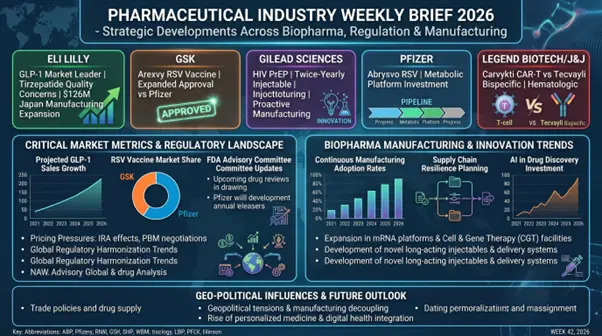
The Strategic Developments in Biopharma, Regulation and Manufacturing
The pharmaceutical industry remains characterized by astounding growth direction and positioning. In this week analysis, the critical developments that are transforming the dynamics of competition, including the expansion of manufacturing capacities and modernization of the regulatory landscape, and both short-term and long-term strategic outlooks of the industry stakeholders are discussed.
Executive Summary
The pharmaceutical industry is undergoing a phase of its major strategic realignment. The metabolic disease and rare condition market leaders are riding unprecedented demand, as traditional players are dealing with patent cliff pressures and manufacturing quality issues. Manufacturing capacity has no longer been an auxiliary role but has become one of the major competitive advantages with organizations such as Eli Lilly investing heavily in capacity. At the same time, the regulatory agencies are updating oversight systems as well as ensuring high-quality standards, leaving both opportunities and compliance challenges to industry participants.
- Rare Disease Market: Therapeutics Sector will grow to over $400billion in 2032 (global)
The News: Industry projections suggest that the global rare disease therapeutics market is set to experience a phenomenal growth and the estimated revenues are expected to exceed . This growth can be attributed to the increased pace of innovations in gene therapies, the increase in regulatory incentives to grow orphan drugs and better diagnostic tools that allow the early detection of patients.
Market Impact & Analysis: Short-Term (1-3 years): Anticipate increased merger and acquisition activity as big pharmaceutical firms will pursue late-stage rare disease acquisitions as the means to mitigate the effects of patent cliffs. The diversion of investment will be focused on gene therapy systems and ultra-rare indication experts.
Long-Term (3-10 years): Portfolios of rare diseases will emerge as core growth vehicles of large pharma-companies, and provide them with high-margin revenue streams with a low level of competition. Nevertheless, reimbursement models such as outcomes-based contracts and annuity payment models will be more in demand by payers as high-cost treatments will be applied to larger groups of patients.
- Eli Lilly: Metabolic Franchise Makes it to the Exceptional Growth as 2026 Revenue Headwinds Cascade on Industry Peers
The News: There is an acute deviation of performance in the major pharmaceutical companies. Eli Lilly is still delivering strong growth on the back of its metabolic and obesity treatment line with a good mix of GLP-1 receptor agonists, as many industry competitors are showing difficult revenues into the 2026-2030 period as a result of patent expiry and competitiveness.
Market Impact & Analysis: Short-Term: The growing performance difference between the metabolic disease leaders and the diversified counterparts will increase the consolidation activities in the industry. Firms that are endowed with good cash will consider transformational acquisitions and those that are under pressure of patents will consider strategic alliances to continue their growth paths.
Long-Term: There will be a movement to invest more in companies that have a differentiated position in high growth therapeutic areas. Portfolio mix will alter to specialty and heavy biologics business with companies that do not have any appreciable exposure to obesity, oncology, or rare disease perhaps not being in a position to sustain historical growth rates.
- Eli Lilly: Quality Issues Raised about Tirzepatide Compounded amidst Glb-1 Demand Like Never Before
The News: Eli Lilly has already expressed in the media the presence of impurity in compounded forms of tirzepatide and the possible safety risks presented by non-FDA approved versions. This is indicative of the larger supply-demand imbalances in the GLP-1 market with unprecedented demand conditions providing the possibility of compounding pharmacies to enter via regulatory shortage conditions.
Market Impact & Analysis: Short-Term: Regulatory bodies will also focus more on the inspection of the compounded GLP-1 products, which may result in the enforcement of facilities that fail to prove the proper quality control. This regulatory emphasis would be beneficial to branded manufacturers as it would minimize competition by less expensive substitutes.
Long-Term: Companies that are able to scale up their production to the demand will get huge market share in what analysts forecast may turn into a market within what analysts estimate will be a market of over. The critical factor to market leadership in the GLP-1 space in the long term is now manufacturing capacity expansion.
- FDA: Advertisement: Adverse Event Monitoring System has been Updated to Revolutionize Pharmacovigilance
The News: The U.S. Food and Drug Administration has introduced a simplified adverse event reporting system that is expected to update the post-market drug safety surveillance system. The system combines the information of the electronic health records system, insurance claims system, and conventional reporting system to facilitate quicker identification of safety signals.
Market Impact and Analysis: Short term: The pharmaceutical firms need to invest in improved pharmacovigilance systems and data analytics capacity to meet the new reporting requirements. There will be an upsurge in the near-term compliance costs in the industry.
Long-Term: The more developed safety monitoring infrastructure will help the company to be more efficient in detecting and responding to safety indicators before they turn into expensive regulatory measures. The benefits of the improved surveillance ecosystem should include the ability of the industry to detect safety problems earlier and implement risk mitigation strategies in a more specific manner.
- Eli Lilly: Japan Manufacturing Investments of $126 million point to Global Capacity Strategy
The News: Eli Lilly has invested in establishing increased manufacturing capacity in Japan which is a follow-up to large-scale investments in capacity in the United States, Europe, and Asia. This business strategy is focused on geographic diversification and closeness to major markets and developing supply chain resilience.
Market Impact & Analysis: Short-Term: The investments in manufacturing capacity will lead to an increase in the level of capital expenditure and temporary pressure on the margins of investing companies, but will create higher supply predictability to high-demand products and capabilities to respond to the market boom.
Long-Term: The ability to manufacture is turning into a competitive advantage, especially in the case of biologics and specialty pharmaceuticals. Firms that make insufficient investments in manufacturing infrastructure can end up being capacity constrained at important milestones of commercialization and do not have to lose market shares to firms that make superior preparations.
- Legend Biotech/ Johnson & Johnson: Competition in the CAR-T Therapy Market Heats Up with Carvykti Competing with Tecvayli
The News: The competitive environment in the field of hematologic malignancies is changing very fast with Legend Biotech stating its belief in the ability of Carvykti to grow even with the rising competition posed by Johnson and Johnson bispecific antibody, Tecvayli. The competition is a more general "modality war" between customized cell therapies and off-the-shelf products.
Market Impact and Analysis: Short-Term: Competition between personalized CAR-T therapies and off-the-shelf bispecifics will continue to be increased and the payers will examine the cost and clinical benefits especially in earlier lines of treatment where the patient population is larger.
Long-Term: CAR-T market is poised to see a tremendous growth as the treatment options go up in the sequence of treatments and production streamlines. Firms that are able to effectively decrease the complexity of manufacturing therapeutically but preserve efficacy will be at the forefront of commercial success, but large companies will have a significant capital advantage.
- Hyloris Pharmaceuticals: FDA Full Response Letter Reveals Quality of Manufacturing as a risk
The News: The FDA sent a Complete Response Letter to the Hyloris Pharmaceuticals claiming manufacturing-related inadequacies, an increasing trend of regulatory delays on a chemistry, manufacturing, and controls ground rather than a clinical efficacy ground.
Market Impact and Analysis: Short-term: The loss of manufacturing-related regulatory approvals usually causes large stock price declined and long market entry periods during which competitors could gain market benefits. This is in view of the essence of thorough manufacturing preparedness testing by firms on the verge of regulatory milestones.
Long-Term: Quality in manufacturing has become a highly important point of differentiation with regulators becoming more and more disposed to withhold their approvals when there are issues with quality. Companies focusing on manufacturing excellence at an early stage of development will get easier regulatory approvals and successful commercial launches.
- GSK: Arexvy Widened Approval Bolsters position in the market against Pfizer Competition
The News: GSK has gained increased regulatory approvals regarding its RSV vaccine Arexvy, which strengthens its competitiveness against Pfizer, which has an RSV vaccine, Abrysvo, as well as other vaccine manufacturers in the pipeline. The market of respiratory syncytial virus vaccines is a huge business potential because immunization turns into the order of things among the target population.
Market Impact and Analysis: Short-Term: Competitive rivalry in positioning and mindshare of physicians associated with formulary vaccinations will define the market of RSV vaccines, and the older adult vaccination programs will result in high revenue contribution in the earlier-adopter markets.
Long-term: It is likely that RSV vaccines will emerge as regular seasonal items like influenza vaccines in some groups of the population. The market will mature and give scale benefits and cross-selling capability to manufacturers with wide portfolios of respiratory products that are used by adults.
- Pfizer, Sciwind Biosciences & Astellas: Strategics Fuel in Next-Gen Metabolic Platforms
The News: Recognition of Pfizer, Sciwind Biosciences and Astellas Pharma investment activity signifies a harsher tussle to gain leadership roles in next generation metabolic therapies and advanced biologics platforms, such as dual and triple hormone agonists, oral preparations and new mechanism strategies.
Market Impact and Analysis: Short-Term: More deal-making and partnering around the promising early and mid-stage metabolic assets will cause the valuation of the biotechnology companies having novel technologies to increase. The meaningful differentiation will increase when there are crowded clinical pipelines.
Long-Term: Market share can be drawn to the best in class agents instead of first in class products only. Firms that do not have plausible metabolic disease or next-generation biologics strategies face the risk of trailing their high-growth counterparts as competitors intensify their efforts.
- Gilead Sciences: HIV PrEP Therapy Presentation in the Market by Proactive Manufacturing Strategy
The News: Gilead Sciences is practicing forward manufacturing plans in its investigational twice-yearly pre-exposure prophylaxis therapy against HIV to show how proactive capacity planning can expedite the market penetration and optimize business prospect when regulatory approval is provided.
Market Impact/Analysis: Short Term: Gilead will be able to penetrate the market quickly due to its manufacturing preparedness, which will create first-mover advantages in the long-acting prevention of HIV. The competitive reactions will probably target the dosing convenience, positioning of cost, and access programs.
Long-Term: The injectable prevention therapies that are used as long-acting drugs would potentially alter the overall HIV prevention in the setting of a public health program. The manufacturing capacity model that involves developing capacity before approval can be duplicated in other prevention and chronic disease therapies.
About This Analysis
The brief is an analysis of the pharmaceutical industry based on publicly accessible information and regulatory submissions, and company press releases and industry publications aimed at providing the healthcare industry stakeholders with strategic information. The analysis concentrates on developments that have a high potential of market impact and looks at its implication on the competitive dynamics, investment decision making and strategic planning.
Disclosure: The following analysis is done on an informational basis and should not be interpreted as investment advice. Market forecasts and strategy evaluation are calculated on the published information, and industry evaluation. Before making investment and business decisions, readers are advised to carry out the independent research and seek the advice of qualified professionals.