
America’s Packing Revolution: The Rise of the Travel Compression Bags Market
Author:
Intellectual Market Insights Research
Published Date:
23 May 2026
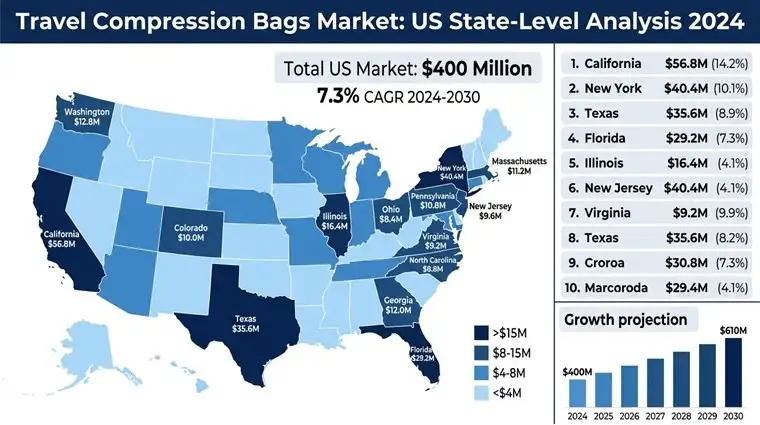
The USD 400 Million Packing Revolution: Why Travel Compression Bags Are Reshaping How America Travels
We have all had to struggle to zip our oversized bag shut while inwardly swearing at the baggage fees imposed by airlines. However, this once ubiquitous issue among travelers has transformed itself into a USD 400 million opportunity in the US travel compression bags market that is now transforming the way Americans pack their bags. In 2024, the US travel compression bags market is expected to be valued at USD 400 million for vacuum bags, roll-up bags, and other hybrid types of packing products and does not seem to be showing any sign of slowing down. Projections suggest that it will reach USD 610 million by 2030.
The USD 400M Travel Compression Bag Market's Geographic Goldmine
The United States travel compression bags industry showcases a remarkable geographic truth in that almost fifty percent of all market demand is concentrated in only five states.
The State-Level Power Players
- The largest market share goes to California, which boasts USD 56.8 million (14.2%), thanks to the large volume of international traffic from Los Angeles International Airport (LAX) and San Francisco International Airport (SFO). The second biggest comes from New York, with USD 40.4 million (10.1%). Carry-on only is an attitude in New York.
- Texas gets USD 35.6 million (8.9%) due to the major hub position of DFW and Houston, Florida receives USD 29.2 million (7.3%) as the biggest cruise departure state in the US, whereas Illinois earns USD 16.4 million (4.1%) based on the significant number of business travelers passing through O'Hare.
The Companies Winning Regional Wars
Eagle Creek has a stronghold in outdoor-centric regions such as Colorado and Washington. Similarly, compression cubes have companies like Gonex that can target urban areas via Amazon through New York and California. Good brands match their strategies according to travel patterns. For example, Samsonite uses its traditional distribution network in states like Florida and Texas. On the other hand, brands like Peak Design use premium positioning in technical regions like Seattle and San Francisco.
The Future Packs Light and Smart
In light of shrinking overhead bins and higher baggage fees, this growing market worth USD 400 million that will reach USD 610 million by 2030 makes it evident that the Americans have finally stopped playing the game of packing roulette. Whether they come from adventurous Californians or New York's carry-on mavens, the regional winners are obvious, where states blessed with significant hubs of travel dictate the demands. On the other hand, for companies, the game plan goes beyond country-wide it is more about individual zip codes.