Trump's 100% Drug Tariff Plan Triggers Global Pharma Manufacturing Exodus
Author:
Intellectual Market Insights Research
Published Date:
07 Apr 2026
Framework Details of Proposed 100% Drug Tariff Structure
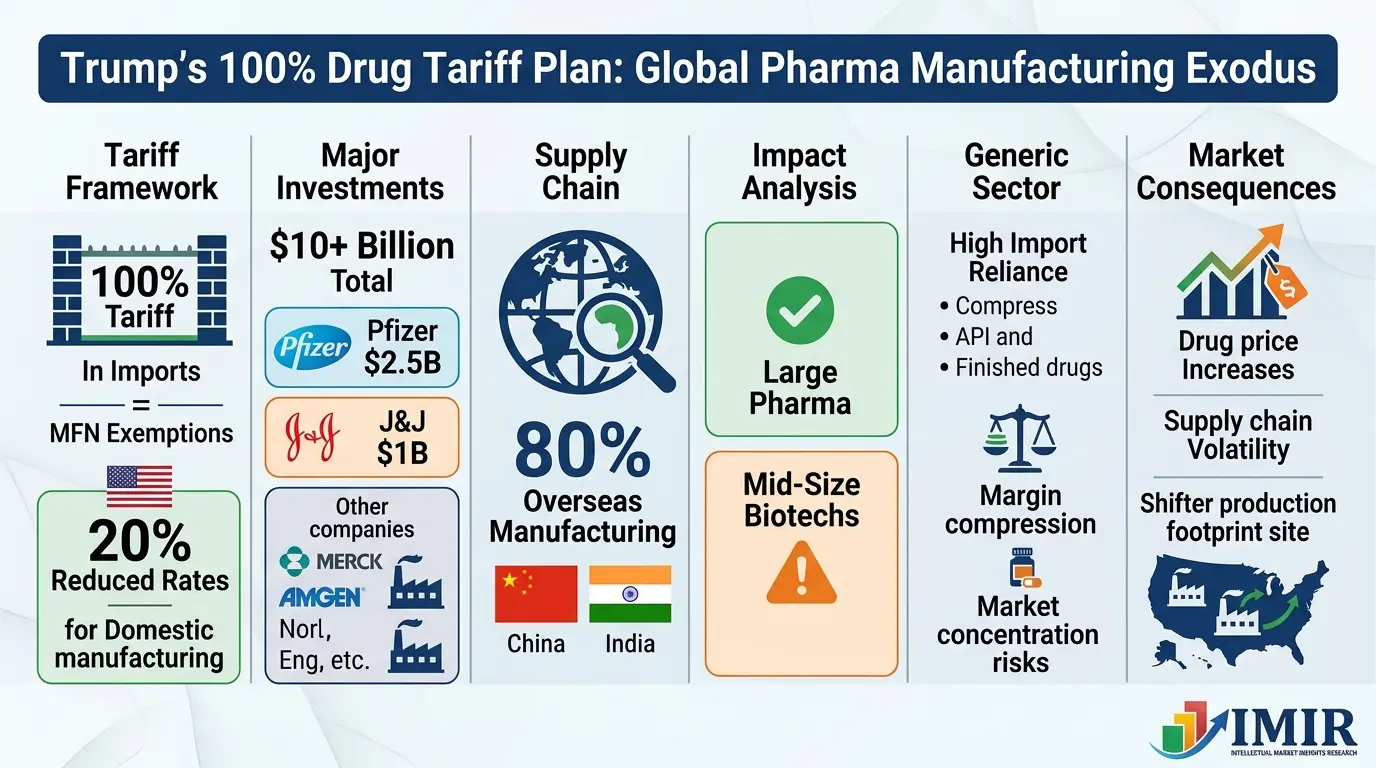
In the conceptual framework under discussion in the policy circles, the US would impose 100% tariffs on some imported patented pharmaceuticals, but there would be a vital compliance mechanism. Companies that signed MFN prices with the United States government would have exemptions on tariffs and those who agreed to make investments in domestic manufacturing would be charged lower tariffs of about 20 percent over transitional periods.
The suggested MFN agreements would entail drugmakers to match the U.S. medication costs to considerably reduced costs in different developed countries, invest a lot of money in manufacturing plants in the United States of America, and engage in government-supported pricing schemes. The implementation timelines being discussed imply 120 days compliance windows of big pharmaceutical companies and 180 days of small ones.
The data collected in the industry to justify such discussions of policies indicates that about 80 percent of the active pharmaceutical ingredients utilized in the U.S. drugs are produced abroad, mostly in China and India. The COVID-19 pandemic revealed what are known to be critical vulnerabilities of this supply chain dependency when disruptions resulted in medication shortage, which endangered the treatment of patients across the country.
Major Pharma Companies Accelerate Domestic Investment Strategies
Major drug corporations have already declared large domestic production investments if any policy changes are implemented. Pfizer has invested up to 2.5 billion into manufacturing plants in the United States, and Johnson and Johnson have invested up to 1 billion in the domestic manufacturing expansion. Merck, Bristol Myers Squibb, and AbbVie announced the same, which is more than 10 billion invested in domestic pharmaceutical manufacturing.
Such investments indicate a true business understanding that supply chain diversification minimizes operational risk and enhances long-term competitive positioning despite policy actions. Most pharmaceutical giants in the world have the capital, portfolio mix, and scale of operation that are able to absorb transition costs as they reorganize their production footprints over a multi-year period.
Mid-Sized Biotechs Face Disproportionate Pressure Under Proposed Framework
The biggest issues of proposed tariff systems revolve around mid-sized biotechnology companies. Such firms do not usually have the huge capital necessary to construct the manufacturing facilities in the U.S and usually have limited product lines that provide minimal price elasticity to meet the demands of the MFN agreements.
The advocacy organizations representing the small biotech’s have cautioned that such policies would establish a two-tier pharmaceutical ecosystem that benefits big companies at the expense of smaller innovative companies that design most of the early-stage research and development work. This dynamic may possibly choke the innovation pipeline which has historically been created through agile biotech startups.
Generic Drug Sector Positioned for Market Share Expansion
The policy frameworks proposed tend to have extensive exemptions in generic and biosimilar drugs, as it has been noted that they have a vital role in health care cost. Such exemption scheme would be of great advantage to the countries that lead in generic drugs production, especially India, which produces about 40 percent of drugs used throughout the world.
With the risk of an increase in the prices of branded drugs due to the additional costs imposed by tariffs, the demand of the cheap generic analogs would increase significantly. More than 30 biosimilar products have already been approved by FDA, and this may increase the rate of healthcare savings in the billions, and this may increase under a situation of tariff pressure.
Global Trade Implications Create Geopolitical Leverage
Other frameworks of tariffs that are proposed are said to have differentiated treatment of various trading partners which can give them wider geopolitical approaches. The United Kingdom may be allowed to continue to export pharmaceuticals tariff-free, whilst European Union member states, Japan and Switzerland may be exposed to lower tariff rates between 15%. The entire tariff may be imposed on other areas that have no preferential agreements.
These diversifications reveal that pharmaceutical trade terms are being entrenched in the wider diplomatic relation management, which is indeed establishing new leverage points in international negotiations.
Artificial Intelligence Integration Accelerates Amid Cost Pressures
At the same time, pharmaceutical firms are stepping up the adoption process of artificial intelligence in a bid to compensate for the increased cost of operation by enhancing research and development efficiency. Large companies such as Roche, Novartis, and AstraZeneca have come out with significant AI collaboration agreements to help cut down on drug development times and expenses.
The average cost of developing a traditional drug is 2.6 billion per approved therapy over 10-15 year periods. AI-based platforms have shown the potential to reduce these timelines by a large margin through a better identification of targets, predicting molecular behavior, and optimization of clinical trials.