
Top 10 Companies in the Global Blood Pressure Monitors Market
Author:
Intellectual Market Insights Research
Published Date:
12 Sep 2026
Introduction
Blood pressure monitoring has quietly become one of the most widely performed health measurements in the world, checked routinely in doctor's offices, monitored continuously in hospital ICUs, and increasingly tracked at home by patients managing hypertension on their own. From simple mercury and aneroid sphygmomanometers to sophisticated digital, automated, and ambulatory monitoring systems, blood pressure devices have evolved dramatically while remaining central to preventing and managing cardiovascular disease, one of the leading causes of death worldwide.
The global blood pressure monitors market was valued at approximately USD 4.2 billion in 2025 and is projected to reach USD 9.1 billion by 2034, expanding at a compound annual growth rate (CAGR) of 8.75% over the forecast period. This growth reflects rising global hypertension prevalence, growing emphasis on home-based health monitoring, and continued innovation in connected, AI-enabled devices capable of detecting conditions like atrial fibrillation alongside routine blood pressure readings.
The competitive landscape spans large diversified medical technology conglomerates with broad hospital patient monitoring portfolios, consumer-focused home health device specialists, and companies whose sensor and monitoring technology increasingly cuts across both hospital and home settings. Because blood pressure monitors must balance clinical-grade accuracy with, in the home segment, consumer ease of use, the market rewards companies that combine rigorous validation with strong brand trust among both healthcare professionals and everyday consumers.
Understanding which companies lead this foundational health monitoring market is essential for hospitals, healthcare providers, and increasingly for consumers investing in home-based cardiovascular health management. This article provides a research-based analysis of the top companies in the global blood pressure monitors market, their positioning, flagship offerings, and the competitive forces shaping the landscape.
Market Overview
|
Parameter |
Details |
|---|---|
|
Market Size (2025) |
USD 4.2 Billion |
|
Projected Market Size (2034) |
USD 9.1 Billion |
|
CAGR (2025–2034) |
8.75% |
|
Base Year |
2023/2024 |
|
Historic Period |
2018–2023 |
|
Forecast Period |
2025–2034 |
|
Leading Region |
North America |
|
Fastest-Growing Region |
Asia-Pacific, led by China and Japan |
|
Key Growth Drivers |
Rising global hypertension prevalence, growing home health monitoring adoption, innovation in AI-enabled and connected devices |
|
Key Challenges |
Accuracy variability among low-cost consumer devices, market consolidation among established diagnostics players |
|
Key Opportunities |
AI-powered atrial fibrillation detection, ambulatory and 24-hour monitoring growth, integration with digital health platforms |
Why the Blood Pressure Monitors Market Is Growing
1. Rising Global Hypertension Prevalence
Hypertension remains one of the most common chronic conditions worldwide and a leading risk factor for heart disease, stroke, and dementia, driving sustained demand for blood pressure monitoring across both clinical and home settings.
2. Growing Emphasis on Home-Based Health Monitoring
Updated clinical guidelines increasingly emphasize earlier treatment and closer at-home blood pressure management to reduce cardiovascular and dementia risk, driving urgency around routine home monitoring and supporting continued growth in the home healthcare device segment.
3. Innovation in AI-Enabled Detection Features
Newer blood pressure monitors increasingly incorporate AI-powered features such as automatic atrial fibrillation screening during routine blood pressure checks, adding clinical value beyond simple pressure readings and driving device upgrades.
4. Expansion of Enterprise and Centralized Monitoring
Hospitals are increasingly adopting enterprise-scale, centralized patient monitoring platforms that integrate blood pressure and other vital sign data across departments, driving demand for connected, interoperable monitoring technology.
5. Growth in Remote Patient Monitoring Programs
Healthcare systems are increasingly using connected blood pressure monitors as part of remote patient monitoring and hospital-at-home programs, supporting earlier intervention and reducing readmissions for patients with chronic cardiovascular conditions.
6. Rising Healthcare Investment in Emerging Markets
Growing healthcare infrastructure investment across Asia-Pacific and other developing regions is expanding access to both clinical and consumer blood pressure monitoring devices as more patients gain access to modern cardiovascular care.
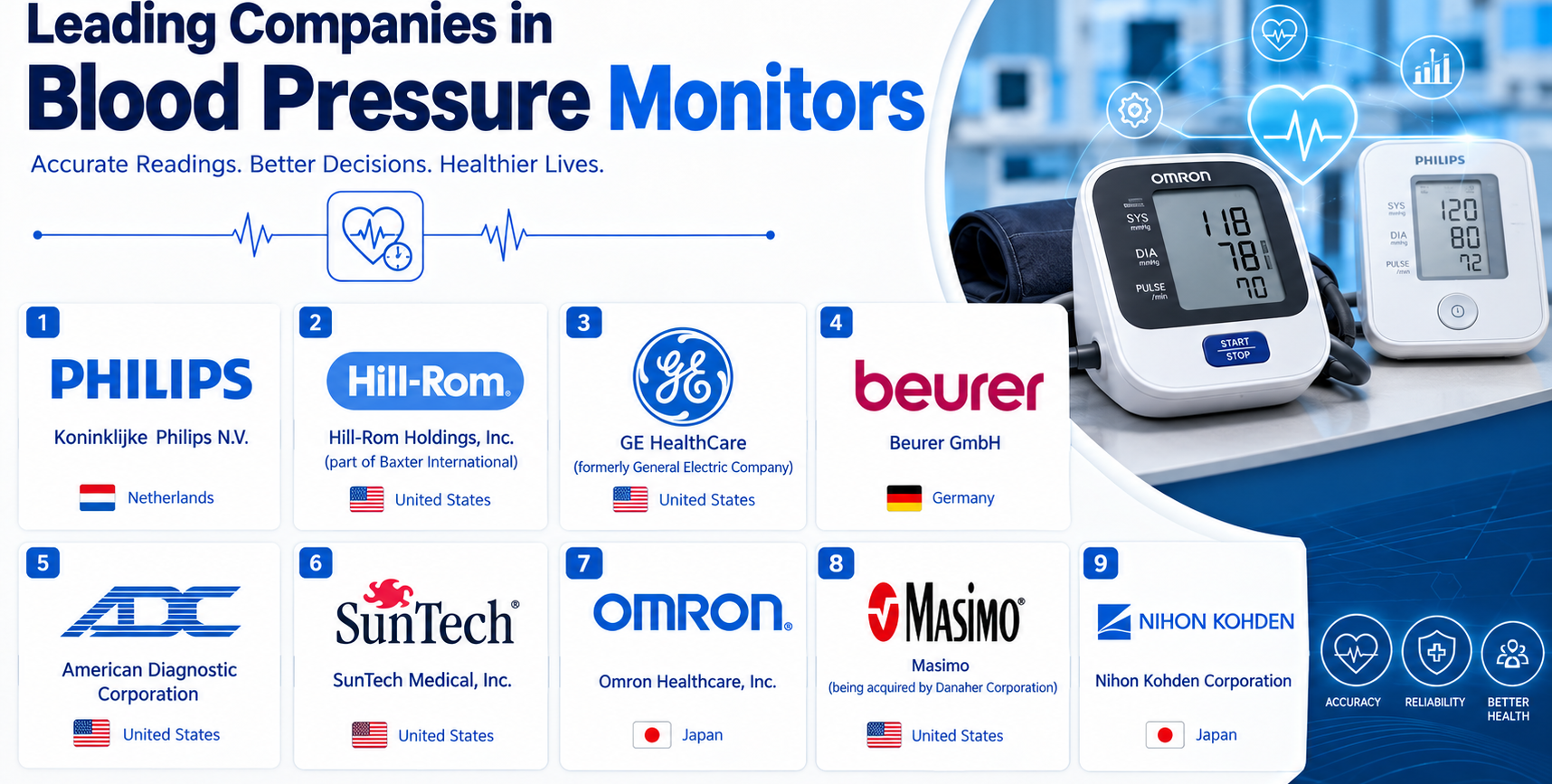
Top Companies in the Global Blood Pressure Monitors Market
- Koninklijke Philips N.V.
- Hill-Rom Holdings, Inc. (part of Baxter International)
- GE HealthCare (formerly General Electric Company)
- Beurer GmbH
- American Diagnostic Corporation
- SunTech Medical, Inc.
- Omron Healthcare, Inc.
- Masimo (being acquired by Danaher Corporation)
- Nihon Kohden Corporation
1. Koninklijke Philips N.V.
|
Category |
Details |
|---|---|
|
Company Name |
Koninklijke Philips N.V. (Royal Philips) |
|
Headquarters |
Amsterdam, Netherlands |
|
Founded |
1891 |
|
Employees |
Approx. 63,700–67,800 |
|
Revenue |
Approx. €18–20.6 Billion (group-wide) |
|
Company Overview |
Philips is a diversified global health technology company whose Connected Care segment includes patient monitoring and analytics systems for hospitals, spanning blood pressure and broader vital sign monitoring integrated into enterprise-scale care platforms. |
|
Key Products |
Enterprise patient monitoring solutions offering a complete, live view of patient vitals including blood pressure, alongside HealthSuite cloud-based informatics and Enterprise Monitoring as-a-service offerings. |
|
Market Position |
A leading global provider of hospital patient monitoring technology, recently expanding long-term monitoring partnerships with major U.S. health systems including Rush University System for Health, Hoag, and Rady Children's Hospital. |
|
Recent Developments |
Formed a renewed collaboration with Masimo to integrate advanced technologies into Philips' multi-parameter patient monitoring platforms, and signed a five-year strategic partnership with AdventHealth to replace and upgrade patient monitors across more than 50 hospital campuses. |
|
Strategic Advantages |
Deep enterprise hospital relationships supporting large-scale monitoring deployments, a broad connected care and informatics portfolio, and continued strategic partnerships expanding its monitoring technology ecosystem. |
2. Hill-Rom Holdings (part of Baxter International)
|
Category |
Details |
|---|---|
|
Company Name |
Hill-Rom Holdings, Inc. (acquired by and now part of Baxter International) |
|
Headquarters |
Chicago, Illinois, United States (parent Baxter headquartered in Deerfield, Illinois) |
|
Founded |
1929 (as Hill-Rom Company) |
|
Employees |
Part of Baxter's approximately 34,700–38,000 global workforce |
|
Revenue |
Acquired by Baxter for approximately USD 12.5 Billion in December 2021 |
|
Company Overview |
Hill-Rom was a leading medical technology company known for hospital beds, patient monitoring, and vital signs devices, including blood pressure monitors, before being acquired by Baxter International in a deal that significantly expanded Baxter's connected care and monitoring portfolio. |
|
Key Products |
Vital signs monitors and spot-check devices incorporating blood pressure measurement, now integrated within Baxter's broader connected care and patient monitoring product lines. |
|
Market Position |
A well-established brand in hospital vital signs monitoring, now operating as part of Baxter's broader medical technology portfolio following one of the largest deals in clinical care market history. |
|
Recent Developments |
Continued integration into Baxter's broader Medical Products and Therapies business following the 2021 acquisition, as Baxter has since reshaped its overall portfolio through several strategic divestitures. |
|
Strategic Advantages |
Decades of hospital vital signs monitoring heritage, now backed by Baxter's global distribution scale and integration with Baxter's broader connected care product ecosystem. |
3. GE HealthCare
|
Category |
Details |
|---|---|
|
Company Name |
GE HealthCare Technologies Inc. |
|
Headquarters |
Chicago, Illinois, United States |
|
Founded |
1892 (GE Healthcare heritage); spun off as an independent public company in January 2023 |
|
Employees |
Approx. 54,000 |
|
Revenue |
Approx. USD 20.6 Billion (FY2025) |
|
Company Overview |
GE HealthCare is a global medical technology company whose Patient Care Solutions segment includes patient monitoring, diagnostic cardiology, anesthesia delivery, and maternal-infant care products, with blood pressure monitoring integrated across its hospital vital signs monitoring portfolio. |
|
Key Products |
Hospital patient monitors incorporating blood pressure, SpO2, and other vital sign measurement, alongside broader remote patient monitoring and diagnostic cardiology solutions. |
|
Market Position |
A leading global patient monitoring provider serving customers in over 160 countries, leveraging its scale and installed base as a top-tier hospital equipment supplier following its 2023 spin-off from General Electric. |
|
Recent Developments |
Continued executing its precision care strategy focused on combining devices, software, AI, and diagnostics, reporting strong fourth-quarter 2025 growth driven primarily by the U.S. and EMEA regions. |
|
Strategic Advantages |
More than 125 years of medical technology heritage, deep hospital installed base and service infrastructure, and continued investment in AI-enabled clinical decision support integrated with its monitoring platforms. |
4. Omron Healthcare
|
Category |
Details |
|---|---|
|
Company Name |
Omron Healthcare, Inc. (subsidiary of Omron Corporation) |
|
Headquarters |
Hoffman Estates, Illinois, United States (parent Omron Corporation headquartered in Kyoto, Japan) |
|
Founded |
Omron Corporation founded 1933; Omron Healthcare established 1998 |
|
Employees |
Several hundred at Omron Healthcare's U.S. operations; part of Omron Corporation's broader global workforce of approximately 26,600 |
|
Revenue |
Approx. USD 1.07 Billion (Omron Healthcare segment) |
|
Company Overview |
Omron Healthcare is the world's leading manufacturer and distributor of home blood pressure monitors, having sold more than 350 million units across more than 130 countries since introducing its first manual model, the HEM-1, more than 50 years ago. |
|
Key Products |
Upper-arm and wrist home blood pressure monitors featuring OMRON Intellisense technology, including newer models with AI-powered atrial fibrillation screening built into routine blood pressure checks. |
|
Market Position |
The world's leading brand for home-use blood pressure monitors and the number one doctor- and pharmacist-recommended brand for home blood pressure monitoring in the United States. |
|
Recent Developments |
Won Best in Class in the 2025 Digital Health Awards for its AI-powered AFib detection technology, and issued a national call-to-action encouraging routine at-home blood pressure monitoring in response to updated clinical guidelines. |
|
Strategic Advantages |
Unmatched global brand trust and clinical recommendation among healthcare professionals, more than five decades of home blood pressure monitoring expertise, and continued innovation in AI-powered detection features. |
5. Masimo (being acquired by Danaher Corporation)
|
Category |
Details |
|---|---|
|
Company Name |
Masimo Corporation |
|
Headquarters |
Irvine, California, United States |
|
Founded |
1989 |
|
Employees |
Approx. 2,200–6,200 |
|
Revenue |
Approx. USD 1.5–1.55 Billion (FY2025, continuing healthcare operations) |
|
Company Overview |
Masimo is a leading noninvasive patient monitoring technology company whose Masimo SET pulse oximetry and broader vital sign monitoring platforms, including blood pressure measurement, monitor approximately 100 million patients annually and are used in the top 10 hospitals in the United States. |
|
Key Products |
Masimo SET pulse oximetry and multi-parameter patient monitoring technology, incorporating blood pressure and other vital sign measurement used widely across acute care settings. |
|
Market Position |
A leader in pulse oximetry and patient monitoring with an extensive global installed base, approximately 80% recurring revenue, and close to 98% customer retention, making it a highly attractive acquisition target in the diagnostics space. |
|
Recent Developments |
Entered a definitive agreement in February 2026 to be acquired by Danaher Corporation for approximately USD 9.9 billion in an all-cash deal, positioning Masimo to operate as a standalone diagnostics business alongside Danaher's Radiometer, Leica Biosystems, and Beckman Coulter businesses upon closing. |
|
Strategic Advantages |
Deep clinical trust and an extensive acute-care installed base built over decades, highly recurring, sticky revenue from its sensor and monitor ecosystem, and soon the backing of Danaher's global scale and Danaher Business System operational discipline. |
Competitive Landscape
The global blood pressure monitors market is led by a mix of large diversified hospital monitoring conglomerates, including Philips, GE HealthCare, and Baxter (through its acquired Hill-Rom business), alongside consumer home health leaders like Omron Healthcare and clinically focused monitoring specialists like Masimo, which is set to become part of Danaher's diagnostics portfolio.
Consolidation Reshaping the Competitive Field: The blood pressure and broader patient monitoring market has seen substantial consolidation in recent years, from Baxter's 2021 acquisition of Hill-Rom for USD 12.5 billion to Danaher's 2026 agreement to acquire Masimo for USD 9.9 billion, reflecting large medtech conglomerates' continued appetite for scaled diagnostics and monitoring businesses even as some peers pursue streamlining instead.
Home vs. Hospital Market Segmentation: Omron Healthcare's dominant position in home-use blood pressure monitors contrasts with hospital-focused players like Philips, GE HealthCare, and Masimo, whose blood pressure technology is typically integrated within broader multi-parameter patient monitoring platforms rather than sold as standalone consumer devices.
Brand Trust as a Differentiator in Consumer Devices: In the home healthcare segment, clinical recommendation and brand trust act as significant competitive moats, with Omron's position as the top doctor- and pharmacist-recommended brand reinforcing its market leadership against lower-cost, less clinically validated alternatives.
AI Integration as an Emerging Battleground: Companies across both hospital and consumer segments are racing to integrate AI-powered features, such as Omron's AFib detection and Philips' AI-enabled clinical decision support, into their monitoring platforms to differentiate beyond basic pressure measurement.
Emerging Trends in the Blood Pressure Monitors Market
1. AI-Powered Multi-Condition Screening: Blood pressure monitors are increasingly incorporating AI to detect additional conditions like atrial fibrillation during routine checks, adding diagnostic value without requiring separate testing.
2. Consolidation Among Diagnostics and Monitoring Leaders: Large medtech conglomerates continue pursuing major acquisitions in the patient monitoring space, as demonstrated by Danaher's pending acquisition of Masimo, reshaping the competitive landscape at the high end of the market.
3. Enterprise Monitoring as a Service: Hospitals are increasingly adopting subscription-based, enterprise-scale monitoring models that reduce upfront capital costs and improve interoperability across departments and care settings.
4. Growth in Ambulatory and 24-Hour Monitoring: Rising clinical emphasis on more comprehensive blood pressure assessment is driving growth in ambulatory blood pressure monitoring devices that track readings continuously outside traditional single-point clinical measurements.
5. Integration with Remote Patient Monitoring Platforms: Connected blood pressure monitors are increasingly integrated into broader remote patient monitoring and hospital-at-home programs, supporting earlier clinical intervention for patients with chronic cardiovascular conditions.
Future Outlook (2025–2034)
The global blood pressure monitors market's trajectory toward USD 9.1 billion by 2034 reflects the durable, foundational role of blood pressure measurement in both preventive and acute cardiovascular care, even as the competitive landscape continues to consolidate around larger diagnostics and monitoring platforms. The 8.75% CAGR forecast through 2034 assumes continued growth in home-based hypertension management, ongoing innovation in AI-enabled detection features, and expanding enterprise-scale hospital monitoring adoption.
Key investment themes include continued growth in AI-powered multi-condition screening, expansion of ambulatory and remote patient monitoring applications, and further consolidation of diagnostics and monitoring businesses among large medtech conglomerates. Leading companies including Philips, GE HealthCare, Omron Healthcare, and the soon-to-be Danaher-owned Masimo are likely to retain strong market positions by combining clinical validation, brand trust, and continued investment in connected, AI-enabled monitoring technology across both hospital and home settings.
Frequently Asked Questions (FAQ)
1. What is the current size of the global blood pressure monitors market?
The global blood pressure monitors market was valued at approximately USD 4.2 billion in 2025 and is projected to reach USD 9.1 billion by 2034, growing at a CAGR of 8.75%.
2. Who are the top companies in the blood pressure monitors market?
Leading companies include Koninklijke Philips N.V., Hill-Rom Holdings (part of Baxter International), GE HealthCare, Beurer, American Diagnostic Corporation, SunTech Medical, Omron Healthcare, Masimo (being acquired by Danaher Corporation), and Nihon Kohden Corporation.
3. What is the forecast CAGR for the blood pressure monitors market?
The market is forecast to grow at a CAGR of 8.75% from 2025 to 2034.
4. What are the main growth drivers for this market?
Key drivers include rising global hypertension prevalence, growing emphasis on home-based blood pressure monitoring following updated clinical guidelines, and continued innovation in AI-enabled detection features like atrial fibrillation screening.
5. Why is Danaher acquiring Masimo?
Danaher agreed in February 2026 to acquire Masimo for approximately USD 9.9 billion to strengthen its diagnostics franchise, adding Masimo's leading pulse oximetry and patient monitoring technology, extensive acute-care installed base, and highly recurring revenue to Danaher's existing diagnostics portfolio alongside Radiometer and Beckman Coulter.
6. What is the difference between home and hospital blood pressure monitors?
Home blood pressure monitors, led by brands like Omron, are typically simpler, standalone digital devices designed for consumer ease of use, while hospital monitors are usually integrated into broader multi-parameter patient monitoring platforms from companies like Philips, GE HealthCare, and Masimo that track blood pressure alongside other vital signs.
7. Which end-use setting drives the most demand for blood pressure monitors?
Home healthcare represents a rapidly growing segment given rising emphasis on at-home hypertension management, while hospitals and clinics remain a substantial and steady source of demand for both routine and continuous ambulatory blood pressure monitoring.
Conclusion
The global blood pressure monitors market sits at the intersection of everyday preventive health and acute clinical care, spanning everything from a simple home device to sophisticated hospital monitoring platforms. With a projected size of USD 9.1 billion by 2034 at a 8.75% CAGR, the sector offers strong growth potential for companies that can combine clinical validation with continued innovation in connected, AI-enabled monitoring technology.
Omron Healthcare's dominant brand trust in home blood pressure monitoring stands alongside hospital monitoring leaders like Philips and GE HealthCare, while Danaher's pending USD 9.9 billion acquisition of Masimo signals continued consolidation at the high end of the diagnostics and monitoring market. The companies that successfully extend AI-powered detection features, expand remote and ambulatory monitoring capabilities, and maintain deep clinical trust will define market leadership through 2034 and beyond.