
Chilling the Future A 2025 Deep Dive into the Global Liquid Nitrogen Market Top Leader
Author:
Intellectual Market Insights Research
Published Date:
08 Aug 2026
Liquid Nitrogen Market Size, Share & Growth Forecast 2025–2034: Trends, Drivers, and Key Players
Liquid nitrogen has quietly become one of the most indispensable industrial materials of the modern economy, cooling semiconductor fabs, preserving vaccines and biological samples, freezing food at scale, and enabling metal fabrication processes that would otherwise be impossible at ambient temperature. Produced primarily by cooling atmospheric air until it liquefies and then separating it into its component gases, liquid nitrogen delivers an inert, ultra-cold medium that is prized across industries wherever oxidation must be prevented, extreme cold is required, or gas needs to be transported and stored efficiently in compact liquid form.
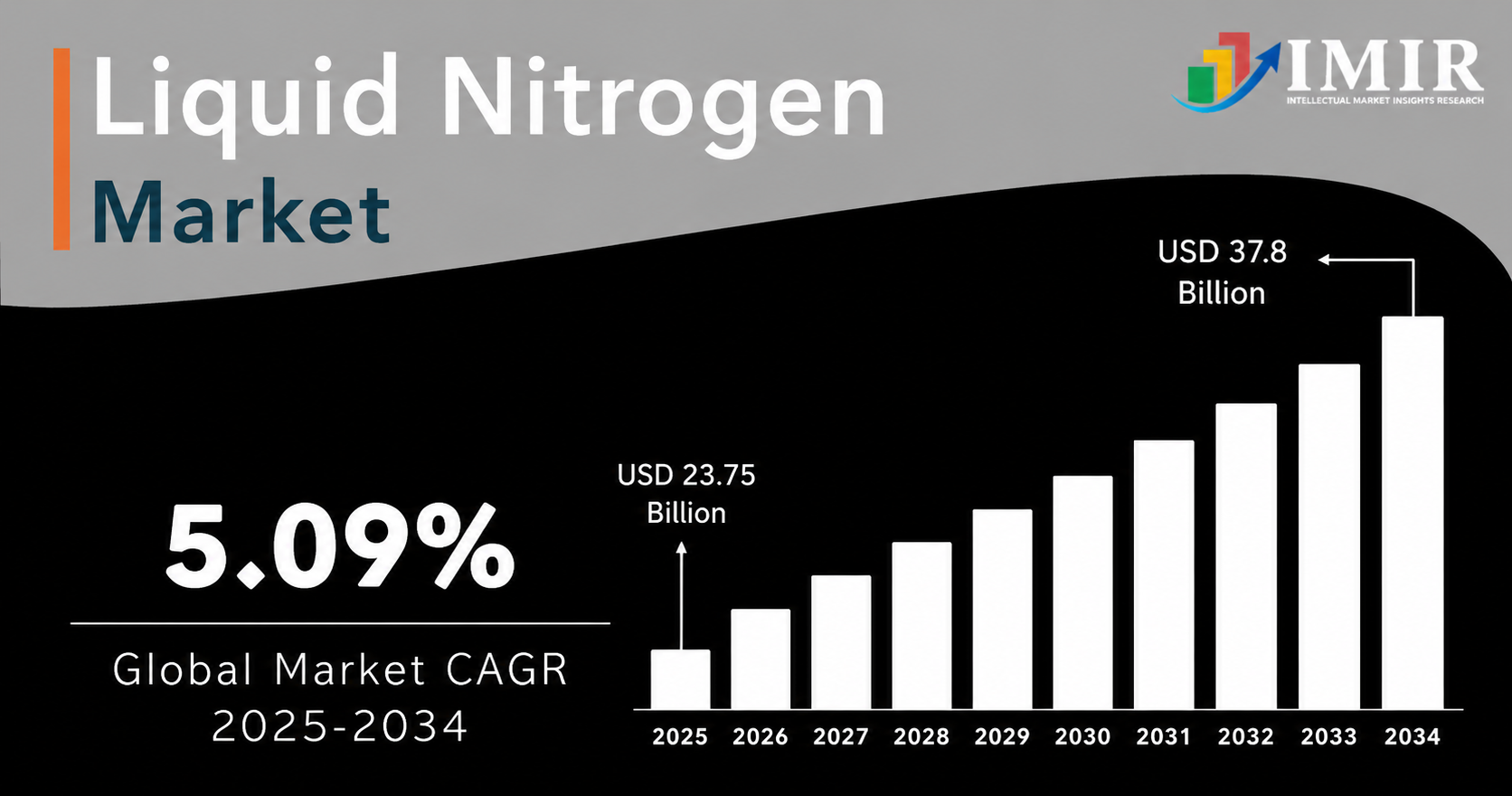
According to a new report from Intellectual Market Insights Research, the global liquid nitrogen market was valued at approximately USD 23.75 billion in 2025 and is projected to reach USD 37.8 billion by 2034, growing at a compound annual growth rate (CAGR) of 5.09% between 2025 and 2034. That is a steady, structural expansion, reflecting how deeply liquid nitrogen is embedded in semiconductor manufacturing, healthcare, food and beverage processing, metal fabrication, and chemical and pharmaceutical production worldwide.
In this article, we break down what's driving this growth, the challenges holding the market back, where the biggest opportunities lie, how the market is segmented, which regions are leading adoption, and who the major players are. Whether you're an investor, a plant operations manager, a healthcare or semiconductor procurement professional, or simply curious about where the liquid nitrogen market is headed, this guide will give you a clear, structured view of the industry landscape through 2034.
Market Overview
What Is Liquid Nitrogen?
Liquid nitrogen is nitrogen gas that has been cooled to an extremely low temperature, below approximately -196°C, until it condenses into a colorless, odorless liquid. It is produced industrially by compressing and cooling atmospheric air and then separating it into its constituent gases, primarily nitrogen, oxygen, and argon, based on their differing boiling points. Because nitrogen makes up roughly 78% of the atmosphere, air remains the primary feedstock for large-scale production.
Liquid nitrogen is manufactured through two principal processes: cryogenic distillation, which cools and liquefies air before separating it into high-purity gas streams through fractional distillation, and pressure swing adsorption (PSA), a non-cryogenic method that uses adsorbent materials to separate nitrogen from air at ambient temperature, typically for smaller-scale or on-site generation needs. Once produced, liquid nitrogen is used across two broad functional applications, as a coolant for freezing, cold storage, and low-temperature processing, and as a refrigerant for maintaining stable low-temperature environments in transport, storage, and industrial systems.
Current Market Landscape
The liquid nitrogen space today sits at the intersection of heavy industrial gas production, semiconductor manufacturing, and everyday healthcare and food processing applications. What was once viewed primarily as an industrial byproduct of oxygen production has become a strategically important, purpose-produced commodity in its own right, particularly as electronics and semiconductor fabrication have scaled globally. Large industrial gas majors have steadily expanded dedicated air separation unit (ASU) capacity, on-site generation partnerships, and merchant liquid nitrogen distribution networks, widening the customer base from traditional metal manufacturing and chemical processing plants to hyperscale semiconductor fabs, biobanks, and food cold-chain operators.
Industry Background
Liquid nitrogen production traces back to the late 19th century, when the first practical methods for liquefying air were developed, laying the groundwork for modern cryogenic engineering. Industrial-scale air separation matured through the 20th century as demand grew from steelmaking, welding, and chemical processing industries, with major industrial gas companies building out extensive networks of air separation plants and distribution infrastructure. Over the past two decades, the technology has benefited from larger, more energy-efficient air separation units, growing on-site generation models for large industrial customers, and surging demand from the semiconductor and electronics sector, setting the stage for liquid nitrogen's expansion from a heavy-industry input into a critical enabler of advanced manufacturing, healthcare, and food processing worldwide.
Key Market Trends
- Surging demand from semiconductor and electronics manufacturing: The global buildout of semiconductor fabrication capacity, driven in large part by AI chip demand, is pushing industrial gas majors to build dedicated, ultra-high-purity nitrogen production units directly tied to individual fab expansions.
- Growing on-site and dedicated production models: Rather than relying solely on merchant liquid nitrogen delivery, large industrial customers, particularly in electronics and steel, are increasingly entering long-term agreements for gas suppliers to build, own, and operate dedicated air separation units at or near their facilities.
- Rising integration with carbon capture and low-carbon production: Industrial gas producers are increasingly pairing new nitrogen and hydrogen production capacity with onsite carbon capture technology, reflecting growing customer and regulatory pressure to decarbonize industrial gas supply chains.
- Expansion of liquid nitrogen use in the space and aerospace sector: Liquid nitrogen and liquid oxygen demand tied to commercial rocket launch operations is emerging as a notable growth niche, with gas majors building dedicated plants near launch sites to support rapid launch cadences.
- Geographic diversification of production capacity: Industrial gas companies continue to expand air separation capacity across the U.S., Asia-Pacific, and Europe to shorten supply chains, reduce distribution costs, and meet regional semiconductor and industrial growth.
Market Growth Drivers
Expansion of Semiconductor and Electronics Manufacturing: The global scale-up of semiconductor fabrication capacity, accelerated by demand for AI-related chips, continues to be one of the largest drivers of new liquid nitrogen production capacity, as fabs require continuous, ultra-high-purity nitrogen supply.
Growing Healthcare and Biopharmaceutical Applications: Rising demand for cryopreservation of biological samples, vaccines, cell and gene therapies, and reproductive materials continues to expand liquid nitrogen use across the healthcare and life sciences sectors.
Expansion of Food and Beverage Cold Chain Infrastructure: Increasing use of cryogenic freezing for food preservation, transport, and processing, particularly for perishable and premium food products, supports steady demand growth in the food and beverage end-user segment.
Growth in Metal Manufacturing and Construction Applications: Liquid nitrogen's role in metal fabrication processes such as shrink fitting, heat treatment, and inert atmosphere welding continues to support demand from metal manufacturing and construction end users.
Increasing Industrial Gas Infrastructure Investment: Sustained capital investment by major industrial gas companies in new and expanded air separation units, particularly those tied to semiconductor, steel, and chemical manufacturing customers, continues to expand global production capacity and supply reliability.
Market Challenges
High Capital Costs for Production Infrastructure: Air separation units require substantial upfront capital investment, and new dedicated facilities tied to individual customer contracts can carry construction timelines of two to three years, creating a lag between demand signals and new supply.
Transportation and Storage Complexity: Liquid nitrogen's extremely low temperature requires specialized cryogenic transport and storage equipment, adding logistics cost and complexity, particularly for distribution to remote or smaller-volume customers.
Energy Intensity of Production: Cryogenic air separation is an energy-intensive process, making production costs sensitive to electricity prices and creating pressure on producers to improve energy efficiency and integrate lower-carbon power sources.
Safety and Handling Requirements: The extreme cold and potential asphyxiation risk associated with liquid nitrogen require rigorous safety protocols and specialized handling training, which can be a barrier for smaller end users adopting on-site systems.
Regional Supply Chain Concentration: Because large-scale production is capital-intensive and often tied to long-term customer contracts, liquid nitrogen supply capacity can become geographically concentrated near major industrial and semiconductor hubs, creating potential regional supply constraints elsewhere.
Market Opportunities
Untapped Emerging Markets: Expanding semiconductor investment, growing healthcare infrastructure, and rising food cold-chain development in parts of Asia-Pacific, Latin America, and the Middle East are opening new territory for liquid nitrogen production and distribution as regional industrial capacity expands.
Growth in Dedicated On-Site Production Partnerships: As large industrial customers increasingly prefer dedicated, long-term gas supply agreements over merchant delivery, there is room for gas suppliers to capture greater value through build-own-operate production models tied directly to customer facilities.
Space and Aerospace Sector Expansion: The growing cadence of commercial rocket launches and expanding space industry infrastructure represents an emerging, high-value niche for liquid nitrogen and liquid oxygen supply near launch facilities.
Low-Carbon and Decarbonized Production: Continued investment in energy-efficient air separation technology and integration with carbon capture offers a path toward lower-carbon liquid nitrogen production, a meaningful differentiator as customers face their own decarbonization mandates.
Investment and Capacity Expansion Activity: As demand from semiconductor and AI-driven infrastructure continues to scale, there is ongoing opportunity for strategic investment, plant construction, and geographic expansion among industrial gas majors and regional gas suppliers serving the liquid nitrogen ecosystem.
Market Segmentation
By Manufacturing Process
- Cryogenic distillation
- Pressure swing adsorption
By Application
- Coolant
- Refrigerant
By Industry Vertical
- Chemicals & pharmaceuticals
- Food & beverage
- Healthcare
- Metal manufacturing & construction
- Rubber & Plastic
- Others
Cryogenic distillation represents the dominant manufacturing process segment given its ability to deliver the large volumes and ultra-high purity levels required by semiconductor, healthcare, and heavy industrial customers, while pressure swing adsorption continues to serve smaller-scale and on-site generation needs where lower purity requirements and flexibility are prioritized. On the industry-vertical side, chemicals & pharmaceuticals and healthcare are expected to anchor much of the market's highest-value demand given stringent purity requirements, while food & beverage and metal manufacturing & construction continue to drive substantial volume given the breadth of cryogenic freezing and metal fabrication applications across those industries.
Regional Analysis
North America: North America holds a leading share of the global liquid nitrogen market, underpinned by substantial semiconductor fabrication investment, an extensive existing air separation infrastructure network, and strong demand from healthcare, food processing, and the emerging commercial space sector.
Europe: Europe represents a mature, steadily growing market, supported by well-established chemical and pharmaceutical manufacturing, robust food and beverage cold-chain infrastructure, and ongoing investment in energy-efficient and lower-carbon air separation technology.
Asia-Pacific: Asia-Pacific is expected to be among the fastest-growing regions over the forecast period, driven by expanding semiconductor and electronics manufacturing capacity, rising industrial and healthcare infrastructure investment, and the presence of major industrial gas producers in economies like China, Japan, and South Korea.
Latin America: Latin America remains a smaller but developing market, with Brazil and Mexico leading regional demand as industrial manufacturing and food processing infrastructure expand.
Middle East & Africa: The Middle East & Africa region is an emerging opportunity area, with growth concentrated in countries expanding industrial and healthcare infrastructure, such as Saudi Arabia and the UAE, supported by regional industrial gas suppliers and gradual uptake in South Africa.
Competitive Landscape
The global liquid nitrogen market features a mix of diversified global industrial gas majors and specialized regional suppliers. Key players identified in the market include:
- Linde (Germany)
- Asia Industrial Gases Pte. Ltd (Singapore)
- Southern Industrial Gas Sdn Bhd (Malaysia)
- Air Liquide (France)
- nexAir LLC (US)
- Taiyo Nippon Sanso Corporation (Japan)
- Praxair Technology Inc. (US)
- Air Products and Chemicals Inc. (US)
- Gulf Cryo (the UAE)
- AMCS Corporation (US)
- Statebourne Cryogenics Ltd (UK)
Competition in this space centers on expanding air separation capacity, securing long-term dedicated supply contracts with semiconductor and heavy industrial customers, and improving the energy efficiency and carbon footprint of production. Diversified global majors such as Linde and Air Liquide benefit from extensive production networks and deep relationships with hyperscale semiconductor and industrial customers, while regional and specialized suppliers compete on proximity, service flexibility, and niche end-market expertise. As the market matures, continued capacity expansion, long-term build-own-operate agreements tied to individual customer facilities, and new investment targeting semiconductor, healthcare, and space-sector demand are expected to shape the competitive landscape through 2034.
1. Linde plc
|
Category |
Details |
|---|---|
|
Company Name |
Linde plc |
|
Headquarters |
Woking, United Kingdom (with major U.S. and German operating presence) |
|
Industry Focus |
Industrial Gases and Engineering |
|
Global Presence |
Global industrial gases and engineering operations with 2025 sales of $34 billion, serving chemicals & energy, food & beverage, electronics, healthcare, and metals customers |
|
Company Overview |
Linde is the world's largest industrial gases and engineering company, operating an extensive global network of air separation units that produce liquid nitrogen, oxygen, and argon for merchant delivery and dedicated on-site customer supply. |
|
Key Products & Services |
Merchant and bulk liquid nitrogen, oxygen, and argon supply; dedicated build-own-operate air separation units for semiconductor, steel, and space-industry customers; on-site nitrogen generation systems and cryogenic engineering services. |
|
Market Position |
The leading global supplier of liquid nitrogen and industrial gases by production capacity and geographic footprint, with an extensive and growing pipeline of new air separation projects tied to long-term customer contracts. |
|
Recent Developments |
Announced a new air separation plant in Garysburg, North Carolina in April 2026 to produce liquid oxygen, nitrogen, and argon, alongside a more than $400 million investment in a new ASU at Louisiana's RiverPlex MegaPark to supply a major low-carbon ammonia plant. Linde also completed a dedicated air separation facility in Brownsville, Texas in 2026 to supply liquid oxygen and nitrogen directly to SpaceX's Starbase launch operations. |
|
Strategic Advantages |
The largest global production and distribution network among industrial gas suppliers, deep long-term relationships across semiconductor, aerospace, steel, and chemical customers, and substantial ongoing capital investment in new dedicated production capacity. |
2. Air Liquide S.A.
|
Category |
Details |
|---|---|
|
Company Name |
Air Liquide S.A. |
|
Headquarters |
Paris, France |
|
Industry Focus |
Industrial and Medical Gases, Electronics, and Engineering |
|
Global Presence |
Global operations with an extensive electronics-dedicated production network, including 78 units serving electronics customers in Japan and 54 units in Taiwan |
|
Company Overview |
Air Liquide is a leading global industrial gas supplier with a particularly strong position in ultra-pure nitrogen supply for semiconductor manufacturing, operating dedicated air separation units built specifically to support individual chip fabrication customers around the world. |
|
Key Products & Services |
Ultra-pure nitrogen, oxygen, argon, and hydrogen for semiconductor fabs; bulk liquid nitrogen for chemicals, healthcare, and food processing customers; low-carbon hydrogen production integrated with onsite carbon capture. |
|
Market Position |
One of the top global industrial gas suppliers, with a leading position in electronics-grade gas supply and an active pipeline of dedicated semiconductor-customer production facilities across the U.S., Japan, and broader Asia-Pacific. |
|
Recent Developments |
Announced over $530 million in combined U.S. investment in July 2026 across Indiana, Texas, and Arizona facilities tied to semiconductor and chemical manufacturing customers, alongside a further $150 million Idaho investment in August 2026 to support memory chip production, and a €200 million investment in Hiroshima, Japan announced in April 2026 to supply a leading semiconductor manufacturer producing next-generation AI chips. |
|
Strategic Advantages |
Deep, long-standing relationships with hyperscale semiconductor manufacturers, a global electronics-dedicated production network, and an accelerating investment pace tied to AI-driven chip demand growth. |
3. Air Products and Chemicals, Inc.
|
Category |
Details |
|---|---|
|
Company Name |
Air Products and Chemicals, Inc. |
|
Headquarters |
Allentown, Pennsylvania, USA |
|
Industry Focus |
Industrial Gases, Hydrogen, and Process Technology |
|
Global Presence |
Global operations serving chemical, refining, electronics, healthcare, and manufacturing customers across dozens of countries |
|
Company Overview |
Air Products is a major global industrial gas company with an extensive air separation and gasification technology base, supplying liquid nitrogen, oxygen, and argon alongside its larger hydrogen and gasification business to industrial and manufacturing customers worldwide. |
|
Key Products & Services |
Merchant liquid nitrogen, oxygen, and argon; on-site industrial gas generation and supply agreements; air separation unit engineering and construction services for large industrial customers. |
|
Market Position |
A top-tier global industrial gas supplier with a diversified customer base spanning refining, chemicals, metals, and electronics, and continued expansion of dedicated air separation capacity in key U.S. growth markets. |
|
Recent Developments |
Announced construction of a new air separation unit in Cocoa, Florida in 2026 to expand regional merchant and on-site liquid nitrogen and oxygen supply, continuing the company's broader pattern of capacity investment across U.S. industrial and manufacturing hubs. |
|
Strategic Advantages |
Broad in-house engineering and construction capability for large-scale air separation and gasification facilities, an extensive global distribution network, and a diversified portfolio spanning industrial gases and hydrogen infrastructure. |
4. Taiyo Nippon Sanso Corporation (Nippon Sanso Holdings)
|
Category |
Details |
|---|---|
|
Company Name |
Taiyo Nippon Sanso Corporation, a subsidiary of Nippon Sanso Holdings Corporation |
|
Headquarters |
Tokyo, Japan |
|
Industry Focus |
Industrial and Electronic Gases, Cryogenic Equipment, and Plant Engineering |
|
Global Presence |
Operations across Japan, the United States, Europe, and Asia-Oceania through five reporting segments, including its Nippon Sanso Matheson subsidiary in North America |
|
Company Overview |
Taiyo Nippon Sanso is a leading Japanese industrial gas company with a long history in air separation technology, dating back to manufacturing Japan's first domestic air separation units in 1935, and a strong position supplying liquid nitrogen and electronic-grade gases to semiconductor and manufacturing customers globally. |
|
Key Products & Services |
Liquid nitrogen, oxygen, and argon from company-engineered air separation units; the ULTIMO Series modular on-site nitrogen generation system using pressure swing adsorption technology; electronic material gases and semiconductor manufacturing equipment. |
|
Market Position |
A leading industrial gas supplier in Japan and a growing presence in North America through its Nippon Sanso Matheson subsidiary, differentiated by deep in-house air separation plant engineering expertise built over nearly a century. |
|
Recent Developments |
Its Nippon Sanso Matheson subsidiary started up a new air separation unit in Irwindale, California in mid-2026, expanding regional nitrogen, oxygen, and argon production capacity for aerospace, electronics, and advanced manufacturing customers in Southern California. |
|
Strategic Advantages |
Nearly a century of proprietary air separation and cryogenic plant engineering expertise, a diversified regional footprint spanning Japan, the U.S., and Europe, and an integrated equipment and engineering business that complements its gas production operations. |
5. Gulf Cryo
|
Category |
Details |
|---|---|
|
Company Name |
Gulf Cryo |
|
Headquarters |
Dubai, United Arab Emirates |
|
Industry Focus |
Industrial, Medical, and Specialty Gases |
|
Global Presence |
Regional production and distribution network spanning the Middle East, North Africa, and neighboring markets |
|
Company Overview |
Gulf Cryo is one of the largest independent industrial gas producers in the Middle East, operating a network of air separation and gas filling plants that supply liquid nitrogen and other industrial gases to healthcare, manufacturing, oil and gas, and food processing customers across the region. |
|
Key Products & Services |
Liquid nitrogen, oxygen, and argon supply for regional industrial and healthcare customers; specialty and medical gas production; cylinder filling and cryogenic distribution infrastructure across the Middle East and North Africa. |
|
Market Position |
A leading independent regional industrial gas supplier in the Middle East, positioned to serve the region's expanding industrial, healthcare, and infrastructure investment as an alternative to global majors for regional and domestic customers. |
|
Recent Developments |
Continues to expand its regional production and distribution footprint as Middle Eastern countries, including Saudi Arabia and the UAE, invest in industrial diversification, healthcare infrastructure, and manufacturing capacity that supports growing regional liquid nitrogen demand. |
|
Strategic Advantages |
Deep regional market knowledge and distribution infrastructure across the Middle East and North Africa, established relationships with regional healthcare and industrial customers, and a position as a nimble independent alternative to global industrial gas majors. |
Future Outlook
The liquid nitrogen market is on a steady upward trajectory, with the forecasted CAGR of 5.09% through 2034 reflecting sustained demand across semiconductor manufacturing, healthcare, food and beverage processing, and metal fabrication applications. Growth is expected to be increasingly driven by the electronics and semiconductor segment, as AI-related chip demand continues to fuel a global buildout of new fabrication capacity requiring dedicated, ultra-high-purity nitrogen supply.
Looking ahead, expect continued expansion of dedicated, build-own-operate air separation capacity tied to individual semiconductor and industrial customers, growing integration of carbon capture and lower-carbon production methods, emerging demand from the commercial space and aerospace sector, and sustained capital investment from global industrial gas majors as they compete for long-term supply contracts. Continued geographic diversification of production capacity across the U.S., Asia-Pacific, and the Middle East is also likely as the industry continues to scale through 2034.
Frequently Asked Questions (FAQ)
Q1: How big is the liquid nitrogen market currently?
The global liquid nitrogen market was valued at approximately USD 23.75 billion in 2025.
Q2: How fast is the liquid nitrogen market expected to grow?
The market is projected to grow at a CAGR of 5.09% from 2025 to 2034, reaching an estimated USD 37.8 billion by 2034.
Q3: What is the difference between cryogenic distillation and pressure swing adsorption?
Cryogenic distillation cools and liquefies air before separating it into high-purity nitrogen, oxygen, and argon streams through fractional distillation, while pressure swing adsorption uses adsorbent materials to separate nitrogen from air at ambient temperature, typically for smaller-scale or on-site generation needs.
Q4: What are the main applications of liquid nitrogen?
Liquid nitrogen is primarily used as a coolant for freezing, cold storage, and low-temperature processing, and as a refrigerant for maintaining stable low-temperature environments in transport, storage, and industrial systems.
Q5: Which region leads the liquid nitrogen market?
North America currently holds a leading market share, supported by substantial semiconductor investment and extensive existing production infrastructure, while Asia-Pacific is expected to see some of the fastest growth over the forecast period.
Q6: Who are the major companies in the liquid nitrogen market?
Leading players include Linde, Air Liquide, Air Products and Chemicals, Taiyo Nippon Sanso Corporation, Praxair Technology, Gulf Cryo, Asia Industrial Gases, Southern Industrial Gas, nexAir, AMCS Corporation, and Statebourne Cryogenics.
Q7: What are the biggest challenges facing the liquid nitrogen market?
High capital costs for production infrastructure, transportation and storage complexity, energy-intensive production, strict safety and handling requirements, and regional supply chain concentration are among the primary challenges.
Q8: What industry verticals use liquid nitrogen?
The main industry-vertical segments are chemicals & pharmaceuticals, food & beverage, healthcare, metal manufacturing & construction, rubber & plastic, and other industrial applications.
Q9: Is liquid nitrogen demand mainly driven by semiconductor manufacturing?
Semiconductor and electronics manufacturing has become one of the largest and fastest-growing sources of new demand, particularly as AI-related chip production drives fab expansion, but healthcare, food and beverage, and metal manufacturing continue to represent substantial and steady demand across the broader market.
Q10: What opportunities exist in the liquid nitrogen market going forward?
Opportunities include expansion of dedicated on-site production partnerships with large industrial customers, growth in the commercial space and aerospace sector, investment in low-carbon and decarbonized production methods, and continued capacity expansion by industrial gas majors and regional suppliers alike.
Conclusion
Liquid nitrogen has evolved from a byproduct of industrial air separation into a strategically important, purpose-produced commodity underpinning semiconductor manufacturing, healthcare, food processing, and heavy industry alike, and the numbers reflect that shift. With the market projected to grow from USD 23.75 billion in 2025 to USD 37.8 billion by 2034, the opportunity spans global industrial gas majors, regional suppliers, and the semiconductor, healthcare, and industrial customers that depend on reliable ultra-pure gas supply. While capital intensity, energy costs, and logistics complexity remain real challenges, the underlying demand drivers, namely semiconductor fabrication growth, healthcare and cold-chain expansion, and sustained industrial investment, show no signs of slowing. For stakeholders across the value chain, understanding regional dynamics, segmentation trends, and the competitive landscape will be key to capturing this growth.