
Top 20 Leading Companies in the Global Oncology Clinical Trials Market
Author:
Intellectual Market Insights Research
Published Date:
02 Jul 2026
Introduction
The global fight against cancer is no longer waged solely in the lab or the operating room — increasingly, it's being fought inside clinical trial protocols, decentralized data platforms, and adaptive study designs that get promising therapies to patients faster than ever before. The Oncology Clinical Trials Market sits squarely at the intersection of two of healthcare's biggest forces: a relentlessly rising global cancer burden, and a pharmaceutical industry racing to commercialize next-generation oncology treatments.
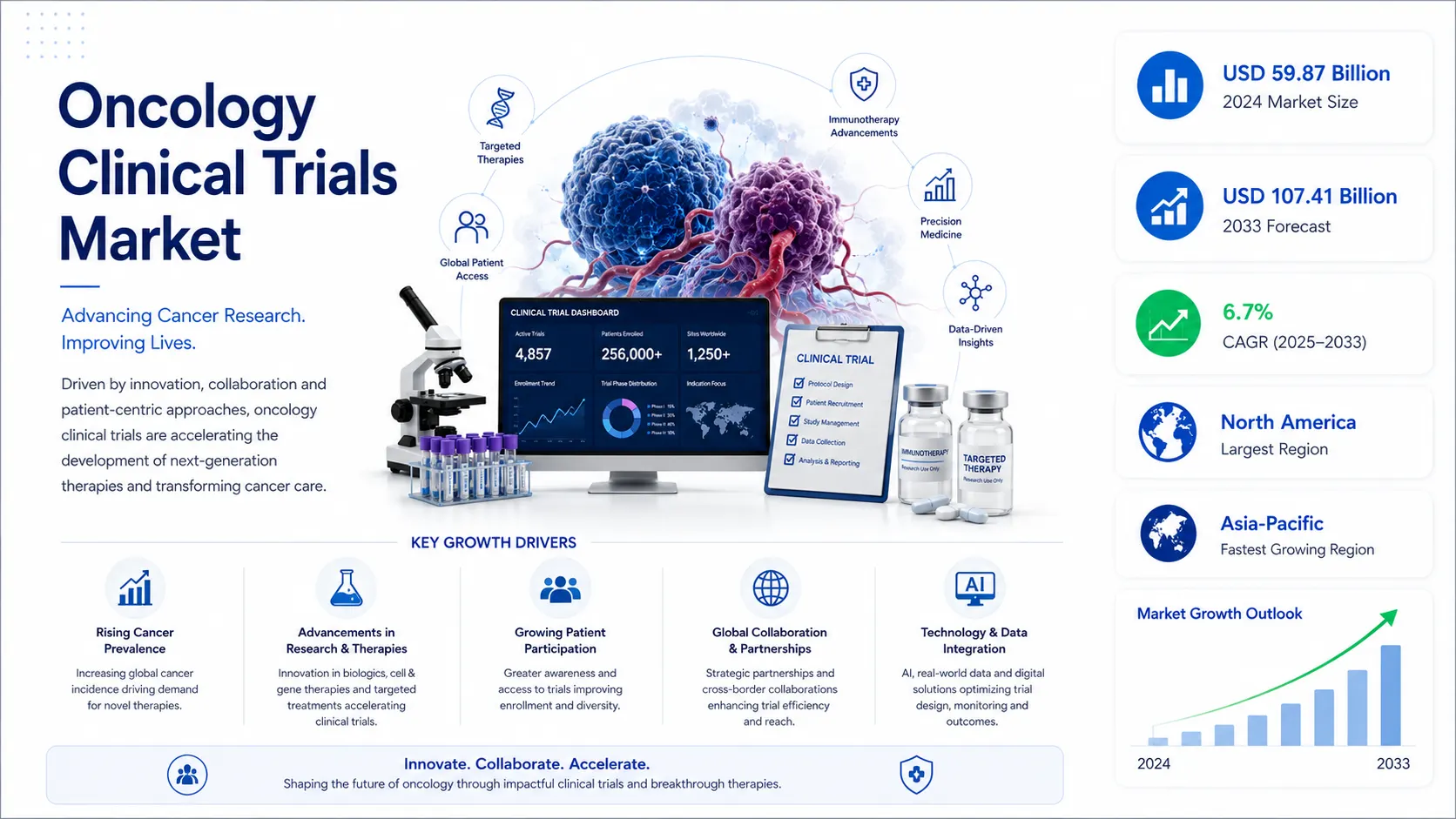
According to Intellectual Market Insights Research, the global Oncology Clinical Trials Market was valued at USD 11.95 billion in 2022 and is projected to reach USD 19.27 billion by 2031, expanding at a CAGR of 5.45% across the 2022–2031 forecast window. That trajectory reflects steady, structural growth rather than a short-term spike — driven by an aging global population, a growing pipeline of targeted and immune-based oncology drugs, and sponsors' increasing reliance on specialized contract research organizations (CROs) to run trials across Phase I through Phase IV.
Unlike many therapeutic categories, oncology trials are unusually complex: they demand large multi-site networks, rigorous biomarker-driven patient selection, and increasingly sophisticated statistical designs (basket trials, umbrella trials, adaptive protocols) to keep pace with a fast-moving science base. This complexity is precisely why the market for running these trials — the protocol design, patient recruitment, site management, data monitoring, and regulatory submission work — has become a distinct, high-value industry vertical in its own right, closely tied to adjacent segments like the Oncology Based Preclinical CRO Market and the Oncology Based In-Vivo CRO Market.
Several converging forces are shaping this market's near-term trajectory. On the demand side, rising cancer incidence across nearly every region — a trend closely tracked in reports such as the Brain Cancer Diagnostics Market and the Cervical Cancer Market — is pushing more compounds into clinical development than at any point in the past decade. On the innovation side, breakthroughs in immuno-oncology, cell and gene therapy, and biomarker-driven precision medicine are reshaping how trials are designed, monitored, and staffed. And on the operational side, sponsors are increasingly outsourcing trial execution to specialized CROs and adopting decentralized and hybrid trial models to accelerate enrollment and improve patient diversity.
This pillar guide walks through the full landscape of the Oncology Clinical Trials Market: its core segments by phase, study design, and cancer type; the leading CROs and sponsors shaping competitive dynamics; the technology and regulatory trends redefining how trials are run; regional opportunities and challenges; and a forward-looking view of where the market is headed through 2031 and beyond.
Oncology Clinical Trials Market Overview
Market Size and Growth Trajectory
At USD 11.95 billion in 2022 and a projected USD 19.27 billion by 2031, the Oncology Clinical Trials Market's 5.45% CAGR places it among the steadier — if less flashy — growth stories in the broader oncology ecosystem. Compare that to adjacent, faster-growing segments: the Oncology Based Molecular Diagnostics Market, valued at USD 3.19 billion in 2023 and forecast to reach USD 9.17 billion by 2032 at a 12.4% CAGR, or the Clinical Oncology Next Generation Sequencing Market, projected to climb from USD 427.99 million in 2023 to USD 1,564.36 million by 2032 at a 15.5% CAGR. These faster-growing diagnostic and sequencing markets are, in effect, feeding the clinical trials market — better biomarker science means more targeted, better-designed oncology trials, which in turn sustains steady demand for trial execution services.
Why Growth Is Steady Rather than Explosive
Clinical trial volume tracks drug development pipelines, and pipeline growth — while robust — is naturally constrained by regulatory throughput, funding cycles, and the multi-year timelines inherent to oncology drug development. A Phase III oncology trial can run three to five years from first patient enrolled to database lock. That means today's trial volume reflects R&D decisions made years ago, and today's trial starts will shape market revenue through the early 2030s. This lag effect is part of why market forecasters model steady, compounding growth rather than sharp inflection points.
Market Segmentation Analysis
By Trial Phase
- Phase I (First-in-Human Studies) Phase I oncology trials are typically small, dose-escalation studies designed to establish safety, tolerability, and maximum tolerated dose in a limited patient population — often patients who have exhausted standard treatment options. Oncology Phase I trials are unusual among therapeutic areas in that they are frequently conducted directly in patients rather than healthy volunteers, given the toxicity profiles of many cancer therapeutics. Growth in this segment is closely tied to the sheer volume of novel compounds entering early clinical development, particularly from biotech innovators working in cell therapy, bispecific antibodies, and antibody-drug conjugates.
- Phase II (Proof-of-Concept and Dose Optimization) Phase II trials expand the patient population to assess efficacy signals and refine dosing. In oncology, this phase increasingly incorporates biomarker-stratified cohorts and adaptive designs that allow sponsors to drop ineffective arms early — a design philosophy that has meaningfully shortened average development timelines for targeted therapies over the past decade.
- Phase III (Pivotal, Registration-Enabling Studies) Phase III trials remain the largest single cost driver in oncology drug development, often requiring hundreds to thousands of patients across dozens of countries. These trials are the primary revenue driver for large, full-service CROs and are where decentralized trial technology, patient recruitment platforms, and global site networks deliver the most measurable value.
- Phase IV (Post-Marketing Surveillance) Post-approval studies monitor long-term safety, real-world effectiveness, and expanded label indications. As payers and regulators increasingly demand real-world evidence to support pricing and reimbursement decisions, Phase IV oncology studies have taken on growing strategic importance, particularly for high-cost immunotherapies and cell therapies.
By Study Design
- Interventional Trials The dominant study design in oncology, interventional trials actively assign participants to a treatment protocol — a new drug, combination regimen, radiation approach, or surgical technique — and measure defined clinical outcomes. The overwhelming majority of registration-enabling oncology studies fall into this category.
- Observational Trials Observational studies track patient outcomes without assigning specific interventions, often used to build natural history data, validate biomarkers, or generate real-world evidence for approved therapies. This design has grown in relevance alongside the broader real-world evidence movement in oncology, which overlaps meaningfully with data captured in platforms tracked under the Oncology Information Systems Market, valued at USD 7,900 million in 2022 and growing at a 7.9% CAGR through 2032.
- Expanded Access Programs Also known as "compassionate use," expanded access allows patients with serious or life-threatening cancers who don't qualify for ongoing trials to access investigational therapies outside a formal study. While smaller in scale, this segment has grown in visibility as regulatory bodies streamline expanded access pathways for oncology.
By Cancer Type
The report segments the market across a wide range of oncology indications, each with distinct trial-design complexity and competitive dynamics:
- Lung cancer — the single largest contributor to global cancer mortality, and a major driver of trial volume given the depth of the targeted-therapy and immunotherapy pipeline for both NSCLC and SCLC.
- Breast cancer — a mature but still highly active trial category, particularly around combination immunotherapy approaches tracked in the Breast Cancer Immunotherapy Market, projected to reach USD 500.62 billion by 2031 at a 12.8% CAGR.
- Thyroid cancer — a smaller but growing trial category as targeted kinase inhibitors expand treatment options.
- Leukemia — a hotbed of cell therapy innovation, closely linked to advances tracked in the T-Cell Therapy Market, forecast to grow at an exceptional 35.33% CAGR to reach USD 36.86 billion by 2031.
- Liver cancer — rising in trial priority alongside increasing global incidence linked to metabolic and viral hepatitis-related liver disease.
- Skin cancer — dominated by melanoma trials, an early proving ground for checkpoint inhibitor immunotherapy.
- Lymphoma — another major beneficiary of CAR-T and bispecific antibody trial activity.
- Pancreatic cancer — historically underserved by effective therapies, driving elevated R&D urgency and trial investment despite difficult recruitment dynamics.
- Prostate cancer — a steady, high-volume trial category given the disease's prevalence in aging male populations.
- Colon & rectal cancer — closely tied to advances in molecular diagnostics and biomarker-driven trial enrollment.
- Urinary system cancer — a smaller but growing segment as immunotherapy combinations expand into bladder and renal cancers.
- Other cancer types — encompassing rarer indications where trial design often requires global, multi-country recruitment strategies to reach adequate patient populations, an area where the Virtual Clinical Trials Market — projected to reach USD 13.5 billion by 2031 at a 5.7% CAGR — plays an increasingly important enabling role, with oncology already representing close to a quarter of decentralized trial activity by indication.
Top 20 Leading Companies in the Global Oncology Clinical Trials Market
- PAREXEL International Corporation
- ICON plc (incl. PRA Health Sciences)
- Syneos Health
- Medpace
- Novotech
- Pivotal
- IQVIA
- Fortrea Holdings Inc.
- Charles River Laboratories
- WuXi AppTec
- Thermo Fisher Scientific (PPD)
- Worldwide Clinical Trials
- Premier Research
- Advarra
- Catalyst Clinical Research
- Roche / Genentech
- Bristol Myers Squibb
- AstraZeneca
- Merck & Co.
- Novartis
1. PAREXEL International Corporation
Headquarters: Newton, Massachusetts, USA Core Services: Full-service clinical development, biostatistics, regulatory affairs, patient recruitment Market Position: One of the largest global CROs with a dedicated oncology and hematology therapeutic unit spanning Phase I through registration trials Technology & Innovation: Investment in adaptive trial design and biostatistics platforms tuned specifically to complex, biomarker-driven oncology protocols Competitive Advantages: Deep global site network and regulatory affairs expertise across dozens of countries, enabling single-partner execution of multi-region oncology programs Recent Developments: Continued expansion of decentralized trial technology offerings to support broader, more diverse oncology patient recruitment across rare and common cancer types
2. ICON plc (incorporating PRA Health Sciences)
Headquarters: Dublin, Ireland Core Services: Full-service CRO operations, data science, decentralized and hybrid trial technology Market Position: One of the largest global CROs by scale following its 2021 acquisition of PRA Health Sciences, with substantial oncology trial capacity across solid tumors and hematologic malignancies Technology & Innovation: Combined data science and site network resources supporting large, multi-country Phase III oncology programs Competitive Advantages: Scale, integrated data infrastructure, and a broad global regulatory footprint Recent Developments: Continued expansion of decentralized and hybrid trial offerings aimed at accelerating oncology enrollment timelines
3. Syneos Health
Headquarters: Morrisville, North Carolina, USA Core Services: Integrated clinical development and commercialization solutions Market Position: A preferred partner for oncology sponsors planning ahead toward commercial launch, combining trial execution with go-to-market services Technology & Innovation: Investment in integrated data platforms connecting clinical development data to commercialization planning Competitive Advantages: End-to-end development-to-commercial model, appealing to mid-size pharma and biotech oncology sponsors Recent Developments: Company was taken private in 2023 via a consortium including Elliott Investment Management and Patient Square Capital; has continued competing in oncology CRO services since the transaction
4. Medpace
- Headquarters:
- Core Services:
- Market Position:
- Technology & Innovation:
- Competitive Advantages:
- Recent Developments:
5. Novotech
- Headquarters:
- Core Services:
- Market Position:
- Technology & Innovation:
- Competitive Advantages:
- Recent Developments:
Related Markets Shaping the Oncology Clinical Trials Ecosystem
The Oncology Clinical Trials Market doesn't operate in isolation — it's deeply interconnected with diagnostics, drug discovery, manufacturing, and adjacent therapeutic-area markets. Below are the related markets most relevant to sponsors, CROs, and investors tracking this space, each linked to its corresponding IMI report where available.
Oncology Based Molecular Diagnostics Market — Molecular diagnostics underpin biomarker-driven patient selection in modern oncology trials. Valued at USD 3.19 billion in 2023 and projected to hit USD 9.17 billion by 2032 (12.4% CAGR), this market's growth directly enables more precisely targeted, and often smaller and faster, clinical trials.
Clinical Oncology Next Generation Sequencing Market — NGS technology identifies the genomic alterations that determine trial eligibility for targeted therapies. Forecast to grow from USD 427.99 million in 2023 to USD 1,564.36 million by 2032, this market is foundational infrastructure for precision oncology trial design.
Immunohistochemistry Market — IHC testing for biomarkers like PD-L1, HER2, and ER/PR is a routine companion diagnostic step in oncology trial screening, making this a critical enabling technology market.
Oncology Based Preclinical CRO Market — Valued at USD 7.82 billion in 2023 with a projected 14.1% CAGR through 2032, preclinical CRO services form the pipeline feeding into clinical-stage trials.
Oncology Based In-Vivo CRO Market — In-vivo preclinical models remain essential for validating oncology drug candidates before they advance into human trials.
Biopharmaceuticals Contract Manufacturing Market — As oncology pipelines shift toward complex biologics, cell therapies, and biosimilars, contract manufacturing capacity has become a genuine bottleneck and strategic consideration for trial sponsors.
Cancer Immunotherapy Market — Projected to reach USD 274.35 billion by 2032 at an 8.95% CAGR, immunotherapy remains the single largest driver of new oncology trial starts globally.
T-Cell Therapy Market — With a striking 35.33% CAGR forecast through 2031, CAR-T and TCR-based cell therapies represent one of the fastest-growing — and most operationally complex — categories of oncology trials.
Cancer Immunotherapy Drug Discovery Outsourcing Market — Valued at USD 3.62 billion in 2021, this upstream discovery-outsourcing market feeds the immuno-oncology trial pipeline.
Virtual Clinical Trials Market — Forecast to reach USD 13.5 billion by 2031, decentralized and hybrid trial technology is reshaping how oncology trials recruit and monitor patients, with oncology already one of the largest indication categories by trial share.
Multiplexed Diagnostics Market — Projected to reach USD 49.62 billion by 2034 (10.3% CAGR), multiplex diagnostic panels increasingly support oncology trial screening alongside infectious disease and other applications.
Oncology Information Systems Market — Valued at USD 7,900 million in 2022, oncology-specific data and information management platforms are core infrastructure for trial data capture, monitoring, and real-world evidence generation.
Interventional Oncology Devices Market — Device-based oncology interventions increasingly intersect with drug trials in combination-therapy study designs; see also IMI's related analysis of the top interventional oncology device companies.
Breast Cancer Immunotherapy Market — Projected to reach USD 500.62 billion by 2031, breast cancer remains one of the highest-volume indications for combination immunotherapy trials.
Peptide Cancer Vaccine Market — Valued at USD 4,620 million in 2022 and growing at a 10.9% CAGR, therapeutic cancer vaccines represent an emerging trial category built on neoantigen and biomarker science.
Metastatic Cancer Treatment Market — Late-stage and metastatic disease trials carry distinct recruitment and endpoint-design challenges relative to earlier-stage cancer studies.
Brain Cancer Diagnostics Market — Advances in imaging and molecular diagnostics for brain tumors are improving trial patient stratification for a historically difficult-to-treat indication.
Cervical Cancer Market — Valued at USD 7.25 billion in 2023 with a 5.6% CAGR, cervical cancer trial activity is closely tied to HPV-related screening and prevention advances.
For a broader view of how immuno-oncology-specific trial activity is evolving by company, see IMI's dedicated analysis: Global Immuno-Oncology Clinical Trials Market: Top Leading Companies.
Market Drivers, Restraints, and Opportunities
Growth Drivers
- Rising global cancer incidence. Aging populations and lifestyle-related risk factors continue to push new cancer diagnoses upward globally, sustaining a steady flow of patients eligible for — and often actively seeking — clinical trial enrollment.
- Expanding oncology drug pipelines. The sheer volume of novel compounds — particularly in immuno-oncology, cell therapy, and targeted small molecules — in preclinical and early clinical development continues to feed new trial starts.
- Growing CRO outsourcing. Sponsors, particularly emerging biotechs without in-house clinical operations infrastructure, increasingly rely on CROs to manage the full trial lifecycle, sustaining demand for specialized oncology CRO services.
- Technology-enabled trial efficiency. AI-driven patient matching, decentralized trial technology, and digital data capture are collectively reducing enrollment timelines and operational costs, making previously uneconomical trial designs more viable.
Market Restraints
- High trial costs and long timelines. Oncology trials remain among the most expensive and longest-running clinical study categories, a persistent constraint on how many programs sponsors — particularly smaller biotechs — can run simultaneously.
- Patient recruitment challenges. Biomarker-driven eligibility criteria can dramatically narrow the pool of eligible patients for a given trial, particularly for rare cancer subtypes, extending enrollment timelines.
- Regulatory complexity across regions. Running multi-country oncology trials requires navigating a patchwork of regulatory requirements, adding administrative burden and cost.
- Trial dropout and retention issues. Cancer patients, particularly those with advanced disease, face genuine physical and logistical barriers to sustained trial participation, contributing to attrition that can compromise statistical power.
Emerging Opportunities
- Decentralized trial expansion into historically underserved patient populations and geographies.
- AI-driven protocol optimization reducing both trial cost and duration.
- Growth in emerging-market trial infrastructure, particularly across Asia-Pacific, expanding the addressable patient pool for global sponsors.
- Real-world evidence integration creating new post-approval revenue streams for data and CRO service providers.
Regional Analysis
North America
North America remains the largest contributor to global oncology clinical trial activity, underpinned by deep clinical research infrastructure, a high concentration of leading pharmaceutical and biotech sponsors, well-established academic medical centers, and a regulatory environment (via the FDA) that has actively supported accelerated oncology drug development pathways. The United States in particular continues to attract the largest share of early-phase and pivotal oncology trials globally, supported by substantial private and public R&D investment.
Europe
Europe maintains a strong oncology trial base, supported by coordinated research initiatives such as EU Horizon programs and a deep network of academic and hospital-based research centers across Germany, the UK, France, and other major markets. The EMA's adaptive pathways framework has helped sustain innovation-friendly regulatory conditions for oncology development, though harmonization challenges across individual EU member states remain a structural consideration for multi-country trial sponsors.
Asia-Pacific
Asia-Pacific is widely expected to be the fastest-growing regional market for oncology clinical trials over the coming decade, driven by the presence of major CRO operations in countries like Japan, China, South Korea, and Australia, alongside large, genetically diverse patient populations that support faster enrollment for global trials. Growing government investment in clinical research infrastructure across India, China, and Southeast Asia is further strengthening the region's position as a trial execution hub, a trend reflected in the growing footprint of regionally focused CROs like Novotech and Pivotal.
Latin America
Latin America represents a growing, if still comparatively smaller, oncology trial market, with Brazil, Mexico, and Argentina serving as the primary hubs for regional trial activity. Lower per-patient trial costs relative to North America and Europe, combined with large urban patient populations, continue to attract sponsor interest, though clinical research infrastructure development remains uneven across the region.
Middle East & Africa
The Middle East, led by Saudi Arabia and the UAE, has been actively investing in clinical research infrastructure as part of broader healthcare-sector diversification strategies, while South Africa remains the most established oncology trial market on the African continent. Both sub-regions represent longer-term growth opportunities as investment and regulatory frameworks continue to mature.
Frequently Asked Questions
1. How much is the global Oncology Clinical Trials Market worth? The market was valued at USD 11.95 billion in 2022 and is projected to reach USD 19.27 billion by 2031, growing at a CAGR of 5.45%, according to Intellectual Market Insights Research.
2. What is driving growth in the Oncology Clinical Trials Market? Key drivers include rising global cancer incidence, an expanding pipeline of immuno-oncology and cell therapy candidates, growing sponsor reliance on outsourced CRO services, and the adoption of AI and decentralized trial technologies that improve enrollment speed and trial efficiency.
3. Which trial phase represents the largest share of oncology trial activity? Phase III pivotal trials typically represent the largest single cost and resource driver in oncology drug development, given the large patient populations and extensive multi-country site networks required for registration-enabling studies.
4. Which cancer types see the most clinical trial activity? Lung cancer, breast cancer, and hematologic malignancies (leukemia and lymphoma) consistently rank among the highest-volume trial categories, reflecting both disease prevalence and the depth of the targeted therapy and immunotherapy pipeline in these indications.
5. Who are the leading CROs in the oncology clinical trials space? Leading players identified in IMI's research include PAREXEL International Corporation, ICON plc (incorporating the former PRA Health Sciences), Medpace, Novotech, Syneos Health, and Pivotal.
6. How are decentralized clinical trials changing oncology research?
7. What role does AI play in oncology clinical trials?
8. Which region is expected to grow fastest in oncology clinical trials?
9. What is the difference between interventional and observational oncology trials?
10. How does biomarker-driven patient selection affect trial design?
11. What are the biggest challenges facing oncology trial sponsors today?
12. How is real-world evidence influencing oncology trial strategy?
Future Outlook
Looking toward 2031 and beyond, the Oncology Clinical Trials Market is positioned for continued, steady expansion rather than dramatic disruption — though the way trials are designed and executed is set to change substantially. Expect continued growth in decentralized and hybrid trial models as sponsors and regulators alike become more comfortable with remote monitoring and eConsent infrastructure, particularly as tools mature within the broader Virtual Clinical Trials Market. AI-driven trial optimization, from patient matching to adaptive statistical design, is likely to move from early-adopter status to standard practice across most major CROs over the coming five years.
The continued maturation of cell and gene therapy — reflected in the striking 35.33% CAGR forecast for the T-Cell Therapy Market — will keep driving specialized, operationally complex early-phase trial activity, requiring CROs to build out increasingly specialized manufacturing logistics and cold-chain trial support capabilities. Meanwhile, the steady advance of molecular diagnostics and next-generation sequencing will continue enabling more precisely targeted, biomarker-driven trial designs across nearly every major cancer type.
Regionally, expect Asia-Pacific to continue closing the gap with North America and Europe as regional CRO infrastructure matures and government investment in clinical research capacity grows. Consolidation among CROs — following the pattern set by ICON's acquisition of PRA Health Sciences — is likely to continue, as scale becomes an increasingly important competitive advantage for running large, global, multi-indication oncology programs.
For sponsors, investors, and CRO leadership evaluating strategy in this space, the throughline is clear: the Oncology Clinical Trials Market's steady 5.45% CAGR understates how much operational transformation is happening beneath the surface. Technology, biomarker science, and globalization are together reshaping how trials get done, even as the underlying growth curve stays comparatively stable.
Conclusion
The global Oncology Clinical Trials Market's climb from USD 11.95 billion in 2022 to a projected USD 19.27 billion by 2031 tells a story of steady, structural growth — but the numbers alone understate how much is actually changing underneath. Rising cancer incidence and an expanding pipeline of immuno-oncology, cell therapy, and targeted drug candidates are keeping trial volume high, while AI-driven patient matching, decentralized and hybrid trial models, and biomarker-based patient selection are fundamentally reshaping how those trials get designed and run.
The competitive landscape reflects this shift toward scale and specialization. Full-service global CROs like PAREXEL and ICON (now incorporating PRA Health Sciences) continue to compete on breadth of site networks and regulatory reach, while mid-size and regional players such as Medpace, Novotech, and Pivotal carve out advantage through speed, integration, and local market depth. Consolidation — ICON's acquisition of PRA, Fortrea's spin-off from Labcorp, Syneos Health's take-private transaction — is likely to continue as sponsors increasingly favor partners who can run large, multi-region, multi-indication programs without extensive subcontracting.
Regionally, North America and Europe remain the established centers of gravity, but Asia-Pacific's growing CRO infrastructure, large patient populations, and rising government investment position it as the fastest-growing region through the forecast period. And across every geography, the same underlying dynamic holds: trials tied to molecular diagnostics, next-generation sequencing, and biomarker-driven design are increasingly the ones attracting sponsor investment.
For sponsors, CROs, investors, and vendors evaluating strategy in this space, the takeaway is straightforward: the market's comparatively modest 5.45% CAGR is not a signal to underinvest — it's a market undergoing real operational transformation even as its headline growth curve stays steady. Organizations that build capability now in AI-enabled recruitment, decentralized trial infrastructure, and biomarker-driven protocol design will be best positioned to capture share as the market approaches USD 19.27 billion by 2031.