
Leading Companies in the Global Electronic Warfare Market
Author:
Intellectual Market Insights Research
Published Date:
02 Jul 2026
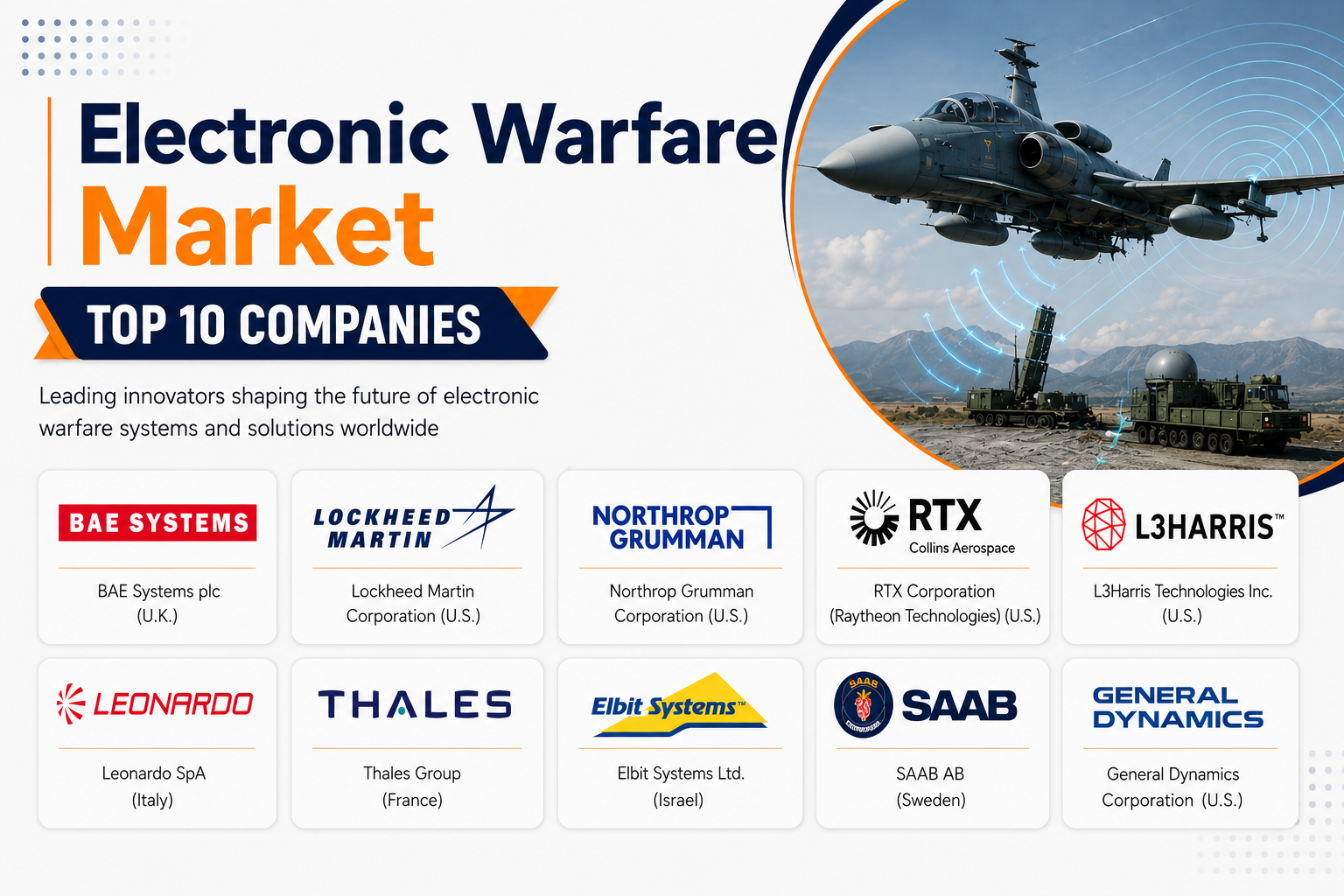
Top 10 Leading Companies in the Global Electronic Warfare Market Driving Industry Growth in 2025
The global Electronic Warfare market has transformed from a niche defense technology segment into one of the most strategically critical sectors at the intersection of electromagnetic spectrum dominance, artificial intelligence integration, advanced signal processing, and multi-domain military operations. As geopolitical tensions escalate across Eastern Europe, the Asia-Pacific region, and the Middle East, defense budgets worldwide continue to expand, and the demand for advanced electronic warfare systems capable of disrupting, deceiving, and defending against adversarial electromagnetic threats has never been more urgent.
According to Intellectual Market Insights Research, the Electronic Warfare market is projected to grow from USD 21.74 Billion in 2025 to USD 34.44 Billion by 2034, registering a compound annual growth rate (CAGR) of 5.25% during the forecast period. This trajectory is driven by increasing defense investments, rapid integration of AI and machine learning into EW systems, the proliferation of unmanned aerial vehicles creating new threat vectors, and the urgent need for electromagnetic spectrum dominance across land, air, naval, space, and cyber domains. North America dominated the electronic warfare market with a market share of 46.10% in 2025, underpinned by the world's largest defense budget, extensive military modernization programmes, and the presence of the most advanced defense contractor base on the planet. Meanwhile, Asia-Pacific is estimated to grow with the highest CAGR over the forecast period, with growth in the region attributed to increasing expenditure in the defense sector from India, China, Japan, and Australia.
Market Overview
The global electronic warfare market size was valued at USD 20.20 billion in 2025 and is projected to grow from USD 22.20 billion in 2026 to USD 41.70 billion by 2034, exhibiting a CAGR of 8.20% over the forecast period. North America is the leading region in 2025 while Asia-Pacific is the fastest-growing region. Electronic Attack leads the capability segment, accounting for approximately 42% of market share. The naval platform segment leads in end-user adoption owing to advanced naval technologies and procurement of naval-grade sub-systems. The airborne platform segment is the fastest-growing, driven by UAV proliferation and stealth aircraft integration. Key growth drivers include rising geopolitical tensions, military modernization programmes, AI integration, UAV proliferation, and expanding cyber-electronic warfare convergence. Key challenges include high development and maintenance costs, export control restrictions on advanced EW components, interoperability complexity across allied forces, and the rapid evolution of adversarial counter-EW capabilities. Major companies operating in the electronic warfare market include Lockheed Martin Corporation, BAE Systems, Saab, RTX Corporation, Thales Group, General Dynamics, L3Harris Technologies, Northrop Grumman Corporation, Israel Aerospace Industries Ltd., and Leonardo SpA. The forecast period is 2025 to 2034 and the study period is 2018 to 2034.
Why the Electronic Warfare Market Is Growing
1. Escalating Geopolitical Tensions Drive Urgent Defense Investment
The single most powerful structural driver of the electronic warfare market share is the rapid deterioration of global security conditions across multiple strategic theatres simultaneously. The ongoing conflict in Ukraine has provided the most comprehensive real-world validation of electronic warfare's decisive role in modern military operations, with both sides deploying GPS jamming, radar spoofing, communications disruption, and drone counter-EW systems at unprecedented scale. This conflict has served as a forcing function for NATO member states to dramatically accelerate their EW system procurement and modernization programmes. Simultaneously, rising tensions in the South China Sea, the Korean Peninsula, the Middle East, and the Taiwan Strait are compelling defense ministries across Asia-Pacific, the Gulf states, and Europe to prioritize electronic warfare capability development as an essential component of national defense strategy, creating sustained structural demand that is independent of individual procurement cycles.
2. AI and Machine Learning Revolutionize EW System Capabilities
Ongoing advancements in technology such as artificial intelligence, machine learning, and sensor miniaturization enable the development of more sophisticated and capable EW systems. Traditional electronic warfare systems operated on pre-programmed threat libraries requiring manual updates and could only respond to known signal signatures. AI-powered cognitive EW systems represent a fundamental paradigm shift, enabling systems to autonomously identify, characterize, and respond to novel electromagnetic threats in real time without prior programming. Programs such as DARPA's Adaptive Radar Countermeasures (ARC) and Behavioral Learning for Adaptive Electronic Warfare (BLADE) signify the emergence of a new generation of cognitive EW technology that anticipates and adapts to threats across broader bandwidths with better RF agility and adaptability, leveraging digital waveform generation and processing. This cognitive capability transformation is making EW systems dramatically more effective against the rapidly evolving threat environments that modern adversaries present.
3. Proliferation of Unmanned Aerial Vehicles Creates New EW Threat Vectors and Market Opportunities
The explosive growth of drone technology across both military and commercial applications has created entirely new threat categories that traditional EW systems were not designed to counter, simultaneously generating substantial new market demand for counter-UAV electronic warfare solutions. The rapid adoption of unmanned aerial vehicles in surveillance and attacks is further fuelling the demand for electronic warfare systems to disrupt enemy drones, provide protection of airspace, and detect low radar cross-section targets, with widespread usage driving government investment to deploy counter-UAV electronic warfare systems. The emergence of drone swarm tactics, where coordinated groups of low-cost UAVs are deployed to overwhelm conventional air defense systems, is driving particular urgency in the development of EW solutions capable of simultaneously neutralizing multiple small drone threats across contested airspace.
4. Military Modernization Programmes Across All Major Defense Spenders
Defense budgets globally are at post-Cold War highs and continuing to grow as nations respond to a more dangerous and multipolar strategic environment. The surge in implementation of military modernization programs across the globe has led to incorporation of electronic warfare systems as a core component among air forces for electronic countermeasures, navies for electromagnetic protection, and armies to shield communications and intercept enemy transmissions. The United States continues to lead global EW investment through programmes including the Next Generation Jammer, the EA-18G Growler upgrade programme, and Army electronic warfare modernization initiatives. European NATO members are dramatically increasing EW investment following the lessons of the Ukraine conflict, while India, Japan, South Korea, and Australia are deploying EW systems across all military branches as part of comprehensive defense modernization strategies.
5. Convergence of Cyber Warfare and Electronic Warfare Creates Integrated Defense Domains
The boundary between electronic warfare and cyber warfare is rapidly dissolving as modern military operations require seamless integration of electromagnetic spectrum operations with cyber offense and defense capabilities. Nations are prioritizing the development of cyber-electronic warfare capabilities, ensuring the integration of EW systems with cyber defense mechanisms to counter sophisticated cyber-physical threats. This convergence creates new market demand for integrated cyber-EW platforms that can simultaneously operate across electromagnetic and digital domains, enabling military forces to execute coordinated attacks on adversary command and control infrastructure while protecting their own communications and data networks from reciprocal disruption.
6. Space-Based Electronic Warfare Emerges as Critical New Domain
Looking ahead, the Electronic Warfare Systems market is expected to witness greater adoption of space-based electronic warfare capabilities, as the military's dependence on satellite communications, GPS navigation, and space-based intelligence gathering creates both critical vulnerabilities and new offensive opportunities in the electromagnetic spectrum. Nation-state adversaries including China and Russia have developed and demonstrated anti-satellite and satellite signal jamming capabilities that threaten the GPS, communications, and surveillance infrastructure upon which modern military operations critically depend. This space-EW threat is driving substantial new investment in satellite hardening, alternative positioning systems, and dedicated space domain EW capabilities across all major defense programs.
Top 10 Companies in the Global Electronic Warfare Market
- BAE Systems plc (U.K)
- Lockheed Martin Corporation (U.S.)
- Northrop Grumman Corporation (U.S.)
- RTX Corporation (Raytheon Technologies) (U.S.)
- L3Harris Technologies Inc. (U.S.)
- Leonardo SpA (Italy)
- Thales Group (France)
- Elbit Systems Ltd. (Israel)
- SAAB AB (Sweden)
- General Dynamics Corporation (U.S.)
Company Profiles
1. BAE Systems plc (U.K.)
Headquarters: London, United Kingdom | Focus: Electronic Attack, Electronic Support & Countermeasures | Global Presence: 40+ countries
BAE Systems is Europe's largest defense contractor and one of the world's foremost electronic warfare technology companies, operating a dedicated Electronic Systems division that develops and manufactures a comprehensive portfolio of EW equipment spanning airborne, naval, and land-based platforms across the full electronic attack, electronic support, and electronic protection capability spectrum. BAE Systems' EW heritage stretches back decades through its predecessor companies, giving it deep institutional knowledge of radar, signals intelligence, and countermeasure system design that few competitors can match. The company's global customer base spans NATO member states across North America, Europe, the Middle East, and Asia-Pacific, with long-term support contracts creating substantial recurring revenue alongside new system sales. BAE Systems' EW product portfolio includes the Integrated Defensive Aids Systems (IDAS) for combat aircraft, the AN/ALQ-214 Integrated Defensive Electronic Countermeasures (IDECM) system for the U.S. Navy's F/A-18 Hornet family, airborne self-protection jammers, towed radar decoys including the ALE-55 Fiber Optic Towed Decoy, and comprehensive naval EW suites.
2. Lockheed Martin Corporation (U.S.)
Headquarters: Bethesda, Maryland, USA | Focus: Integrated EW Systems, Radar & Signals Intelligence | Global Presence: 70+ countries
Lockheed Martin is the world's largest defense contractor by revenue and a dominant force across every segment of the electronic warfare market share, integrating EW capabilities into the full spectrum of its military platforms from the F-35 Lightning II stealth fighter to the C-130 transport aircraft family, shipboard combat systems, and ground-based air defense installations. Lockheed Martin's EW capabilities span electronic attack, electronic support, and electronic protection, with particular strength in the integration of EW suites into complex, multi-domain military platforms that require seamless electromagnetic spectrum management across all operational scenarios. The company's Skunk Works advanced development programmes are at the forefront of next-generation cognitive EW and directed energy weapon development. Lockheed Martin's EW product range includes the AN/ALQ-218 tactical jamming system, the Sniper Advanced Targeting Pod with integrated EW capabilities, the F-35's highly integrated AN/ASQ-239 EW system, the Sentinel air defense radar, and a range of shipboard and ground-based signals intelligence and jamming systems. The company is also a prime contractor for the U.S. Army's Electronic Warfare Planning and Management Tool (EWPMT).
3. Northrop Grumman Corporation (U.S.)
Headquarters: Falls Church, Virginia, USA | Focus: Cognitive EW, Radar Warning Receivers & Airborne Jamming | Global Presence: 25+ countries
Northrop Grumman is one of the United States' premier electronic warfare technology companies, with particular expertise in airborne EW systems, radar warning receivers, and the development of next-generation cognitive electronic warfare capabilities that use machine learning to autonomously adapt to novel electromagnetic threats. Northrop Grumman's EW portfolio includes digital radar warning receivers, radio frequency countermeasures, and electronic support and attack suites critical to next-generation fighter jets and naval vessels, with emphasis on cognitive EW, adaptive signal processing, and open-system architectures allowing swift upgrades to counter evolving threats. Northrop Grumman is a key EW systems provider for the U.S. Air Force, Navy, and Army, with deep programme history including the EA-6B Prowler and ongoing work on successor jamming and EW systems. Northrop Grumman's EW product portfolio includes the ALQ-131 and ALQ-162 electronic countermeasures pods, the AN/ALQ-135 internal countermeasure set for the F-15 Eagle, the AN/ASQ-239 EW system contributions for the F-35, the Next Generation Jammer development contributions, and dedicated signals intelligence and electronic support systems for special operations aircraft.
4. RTX Corporation Raytheon Technologies (U.S.)
Headquarters:
Focus:
Global Presence:
5. L3Harris Technologies Inc. (U.S.)
Headquarters:
Focus:
Global Presence:
Competitive Landscape
The global Electronic Warfare market forecast in 2025 is characterized by high concentration among a small number of large defense prime contractors who combine EW capability with broad multi-domain defense platform integration, alongside a second tier of specialized EW system providers who compete on technological depth in specific niches such as directed infrared countermeasures, counter-UAV EW, and signals intelligence systems. The U.S. defense industrial base commands the largest share of global EW market revenue, driven by the United States' dominant global defense expenditure position and the breadth of U.S. military EW modernization programmes. However, European companies including BAE Systems, Leonardo, Thales, and SAAB hold strong positions in both the European defense market and the broader international export market, particularly in airborne EW and naval EW systems.
The most strategically significant competitive dimension in 2025 is the race to develop cognitive electronic warfare systems capable of autonomous threat identification and countermeasure deployment without human intervention. Companies that establish credible cognitive EW capability through DARPA and military service R&D partnerships are positioning themselves for the next generation of EW programme competition, where traditional pre-programmed threat library systems will be superseded by AI-driven adaptive EW architectures.
Counter-UAV electronic warfare represents the most immediately commercially active growth segment in 2025, driven by the rapid proliferation of military and commercial drones creating urgent demand for electromagnetic jamming and spoofing solutions capable of neutralizing drone threats across military, critical infrastructure, and border security applications. Companies including Elbit Systems, Northrop Grumman, Leonardo, and dedicated counter-drone specialists are competing intensively in this high-growth segment that bridges traditional military EW and commercial security markets.
Regional Analysis
North America dominated the electronic warfare market growth with a market share of 46.10% in 2025, driven by the United States market which is projected to grow significantly, reaching an estimated value of USD 11,411.08 million by 2032, driven by a rising aircraft refurbishment drive extending the lifespan of older aircraft. The U.S. military continues to execute the world's most ambitious EW modernization programme spanning the Next Generation Jammer for the EA-18G Growler, Next Generation EW systems for the F-35 fleet, Army EW modernization across ground vehicle and dismounted platforms, and Navy shipboard EW upgrade programmes. Canada contributes through joint programmes with the United States and through its own CF-18 Hornet EW upgrade initiatives.
Asia-Pacific held 21.40% of the global market in 2025, reaching a valuation of USD 4 billion, and is projected to grow to USD 5 billion in 2026, with the region estimated to grow at the highest CAGR over the forecast period driven by increasing defense expenditure from India, China, Japan, and Australia. India's defense ministry has signed major contracts with Bharat Electronics Limited for advanced EW suites across its air force helicopter fleet, while Japan is investing heavily in airborne EW capabilities for its F-35 fleet and maritime EW systems for its expanding naval force. China's own indigenous EW development programme is the most ambitious in the Indo-Pacific region, representing both a market opportunity for domestic Chinese EW companies and a significant strategic driver for neighboring nations' EW investment.
Europe's electronic warfare market share is experiencing its fastest growth in decades, driven directly by the lessons of the Ukraine conflict that have exposed critical electromagnetic spectrum vulnerabilities in the forces of multiple NATO member states. Germany, France, the United Kingdom, Poland, and the Nordic nations are all accelerating EW system procurement and development programmes. The NATO Electronic Warfare Advisory Committee is coordinating an unprecedented level of allied EW interoperability investment, creating multi-national programme opportunities for European EW system suppliers. The Middle East represents a high-per-unit-value EW market, with Gulf state air forces and navies investing in advanced EW system procurement as part of broader defense modernization programmes funded by substantial oil revenues.
Segmentation Analysis
Electronic Attack capability leads the global electronic warfare market, accounting for approximately 42% of market share in 2025. Electronic attack systems that actively disrupt, jam, or destroy adversary electronic systems represent the most operationally decisive EW capability and consequently attract the largest share of defense procurement investment. Airborne jamming platforms including the EA-18G Growler and electronic attack pods mounted on combat aircraft represent the highest-value procurement programmes. Electronic support systems capturing and analyzing adversary electromagnetic emissions represent the second largest capability segment, providing the signals intelligence foundation that enables effective electronic attack and electronic protection. Electronic protection systems ensuring friendly forces' electromagnetic systems can operate in contested spectrum environments are the fastest-growing capability segment as adversary jamming capabilities improve.
The naval platform segment leads in end-user adoption, driven by the comprehensive EW suite requirements of modern surface combatants and submarines that must operate across all electromagnetic threat environments from radar jamming to communications disruption to anti-ship missile guidance interference. The airborne platform segment is the fastest growing, propelled by the integration of advanced EW systems into new-generation combat aircraft including the F-35 Lightning II across multiple allied air forces, the Rafale, Eurofighter Typhoon, and the proliferating use of EW-equipped unmanned combat aerial vehicles. The land platform segment serves the large installed base of ground vehicle EW protection systems and the growing market for man-portable counter-drone jamming solutions deployed by dismounted ground forces.
Key Industry Developments
In January 2025, BAE Systems secured contracts worth USD 2.5 billion to supply armored combat vehicles to Sweden and Denmark, reinforcing its European defense market position as NATO members dramatically accelerate military procurement. In April 2025, Bharat Electronics Limited signed a contract with India's Ministry of Defence valued at USD 259.3 billion to supply EW suites for Mi-17 V5 helicopters of the Indian Air Force, comprising radar warning receivers, missile approach warning systems, and countermeasure dispensing systems that significantly enhance the combat survivability of the helicopter fleet. In Q3 2024, Raytheon Technologies secured a USD 500 million contract from the U.S. Navy to upgrade shipboard electronic warfare systems, focusing on improved threat detection and countermeasure capabilities, while BAE Systems inaugurated a new electronic warfare industry research and development facility in Texas to accelerate next-generation EW system development. The Ukraine conflict has driven an unprecedented volume of real-world EW operational data, with multiple participating companies incorporating lessons learned from GPS jamming, drone counter-EW operations, and communications disruption systems into accelerated product development programmes.
Market Dynamics
Escalating geopolitical tensions across multiple strategic theatres simultaneously and the associated surge in global defense budgets represent the primary structural growth driver for the electronic warfare market. The Ukraine conflict has validated the decisive operational importance of electromagnetic spectrum dominance in ways that have persuaded even fiscally conservative NATO defense ministries to dramatically accelerate EW investment. The integration of AI and machine learning into cognitive EW systems is simultaneously improving system performance and expanding the addressable market by enabling EW capabilities in platforms too small or cost-constrained to carry traditional programmable EW systems.
The most significant challenge facing the electronic warfare industry market is the rapidly escalating cost and complexity of developing EW systems capable of operating effectively in the extremely dense and contested electromagnetic environments that modern adversary nations can create. The Trump administration raised EW system component expenses by imposing trade restrictions on Chinese electronics and defense imports that included semiconductors, circuit boards, and RF modules, creating supply chain disruptions and cost pressures that are flowing through to system acquisition prices. The high maintenance and operational costs of sophisticated EW systems also create budgetary constraints that limit the pace of modernization even when political will to invest exists.
The convergence of military EW with commercial spectrum protection applications, counter-drone security for critical infrastructure, and space-based electromagnetic domain awareness represents the largest long-term market expansion opportunity. The global investment in securing industrial control systems against electromagnetic attacks is projected to reach USD 12 billion by 2025, reflecting the growing recognition that electromagnetic spectrum threats are not exclusively military concerns but increasingly affect civilian energy, transportation, and communications infrastructure. This dual-use market expansion represents a significant growth opportunity for EW system developers seeking to extend their military technology into adjacent commercial security markets.
Future Outlook 2025–2034
The global Electronic Warfare market is on track for strong sustained growth, expanding from USD 21.74 Billion in 2025 to USD 34.44 Billion by 2034, driven by converging forces across AI-powered cognitive EW development, military modernization programme acceleration across all major defense spending nations, counter-UAV EW demand proliferation, space domain EW investment, and the progressive convergence of electronic warfare with cyber operations and spectrum management in multi-domain military operations.
The cognitive EW transition represents the defining technology investment theme across the forecast period, as the limitations of pre-programmed threat library systems become increasingly apparent against adversaries who can rapidly change their electromagnetic signatures to defeat known countermeasure protocols.
FAQ Section
Q1: What is the current size of the global Electronic Warfare market?
The global Electronic Warfare market was valued at approximately USD 21.74 Billion in 2025 and is projected to grow at a CAGR of 5.25%, reaching USD 34.44 Billion by 2034, according to market research analysis.
Q2: Which companies are the top leaders in the global Electronic Warfare market? The top Electronic Warfare market growth companies include BAE Systems plc, Lockheed Martin Corporation, Northrop Grumman Corporation, RTX Corporation (Raytheon Technologies), L3Harris Technologies Inc., Leonardo SpA, Thales Group, Elbit Systems Ltd., SAAB AB, and General Dynamics Corporation.
Q3: Which region dominates the global Electronic Warfare market?
North America dominated the Electronic Warfare market growth in 2025 with a 46.10% market share, driven by the world's largest defense budget, extensive military modernization programmes, and the presence of the most advanced defense contractor base globally, with the United States representing the dominant national market.
Q4: What is the forecast CAGR for the Electronic Warfare market?
The global Electronic Warfare market trends is projected to grow at a CAGR of 5.25% during the forecast period from 2025 to 2034.
Q5: What are the primary growth drivers of the Electronic Warfare market?
Key growth drivers include escalating geopolitical tensions across multiple strategic theatres simultaneously driving defense budget increases, AI and machine learning integration enabling next-generation cognitive EW capabilities, UAV proliferation creating urgent counter-drone EW demand, military modernization programmes across all major defense spending nations
Q6: Which capability segment leads the Electronic Warfare market?
Electronic Attack leads the capability segment, accounting for approximately 42% of market share in 2025, as active disruption and jamming of adversary electronic systems represents the most operationally decisive EW capability and consequently attracts the largest share of defense procurement investment globally.
Q7: Which platform segment leads the Electronic Warfare market?
The naval platform segment leads in end-user adoption due to the comprehensive EW suite requirements of modern surface combatants and submarines that must maintain operational effectiveness across all electromagnetic threat environments from radar jamming to anti-ship missile guidance interference.
Q8: Which region is the fastest growing in the Electronic Warfare market?
Asia-Pacific is the fastest-growing electronic warfare region, driven by rapidly increasing defense expenditure from India, China, Japan, and Australia, with the Indian Air Force and Japanese Defense Force among the most active EW system procurement customers in the region.
Conclusion
The global Electronic Warfare market trends is at a defining strategic inflection point in 2025. What began as a Cold War-era technology focused narrowly on radar jamming and communications disruption has evolved into a comprehensive multi-domain electromagnetic spectrum management discipline spanning cognitive AI-powered jamming, space-based domain awareness, counter-drone electromagnetic neutralization, and integrated cyber-electronic warfare operations.
With a projected market value of USD 34.44 Billion by 2034, electronic warfare represents one of the most strategically critical and financially compelling defense technology investment opportunities of the coming decade.