
Top 10 Portable Chemotherapy Pump Companies Shaping the Global Market
Author:
Intellectual Market Insights Research
Published Date:
12 Sep 2026
Introduction
For many cancer patients, the difference between spending days tethered to a hospital bed and continuing daily life at home while receiving chemotherapy comes down to a small, often pocket-sized device: the portable chemotherapy pump. These devices, ranging from simple disposable elastomeric balloons to sophisticated programmable electronic pumps, let patients receive precisely metered continuous or intermittent chemotherapy infusions outside the hospital, supporting regimens like FOLFOX for colorectal cancer that depend on extended, steady drug delivery over days rather than hours.
The global portable chemotherapy pump market was valued at approximately USD 5.18 billion in 2025 and is projected to reach USD 8.78 billion by 2034, expanding at a compound annual growth rate (CAGR) of 5.8% over the forecast period. Growth is being driven by rising global cancer incidence, an ongoing shift toward outpatient and home-based cancer care, and continued innovation in both disposable elastomeric and programmable electronic pump technology.
The competitive landscape blends large, diversified medical device conglomerates with specialist ambulatory infusion pump manufacturers that have built deep expertise in precise, low-flow-rate fluid delivery. Because portable chemotherapy pumps must safely deliver cytotoxic drugs with tight flow-rate accuracy over extended periods, often in a patient's home without direct clinical supervision, the market rewards companies that combine rigorous engineering with extensive drug stability testing and patient education support.
Understanding which companies lead this specialized but growing segment of oncology care is essential for hospital and home infusion pharmacy programs. This article provides a research-based analysis of the top companies in the global portable chemotherapy pump market, their positioning, flagship offerings, and the competitive and technological forces shaping the landscape.
Market Overview
|
Parameter |
Details |
|---|---|
|
Market Size (2025) |
USD 5.18 Billion |
|
Projected Market Size (2034) |
USD 8.78 Billion |
|
CAGR (2025–2034) |
5.8% |
|
Base Year |
2023/2024 |
|
Historic Period |
2018–2023 |
|
Forecast Period |
2025–2034 |
|
Leading Region |
North America |
|
Fastest-Growing Region |
Asia-Pacific, led by China and Japan |
|
Key Growth Drivers |
Rising global cancer incidence, shift toward outpatient and home-based chemotherapy, innovation in disposable elastomeric pump technology |
|
Key Challenges |
Pump programming errors and malfunctions, cost sensitivity in home infusion reimbursement |
|
Key Opportunities |
Growth in home healthcare chemotherapy delivery, expansion in emerging market oncology infrastructure, dual flow-rate and multi-therapy pump innovation |
Why the Portable Chemotherapy Pump Market Is Growing
1. Rising Global Cancer Incidence
Growing global cancer diagnosis rates are directly increasing the population of patients requiring chemotherapy, and a meaningful share of these regimens, including common colorectal cancer protocols, depend on extended continuous infusions best delivered through portable pump technology.
2. Shift Toward Outpatient and Home-Based Chemotherapy
Healthcare systems are increasingly moving chemotherapy delivery from inpatient oncology wards to outpatient clinics and patients' homes to optimize hospital capacity and improve patient satisfaction, driving demand for pumps specifically designed for ambulatory and home use.
3. Patient Preference for Elastomeric Pump Convenience
Patients have shown a preference for lightweight, discreet ambulatory elastomeric pumps over larger electronic devices, given their lower weight, smaller size, and reduced interference with daily activities, supporting continued adoption of disposable pump technology.
4. Innovation in Flow-Rate Precision and Safety
Advances in flow resolution and continuity, along with protocol library safety systems that let clinicians upload pre-validated drug protocols, are reducing programming errors and improving the safety profile of electronic ambulatory pumps.
5. Extensive Drug Stability Research Supporting Adoption
Decades of rigorous drug stability testing across more than 100 chemotherapy and adjuvant drugs have built clinical confidence in elastomeric pump technology, supporting continued expansion of ambulatory chemotherapy protocols.
6. Growth in Emerging Market Oncology Infrastructure
Expanding cancer treatment infrastructure and rising healthcare investment across Asia-Pacific and other developing regions are creating new demand for portable chemotherapy pump technology as more patients gain access to modern oncology care.
Top Companies in the Global Portable Chemotherapy Pump Market
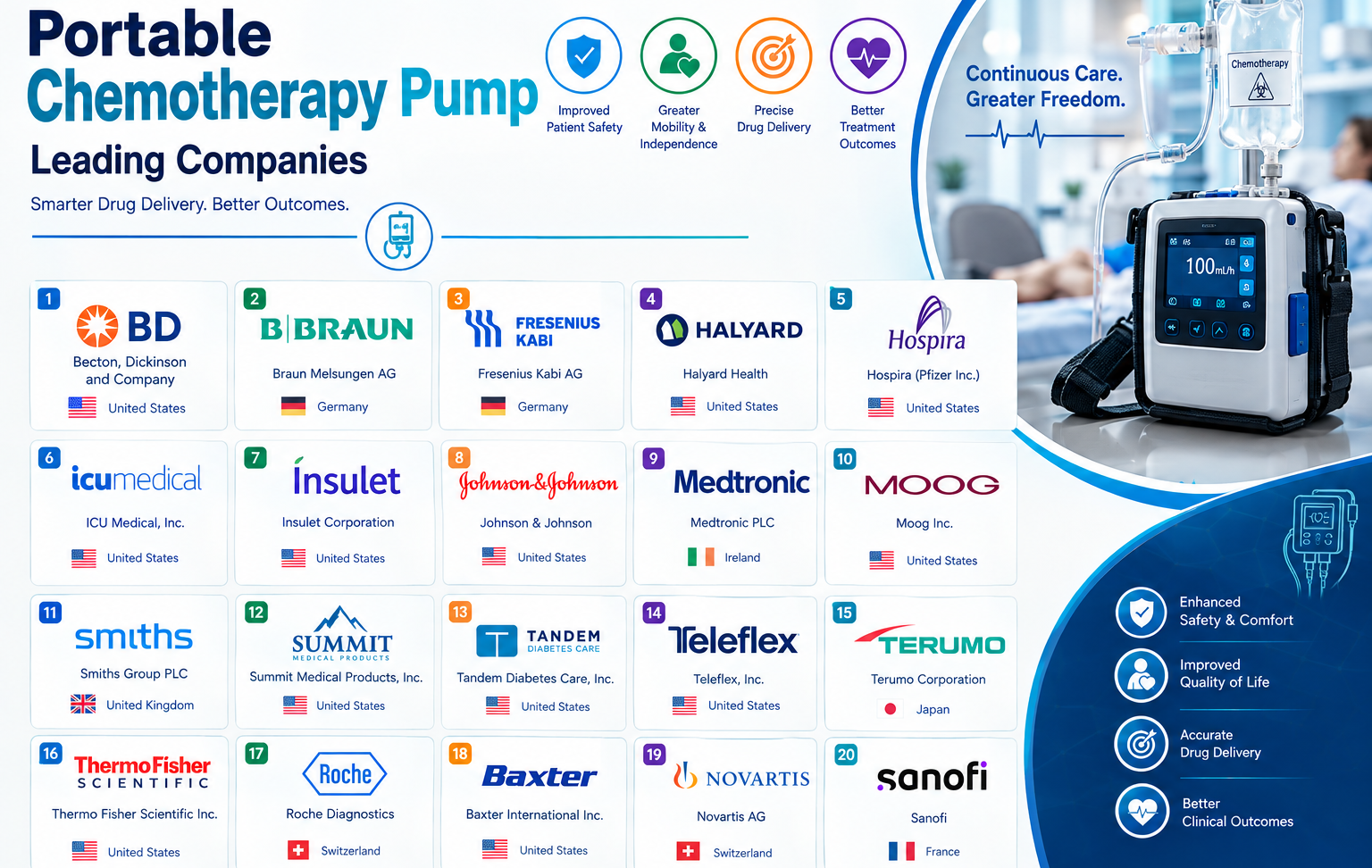
- Baxter International Inc.
- Becton, Dickinson and Company
- B. Braun Melsungen AG
- Fresenius Kabi AG
- ICU Medical, Inc. (including Smiths Medical)
- Moog Inc.
- Teleflex, Inc.
- Terumo Corporation
- Johnson & Johnson
- Medtronic PLC
1. Baxter International
|
Category |
Details |
|---|---|
|
Company Name |
Baxter International Inc. |
|
Headquarters |
Deerfield, Illinois, United States |
|
Founded |
1931 |
|
Employees |
Approx. 34,700–38,000 |
|
Revenue |
Approx. USD 11.24 Billion (FY2025) |
|
Company Overview |
Baxter is a global leader in ambulatory elastomeric infusion technology through its Infusor and Intermate device lines, which deliver an estimated 4.5 million infusions annually for oncology, antibiotic therapy, and pain management. |
|
Key Products |
Baxter Infusor and Intermate elastomeric ambulatory infusion devices, and the SimplFusor elastomeric pump specifically indicated for continuous chemotherapy infusion. |
|
Market Position |
The market-leading elastomeric ambulatory pump provider, with devices established as the standard of care in multicenter international studies of colorectal cancer chemotherapy regimens such as FOLFOX. |
|
Recent Developments |
Continues expanding manufacturing capacity and supporting global centres of excellence for ambulatory infusion therapy, backed by more than 30 years of rigorous drug stability research spanning over 100 chemotherapy and adjuvant drugs. |
|
Strategic Advantages |
Decades of accumulated drug stability data supporting broad clinical adoption, an extensive portfolio of flow-rate options for different treatment regimens, and deep relationships with global oncology centers of excellence. |
2. ICU Medical (including Smiths Medical)
|
Category |
Details |
|---|---|
|
Company Name |
ICU Medical, Inc. |
|
Headquarters |
San Clemente, California, United States |
|
Founded |
1984 |
|
Employees |
Approx. 9,100–14,000 |
|
Revenue |
Approx. USD 2.2–2.3 Billion |
|
Company Overview |
ICU Medical significantly expanded its ambulatory and programmable infusion pump portfolio through its 2022 acquisition of Smiths Medical, which brought the CADD family of ambulatory infusion pumps widely used for chemotherapy, pain management, and other home infusion therapies. |
|
Key Products |
CADD-Solis and related ambulatory infusion pump platforms supporting continuous, intermittent, and patient-controlled analgesia delivery modes for oncology and home infusion use. |
|
Market Position |
A leading global provider of ambulatory and programmable infusion pump technology, competing across both hospital and home infusion settings following its major Smiths Medical acquisition. |
|
Recent Developments |
Continued integrating Smiths Medical's ambulatory infusion pump portfolio while advancing broader IV Performance Platform innovations across its combined device lineup. |
|
Strategic Advantages |
A broadened ambulatory infusion pump portfolio strengthened through the Smiths Medical acquisition, deep expertise spanning oncology and home infusion applications, and an established global service and support network. |
3. Moog Inc. (Moog Medical / CURLIN)
|
Category |
Details |
|---|---|
|
Company Name |
Moog Inc. (Moog Medical Devices Group) |
|
Headquarters |
Salt Lake City, Utah (Moog Medical Devices); parent Moog Inc. headquartered in East Aurora, New York |
|
Founded |
Moog Inc. founded 1951; CURLIN ambulatory infusion pump line built over more than 20 years |
|
Employees |
Moog Medical Devices employs several hundred; parent Moog Inc. employs approximately 11,000 across 27 countries |
|
Revenue |
Moog Medical Devices generates tens of millions in annual revenue; parent Moog Inc. is a multi-billion-dollar NYSE-listed company |
|
Company Overview |
Moog Medical Devices Group is a specialist ambulatory infusion pump manufacturer, producing the CURLIN line of pumps used for home healthcare delivery of antibiotics, nutrition, and highly specialized oncology medications. |
|
Key Products |
CURLIN 6000 and CURLIN 8000 ambulatory infusion pumps, featuring patented curvilinear peristaltic design for precise, steady fluid delivery, alongside the CURLIN PainSmart line for PCA and epidural infusions. |
|
Market Position |
A specialist ambulatory infusion pump provider recognized for industry-leading flow resolution and continuity, positioning its technology as particularly well suited to sensitive patient populations and low-flow-rate drug delivery. |
|
Recent Developments |
Continued expanding its CURLIN Enterprise Solution Software and Protocol Library Safety System to bring smart-pump-level medication error protection to home infusion settings. |
|
Strategic Advantages |
Patented curvilinear peristaltic pump technology offering superior flow resolution compared to standard linear peristaltic designs, deep specialization in the home infusion market, and the backing of Moog Inc.'s broader precision motion control engineering expertise. |
4. B. Braun Melsungen
|
Category |
Details |
|---|---|
|
Company Name |
B. Braun Melsungen SE |
|
Headquarters |
Melsungen, Germany (U.S. headquarters in Bethlehem, Pennsylvania) |
|
Founded |
1839 |
|
Employees |
Approx. 63,000–66,800 |
|
Revenue |
Approx. USD 9.5–10.6 Billion |
|
Company Overview |
B. Braun is a family-owned German medical technology company whose Hospital Care division includes ambulatory and elastomeric infusion pump technology used across oncology, antibiotic, and pain management applications as part of its broader infusion therapy portfolio. |
|
Key Products |
Ambulatory and elastomeric infusion systems supporting continuous and intermittent chemotherapy delivery, alongside broader IV administration sets and safety-engineered access devices. |
|
Market Position |
One of the largest privately held medical device companies globally, with deep infusion therapy expertise built over more than 180 years and a broad international manufacturing and distribution footprint spanning more than 60 countries. |
|
Recent Developments |
Continued expanding its infusion therapy and safety-engineered device portfolio, leveraging its long-standing position as a leading global infusion technology manufacturer. |
|
Strategic Advantages |
Family ownership enabling long-term strategic investment horizons, manufacturing the large majority of its own products in-house, and deep integration across infusion therapy and broader hospital care businesses. |
5. Becton, Dickinson and Company (BD)
|
Category |
Details |
|---|---|
|
Company Name |
Becton, Dickinson and Company |
|
Headquarters |
Franklin Lakes, New Jersey, United States |
|
Founded |
1897 |
|
Employees |
Approx. 70,000–74,000 |
|
Revenue |
Approx. USD 21.4–21.8 Billion (FY2025) |
|
Company Overview |
BD is a global medical technology leader whose broad infusion and medication management portfolio, including the Alaris Infusion System and its acquired Advanced Patient Monitoring business, supports oncology infusion delivery across hospital and outpatient care settings. |
|
Key Products |
BD Alaris Infusion System components used in oncology infusion centers, alongside vascular access and medication management products supporting chemotherapy administration workflows. |
|
Market Position |
A leading global medical technology company with the dominant installed base in U.S. large-volume infusion pumps, supporting hospital and outpatient oncology infusion centers as part of its broader medication management portfolio. |
|
Recent Developments |
Continued expanding EMR interoperability for its Alaris platform, and integrating its 2024 acquisition of Edwards Lifesciences' Critical Care business to build more comprehensive monitoring and infusion offerings relevant to oncology care settings. |
|
Strategic Advantages |
The dominant U.S. installed base in large-volume infusion pumps, deep integration with major EHR systems, and BD's scale as the largest U.S. manufacturer of medical devices supporting long-term hospital and infusion center relationships. |
Competitive Landscape
The global portable chemotherapy pump market is led by a mix of large, diversified medical device companies with broad infusion portfolios, including Baxter, ICU Medical, B. Braun, and BD, alongside specialist ambulatory infusion pump manufacturers like Moog that compete on precision engineering for home-based delivery.
Elastomeric vs. Electronic Pump Competition: Baxter's dominant position in disposable elastomeric pumps reflects patients' preference for lightweight, discreet devices, while electronic ambulatory pump makers like ICU Medical (through Smiths Medical's CADD line) and Moog compete by offering programmable, multi-therapy flexibility for more complex treatment regimens.
Drug Stability Data as a Competitive Moat: Decades of accumulated drug stability testing, as Baxter has built across more than 100 chemotherapy and adjuvant drugs, create a significant barrier to entry, since clinicians and pharmacists rely on this validated data to safely prescribe ambulatory chemotherapy regimens.
Consolidation Through Acquisition: Much like the broader infusion pump space, this market has seen significant consolidation, with ICU Medical's acquisition of Smiths Medical and BD's acquisition of Edwards Lifesciences' Critical Care business concentrating infusion and monitoring technology among fewer, larger players.
Precision Engineering as a Differentiator for Specialists: Smaller, focused players like Moog compete not on portfolio breadth but on differentiated flow-rate precision technology, positioning their patented curvilinear peristaltic pump design as superior for sensitive patient populations and low-flow-rate drug delivery.
Emerging Trends in the Portable Chemotherapy Pump Market
1. Growth in Home-Based Chemotherapy Delivery: Healthcare systems continue shifting chemotherapy administration from hospital wards to outpatient and home settings, driving demand for pumps specifically designed for safe, unsupervised home use.
2. Smart Safety Software for Home Infusion: Protocol library safety systems that let clinicians upload pre-validated drug protocols are extending smart-pump-level medication error protection from acute care settings into home infusion environments.
3. Continued Elastomeric Pump Innovation: Manufacturers continue refining disposable elastomeric pump designs to offer more flow-rate options, better patient comfort, and simpler operation for both clinicians and patients.
4. Consolidation of Ambulatory Infusion Portfolios: Large medical device companies continue acquiring specialist ambulatory infusion pump businesses to build more comprehensive oncology and home infusion offerings, as seen in ICU Medical's acquisition of Smiths Medical.
5. Expansion into Emerging Market Oncology Care: Growing cancer treatment infrastructure investment across Asia-Pacific and other developing regions is extending portable chemotherapy pump adoption beyond traditionally mature markets.
Future Outlook (2025–2034)
The global portable chemotherapy pump market's trajectory toward USD 8.78 billion by 2034 reflects the durable, long-term shift toward outpatient and home-based cancer care even as rising global cancer incidence continues to expand the overall patient population requiring treatment. The 5.8% CAGR forecast through 2034 assumes continued growth in ambulatory chemotherapy adoption, ongoing innovation in both elastomeric and electronic pump technology, and expanding oncology infrastructure investment in emerging markets.
Key investment themes include continued growth in home healthcare chemotherapy delivery, expansion of smart safety software into home infusion settings, and further consolidation of ambulatory infusion pump portfolios among larger medical device companies. Leading companies including Baxter, ICU Medical, B. Braun, Moog, and BD are likely to retain strong market positions by combining extensive drug stability data, precision flow-rate engineering, and deep relationships with oncology centers and home infusion pharmacy programs.
Frequently Asked Questions (FAQ)
1. What is the current size of the global portable chemotherapy pump market?
The global portable chemotherapy pump market was valued at approximately USD 5.18 billion in 2025 and is projected to reach USD 8.78 billion by 2034, growing at a CAGR of 5.8%.
2. Who are the top companies in the portable chemotherapy pump market?
Leading companies include Baxter International, Becton, Dickinson and Company (BD), B. Braun Melsungen, Fresenius Kabi, ICU Medical (including Smiths Medical), Moog, Teleflex, Terumo Corporation, Johnson & Johnson, and Medtronic.
3. What is the forecast CAGR for the portable chemotherapy pump market?
The market is forecast to grow at a CAGR of 5.8% from 2025 to 2034.
4. What are the main growth drivers for this market?
Key drivers include rising global cancer incidence, the ongoing shift toward outpatient and home-based chemotherapy delivery, and continued innovation in disposable elastomeric pump technology.
5. What is the difference between elastomeric and electronic portable chemotherapy pumps?
Elastomeric pumps are simple, disposable devices that use a pre-stretched balloon reservoir to deliver medication at a set flow rate, while electronic ambulatory pumps are programmable, battery-powered devices that can deliver multiple therapy modes and rates, offering more flexibility for complex treatment regimens.
6. What challenges does the portable chemotherapy pump industry face?
The industry's primary challenges include the risk of pump programming errors or malfunctions during unsupervised home use, and cost sensitivity tied to reimbursement for home infusion therapy compared to inpatient treatment.
7. Which end-use setting drives the most demand for portable chemotherapy pumps?
Outpatient and home care settings represent the fastest-growing end-use segment, as healthcare systems increasingly shift chemotherapy delivery away from inpatient hospital wards to reduce costs and improve patient quality of life during treatment.
Conclusion
The global portable chemotherapy pump market sits at the intersection of oncology care and precision fluid delivery engineering, enabling millions of cancer patients to receive life-saving treatment without being confined to a hospital bed. With a projected size of USD 8.78 billion by 2034 at a 5.8% CAGR, the sector offers steady growth potential for companies that can combine rigorous drug stability validation with continued innovation in both disposable and programmable pump technology.
Baxter's decades of elastomeric pump leadership and extensive drug stability research set the clinical standard for ambulatory chemotherapy, while ICU Medical's Smiths Medical acquisition and Moog's precision engineering demonstrate the value of both scale and specialization in this market. The companies that successfully extend smart safety software into home infusion settings while continuing to expand oncology access in emerging markets will define market leadership through 2034 and beyond.


