
Solar Panel Cleaning Market Size, Share & Top Companies 2034
Author:
Intellectual Market Insights Research
Published Date:
09 Sep 2026
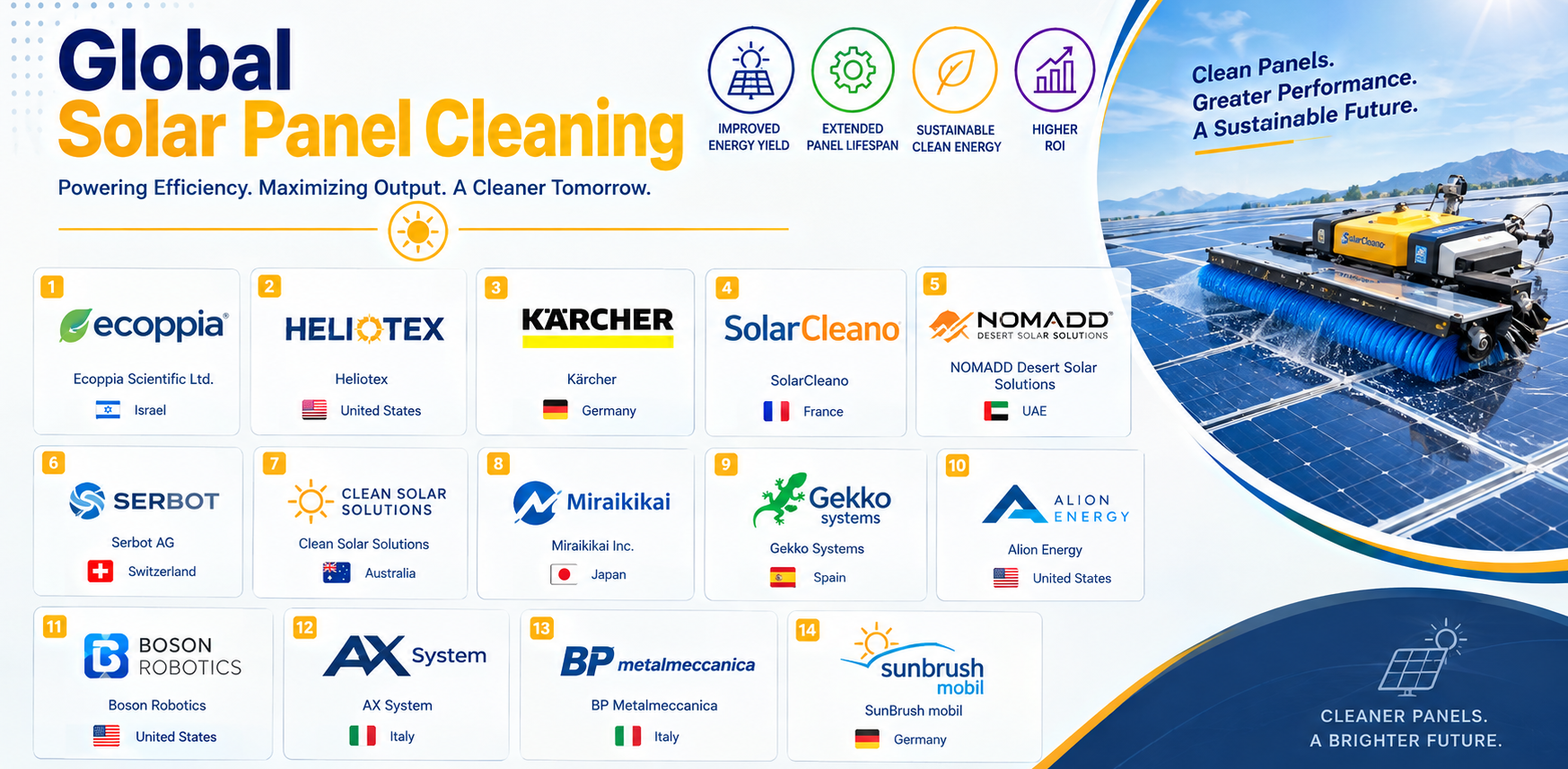
Global Solar Panel Cleaning Market Top Leading Companies
Dust, pollen, bird droppings, and salt deposits settling on photovoltaic modules block incoming solar irradiance and steadily erode the energy output of a solar farm a phenomenon the industry calls "soiling." Left unmanaged, soiling can quietly turn a well-designed solar asset into an underperforming one, which is why systematic panel cleaning has become a core part of solar operations and maintenance (O&M) rather than an afterthought. Solutions range from traditional wet cleaning using deionized water and biodegradable detergents, to waterless dry and electrostatic systems, to fully autonomous robotic platforms guided by AI-driven soiling detection and IoT-based monitoring.
The global solar panel cleaning market was valued at USD 1.85 billion in 2025 and is projected to reach USD 4.32 billion by 2034, growing at a compound annual growth rate (CAGR) of 9.4% from 2025 to 2034. Growth is being driven by the sheer pace of global solar capacity additions, the mounting economic cost of soiling-related energy losses in high-irradiance regions, rising adoption of automated and waterless cleaning technology, and the emergence of AI-powered predictive soiling analytics that shift O&M budgets from fixed cleaning schedules to condition-based servicing.
The competitive landscape features specialist robotic-cleaning innovators such as Ecoppia and Gekko Systems, established industrial cleaning-equipment manufacturers such as Kärcher, and a wide base of regional players including SolarCleano, NOMADD Desert Solar Solutions, Serbot AG, and Miraikikai. This article provides a research-based analysis of the top companies shaping the global solar panel cleaning market, their positioning, flagship offerings, and the regional and technological forces driving the industry forward.
Market Overview
|
Parameter |
Details |
|---|---|
|
Market Size (2025) |
USD 1.85 Billion |
|
Projected Market Size (2034) |
USD 4.32 Billion |
|
CAGR (2025–2034) |
9.4% |
|
Base Year |
2025 |
|
Historical Data |
2022–2025 |
|
Forecast Period |
2025–2034 |
|
Leading & Fastest-Growing Region |
Asia Pacific leads by value; Middle East & Africa is the fastest-growing region |
|
Key Segments (by Technology) |
Wet Cleaning, Dry Cleaning & Robotic Systems, Electrostatic & Contactless Cleaning, Nanocoating & Self-Cleaning |
|
Key Segments (by Application) |
Utility-Scale Solar Farms, Commercial & Industrial Rooftops, Residential Rooftops, Floating Solar |
|
Fastest-Growing Segment |
Dry Cleaning & Robotic Systems (~15.8% CAGR) |
Why the Solar Panel Cleaning Market Is Growing
1. Explosive Growth in Global Solar Installed Capacity
Annual solar PV installations have surpassed 350 gigawatts, pushing cumulative global capacity toward roughly 1.6 terawatts. Every megawatt of new capacity added creates ongoing demand for cleaning and maintenance, and utility-scale farms which account for roughly two-thirds of installed capacity worldwide are where even small efficiency gains translate into meaningful revenue at scale.
2. The Mounting Economic Cost of Soiling
Panels in temperate, rain-fed climates typically lose a manageable 5–7% of output annually to soiling, but installations in arid regions such as the Middle East, North Africa, and India's Rajasthan solar belt can lose 20–35% or more without a systematic cleaning program. Industry estimates put total global revenue lost to soiling at well over USD 14 billion annually, giving operators a direct financial incentive to invest in cleaning infrastructure.
3. Shift Toward Automated and Waterless Cleaning
Robotic and dry-cleaning systems using rotating microfiber brushes, electrostatic treatment, and controlled airflow are gaining share rapidly as water becomes scarcer and more expensive in the desert regions where solar deployment is heaviest.
4. Emergence of AI-Driven Predictive Soiling Analytics
Rather than cleaning on a fixed schedule, operators are increasingly using satellite imagery, ground-based irradiance sensors, and machine-learning models to time cleaning precisely when soiling accumulation actually justifies it cutting cleaning frequency while holding energy output steady.
5. Growth of Performance-Based Service Contracts
Cleaning vendors are moving beyond simple equipment sales toward asset-management offerings that bundle cleaning hardware with monitoring software, drone-based thermal inspection, and contracts tied to guaranteed energy-output metrics rather than cleaning frequency alone.
6. Rapid Growth in Dry Cleaning & Robotic Systems
This segment is expanding fastest, supported by continued gains in battery energy density, autonomous navigation, and lightweight cleaning-mechanism design that are steadily widening the operating range of robotic and drone-based cleaning platforms.
Market Opportunities & Restraints
A key opportunity lies in AI-based soiling prediction platforms: combining satellite and ground-sensor data with machine learning allows operators to move from calendar-based to condition-based cleaning, cutting cleaning frequency while maintaining output, and opening the door to software-as-a-service and performance-guarantee business models. On the restraint side, the high upfront capital cost of automated systems remains the primary barrier robotic cleaning for a large utility-scale project can cost several million dollars versus a fraction of that for a comparable manual-cleaning contract, producing payback periods long enough to deter adoption in markets with cheap labor, low electricity prices, or shorter remaining asset life.
Top 10 Companies in the Solar Panel Cleaning Market
- Ecoppia
- Kärcher
- SolarCleano
- NOMADD Desert Solar Solutions
- Serbot AG
- Gekko Systems
- Heliotex
- Miraikikai Inc.
- Clean Solar Solutions
- Alion Energy
1. Ecoppia
|
Category |
Details |
|---|---|
|
Company Name |
Ecoppia (TASE: ECPA) |
|
Headquarters |
Herzliya, Israel |
|
Founded |
2013 |
|
Employees |
Approx. 100–500 |
|
Revenue |
Estimates vary by source, generally in the tens to low-hundreds of USD millions annually |
|
Company Overview |
Ecoppia is a pioneer in water-free, fully automated robotic cleaning for utility-scale photovoltaic sites, publicly traded on the Tel Aviv Stock Exchange. |
|
Key Products |
Autonomous robots (including the E4 and H4/T4 series) that clean panels at night using microfiber cloths and controlled airflow, paired with a cloud-based monitoring platform. |
|
Market Position |
Widely regarded as a leading specialist in waterless robotic cleaning, with a large installed base across desert and utility-scale solar sites globally. |
|
Recent Developments |
Rolled out a fourth-generation waterless robotic system across roughly 1.2 gigawatts of installations in Saudi Arabia, adding AI-based soiling detection and adaptive cleaning cycles. |
|
Strategic Advantages |
Deep specialization in water-free robotics, a large signed-agreement pipeline in high-soiling desert markets, and integrated data-driven O&M software. |
2. Kärcher
|
Category |
Details |
|---|---|
|
Company Name |
Alfred Kärcher SE & Co. KG |
|
Headquarters |
Winnenden, Germany |
|
Founded |
1935 |
|
Employees |
Approx. 17,000 |
|
Revenue |
Approx. EUR 3.44 Billion (2024, total company revenue) |
|
Company Overview |
Kärcher is a global leader in cleaning technology, best known for pressure washers and industrial cleaning systems, which it has extended into dedicated solar-panel cleaning equipment. |
|
Key Products |
Purpose-built solar cleaning systems (including its iSolar range) alongside its broader industrial and municipal cleaning equipment portfolio. |
|
Market Position |
One of the largest cleaning-equipment manufacturers worldwide, bringing brand scale and distribution reach into the solar cleaning niche. |
|
Recent Developments |
Continues to extend its industrial cleaning-equipment expertise into dedicated solar-farm maintenance products as global PV deployment accelerates. |
|
Strategic Advantages |
Nine decades of cleaning-technology manufacturing heritage, an extensive global distribution and service network, and strong brand recognition beyond the solar niche. |
3. SolarCleano
|
Category |
Details |
|---|---|
|
Company Name |
SolarCleano |
|
Headquarters |
Luxembourg |
|
Company Overview |
SolarCleano designs semi-automated and robotic brush-cleaning equipment for utility-scale, commercial, and rooftop solar installations, with a growing focus on drone-based cleaning technology. |
|
Key Products |
The SolarCleano brush-cleaning robot range, alongside a newer integrated drone-based cleaning system featuring thermal imaging and spot-cleaning capability. |
|
Market Position |
A recognized European specialist in semi-automated solar cleaning equipment with commercial deployments across Europe and the Middle East. |
|
Recent Developments |
Commercially deployed an integrated drone-based cleaning platform with thermal-imaging spot-cleaning across roughly 15 large-scale installations in Europe and the Middle East. |
|
Strategic Advantages |
Early mover in drone-cleaning integration and a diversified product line spanning manual, semi-automated, and aerial cleaning technology. |
4. NOMADD Desert Solar Solutions
|
Category |
Details |
|---|---|
|
Company Name |
NOMADD Desert Solar Solutions |
|
Headquarters |
Saudi Arabia |
|
Company Overview |
NOMADD (No-water Automated Dust Removal Device) specializes in waterless, energy-efficient robotic cleaning systems purpose-built for extreme desert operating conditions. |
|
Key Products |
Automated, waterless dust-removal robots designed to withstand high heat, sandstorms, and the harsh operating conditions of Gulf and North African solar farms. |
|
Market Position |
A leading waterless cleaning specialist for desert utility-scale solar, closely tied to Middle Eastern giga-scale project pipelines. |
|
Recent Developments |
Continues to expand deployments alongside the region's large-scale renewable buildout, including Saudi Arabia's Vision 2030-linked solar pipeline. |
|
Strategic Advantages |
Purpose-engineered for the world's harshest, highest-soiling solar environments, with strong relationships across Middle Eastern utility-scale developers. |
5. Serbot AG
|
Category |
Details |
|---|---|
|
Company Name |
Serbot AG |
|
Headquarters |
Switzerland |
|
Company Overview |
Serbot develops robotic cleaning systems (marketed under the Robosol brand) for solar farms as well as adjacent facade- and glass-cleaning applications. |
|
Key Products |
Robosol robotic cleaning units for ground-mounted and rooftop solar arrays, alongside related robotic cleaning technology for other glazed surfaces. |
|
Market Position |
A recognized European robotics specialist with cross-application cleaning technology serving both solar and broader building-maintenance markets. |
|
Recent Developments |
Continues refining robotic cleaning platforms to serve both utility-scale solar and commercial rooftop segments. |
|
Strategic Advantages |
Technology transfer between solar and facade-cleaning robotics, and an established presence in the European market. |
Competitive Landscape
The global solar panel cleaning market is moderately fragmented, with the leading vendors together holding roughly half of total market value on the strength of technology breadth, utility relationships, and large-scale project track records. Robotic and waterless cleaning specialists such as Ecoppia, NOMADD, Serbot, Gekko Systems, and Miraikikai compete primarily on autonomous performance, water-free operation, and desert-hardened engineering. Established industrial cleaning-equipment manufacturers such as Kärcher bring brand scale and broad distribution into the solar niche as an extension of their core cleaning-technology business. A wide base of regional and specialized providers, including SolarCleano, Heliotex, Clean Solar Solutions, Alion Energy, Boson Robotics, and SunBrush mobil, compete on application-specific engineering, drone-cleaning integration, and cost-competitive service delivery across the fragmented global O&M landscape.
Regional Analysis
Asia Pacific
Asia Pacific holds the largest share of the market, anchored by China, India, Japan, and Australia, which together account for a majority of global installed PV capacity. China's massive annual solar buildout and India's aggressive renewable-energy targets particularly in high-soiling regions like Rajasthan and Gujarat are driving strong demand for both automated and cost-competitive local cleaning services.
Middle East & Africa
Middle East & Africa is the fastest-growing region, driven by extreme solar irradiance combined with frequent dust storms that make systematic cleaning economically essential rather than optional. Saudi Arabia's large-scale renewable buildout under its national energy vision, alongside emerging markets like the UAE, Egypt, and Morocco, is fueling rapid adoption of waterless cleaning technology given the region's acute water scarcity.
North America & Europe
North America and Europe represent mature, steadily growing markets shaped by established utility-scale solar fleets, rising O&M budget allocations toward soiling management, and growing interest in automated and performance-based cleaning contracts.
Latin America
Latin America remains an emerging solar panel cleaning market, expected to grow in line with expanding regional solar deployment and rising awareness of soiling's financial impact on project returns.
Emerging Trends in the Solar Panel Cleaning Market
1. Drone-Based Inspection and Cleaning Integration: UAV platforms combining thermal-infrared inspection with lightweight cleaning payloads are expanding rapidly, with commercial systems now able to clean far more panels per hour than just a few years ago.
2. AI-Driven Predictive Soiling Analytics: Machine-learning platforms that forecast optimal cleaning windows are cutting cleaning frequency while preserving energy output, shifting the industry from fixed schedules toward condition-based maintenance.
3. Growth of Waterless and Electrostatic Cleaning: Water-scarce regions are accelerating adoption of dry, electrostatic, and airflow-based cleaning technology that eliminates dependence on scarce local water supplies.
4. Performance-Based Service Contracts: Vendors are increasingly offering contracts tied to guaranteed energy-output improvements rather than fixed cleaning schedules, aligning incentives between cleaning providers and solar-asset operators.
5. Convergence of Cleaning with Broader Asset-Management Software: Cleaning equipment is increasingly bundled with monitoring, predictive-maintenance, and SCADA-integrated software platforms as part of comprehensive solar O&M offerings.
Future Outlook (2025–2034)
The global solar panel cleaning market's trajectory toward USD 4.32 billion by 2034 reflects the structural, low-cyclicality growth of an addressable market tied directly to rising global solar capacity projected to expand from roughly 1.5 terawatts today toward several times that level by the mid-2030s. The 9.4% CAGR forecast through 2034 assumes continued utility-scale solar deployment, rising O&M budget allocation toward soiling management, and accelerating adoption of automated, AI-optimized cleaning technology, particularly in high-soiling desert markets.
Key investment themes include continued innovation in waterless and drone-based cleaning platforms, growth of AI-driven predictive soiling analytics and performance-based service contracts, and expanding automated-cleaning penetration in the Middle East, North Africa, and South Asia. Specialist robotics players such as Ecoppia, NOMADD, and Gekko Systems are likely to retain strong positions in desert utility-scale markets, while diversified cleaning-equipment manufacturers such as Kärcher continue to leverage brand scale and distribution reach, and a broad base of regional providers compete on cost and application-specific engineering across the fragmented global market.
Frequently Asked Questions (FAQ)
1. What is the current size of the global solar panel cleaning market?
The global solar panel cleaning market was valued at USD 1.85 billion in 2025 and is projected to reach USD 4.32 billion by 2034, growing at a CAGR of 9.4%.
2. Who are the top companies in the solar panel cleaning market?
Leading companies include Ecoppia, Kärcher, SolarCleano, NOMADD Desert Solar Solutions, Serbot AG, Gekko Systems, Heliotex, Miraikikai Inc., Clean Solar Solutions, and Alion Energy.
3. Which region dominates the solar panel cleaning market?
Asia Pacific holds the largest market share, while the Middle East & Africa region is expected to be the fastest-growing, driven by high solar irradiance and frequent dust storms.
4. What is the forecast CAGR for the solar panel cleaning market?
The market is forecast to grow at a CAGR of 9.4% from 2025 to 2034.
5. What are the main growth drivers for this market?
Key drivers include rapid global solar capacity expansion, the significant economic cost of soiling-related energy losses, growing adoption of automated and waterless cleaning technology, and emerging AI-based predictive soiling analytics.
6. Which technology segment is growing fastest?
The Dry Cleaning & Robotic Systems segment is growing fastest, supported by advances in autonomous navigation, battery technology, and lightweight cleaning-mechanism design.
7. Why is soiling such a significant issue for solar panels?
Dust, pollen, bird droppings, and other pollutants settling on panel surfaces block solar irradiance from reaching PV cells, causing modest annual losses in wet, temperate climates but severe losses often 20% or more in arid, high-dust regions without systematic cleaning.
Conclusion
The global solar panel cleaning market sits at the intersection of explosive solar capacity growth and the operational reality that uncleaned panels quietly underperform. With a projected size of USD 4.32 billion by 2034 at a 9.4% CAGR, the market offers steady, structurally-driven growth tied to the world's continuing shift toward solar power.
Ecoppia and NOMADD continue to lead in waterless robotic cleaning for the world's harshest desert solar markets, Kärcher brings the scale and distribution of an established global cleaning-equipment giant, and a broad base of regional specialists compete on drone integration, application-specific engineering, and cost-competitive service delivery. As AI-driven predictive analytics, waterless technology, and performance-based contracts reshape the industry, the companies that combine automation expertise with data-driven O&M platforms will define market leadership through 2034 and beyond.