Share this link via:

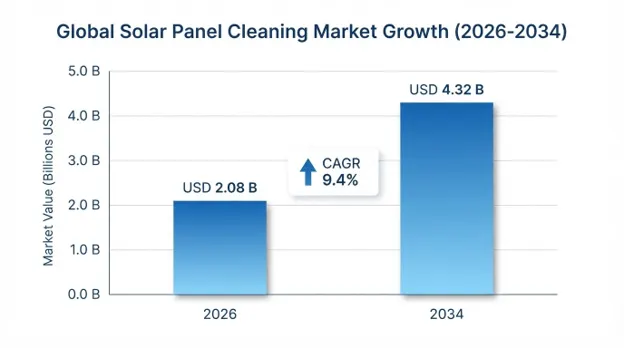
The global solar panel cleaning market size was valued at USD 1.85 billion in 2025 and is projected to reach USD 2.08 billion in 2026, expanding to USD 4.32 billion by 2034, growing at a CAGR of 9.4% during the forecast period (2026-2034).
The maintenance of solar power plants depends on critical solar panel cleaning technologies, including manual, semi-automated, and fully automated systems. which combines the use of complex manual, semi-automated and completely automated solutions, all of which address the significant losses of energy caused by soiling, which is a major concern in the operation of PVs. Soiling affects PV modules of the PV system by blocking the transmission of solar irradiance to the underlying PV cells, and is especially severe since it can cause dust, dirt, pollen, bird droppings, salt deposits, and other environmental pollutants to settle on the PV module surface. A consistent pattern has emerged in all major areas of solar deployment, compared to clean and well maintained panels, those in temperate regions with frequent precipitation loss between 5-7% per year due to soiling, while those in arid and desert areas suffer energy losses of 20-35% annually, with some installations in the Middle East and North Africa losing more than 40% without any systematic cleaning program.
It covers a wide range of technologies that meet various operational needs, environmental requirements, and scales. Traditional wet cleaning systems use deionized water, biodegradable detergents and motorized brush assemblies, while waterless cleaning systems are advanced systems that remove particulates without the use of water, using specialized microfiber rotating brushes, electrostatic surface treatment systems and targeted airflow mechanisms. The most advanced technologies are fully automated cleaning systems. with edge-detectors, AI algorithms for optimal cleaning paths, IoT integration for real-time cleaning performance monitoring, and SCADA integration for predictive maintenance scheduling for cleaning operations based on soiling detection and weather forecasting.
In addition to selling the equipment, the commercial value of those solutions is expanded to include full solar asset management solutions that combine cleaning equipment with performance measurement software; machine-learning powered predictive analytics platforms; thermal imaging by drone to assess cleaning effectiveness; and service contracts based on energy output metrics instead of cleaning frequency. The share of solar PV in total electricity generation has been increasing, and in 2025, global installed capacity reached 1.5 TW and is projected to grow towards 5.5 TW by 2034, which results in a structurally growing addressable market with limited cyclicality in demand caused by the aggressive deployment targets for renewables in major economies.
| Report Coverage | Details |
|---|---|
| Base Year | 2025 |
| Base Year Value | USD 1.85 Billion |
| Forecast Value | USD 4.32 Billion |
| CAGR | 9.4% |
| Forecast Period | 2025-2034 |
| Historical Data | 2022-2025 |
| Largest Market | Asia Pacific |
| Fastest Growing Market | Middle East & Africa |
| Segments Covered | By Technology, Equipment Type, Application, Service Type, Component, Region |
| Region Covered | North America, Europe, Asia Pacific, Middle East & Africa, Latin America |
| Countries Covered | US, Canada, Mexico, UK, Germany, France, Italy, Spain, Netherlands, China, Japan, India, Australia, South Korea, Brazil, Argentina, UAE, Saudi Arabia, South Africa |
| Key Market Playes | Ecoppia, Heliotex, Kärcher, SolarCleano, Serbot AG, Clean Solar Solutions, NOMADD Desert Solar Solutions, Miraikikai, Gekko Systems |
Get more details on this report - Request Free Sample
The solar panel cleaning market's expansion is primarily being fueled by an unprecedented rate of global PV capacity deployment, as annual installations surpass 350 GW in 2025 and total PV capacity installed worldwide is around 1.6 TW. Each unit of installed capacity automatically creates proportionate demand for cleaning and maintenance for the energy production system to satisfy design specifications, thus creating a direct demand for cleaning and maintenance services. The highest concentrations of professional cleaning services are found in utility-scale solar farms, which account for about 65% of the installed capacity worldwide, where even small savings in efficiency over hundreds of megawatts of generation are economically important..
The soiling losses in a 200MW solar farm of 15% equate to 30MW of capacity that is lost, corresponding to USD 1.2-1.8 million per year in revenue using average PPA pricing, providing a strong economic incentive. for systematic investments in cleaning. A utility-scale installation of 500MW, under a 25-year power purchase agreement at USD 35/MWh, would see about USD 15M in extra revenue per annum for the project from systematic cleaning resulting in a 10% reduction in soiling loss, and a project lifetime NPV of more than USD 200M.
Soiling losses account for the largest controllable factor affecting the performance of photovoltaics other than design and installation quality and are fully recoverable through systematic cleaning.. Studies have shown considerable variations in soiling losses depending on geographical areas, with dry areas such as the Arabian Peninsula, North Africa, Rajasthan solar valley in India, and Atacama Desert recording soiling losses of 0.2-0.5% of their energy production per day amounting to 15-35% in the absence of rainfall during the dry months. In temperate zones where there is precipitation, soiling losses are mitigated but do not disappear completely, and annual soiling losses average between 3-8%.
The economic case further improves as power purchase agreements become more competitive for pricing, and the operators of solar farms find themselves under increasing pressure to produce maximum output from the installed capacity. Soiling-related losses in terms of energy produced worldwide have grown to 11.4% for installed photovoltaic capacity in 2025, which equates to losses of USD 14.2 billion in generation revenues, while in the Middle East and North Africa regions annual soiling losses are in the range of 28-35%.
The major constraint affecting wide adoption of automated cleaning solutions is high capital costs required in comparison with the cost of manual cleaning solutions. Robotic cleaning systems for 100 MW utility-scale projects. will require a capital cost of USD 2.5-4.8 million in comparison with annual manual cleaning solutions which are offered at a price of USD 180,000-320,000 per year, leading to payback periods between 8-15 years which makes the project financially unviable in markets where electricity prices are low or the asset life remaining is short.
High capital cost is further augmented by the need for customized solutions due to the difference in the orientation of panels, spacing between rows, terrain topology and structure designs.
The market presents significant opportunities for developing soiling prediction and cleaning optimization platform solutions based on AI, which can help solar farm operators to switch from schedule-based to condition-based maintenance methods. Most current soiling programs are based on a fixed schedule, not on actual soiling accumulation, which can range widely depending on conditions like wind, rainfall, construction and seasonal changes.
AI-driven platforms that combine satellite imagery analysis and data feeds from the ground-based irradiance monitors., meteorological data and machine learning algorithms trained on soiling patterns can predict the ideal times to clean accurately enough to reduce cleaning frequencies by 20-35% while achieving the same energy output performance. The commercial opportunity includes software-as-a-service subscription models, integration with current supervisory control systems and performance-based service contracts that provide guarantees of energy output metrics.
In the solar panel cleaning field, the market is seeing a growing trend of the use of UAV platforms built to incorporate thermal infrared inspection technology, lightweight cleaning systems, and using thermal imaging data to guide targeted cleaning operations. across large installations where access infrastructure requirements are eliminated. Drone-based thermal inspection is now a common tool for detecting hotspots, bypassing diode failures and soiling patterns and with natural evolution on the path to integrated cleaning capabilities.
Existing drone cleaning technology is mainly for inspection and selective spot cleaning applications, with payload and flight endurance limitations. But, as the battery energy density continues to increase, as well as the autonomous navigation accuracy and lightweight cleaning mechanism design, the operating range of the cleaning system is gradually becoming wider, and by 2025, the commercial systems can clean 500–800 panels per hour., while the 2022 figure was 200-350 panels per hour.
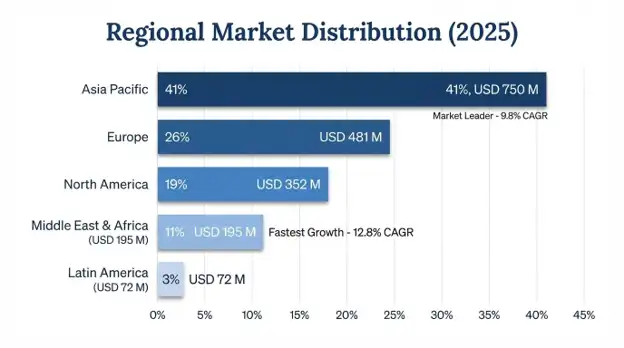
Asia Pacific is expected to account for the highest market share in the year 2025 at USD 750 million with a projected CAGR of 9.8% for the forecast period 2025-2034. Regional dominance indicates that the Chinese, Indian, Japanese and Australian markets have concentrated a significant share of the PV market, which represents about 58% of the global installed capacity. China alone installed 217 gigawatts of solar capacity in 2024 and has the largest overall market yet for solar power, driving a proportionately large demand for cleaning services on an installed base of more than 750 gigawatts.
India's aggressive growth in solar energy, as per its national targets of 500 gigawatts (GW) of renewable energy by 2030, results in a rapid growth in cleaning market, while the solar corridors in Rajasthan and Gujarat, where dust soiling is severe, making cleaning economically attractive. even in low-labor-cost environments.. As a result of resilient government policies for renewable deployment, increased soiling loss financial materiality awareness and increasing local cleaning service provider ecosystems providing cost-competitive solutions, the regional market is strong.
The Middle East & Africa region is the fastest-growing. with expected CAGR of 12.8% up to 2034, with revenues projected to amount to USD 195 million by 2025. High solar irradiance and frequent dust storms make the region the most challenging and economic place to implement systematic cleaning programs. The Vision 2030 renewable energy targets in Saudi Arabia are stimulating huge scale deployment of solar and multiple gigawatt-scale projects. with the need for extensive cleaning infrastructure.
Other markets with high growth potential such as the UAE, Egypt and Morocco include explicit soiling management as a key operational requirement that is built into project planning and operations budgeting. Water scarcity is most acute in the region, driving the demand for waterless cleaning solutions, while water-free cleaning has been encouraged in the region, with governments incorporating water-use reduction into procurement specifications.
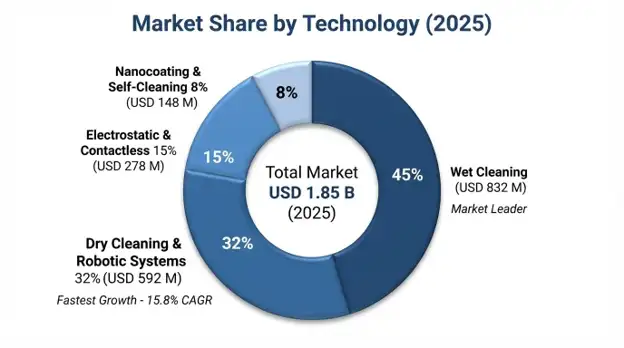
The Wet Cleaning technology segment accounts for 45% of the total market share worth USD 832 million in 2025. The segment includes deionized water-based cleaning systems, biodegradable detergent solutions, and motorized brush systems., biodegradable detergents-based cleaning solution, and motorized brush cleaning system. This technology is extensively used in areas where there is an abundance of water supply and moderate levels of soiling.
Dry Cleaning & Robotic Systems is the fastest growing technology segment in the market, accounting for 32% market share worth USD 592 million in 2025 and registering a compound annual growth rate of 15.8% during 2026-2034. The segment includes autonomous robots, rail-based cleaning systems., electrostatic cleaning systems, and waterless brush-based cleaning system.
The Utility-Scale Solar Farms category is by far the biggest end-user category, with a 58% market share worth USD 1.07 billion in 2025 and a CAGR of 11.2% during the forecast period until 2034. This category pushes technological advancements since the scale of operations allows the use of automated technologies, advanced monitoring systems, and performance-based contracts which would be impossible for small-scale projects.
The Commercial & Industrial Rooftops category has a 26% market share with revenues of USD 481 million in 2025. This category is one of the fastest-growing ones due to the increasing number of solar panels installed on the roofs of commercial buildings and their impact on building performance.
The largest share is held by the Annual Maintenance Contract segment with 52% market share worth USD 962 million by 2025, which is more popular among utility-scale and enterprise customers due to budgeting needs for operations and predetermined operational requirements. This type of contract. normally assures the minimum number of cleanings with additional services for soiling under exceptional conditions.
The Performance Based O&M Service represents the most promising differentiated service offering segment with 18% market share, wherein cleaning operators have an incentive or are jointly responsible for certain results.
The global solar panel cleaning system market is moderately fragmented with the key vendors having around 45-52% market value because of their extensive range of technologies, strong utility connections, and field experience on large scale projects. The competition is based on the robustness of the products under tough environmental conditions, adaptability to various mounting arrangements, energy efficiency, installation and maintenance, etc.
Turnkey vendors that provide solutions such as equipment, installation, training, maintenance, and performance monitoring would be especially advantageous for utility scale and large commercial sectors. Turnkey vendors include manufacturers of robotic systems., regional providers of operations and maintenance services, and diversified equipment manufacturers that offer cleaning solutions among other products.
March 2026: Ecoppia unveiled fourth-generation waterless robotic cleaning system across 1.2-gigawatt solar energy installations in Saudi Arabia, utilizing artificial intelligence-enabled soiling detection technology along with autonomous adjustment in cleaning cycles based on real-time panel performance monitoring.
February 2026: Gekko Systems was contracted to deploy an automated cleaning system in 800 MW utility-scale solar farms. in Rajasthan, India, which is the largest deployment of any cleaning system in South Asia markets.
January 2026: SolarCleano developed an integrated drone-based cleaning system with thermal imaging and spot-cleaning technology and deployed it commercially in 15 large-scale installations located in Europe and Middle East.
December 2025: The Miraikikai secured USD 42 million for Series B financing of its electrostatic water-free cleaning technology commercialization in Middle East and North Africa regions with deployment partnerships with the three largest IPPs..
You'll get the sample you asked for by email. Remember to check your spam folder as well. If you have any further questions or require additional assistance, feel free to let us know via-
+1 724 648 0810 +91 976 407 9503 sales@intellectualmarketinsights.com
08 Jul 2026
Intellectual Market Insights Research © 2026. All rights reserved.