
Top Leading Companies Transforming the Global Supply Chain Management Software Market in 2026: AI, Automation, and the Future of Intelligent Logistics
Author:
Intellectual Market Insights Research
Published Date:
08 Jul 2026
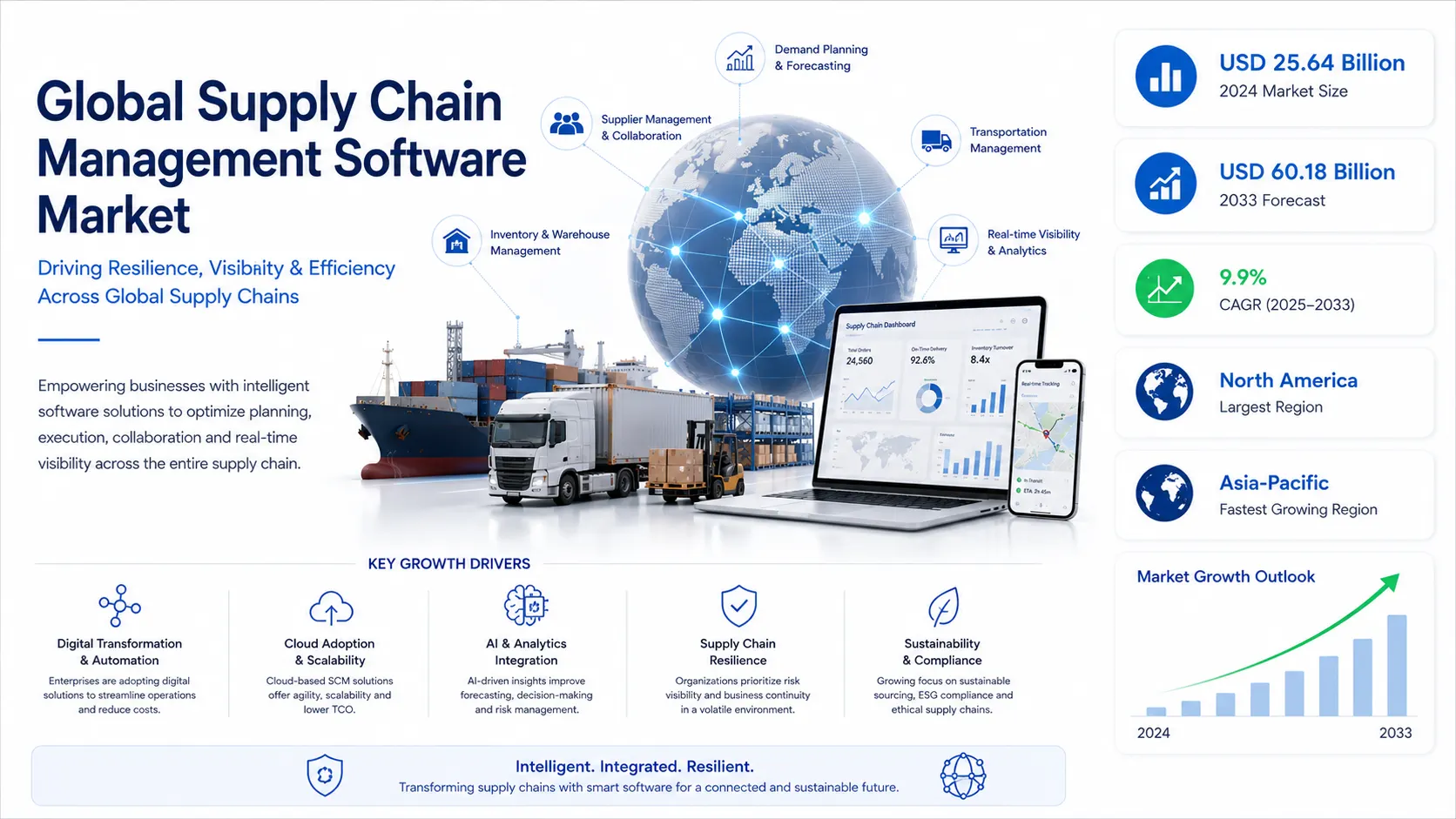
Top 10 Leading Companies in the Global Supply Chain Management Software Market
The global Supply Chain Management (SCM) Software Market is undergoing rapid transformation as businesses embrace digital technologies to improve operational efficiency, enhance supply chain visibility, and build resilience against disruptions. Organizations across manufacturing, retail, healthcare, logistics, automotive, food & beverage, and e-commerce sectors are increasingly investing in advanced SCM platforms that integrate procurement, inventory management, warehouse operations, transportation management, supplier collaboration, and demand forecasting into a unified ecosystem.
Global Supply Chain Management Software Market size was valued at USD 23.3 Billion in 2025 and is projected to reach USD 54.8 Billion by 2034, growing at a CAGR of 10.3% from 2025 to 2034 according to a new report by IMIR Market Research.
The rise of artificial intelligence (AI), machine learning (ML), cloud computing, Internet of Things (IoT), blockchain, and predictive analytics has significantly improved supply chain planning and execution. Modern SCM software enables enterprises to optimize inventory levels, reduce operational costs, improve customer satisfaction, and make real-time decisions based on accurate data insights.
Growing globalization, increasing e-commerce activities, and frequent supply chain disruptions have made digital supply chain transformation a strategic priority for businesses worldwide. Cloud-native SCM platforms are particularly gaining momentum due to their scalability, flexibility, and lower deployment costs compared to traditional on-premise systems.
According to Intellectual Market Insights Research, the Supply Chain Management Software Market is expected to witness robust growth throughout the forecast period, driven by increasing automation, digital transformation initiatives, and growing demand for end-to-end supply chain visibility.
Market Snapshot
|
Market Attribute |
Details |
|---|---|
|
Market |
Supply Chain Management Software Market |
|
Forecast Period |
2025–2034 |
|
Deployment |
Cloud-based & On-Premise |
|
Enterprise Size |
Large Enterprises & SMEs |
|
Key Technologies |
AI, IoT, Machine Learning, Blockchain, Cloud Computing |
|
Fastest Growing Segment |
Cloud-based SCM Software |
|
Major End Users |
Manufacturing, Retail, Healthcare, Logistics, Automotive, Food & Beverage |
|
Growth Drivers |
Supply Chain Digitalization, Automation, Real-Time Analytics |
Market Overview
Supply Chain Management software has evolved from a traditional logistics management tool into a comprehensive digital platform that connects suppliers, manufacturers, distributors, logistics providers, and customers through real-time information sharing. Modern SCM solutions support demand planning, procurement, warehouse management, transportation management, order fulfillment, supplier relationship management, and risk mitigation.
The increasing complexity of global supply chains has accelerated demand for intelligent software capable of predicting disruptions, optimizing inventory, and improving operational efficiency. Organizations are leveraging AI-powered analytics to forecast demand accurately, while IoT-enabled sensors provide real-time shipment tracking and warehouse monitoring.
Cloud deployment has emerged as the preferred implementation model, allowing organizations to rapidly deploy software, reduce infrastructure costs, and continuously receive feature updates. Integration with Enterprise Resource Planning (ERP), Customer Relationship Management (CRM), Manufacturing Execution Systems (MES), and financial applications further enhances operational efficiency.
As sustainability becomes a strategic priority, SCM software vendors are also incorporating carbon footprint tracking, supplier sustainability assessment, and ESG reporting capabilities into their platforms.
Key Growth Drivers
Digital Transformation Across Industries
Organizations worldwide are replacing legacy supply chain systems with intelligent digital platforms that improve operational agility, increase productivity, and support data-driven decision-making.
Rising Adoption of Artificial Intelligence
AI-powered forecasting, intelligent inventory optimization, predictive maintenance, and automated procurement are helping companies reduce operational costs while improving customer service.
Growth of E-commerce
The rapid expansion of online retail has significantly increased demand for advanced warehouse management systems, transportation management platforms, and order fulfillment solutions.
Increasing Supply Chain Complexity
Global sourcing, geopolitical uncertainties, changing regulations, and customer expectations have created complex supply networks that require intelligent SCM software for effective management.
Cloud-Based Software Adoption
Cloud deployment offers lower implementation costs, scalability, faster upgrades, remote accessibility, and improved collaboration among supply chain stakeholders.
Emerging Market Trends
AI-Powered Decision Intelligence
Machine learning algorithms are enabling predictive demand planning, supplier risk analysis, inventory optimization, and automated procurement workflows.
Digital Twins
Digital twin technology allows organizations to simulate supply chain operations, evaluate disruption scenarios, and optimize logistics performance before implementation.
Blockchain Integration
Blockchain enhances transparency, traceability, and security throughout the supply chain, particularly in pharmaceutical, food, and luxury goods industries.
Sustainable Supply Chains
Organizations are increasingly implementing software solutions capable of tracking emissions, reducing waste, improving energy efficiency, and monitoring supplier sustainability.
End-to-End Visibility
Real-time dashboards integrating suppliers, logistics providers, manufacturers, and customers have become essential for proactive supply chain management.
Top 10 Leading Companies in the Global Supply Chain Management Software Market
- SAP SE
- Oracle Corporation
- Microsoft Corporation
- Blue Yonder
- Manhattan Associates
- Kinaxis Inc.
- Infor Inc.
- IBM
- Descartes Systems Group
- Epicor Software Corporation
1. SAP SE
|
Category |
Details |
|---|---|
|
Company Name |
SAP SE |
|
Headquarters |
Walldorf, Germany |
|
Founded |
1972 |
|
Industry Focus |
Enterprise Software, ERP, Supply Chain Management, Cloud Computing |
|
Global Presence |
Operations in over 180 countries with customers across all major industries |
|
Company Overview |
SAP SE is one of the world's leading enterprise software providers and a market leader in Supply Chain Management (SCM) software. Its SAP Digital Supply Chain portfolio enables organizations to optimize planning, procurement, manufacturing, logistics, warehousing, transportation, and asset management through AI-powered, cloud-based solutions. SAP serves thousands of enterprises worldwide, helping businesses improve operational efficiency, supply chain visibility, and resilience. |
|
Key Products & Services |
SAP Integrated Business Planning (IBP), SAP Extended Warehouse Management (EWM), SAP Transportation Management, SAP Digital Manufacturing, SAP Business Network, SAP Ariba, SAP Asset Intelligence Network, Supply Chain Control Tower. |
|
Market Position |
One of the global leaders in enterprise ERP and Supply Chain Management software, trusted by many of the world's largest manufacturers, retailers, logistics providers, and industrial enterprises. |
|
Recent Developments |
Expanded AI-powered supply chain capabilities through SAP Business AI and enhanced cloud-native applications with predictive analytics, sustainability tracking, and intelligent automation across its Digital Supply Chain portfolio. |
|
Strategic Advantages |
Comprehensive end-to-end SCM portfolio, seamless ERP integration, strong cloud ecosystem, advanced AI and analytics capabilities, extensive global partner network, and industry-specific digital transformation expertise. |
2. Oracle Corporation
|
Category |
Details |
|---|---|
|
Company Name |
Oracle Corporation |
|
Headquarters |
Austin, Texas, United States |
|
Founded |
1977 |
|
Industry Focus |
Cloud Computing, Enterprise Software, Supply Chain Management, Enterprise Resource Planning (ERP) |
|
Global Presence |
Operates in more than 175 countries, serving organizations across manufacturing, retail, healthcare, automotive, telecommunications, consumer goods, logistics, and industrial sectors. |
|
Company Overview |
Oracle Corporation is one of the world's leading enterprise technology companies, providing cloud-based Supply Chain Management (SCM) solutions that help organizations optimize procurement, manufacturing, inventory, logistics, order management, and supply chain planning. Through Oracle Fusion Cloud Supply Chain & Manufacturing (SCM), the company integrates artificial intelligence (AI), machine learning (ML), Internet of Things (IoT), and advanced analytics to improve end-to-end supply chain visibility, operational efficiency, and business resilience. Oracle's cloud-first strategy has made it a preferred technology partner for enterprises undergoing digital transformation worldwide. |
|
Key Products & Services |
Oracle Fusion Cloud Supply Chain & Manufacturing (SCM), Oracle Transportation Management, Oracle Warehouse Management, Oracle Procurement Cloud, Oracle Manufacturing Cloud, Oracle Demand Management, Oracle Inventory Management, Oracle Logistics Network Modeling. |
|
Market Position |
One of the global leaders in cloud-based ERP and Supply Chain Management software, trusted by thousands of enterprises for its comprehensive, AI-powered, and scalable supply chain solutions across multiple industries. |
|
Recent Developments |
Oracle has expanded its Oracle Fusion Cloud SCM platform by incorporating generative AI capabilities, predictive analytics, intelligent automation, and enhanced supply chain planning features. The company continues to strengthen its cloud infrastructure and industry-specific solutions to support resilient, data-driven supply chain operations. |
|
Strategic Advantages |
Comprehensive cloud-native SCM platform, seamless integration with Oracle ERP and enterprise applications, advanced AI and machine learning capabilities, scalable Oracle Cloud Infrastructure (OCI), strong global customer base, industry-specific solutions, and continuous innovation in intelligent supply chain technologies. |
3. Microsoft Corporation
|
Category |
Details |
|---|---|
|
Company Name |
Microsoft Corporation |
|
Headquarters |
Redmond, Washington, United States |
|
Founded |
1975 |
|
Industry Focus |
Cloud Computing, Enterprise Software, Supply Chain Management, Artificial Intelligence, Business Applications |
|
Global Presence |
Operates in more than 190 countries, serving organizations across manufacturing, retail, healthcare, logistics, automotive, consumer goods, and numerous other industries through its global partner ecosystem. |
|
Company Overview |
Microsoft Corporation is one of the world's leading technology companies, offering intelligent supply chain solutions through Microsoft Dynamics 365 Supply Chain Management and the Microsoft Cloud ecosystem. Its platform integrates enterprise resource planning (ERP), artificial intelligence (AI), Internet of Things (IoT), machine learning, and advanced analytics to help organizations optimize manufacturing, warehouse operations, inventory management, procurement, and logistics. With the support of Microsoft Azure and Power Platform, businesses can improve end-to-end supply chain visibility, automate workflows, and make data-driven decisions to enhance operational efficiency and resilience. |
|
Key Products & Services |
Microsoft Dynamics 365 Supply Chain Management, Dynamics 365 Intelligent Order Management, Microsoft Azure, Azure IoT, Microsoft Fabric, Power BI, Power Platform, Microsoft Copilot for Dynamics 365, Azure AI Services. |
|
Market Position |
One of the global leaders in cloud computing and enterprise business applications, recognized for delivering AI-powered, cloud-based supply chain solutions that support digital transformation across diverse industries. |
|
Recent Developments |
Microsoft has expanded generative AI capabilities across Dynamics 365 with Microsoft Copilot, enhancing demand forecasting, procurement, inventory optimization, and operational decision-making. The company continues to strengthen Azure AI, IoT integration, and cloud-native business applications to help organizations build more resilient and intelligent supply chains. |
|
Strategic Advantages |
Extensive global cloud infrastructure through Microsoft Azure, advanced artificial intelligence and machine learning capabilities, seamless integration with Microsoft 365 and Power Platform, scalable cloud solutions, strong partner ecosystem, enterprise-grade security, and continuous innovation in intelligent business applications. |
4. Blue Yonder
|
Category |
Details |
|---|---|
|
Company Name |
Blue Yonder |
|
Headquarters |
Scottsdale, Arizona, United States |
|
Founded |
1985 (formerly JDA Software) |
|
Industry Focus |
Supply Chain Management Software, Retail Planning, Warehouse Management, Transportation Management |
|
Global Presence |
Serves customers in more than 75 countries across retail, manufacturing, logistics, healthcare, automotive, and consumer goods industries. |
|
Company Overview |
Blue Yonder is a leading provider of AI-driven digital supply chain and retail planning solutions. Its cloud-native Luminate Platform helps organizations optimize forecasting, inventory planning, warehouse operations, transportation management, and order fulfillment through artificial intelligence, machine learning, and predictive analytics. The company supports enterprises in building agile, resilient, and highly connected supply chains capable of adapting to changing market demands. |
|
Key Products & Services |
Blue Yonder Luminate Platform, Demand Planning, Supply Planning, Warehouse Management System (WMS), Transportation Management System (TMS), Order Management, Inventory Optimization, Retail Planning Solutions. |
|
Market Position |
One of the world's leading providers of AI-powered supply chain planning and warehouse management software, with a particularly strong presence in retail and logistics. |
|
Recent Developments |
Expanded its AI-powered Luminate Platform with generative AI capabilities and enhanced integrations with warehouse automation, robotics, and cloud technologies to improve operational efficiency and supply chain resilience. |
|
Strategic Advantages |
AI-first platform, advanced predictive analytics, strong retail expertise, cloud-native architecture, end-to-end supply chain visibility, extensive global customer base, and continuous product innovation. |
5. Manhattan Associates
|
Category |
Details |
|---|---|
|
Company Name |
Manhattan Associates |
|
Headquarters |
Atlanta, Georgia, United States |
|
Founded |
1990 |
|
Industry Focus |
Warehouse Management, Transportation Management, Omnichannel Commerce, Supply Chain Execution |
|
Global Presence |
Provides solutions to customers across North America, Europe, Asia-Pacific, Latin America, and the Middle East. |
|
Company Overview |
Manhattan Associates is a global leader in warehouse management, transportation management, and omnichannel commerce software. Its cloud-native Manhattan Active® Platform enables organizations to streamline warehouse operations, optimize transportation, improve inventory visibility, and deliver seamless omnichannel fulfillment experiences. The company's solutions are widely adopted by retailers, manufacturers, wholesalers, and logistics providers worldwide. |
|
Key Products & Services |
Manhattan Active Warehouse Management, Manhattan Active Transportation Management, Order Management, Inventory Optimization, Labor Management, Omnichannel Fulfillment, Supply Chain Visibility. |
|
Market Position |
A recognized market leader in warehouse management and transportation management systems, serving many of the world's largest retail and logistics organizations. |
|
Recent Developments |
Continued enhancing the Manhattan Active Platform with AI-powered warehouse optimization, robotics integration, autonomous mobile robot (AMR) compatibility, and intelligent fulfillment capabilities. |
|
Strategic Advantages |
Industry-leading warehouse management expertise, cloud-native platform, strong omnichannel commerce capabilities, scalable architecture, continuous innovation, and high customer satisfaction. |
Competitive Landscape
The global Supply Chain Management Software Market is highly competitive, with established enterprise software vendors competing alongside specialized supply chain technology providers. Companies are investing heavily in artificial intelligence, cloud-native platforms, predictive analytics, digital twins, IoT integration, and automation to strengthen their market positions.
Strategic partnerships, mergers and acquisitions, cloud migration initiatives, and continuous product innovation remain key competitive strategies. Vendors are increasingly focusing on industry-specific solutions that address the unique operational requirements of manufacturing, retail, healthcare, logistics, and consumer goods organizations.
Subscription-based Software-as-a-Service (SaaS) delivery models continue to gain traction, allowing businesses to reduce infrastructure costs while accelerating deployment and scalability.
Regional Market Analysis
North America
North America remains the largest market for supply chain management software due to the presence of major technology providers, widespread cloud adoption, and significant investments in AI-driven digital transformation.
Europe
Europe is experiencing steady growth driven by Industry 4.0 initiatives, manufacturing modernization, sustainability regulations, and increasing adoption of intelligent logistics platforms.
Asia-Pacific
Asia-Pacific is projected to witness the fastest growth during the forecast period. Rapid industrialization, expanding manufacturing capabilities, increasing e-commerce activities, and government-led digital transformation programs are driving demand across China, India, Japan, South Korea, and Southeast Asia.
Latin America
Growing investments in logistics infrastructure and retail modernization are encouraging businesses to adopt cloud-based supply chain management solutions across the region.
Middle East & Africa
The Middle East & Africa is gradually emerging as a promising market due to expanding logistics hubs, smart city initiatives, and increasing investments in digital supply chain infrastructure.
Emerging Technology Trends
The future of supply chain management software will be shaped by several transformative technologies:
- Artificial Intelligence for demand forecasting and intelligent decision-making
- Machine Learning for predictive inventory optimization
- Generative AI assistants for procurement and planning
- Internet of Things (IoT) for real-time asset tracking
- Blockchain for secure and transparent supply chain transactions
- Digital Twin technology for supply chain simulation
- Robotic Process Automation (RPA) for workflow automation
- Autonomous warehouse robotics
- Advanced analytics and business intelligence
- Sustainable supply chain monitoring and ESG reporting
Future Outlook
The Supply Chain Management Software Market is expected to experience strong long-term growth as organizations prioritize resilience, agility, automation, and data-driven decision-making.
Cloud deployment will continue to dominate new implementations, while artificial intelligence, predictive analytics, and digital twins will redefine supply chain planning and execution. Organizations are expected to increase investments in autonomous logistics, warehouse automation, intelligent procurement, and supplier collaboration platforms.
As global supply chains become more interconnected and complex, software vendors that deliver scalable, AI-powered, and industry-specific solutions will be well positioned to capitalize on future market opportunities.
Frequently Asked Questions (FAQs)
1. What is Supply Chain Management Software?
Supply Chain Management (SCM) software is a digital platform that helps organizations manage procurement, production, inventory, transportation, warehousing, supplier collaboration, and order fulfillment across the entire supply chain.
2. Which industries use SCM software?
Manufacturing, retail, healthcare, automotive, food & beverage, consumer goods, logistics, aerospace, pharmaceuticals, and e-commerce are among the primary users.
3. Why is cloud-based SCM software becoming more popular?
Cloud-based solutions offer lower implementation costs, greater scalability, automatic updates, remote accessibility, improved collaboration, and faster deployment compared with traditional on-premises systems.
4. How does AI improve supply chain management?
Artificial intelligence enhances demand forecasting, inventory optimization, predictive maintenance, supplier risk analysis, logistics planning, and automated decision-making, improving both efficiency and resilience.
5. Who are the leading companies in the Supply Chain Management Software Market?
Leading companies include SAP SE, Oracle Corporation, Microsoft Corporation, Blue Yonder, Manhattan Associates, Kinaxis Inc., Infor Inc., IBM Corporation, Descartes Systems Group, and Epicor Software Corporation.
Conclusion
The global Supply Chain Management Software Market continues to evolve rapidly as organizations embrace digital transformation to build smarter, faster, and more resilient supply chains. Advances in artificial intelligence, cloud computing, machine learning, IoT, and predictive analytics are enabling enterprises to optimize operations, reduce costs, and respond more effectively to market disruptions.
The companies highlighted in this report are driving innovation through intelligent planning platforms, cloud-native applications, advanced analytics, and end-to-end supply chain visibility. As enterprises increasingly prioritize automation, sustainability, and operational resilience, these technology leaders are expected to play a pivotal role in shaping the future of global supply chain management.