
Top 10 Leading Companies in the Global Blood Pressure Monitoring Devices Market
Author:
Intellectual Market Insights Research
Published Date:
10 Aug 2026
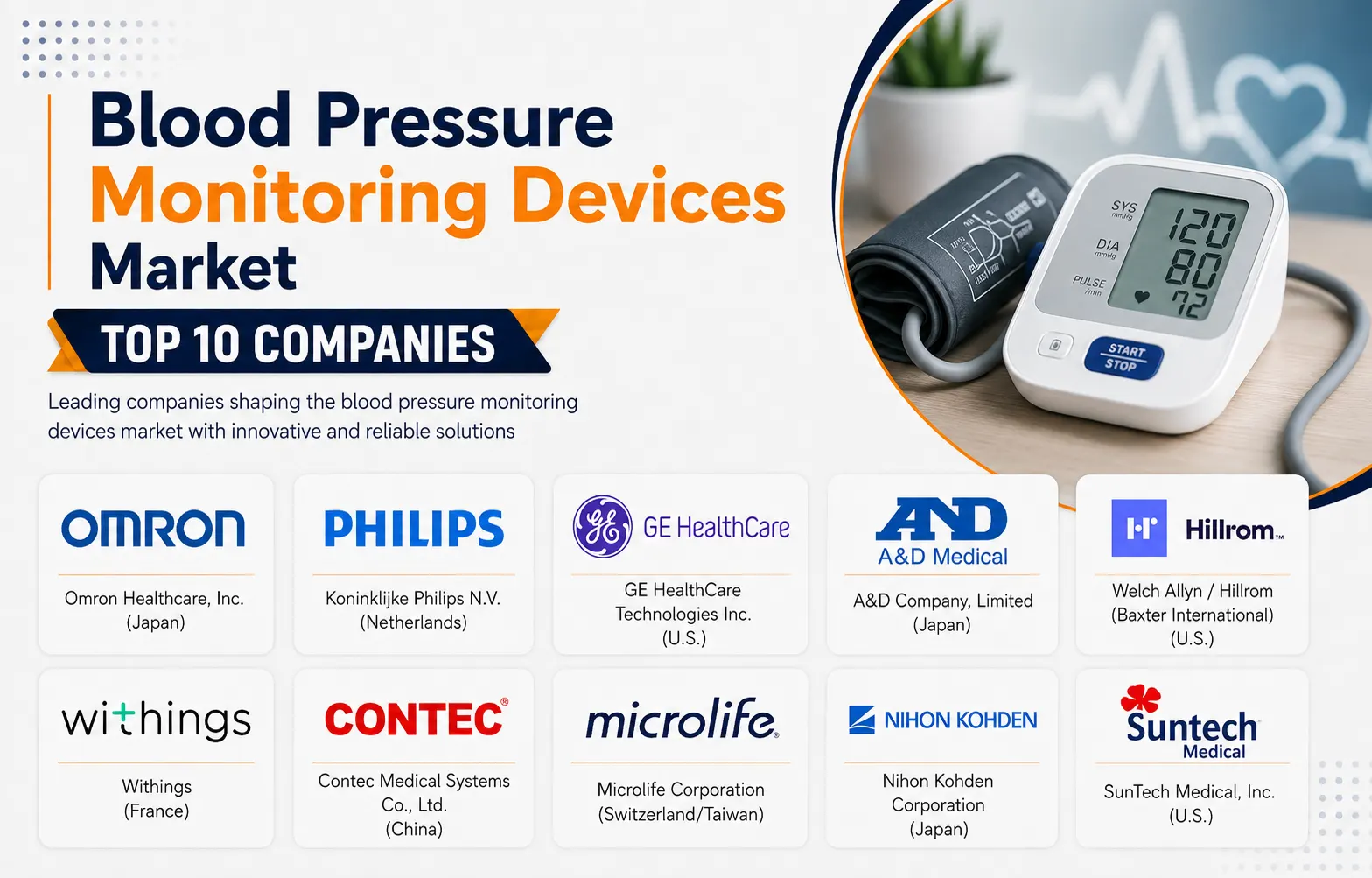
Top 10 Leading Companies in the Global Blood Pressure Monitoring Devices Market
The global blood pressure monitoring devices market has evolved from a category built around basic clinical sphygmomanometers into a fast-digitizing pillar of cardiovascular care, spanning hospitals, ambulatory clinics, and a rapidly expanding home-healthcare segment. As hypertension prevalence climbs worldwide, populations age, and remote patient monitoring becomes a standard part of chronic-disease management, blood pressure monitors have moved from a once-a-year clinic reading to an everyday connected-health device in millions of households.
According to industry research aggregated from leading market intelligence firms, the global blood pressure monitoring devices market was valued at approximately USD 5.7 Billion in 2025 and is projected to grow at a CAGR of roughly 5.4%, reaching approximately USD 8.08 Billion by 2034. This strong growth trajectory is being driven by rising global hypertension and cardiovascular disease burden, the shift toward home-based and remote patient monitoring, tightening reimbursement support for connected devices, and continuous innovation in cuffless and wearable sensing technology.
North America currently leads global demand, supported by high hypertension prevalence, mature digital-health infrastructure, and a strong base of established device manufacturers. Asia-Pacific is emerging as the fastest-growing region, propelled by a large and aging population, rising healthcare investment, and expanding access to affordable digital monitors across China, India, and Southeast Asia.
Market Overview
|
Parameter |
Details |
|---|---|
|
Market Size (2025) |
USD 5.7 Billion |
|
Projected Market Size (2034) |
USD 8.08 Billion |
|
CAGR (2025–2034) |
~5.4% |
|
Leading Region (2025) |
North America |
|
Fast-Growing Region |
Asia-Pacific |
|
Leading Product Segment |
Digital Blood Pressure Monitors |
|
Fastest-Growing Product Segment |
Ambulatory Blood Pressure Monitors / Smart & Connected Devices |
|
Leading End-Use Segment |
Home Healthcare |
|
Key Growth Drivers |
Rising hypertension and cardiovascular disease prevalence, growth of home and remote patient monitoring, aging population, digital health and telehealth integration |
|
Key Challenges |
Accuracy and validation concerns around cuffless technology, reimbursement gaps for connected devices, price sensitivity in emerging markets |
|
Major Players |
Omron Healthcare, Koninklijke Philips N.V., GE HealthCare, A&D Company Ltd., Welch Allyn (Baxter/Hillrom), Withings, Contec Medical Systems, Microlife Corporation, Nihon Kohden Corporation, SunTech Medical |
|
Forecast Period |
2025–2034 |
|
Study Period |
2020–2034 |
Why the Blood Pressure Monitoring Devices Market Is Growing
1. Rising Global Burden of Hypertension and Cardiovascular Disease
The single largest structural driver of demand is the growing global prevalence of hypertension, which continues to rise alongside aging populations, sedentary lifestyles, and increasing rates of obesity and diabetes. As more people are diagnosed with or are at risk of high blood pressure, physicians are prescribing more frequent monitoring, both in clinical settings and at home, driving consistent unit-volume growth across nearly every region.
2. Rapid Shift Toward Home-Based and Remote Patient Monitoring
Healthcare systems are increasingly encouraging patients to monitor their own blood pressure between clinic visits, both to improve diagnostic accuracy (avoiding "white coat" effects) and to reduce the burden on in-person care. This shift has made home healthcare the largest end-use segment for blood pressure devices, with digital and app-connected monitors becoming a standard recommendation for hypertension management programs.
3. Growth of Connected, Smart, and Wearable Monitoring Technology
Consumer demand for devices that sync readings to smartphone apps, track trends over time, and share data with physicians is accelerating the shift from traditional mechanical devices toward smart and connected monitors. Emerging cuffless and wearable technologies, including optical and pulse-wave-based sensing, are attracting significant venture investment as companies race to bring continuous, cuff-free blood pressure tracking to market.
4. Aging Population and Rising Chronic Disease Management Needs
The global population of adults aged 65 and older continues to expand, and this demographic requires more frequent and consistent blood pressure monitoring as part of routine chronic-disease management. Healthcare providers are increasingly prescribing ambulatory and home monitors to elderly patients, supporting steady replacement and new-adoption demand in mature markets.
5. Expansion of Telehealth and Digital Health Ecosystem Integration
The broader growth of telehealth and remote patient monitoring programs is expanding the addressable market for connected blood pressure devices, as healthcare providers and insurers increasingly reimburse for remote monitoring services that rely on patient-generated data. This trend is pushing manufacturers to build stronger software, cloud, and clinician-dashboard capabilities around their hardware.
6. Regulatory Support and Clinical Validation Milestones
Regulatory clearances for next-generation features, such as AI-enabled irregular-heartbeat and atrial fibrillation detection built into consumer BP monitors, are expanding the clinical relevance of home devices and encouraging broader adoption among both patients and prescribing physicians.
Top 10 Companies in the Global Blood Pressure Monitoring Devices Market
- Omron Healthcare, Inc. (Japan)
- Koninklijke Philips N.V. (Netherlands)
- GE HealthCare Technologies Inc. (U.S.)
- A&D Company, Limited (Japan)
- Welch Allyn / Hillrom (Baxter International) (U.S.)
- Withings (France)
- Contec Medical Systems Co., Ltd. (China)
- Microlife Corporation (Switzerland/Taiwan)
- Nihon Kohden Corporation (Japan)
- SunTech Medical, Inc. (U.S.)
Company Profiles
1. Omron Healthcare, Inc. (Japan)
Headquarters: Kyoto, Japan Industry Focus: Digital and Connected Blood Pressure Monitors for Home and Clinical Use Global Presence: 120+ countries
Company Overview: Founded in 1933, Omron Healthcare is the global market leader in blood pressure monitoring, having shipped several hundred million devices worldwide across upper-arm, wrist, and clinical monitor formats. The company's scale and brand recognition in home healthcare are unmatched among dedicated BP monitor manufacturers.
Key Products and Services: Omron's lineup spans its Platinum and Evolv upper-arm monitors, wrist-style devices, and its NightView monitor designed to capture nocturnal blood pressure readings; the company has also secured regulatory clearance for AI-enabled atrial fibrillation detection built into select consumer models.
Market Position: Omron holds the leading global share in home and consumer blood pressure monitors, with particular strength across Asia-Pacific, North America, and Europe.
Strategic Advantages: Massive installed base and brand trust; deep R&D investment in AI-enabled detection features; extensive retail and e-commerce distribution; strong presence in both clinical and consumer channels.
2. Koninklijke Philips N.V. (Netherlands)
Headquarters: Amsterdam, Netherlands Industry Focus: Hospital and Multi-Parameter Patient Monitoring, including Blood Pressure Modules Global Presence: Global, with strong hospital-channel penetration
Company Overview: Philips integrates blood pressure measurement into its broader multi-parameter patient monitoring and connected-care platforms, embedding BP modules within hospital bedside monitors and combining them with predictive analytics for clinical decision support.
Key Products and Services: Philips offers hospital-grade vital signs monitors with integrated NIBP (non-invasive blood pressure) modules, ambulatory monitoring solutions, and digital health platforms that connect patient-generated BP data into hospital and telehealth workflows.
Market Position: Philips is among the top players in the institutional and hospital segment of the market, leveraging its broader health-technology portfolio and hospital relationships.
Strategic Advantages: Strong hospital and health-system relationships; integration with broader multi-parameter monitoring platforms; global scale in health technology and digital health partnerships.
3. GE HealthCare Technologies Inc. (U.S.)
Headquarters: Chicago, Illinois, USA Industry Focus: Clinical Patient Monitoring Systems, including Blood Pressure Measurement Global Presence: Global hospital and clinical channel presence
Company Overview: GE HealthCare supplies blood pressure measurement as part of its broad portfolio of hospital patient-monitoring systems, serving critical care, perioperative, and general ward settings worldwide.
Key Products and Services: The company's offering includes bedside and portable patient monitors with integrated NIBP measurement, ambulatory blood pressure monitoring systems, and connected data platforms for hospital networks.
Market Position: GE HealthCare maintains a strong position in the institutional and hospital-based segment, competing closely with Philips for large health-system contracts.
Strategic Advantages: Deep hospital-system relationships; broad clinical monitoring portfolio; global service and support infrastructure.
4. A&D Company, Limited (Japan)
Headquarters: Tokyo, Japan Industry Focus: Precision Blood Pressure Monitors for Clinical and Home Use Global Presence: Strong presence across Asia-Pacific, North America, and Europe
Company Overview: A&D Medical is a long-established manufacturer known for precision-engineered blood pressure monitors used across both professional clinical settings and home healthcare, with a reputation built on measurement accuracy and rigorous testing standards.
Key Products and Services: A&D's portfolio includes upper-arm and wrist digital monitors, wireless and Bluetooth-connected models, and clinical-grade devices used in hospital and physician-office settings.
Market Position: A&D holds a solid position among the leading dedicated BP monitor brands globally, particularly strong in Japan and broader Asian markets.
Strategic Advantages: Reputation for measurement precision; long operating history and clinical trust; expanding connected health integrations for telehealth platforms.
5. Welch Allyn / Hillrom (Baxter International) (U.S.)
Headquarters: Skaneateles Falls, New York, USA Industry Focus: Clinical-Grade Blood Pressure Devices for Hospitals and Physician Offices Global Presence: Strong North American and global hospital-channel presence
Company Overview: Welch Allyn, now part of Baxter International following its acquisition of Hillrom, is a well-established name in clinical vital-signs measurement, with blood pressure devices deeply embedded in physician-office and hospital workflows across North America.
Key Products and Services: The company's offering includes aneroid and hybrid sphygmomanometers, wall-mounted and mobile clinical BP devices, and integration with broader vital-signs and patient-monitoring systems.
Market Position: Welch Allyn holds a leading position in the hospital and physician-office segment in North America, supported by long-standing clinical trust and distribution relationships.
Strategic Advantages: Deep penetration in hospital and outpatient clinical channels; strong brand trust among clinicians; broad vital-signs product ecosystem under the Baxter umbrella.
Competitive Landscape
The global blood pressure monitoring devices market in 2026 is moderately concentrated, with a handful of large diversified health-technology companies and dedicated device specialists together accounting for a substantial share of global revenue, alongside a fast-growing group of digital health startups pursuing cuffless and wearable innovation.
Market Structure
The competitive set includes large diversified medical-technology companies with broad clinical monitoring portfolios (Philips, GE HealthCare, Baxter/Hillrom), dedicated blood pressure device specialists with strong consumer and clinical brand recognition (Omron, A&D, Microlife), and a wave of digital-health entrants and startups (Withings, Aktiia/Hilo, Qardio, Biobeat, Caretaker) pursuing connected and cuffless monitoring innovation.
Clinical Trust and Validation as a Competitive Battleground
Because blood pressure readings inform clinical decisions, validated measurement accuracy is one of the most important competitive assets in the market. Companies with long clinical track records and regulatory clearances, such as Omron and A&D, benefit from strong repeat-purchase and physician-recommendation advantages that newer cuffless entrants are still working to establish through clinical validation studies.
Connectivity and AI Features as Differentiators
As consumer expectations shift toward continuous, app-connected health tracking, manufacturers are competing intensely on Bluetooth and Wi-Fi connectivity, mobile app integration, and increasingly on AI-enabled features such as irregular-heartbeat and atrial fibrillation detection layered on top of standard blood pressure measurement.
Distribution Channel Breadth
Given that blood pressure monitors are sold through pharmacy retail, e-commerce, hospital procurement, and direct-to-consumer digital-health channels simultaneously, the breadth of a manufacturer's distribution network has become an important competitive factor, particularly for companies seeking to capture both institutional and home-healthcare demand.
Regional Analysis
North America — Leading Region (2025)
North America holds the leading share of the global blood pressure monitoring devices market in 2025, supported by high hypertension prevalence, well-developed digital health infrastructure, favorable reimbursement trends for remote patient monitoring, and the presence of several leading global manufacturers.
Europe — Mature, Steadily Growing Market
Europe represents a mature blood pressure monitoring devices market, led by Germany, the U.K., and France, supported by strong government health initiatives, high awareness of hypertension management, and growing digital-health partnerships between manufacturers and hospital systems.
Asia-Pacific — Fastest-Growing Region
Asia-Pacific is the fastest-growing region for blood pressure monitoring devices, driven by a large and aging population, rising hypertension and cardiovascular disease incidence in China and India, expanding healthcare investment, and growing affordability of digital home monitors across the region.
Latin America — Developing Market
Latin America is a developing market for blood pressure monitors, with Brazil and Mexico leading adoption as healthcare access expands and awareness of hypertension management grows across the region.
Middle East and Africa — Emerging Growth
The MEA region is an emerging market for blood pressure monitoring devices, supported by expanding healthcare infrastructure investment in the Gulf states and gradually improving access to diagnostic and monitoring equipment across the broader region.
Segmentation Analysis
By Product Type
Digital Blood Pressure Monitors hold the leading share of the market, reflecting their ease of use, automated readings, and strong adoption across both clinical and home-healthcare settings. Sphygmomanometers (manual and aneroid) remain widely used in clinical settings for their reliability and low cost. Ambulatory Blood Pressure Monitors are gaining share for their ability to provide continuous 24-hour readings that improve diagnostic accuracy, while emerging Cuffless and Wearable devices represent the fastest-growing innovation category as companies work toward continuous, cuff-free measurement.
By End Use
Home Healthcare represents the leading end-use segment, driven by the shift toward patient self-monitoring and chronic-disease management outside clinical settings. Hospitals remain a major end-use category, given the central role of blood pressure measurement in inpatient and perioperative care. Ambulatory Surgical Centers & Clinics represent a fast-growing segment as outpatient diagnostic and monitoring volumes rise.
Key Industry Developments
2025 — Expansion of AI-Enabled Detection Features Leading manufacturers, including Omron, have secured regulatory clearance for AI algorithms embedded in consumer blood pressure monitors capable of detecting irregular heartbeat and atrial fibrillation alongside standard readings, expanding the clinical relevance of home devices.
2025 — Continued Venture Investment in Cuffless Technology Digital health startups pursuing cuffless and optical blood pressure sensing continued to attract significant venture funding, reflecting investor confidence in the long-term shift toward continuous, cuff-free monitoring, even as clinical validation of these technologies remains an ongoing area of study.
2025–2026 — Deeper Telehealth Platform Integration Manufacturers have continued enhancing wireless connectivity and integration with telehealth and remote-patient-monitoring platforms, enabling healthcare providers to access patient-generated blood pressure data directly within clinical workflows.
2026 — Continued Hospital Platform Consolidation Large diversified health-technology companies have continued integrating blood pressure measurement more deeply into broader multi-parameter patient monitoring and hospital digital-health platforms, reflecting the segment's growing role within connected hospital ecosystems.
Market Dynamics
Market Driver — Rising Hypertension Burden and Home Monitoring Adoption
The combination of rising global hypertension and cardiovascular disease prevalence, an aging population, and the structural shift toward home-based and remote patient monitoring is the primary driver supporting sustained demand growth across mature and developing markets alike.
Market Restraint — Accuracy Validation and Reimbursement Gaps
A significant restraint facing the market, particularly for newer cuffless and wearable technologies, is the ongoing need for rigorous clinical validation against established cuff-based measurement standards, combined with inconsistent reimbursement policies for remote monitoring services across different healthcare systems.
Market Opportunity — Continuous, Cuffless, and AI-Integrated Monitoring
The long-term opportunity lies in the development of clinically validated cuffless and wearable monitoring technologies, combined with AI-enabled features that extend blood pressure devices into broader cardiovascular risk detection, positioning manufacturers to capture growing demand from both consumers and value-based healthcare programs.
Future Outlook 2025–2034
The global blood pressure monitoring devices market is on track for strong, sustained growth, expanding from approximately USD 4.14 Billion in 2025 to an estimated USD 9.52 Billion by 2034, driven by rising hypertension prevalence, an aging global population, and the accelerating shift toward connected home and remote patient monitoring.
Growth Projections
Digital blood pressure monitors will remain the leading product segment given their balance of cost, ease of use, and clinical acceptance, while smart, connected, and cuffless devices are expected to post the fastest growth as clinical validation matures. Home healthcare will remain the leading end-use segment, with Asia-Pacific expected to post the fastest regional growth as healthcare access and digital adoption expand.
Investment Opportunities
The highest-value opportunities lie in clinically validated cuffless and wearable monitoring technology, AI-enabled cardiovascular risk detection layered on top of standard BP measurement, remote-patient-monitoring software and platform integration, and expanded distribution infrastructure in Asia-Pacific and Latin America, where home monitoring adoption is still in its early stages.
Industry Transformation
The blood pressure monitoring devices industry is transitioning from a category defined by standalone clinical instruments toward an increasingly connected, software-enabled component of the broader digital health and remote patient monitoring ecosystem, as AI, telehealth integration, and chronic-disease management programs reshape how, where, and how often blood pressure is measured over the coming decade.
FAQ Section
Q1: What is the current size of the global blood pressure monitoring devices market? The global blood pressure monitoring devices market was valued at approximately USD 5.7 Billion in 2025 and is projected to grow at a CAGR of around 5.4%, reaching approximately USD 8.08 Billion by 2034, based on aggregated industry market research.
Q2: Which companies are the top leaders in the global blood pressure monitoring devices market? The top companies include Omron Healthcare, Koninklijke Philips N.V., GE HealthCare, A&D Company Ltd., Welch Allyn/Hillrom (Baxter), Withings, Contec Medical Systems, Microlife Corporation, Nihon Kohden Corporation, and SunTech Medical.
Q3: Which region dominates the global blood pressure monitoring devices market? North America holds the leading position in 2025, supported by high hypertension prevalence and mature digital health infrastructure, while Asia-Pacific is expected to be the fastest-growing region through 2034.
Q4: What is the forecast CAGR for the blood pressure monitoring devices market? The market is projected to grow at a CAGR of approximately 9.7% during the forecast period from 2025 to 2034, according to aggregated industry estimates.
Q5: What are the primary growth drivers of the blood pressure monitoring devices market? Key drivers include rising global hypertension and cardiovascular disease prevalence, the shift toward home-based and remote patient monitoring, an aging population, growth of connected and wearable devices, and expanding telehealth integration.
Q6: Which product segment holds the largest share in the market? Digital blood pressure monitors hold the largest share due to their ease of use and broad adoption across clinical and home-healthcare settings, though ambulatory, smart, and cuffless devices are gaining share fastest.
Q7: Which end-use segment leads the market? Home healthcare leads the end-use segment, reflecting the growing preference for self-monitoring and chronic-disease management outside clinical settings.
Q8: Which region is the fastest-growing in the blood pressure monitoring devices market? Asia-Pacific is the fastest-growing region, driven by a large aging population, rising hypertension incidence, and expanding healthcare access in China, India, and Southeast Asia.
Q9: What is the major market trend in the blood pressure monitoring devices market? The dominant trend is the shift toward smart, connected, and increasingly cuffless monitoring devices, alongside growing integration of AI-enabled detection features such as atrial fibrillation screening within consumer blood pressure monitors.
Q10: What are the key challenges facing the blood pressure monitoring devices market? Primary challenges include clinical validation requirements for newer cuffless technologies, inconsistent reimbursement policies for remote monitoring, and price sensitivity for advanced connected devices in emerging markets.
Conclusion
The global blood pressure monitoring devices market is on a strong, structurally supported growth path through 2034. What was once a category defined by clinical sphygmomanometers is becoming an increasingly connected, AI-enabled component of everyday cardiovascular care, spanning hospitals, outpatient clinics, and a rapidly expanding home-healthcare segment. With a projected market value of approximately USD 9.52 Billion by 2034, blood pressure monitoring represents a durable, demographically-driven growth opportunity within the broader digital health and medical device landscape.
The top companies shaping this market reflect its blend of established clinical trust and fast-moving digital innovation, from consumer and clinical leaders like Omron and A&D Medical, to diversified health-technology giants like Philips and GE HealthCare, to hospital-channel specialists like Welch Allyn/Hillrom and a growing wave of digital-health entrants pursuing cuffless and wearable monitoring.
What unites these market leaders is a shared focus on measurement accuracy, clinical validation, and distribution breadth across both institutional and consumer channels — and increasingly, on connected, AI-enabled features that will define competitiveness as home and remote monitoring continue to reshape hypertension care over the coming decade.