
Top 20 Companies in the Global Bottled Water Processing Market Driving Industry Growth in 2026
Author:
Intellectual Market Insights Research
Published Date:
06 Jul 2026
Introduction
Water is the most essential element of human life and the business of delivering it safely, efficiently, and sustainably to billions of consumers has become one of the world's most dynamic and strategically critical industries. The global Bottled Water Processing Market sits at the intersection of food safety, environmental engineering, public health, and consumer packaged goods, making it a uniquely complex and highly competitive sector.
According to the latest market intelligence from Intellectual Market Insights Research (IMIR), the Bottled Water Processing Market was valued at USD 193.64 billion in 2024 and is expected to surge to USD 312.14 billion by 2032, advancing at a robust compound annual growth rate (CAGR) of 6.15% throughout the forecast period of 2024–2032. This near-doubling of market value over eight years speaks not just to growing consumer thirst but to the profound transformation of the technologies, equipment, and strategies underpinning the bottled water supply chain.
At its core, the bottled water processing market encompasses all the equipment, technologies, and systems used in the sourcing, filtration, disinfection, purification, packaging, and distribution of bottled water. Key processing technologies include reverse osmosis (RO), UV disinfection, ion exchange, membrane filtration, and advanced packaging systems each playing a critical role in delivering water that meets stringent regulatory and quality standards across global markets.
The industry's growth is being propelled by multiple converging forces. First, a worldwide shift in consumer preference away from sugary carbonated beverages toward healthier hydration options has positioned bottled water as the fastest-growing packaged beverage category globally. Second, escalating concerns about tap water quality and safety from PFAS contamination to aging municipal infrastructure are pushing consumers in both developed and emerging economies to seek trusted, commercially processed water. Third, rapid urbanization, particularly across Asia Pacific and parts of Africa, is generating mass new consumer bases with significant purchasing power.
Perhaps most importantly, the technological backbone of bottled water processing is evolving at an unprecedented pace. From AI-enabled smart filtration monitoring systems to energy-efficient sustainable packaging, companies that invest in next-generation processing technology are gaining decisive competitive advantages in this crowded market. Investment activity remains strong, with major equipment manufacturers and FMCG giants alike allocating significant capital to R&D, capacity expansion, and sustainability initiatives.
The industry also faces serious headwinds: growing regulatory pressure around plastic waste, the discovery of ultra-short-chain PFAS compounds in some bottled water products, and escalating energy costs are creating compliance burdens and reputational risks. Nevertheless, the long-term trajectory of the market remains firmly positive, underpinned by demographic realities, infrastructure gaps in developing nations, and the irreplaceable role of commercially processed water in ensuring public health.
This comprehensive article profiles the top 20 companies shaping the global Bottled Water Processing Market in 2026, provides an in-depth competitive landscape analysis, examines regional dynamics and emerging trends, and offers a forward-looking outlook for the industry through 2035.
Market Overview
|
Parameter |
Details |
|---|---|
|
Market Size (2024) |
USD 193.64 Billion |
|
Market Size (2032) |
USD 312.14 Billion |
|
CAGR (2024–2032) |
6.15% |
|
Forecast Period |
2024–2032 |
|
Base Year |
2023 |
|
Historical Data |
2019–2022 |
|
By Product Type |
Still Water, Sparkling Water |
|
By Technology |
Filtration, Disinfection, Ion Exchange & Demineralization, Packaging |
|
By Packaging Material |
Plastic, Glass, Cans, Other Materials |
|
By Equipment |
Filters, Fillers & Cappers, Moulders, Shrink Wrappers, Bottle Washers |
|
Key Regions |
North America, Europe, Asia-Pacific, Latin America, MEA |
|
Dominant Region |
Asia-Pacific |
|
Fastest Growing Region |
Asia-Pacific |
Key Market Drivers:
- Surging global consumption of bottled water (expected to reach 460 billion litres by 2030)
- Rising health consciousness and preference for clean, safe drinking water
- Urbanization and population growth, especially across Asia Pacific
- Technological advances in filtration, UV disinfection, and sustainable packaging
- Growth of desalination plants creating new processing opportunities
Key Market Opportunities:
- Expansion of membrane filtration technology for desalination applications
- Premiumization of bottled water products (mineral, functional, and flavoured variants)
- Sustainable packaging innovation (lightweight plastics, recycled materials, glass alternatives)
- Untapped market potential in South Asia, Southeast Asia, and Sub-Saharan Africa
Key Market Challenges:
- Environmental backlash against single-use plastic packaging
- Detection of ultra-short-chain PFAS compounds in bottled water
- Rising energy costs in water processing facilities
- Stringent and evolving regulatory frameworks across global markets
Why the Bottled Water Processing Market Is Growing
The trajectory of the bottled water processing market is no accident it is the result of powerful structural shifts reshaping how the world's population consumes water.
1. Explosive Consumption Growth
Between 2010 and 2020, the bottled water industry grew by an extraordinary 73%, according to the UN University's Institute for Water, Environment, and Health. Global bottled water consumption stood at approximately 350 billion litres in 2021 and is forecast to reach 460 billion litres by 2030. This demand surge is simultaneously lifting the market for the processing equipment and technologies that make safe, commercially viable bottled water possible.
2. Health and Wellness Megatrend
Consumers globally are actively substituting bottled water for carbonated soft drinks, juices, and other sugar-laden beverages. In the United States, bottled water surpassed carbonated soft drinks to become the largest packaged beverage category by volume. FDA regulations governing bottled water quality covering contaminant limits, labelling requirements, and source water testing have reinforced consumer trust, further cementing bottled water's dominance.
3. Urbanization and Infrastructure Gaps
Rapid urbanization in developing economies, especially in Asia Pacific, Latin America, and Africa, is creating millions of new bottled water consumers each year. In many cities across China, India, Indonesia, Vietnam, and sub-Saharan Africa, inadequate municipal water infrastructure makes commercially processed bottled water the default choice for safe hydration. China's bottled water market, for example, is expanding at an accelerated pace driven by premiumization, rising disposable incomes, and an increasingly health-aware urban middle class.
4. Technological Innovation
The processing equipment landscape is being transformed by technology. Advanced reverse osmosis membranes deliver higher throughput with lower energy consumption. AI-driven smart filtration software enables real-time remote monitoring of plant performance. UV disinfection systems provide chemical-free pathogen elimination. Automated filling, capping, and packaging lines improve efficiency while reducing labour dependency. Each technological step forward opens new efficiency and sustainability gains for processors.
5. Desalination-Driven Opportunities
Globally, desalination capacity is expanding rapidly, particularly in water-scarce regions such as the Middle East, North Africa, and parts of Southeast Asia. Saudi Arabia alone accounts for more than one-fifth of global desalination capacity. For bottled water processors, desalination plants equipped with reverse osmosis and advanced membrane filtration systems provide an important alternative source of high-quality supply, particularly in freshwater-scarce geographies. This is creating a significant growth opportunity for membrane filtration equipment manufacturers serving the bottled water sector.
6. Sustainability and ESG Investment
Driven by regulatory pressure and consumer expectations, bottled water companies are investing heavily in sustainable processing and packaging. Initiatives include lightweight PET bottle designs, incorporation of recycled plastic content, energy-efficient production processes, and exploration of alternative packaging materials including aluminium and glass. These investments are generating demand for new processing equipment and technologies, further fuelling the market.
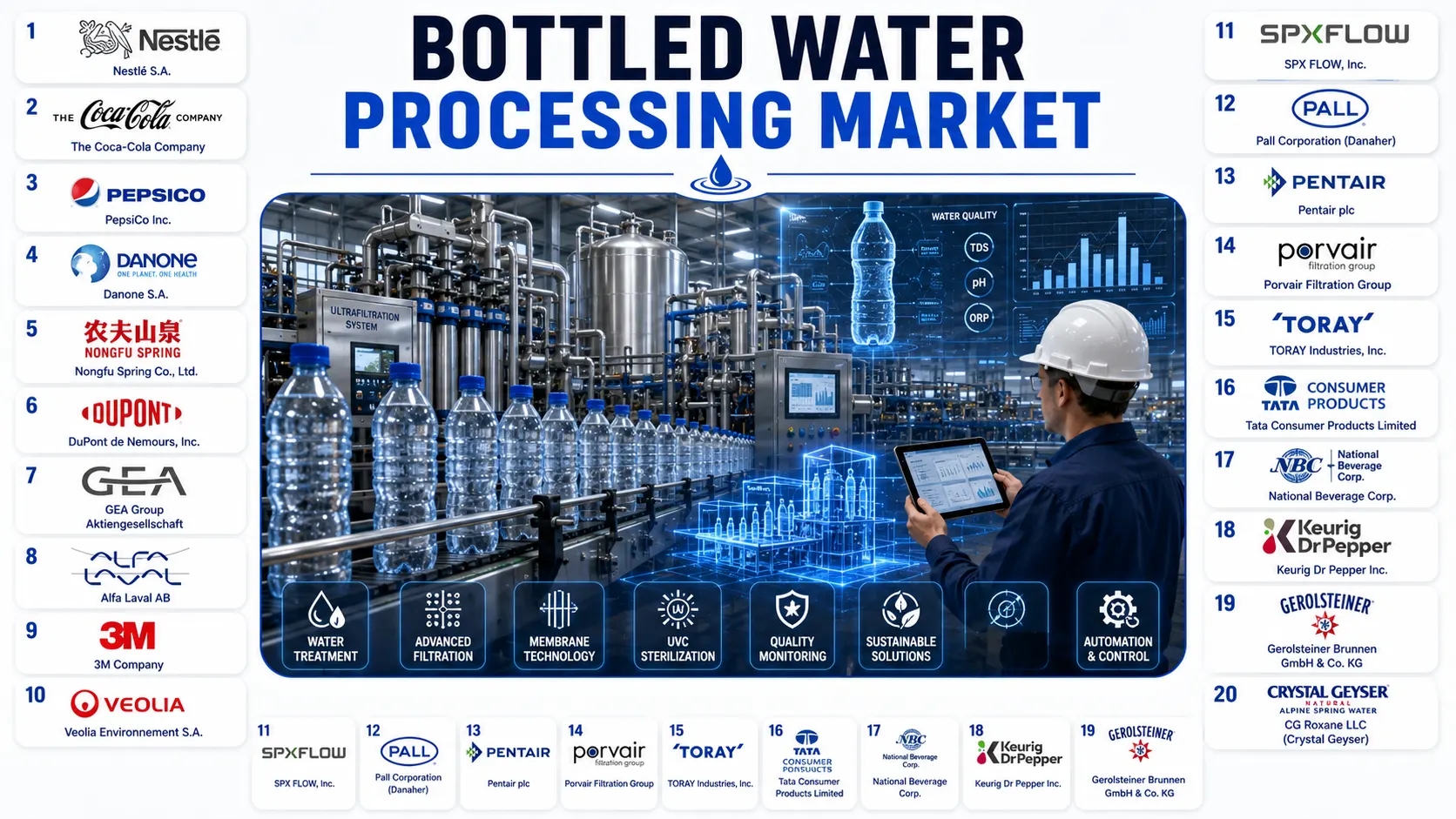
Top 20 Companies in the Global Bottled Water Processing Market
- Nestlé S.A.
- The Coca-Cola Company
- PepsiCo Inc.
- Danone S.A.
- Nongfu Spring Co., Ltd.
- DuPont de Nemours, Inc.
- GEA Group Aktiengesellschaft
- Alfa Laval AB
- 3M Company
- Veolia Environnement S.A.
- SPX FLOW, Inc.
- Pall Corporation (Danaher)
- Pentair plc
- Porvair Filtration Group
- TORAY Industries, Inc.
- Tata Consumer Products Limited
- National Beverage Corp.
- Keurig Dr Pepper Inc.
- Gerolsteiner Brunnen GmbH & Co. KG
- CG Roxane LLC (Crystal Geyser)
1. Nestlé S.A. (Waters Division Now BlueTriton Brands / Nestlé Pure Life)
| Category | Details |
|---|---|
| Company Name | Nestlé S.A. (Nestlé Pure Life) |
| Headquarters | Vevey, Switzerland |
| Founded | 1866 |
| Industry Focus | Consumer Packaged Goods, Bottled Water |
| Global Presence | Operations in 180+ countries |
| Company Overview | Nestlé is one of the world's largest food and beverage companies and has been a major player in the global bottled water industry for decades. Although it divested its North American bottled water brands in 2021 (forming BlueTriton Brands), the Nestlé Pure Life brand continues to operate across numerous international markets, offering still and sparkling bottled water through advanced filtration and high-capacity processing technologies. |
| Key Products & Services | Nestlé Pure Life, Perrier, San Pellegrino, Vittel, Contrex, bottled still water, sparkling water, premium mineral water, water processing and packaging solutions. |
| Market Position | Historically one of the world's leading bottled water companies, supported by a vast processing, packaging, and distribution network across Europe, Asia, Latin America, and other emerging markets. |
| Recent Developments | Expanded sustainability initiatives with a commitment toward 100% recyclable or reusable packaging globally. Premium brands including San Pellegrino and Perrier continue to drive growth in the premium sparkling water segment. |
| Strategic Advantages | Globally recognized brand portfolio, advanced water processing infrastructure, premium brand positioning, strong sustainability initiatives, extensive retail distribution network, and significant presence in both developed and emerging markets. |
2. The Coca-Cola Company
| Category | Details |
|---|---|
| Company Name | The Coca-Cola Company |
| Headquarters | Atlanta, Georgia, USA |
| Founded | 1892 |
| Industry Focus | Beverages, Bottled Water, Soft Drinks |
| Global Presence | Operations in 200+ countries and territories |
| Company Overview | The Coca-Cola Company is one of the world's largest beverage companies, offering an extensive portfolio of bottled water, soft drinks, juices, sports drinks, and ready-to-drink beverages. Through brands such as Dasani and smartwater, the company is a major player in the global bottled water processing industry, supported by an extensive manufacturing and distribution network. |
| Key Products & Services | Dasani, smartwater, Glacéau smartwater, Topo Chico, Ciel, Bonaqua, bottled water processing, beverage manufacturing, and distribution. |
| Market Position | One of the leading global bottled water producers with a strong presence across North America, Europe, Asia-Pacific, Latin America, and the Middle East. |
| Recent Developments | Continued investments in recycled PET (rPET), lightweight packaging, water stewardship initiatives, and expansion of premium bottled water brands including Topo Chico and smartwater. |
| Strategic Advantages | Globally recognized brands, unmatched beverage distribution network, strong sustainability initiatives, advanced processing technologies, and extensive retail partnerships. |
3. PepsiCo Inc.
| Category | Details |
|---|---|
| Company Name | PepsiCo Inc. |
| Headquarters | Purchase, New York, USA |
| Founded | 1965 |
| Industry Focus | Food & Beverages, Bottled Water |
| Global Presence | Operations in 200+ countries and territories |
| Company Overview | PepsiCo is a global food and beverage leader with a significant presence in the bottled water industry through brands such as Aquafina. The company operates advanced water purification and bottling facilities while serving retail, foodservice, and institutional customers worldwide. |
| Key Products & Services | Aquafina, LIFEWTR, Propel, bottled drinking water, purified water, flavored water beverages, beverage processing and packaging. |
| Market Position | Among the leading bottled water manufacturers globally, leveraging its strong beverage portfolio and extensive global distribution infrastructure. |
| Recent Developments | Expanded investments in recyclable packaging, water conservation projects, and premium hydration brands while increasing the use of recycled PET packaging. |
| Strategic Advantages | Strong global distribution network, diversified beverage portfolio, advanced manufacturing capabilities, sustainability leadership, and high consumer brand recognition. |
4. Danone S.A.
| Category | Details |
|---|---|
| Company Name | Danone S.A. |
| Headquarters | Paris, France |
| Founded | 1919 |
| Industry Focus | Food & Beverages, Bottled Water, Dairy & Nutrition |
| Global Presence | Operations in 120+ countries |
| Company Overview | Danone is a global leader in bottled water, dairy, and specialized nutrition. Its Waters division manages several internationally recognized natural mineral water brands and focuses on sustainable water sourcing, premium hydration, and environmentally responsible packaging. |
| Key Products & Services | Evian, Volvic, Bonafont, Aqua, Font Vella, natural mineral water, bottled spring water, premium hydration products. |
| Market Position | One of the world's largest bottled water companies with a strong presence in Europe, Asia-Pacific, Latin America, and Africa. |
| Recent Developments | Increased investment in circular packaging initiatives, carbon-neutral production facilities, and expansion of recyclable packaging across major bottled water brands. |
| Strategic Advantages | Premium global brands, sustainable water resource management, strong environmental commitments, advanced bottling operations, and extensive international distribution. |
5. Nongfu Spring Co.Ltd.
| Category | Details |
|---|---|
| Company Name | Nongfu Spring Co., Ltd. |
| Headquarters | Hangzhou, Zhejiang, China |
| Founded | 1996 |
| Industry Focus | Bottled Water, Beverages |
| Global Presence | Primarily China with expanding international exports |
| Company Overview | Nongfu Spring is China's leading bottled water producer and one of the largest beverage companies in Asia. The company specializes in natural spring water sourced from protected water reserves and has built a dominant position in China's premium bottled water market. |
| Key Products & Services | Natural spring water, bottled drinking water, sparkling water, flavored beverages, tea drinks, juice beverages, functional drinks. |
| Market Position | China's largest bottled water company and one of the world's leading bottled water brands by sales volume, with a dominant share of the domestic premium bottled water market. |
| Recent Developments | Continued expansion of production facilities, investments in premium water sources, adoption of sustainable packaging technologies, and expansion into international markets. |
| Strategic Advantages | Strong domestic market leadership, access to premium natural water sources, highly efficient manufacturing operations, trusted consumer brand, and extensive distribution network across China. |
Competitive Landscape
The global bottled water processing market is characterized by moderate-to-high market concentration at the brand level, but greater fragmentation at the processing equipment and technology supplier level.
Among consumer bottled water brands, the top five players Nestlé Waters, The Coca-Cola Company (Dasani/smartwater), PepsiCo (Aquafina), Danone (Evian/Volvic), and Nongfu Spring collectively command a dominant share of global revenue. However, the market is far from a pure oligopoly; regional champions, private label brands, and fast-growing functional water startups are consistently challenging the incumbents.
At the processing technology level, the competitive landscape is shaped by specialist industrial companies including GEA Group, Alfa Laval, DuPont Water Solutions, TORAY Industries, Pentair, Pall Corporation, Veolia, and 3M. These companies compete on the quality and performance of their filtration membranes, processing equipment, and integrated solutions and are increasingly differentiating through digital and smart monitoring capabilities.
Key Competitive Trends:
Mergers and Acquisitions: The market has seen significant consolidation activity, including Veolia's landmark acquisition of Suez in 2022, Danaher's 2015 acquisition of Pall Corporation, and the 2021 sale of Nestlé's North American water brands to One Rock Capital Partners (creating BlueTriton Brands). M&A activity is expected to continue as companies seek scale, technology access, and geographic expansion.
Partnerships and Collaborations: Technology partnerships, such as DuPont's agreement with Waterise for subsea desalination, are enabling specialist companies to enter new market segments and geographies. FMCG companies are also increasingly partnering with packaging innovators and sustainability-focused startups.
Innovation Strategies: Leading players are investing in AI-enabled plant monitoring, next-generation membrane materials, sustainable packaging, and functional water product development as core innovation priorities.
Regional Analysis
North America
North America represents one of the largest and most mature bottled water markets globally. The United States, where bottled water is the largest packaged beverage category by volume, drives the majority of regional market value. Health consciousness, tap water quality concerns, and a strong on-the-go hydration culture support robust demand. Regulatory oversight from the FDA ensures high quality standards. Key trends include premiumization, growth of sparkling water, and strong investment in sustainable packaging. The region is home to major brands including Dasani, Aquafina, Poland Spring (BlueTriton), Deer Park, and smartwater.
Europe
Europe is a highly diverse and mature bottled water market, home to some of the world's most prestigious natural mineral water brands. Germany, France, Italy, and Spain are among the largest per-capita consumers globally. Consumer preference for natural mineral water (both sparkling and still) differentiates Europe from the purified water-dominated North American market. Strict EU regulations govern labelling, source protection, and contaminant limits. Sustainability is a top priority, with brands across Europe advancing glass packaging, lightweight PET, and recycled content initiatives. Key brands include Evian, Perrier, San Pellegrino, Volvic, Gerolsteiner, and Apollinaris.
Asia Pacific
Asia Pacific is simultaneously the world's largest and fastest-growing bottled water processing market, driven by China, India, Japan, Indonesia, Vietnam, South Korea, and Australia. Rapid urbanization, a growing middle class, rising disposable incomes, and widespread concerns about tap water quality are the primary demand drivers. China, anchored by Nongfu Spring and local brands like Master Kong and Wahaha, is the largest single national market. India's bottled water market is growing rapidly, driven by health awareness and expanding organized retail. Government initiatives to improve safe drinking water access are simultaneously creating and displacing demand for commercial bottled water across the region.
Latin America
Latin America presents significant growth opportunities in the bottled water processing market, with Brazil and Mexico representing the largest national markets. Rising health awareness, urbanization, and concerns about tap water quality are driving demand across the region. Brazil's bottled water market has been expanding strongly, supported by a large domestic consumer base and growing premium water segment. Mexico's market is driven by both still and sparkling water consumption, with local brands competing alongside international players. Infrastructure investment in water treatment and processing is creating opportunities for equipment suppliers across the region.
Middle East & Africa
The Middle East and Africa region presents some of the most distinctive bottled water processing dynamics globally. In the Gulf Cooperation Council (GCC) countries including Saudi Arabia, UAE, Kuwait, and Qatar extreme water scarcity and near-total reliance on desalination for freshwater supply make advanced water processing technology indispensable. Saudi Arabia, which holds more than one-fifth of global desalination capacity, is a critical market for reverse osmosis membrane suppliers and water processing equipment manufacturers. In sub-Saharan Africa, rapid population growth, urbanization, and inadequate water infrastructure are creating significant growth opportunities for commercial bottled water processing operations.
Emerging Trends Shaping the Bottled Water Processing Market
1. Smart and Connected Processing Equipment GEA Group's 2022 launch of GEA Smart Filtration which enables real-time remote monitoring of membrane filtration plants via cloud connectivity and a dedicated app represents the broader industry shift toward AI-enabled, digitally connected processing equipment. Expect continued investment in IoT sensors, predictive maintenance systems, and digital twins across bottled water processing plants.
2. Sustainable and Circular Packaging Consumer and regulatory pressure on single-use plastics is accelerating innovation in sustainable packaging. Leading brands are increasing recycled PET content, exploring PHA and PLA bioplastics, expanding glass bottle programs, and investigating aluminium can formats for premium water products. Light-weighting of PET bottles remains a key engineering priority.
3. Functional and Enhanced Water The functional water segment encompassing alkaline water, electrolyte-enhanced water, collagen-infused water, vitamin-fortified water, and hydrogen water is growing rapidly, requiring specialized processing and filtration technologies to achieve precise mineral and additive formulations. This trend is creating new opportunities for equipment suppliers with expertise in precision blending and mineral dosing.
4. Desalination Expansion As freshwater scarcity intensifies globally, desalination capacity is expanding rapidly, particularly in the Middle East, North Africa, and water-stressed parts of Asia. This is creating growing demand for reverse osmosis membranes, membrane cleaning systems, and associated processing equipment from bottled water processors seeking desalinated water as a reliable supply source.
5. PFAS Monitoring and Mitigation Technology Recent research finding ultra-short-chain PFAS compounds (including TFA, PFPrA, and TFMS) in bottled water is driving investment in enhanced analytical testing and advanced purification technologies capable of removing these compounds. This emerging challenge is both a market risk and an innovation opportunity for equipment and technology suppliers.
6. Premiumization and Natural Source Water Consumer willingness to pay a premium for water with verifiable natural provenance specific spring sources, documented mineral profiles, geographic designation is supporting the growth of premium natural mineral water brands globally. This trend is encouraging investment in source protection, minimal-processing technologies, and premium packaging formats.
Future Outlook (2026–2035)
The global Bottled Water Processing Market is positioned for sustained growth through the 2026–2035 period, underpinned by structural demographic, health, and infrastructure realities that are unlikely to reverse.
Growth Projections: Based on current trajectory, the market is expected to comfortably exceed USD 312 billion by 2032 and could approach USD 400 billion by 2035, assuming continued CAGR in the 5–7% range. The Asia Pacific region will likely remain the dominant growth engine, followed by Latin America and MEA.
Investment Opportunities: The most compelling investment opportunities lie in: advanced membrane filtration technology (RO, ultrafiltration, nanofiltration); smart processing equipment with digital monitoring capabilities; sustainable packaging materials and formats; functional and enhanced water product development; and market expansion in underpenetrated developing economies.
Industry Transformation: The bottled water processing industry will increasingly look like a technology-driven, sustainability-focused sector rather than a simple commodity business. Companies that invest in digital processing intelligence, sustainable production systems, and premium product positioning will capture disproportionate value.
Future Technologies: Key emerging technologies likely to reshape the industry over the next decade include: electrochemical water purification, advanced photocatalytic disinfection, AI-driven predictive water quality management, bio-based packaging materials, and next-generation PFAS removal systems.
Regulatory Evolution: Regulatory frameworks governing bottled water quality, plastic packaging, and PFAS will become more stringent globally over the next decade. Companies that proactively invest in compliance, testing, and quality assurance infrastructure will be best positioned to navigate the evolving regulatory landscape.
FAQ Section: Bottled Water Processing Market
Q1: What is the current size of the global Bottled Water Processing Market?
The global Bottled Water Processing Market was valued at USD 193.64 billion in 2024 and is projected to reach USD 312.14 billion by 2032, growing at a CAGR of 6.15% over the forecast period.
Q2: Who are the leading companies in the Bottled Water Processing Market?
The leading companies include The Coca-Cola Company (Dasani, smartwater), PepsiCo (Aquafina), Danone (Evian, Volvic), Nongfu Spring, Nestlé Waters (Perrier, San Pellegrino), DuPont (filtration technology), GEA Group, Alfa Laval, TORAY Industries, Pall Corporation, Pentair, Veolia, 3M, SPX FLOW, Tata Consumer Products, Keurig Dr Pepper, National Beverage Corp. (LaCroix), Gerolsteiner Brunnen, Porvair Filtration Group, and CG Roxane (Crystal Geyser).
Q3: Which region dominates the Bottled Water Processing Market?
Asia Pacific dominates the global Bottled Water Processing Market, driven by rapid urbanization, population growth, rising disposable incomes, and increasing demand for safe drinking water in countries including China, India, Indonesia, and Vietnam. The region is also expected to be the fastest-growing market during the forecast period through 2032.
Q4: What are the primary growth drivers of the Bottled Water Processing Market?
Key drivers include the 73% growth of the bottled water industry between 2010–2020, rising health consciousness, concerns about tap water quality, rapid urbanization in emerging economies, technological advances in filtration and disinfection, growth of desalination as a water source, and premiumization trends in consumer water preferences.
Q5: What is the projected CAGR of the Bottled Water Processing Market?
The Bottled Water Processing Market is forecast to grow at a CAGR of 6.15% from 2024 to 2032.
Q6: What technologies are used in bottled water processing?
Key technologies include reverse osmosis (RO), UV disinfection, ion exchange and demineralization, membrane filtration (microfiltration, ultrafiltration, nanofiltration), advanced packaging systems (fillers, cappers, moulders, shrink wrappers), and increasingly AI-enabled smart monitoring platforms.
Q7: What are the main packaging materials used in the bottled water industry?
The primary packaging materials are PET plastic (dominant), glass (for premium brands), and aluminium cans (a growing segment for sparkling water). Sustainability concerns are driving innovation in recycled plastic, lightweight packaging, and alternative materials.
Conclusion
The global Bottled Water Processing Market stands as one of the most dynamic, strategically significant, and rapidly evolving sectors within the broader food, beverage, and industrial technology landscape. Growing from USD 193.64 billion in 2024 to a projected USD 312.14 billion by 2032 at a CAGR of 6.15%, the market's trajectory reflects the convergence of irreversible demographic trends, accelerating health consciousness, and the critical role of commercial water processing in addressing global water safety challenges.
The companies profiled in this article spanning global FMCG giants like The Coca-Cola Company, PepsiCo, Danone, and Nongfu Spring; advanced technology suppliers including DuPont, TORAY, GEA Group, and Pall Corporation; and regional champions like Tata Consumer Products, Gerolsteiner, and Crystal Geyser collectively represent the full ecosystem of innovation, investment, and competitive intensity shaping this market in 2026 and beyond.
For investors, procurement professionals, industry analysts, and strategic decision-makers, understanding the dynamics of this market from the promise of desalination-driven supply growth and AI-enabled processing intelligence, to the challenges of PFAS contamination and plastic waste regulation is essential for identifying where opportunity lies and where risk must be managed. The bottled water processing industry is not merely a commodity business: it is a technology-driven, innovation-intensive, and increasingly sustainability-defined sector whose evolution will shape how billions of people around the world access safe, clean drinking water for decades to come.


