Share this link via:

The global personalized pet accessories market size was valued at USD 5.2 billion in 2025 and is projected to reach USD 6.0 billion in 2026, expanding to USD 13.2 billion by 2034, growing at a CAGR of 10.3% during the forecast period (2026-2034).
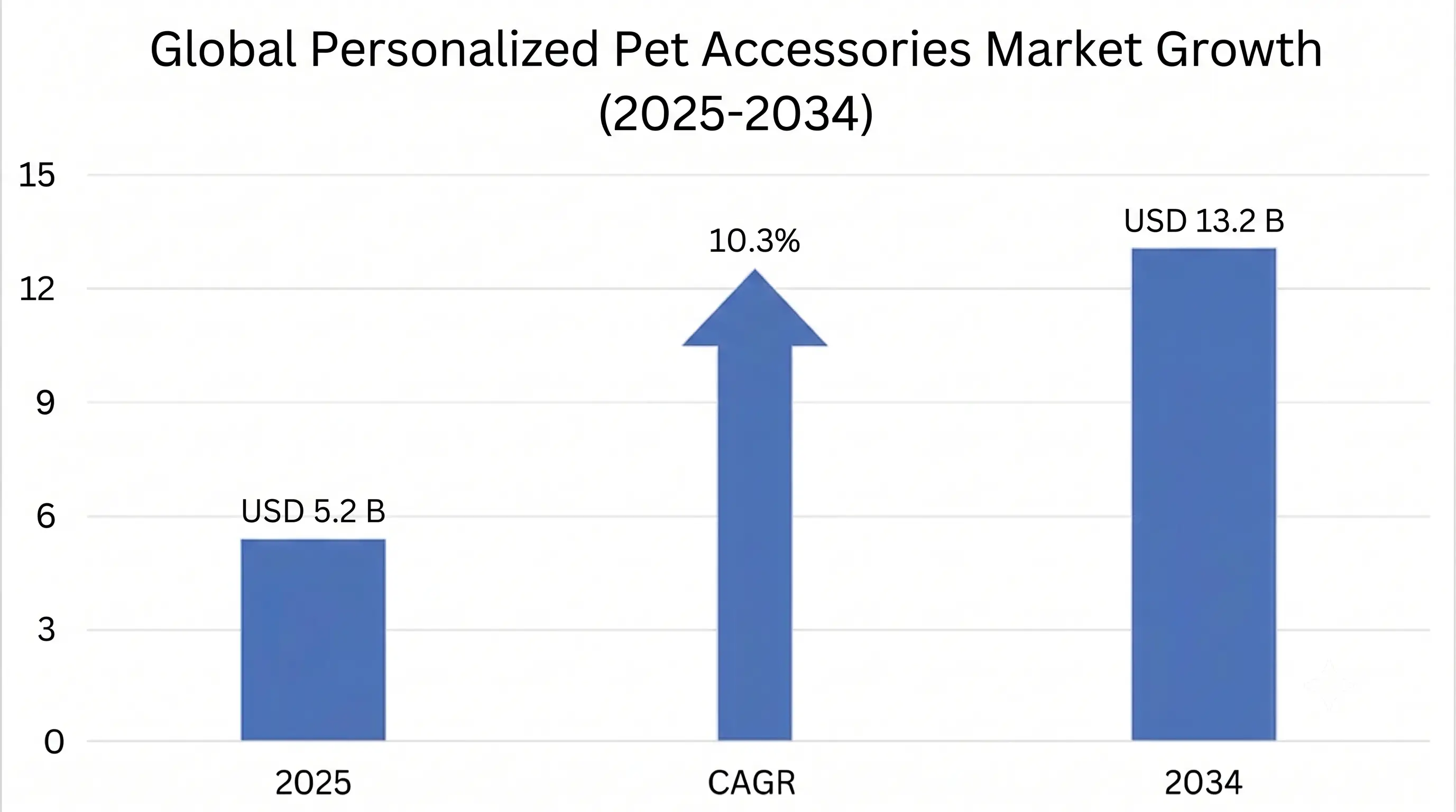
Personalized pet accessories represent a paradigm shift within the global pet care industry, consisting of high-tech personalized products intended to be customized for their uniqueness, personality traits, and preferences of the pet, while also functioning as a reflection of the love and care of the owners towards their pet and their personal taste and style. The products do not only perform a certain practical purpose but become symbols of the relationship between a person and an animal represented through such personalized items as laser etched identification systems, embroidered pet clothes with a name and portrait of the pet, specialized furniture that fits specific breed anatomically, and more technologically advanced products incorporating QR codes and NFC tags.
The market is responding to the powerful cultural trend of pet humanization, through which companion pets are transformed from just being pets into members of a family, who deserve special care and personalized products reflecting their personalities. This cultural trend has been statistically proven through the results obtained from consumer research, where 87% of pet owners from developed nations have admitted having their pets as part of their families, while 62% of these pet owners celebrate the birthdays and other important occasions of their pets with appropriate gifts.
The technology that makes mass customization possible has seen major changes, from increased accuracy in laser engraving to affordable 3D printing, advanced digital sublimation printing, computer-aided embroidery, and AI-assisted design software, all of which make personalization possible at prices that were earlier available only through the high-end craft of artisans. E-commerce websites are now able to incorporate personalized product design features into their operations, with customized products available within 24–72 hours of ordering.
The mathematical relationship between personalization and pricing premium can be expressed as:
where personalized products typically command premiums of 30-50% across major categories, reflecting both increased manufacturing complexity and the emotional value perceived by consumers willing to invest in products celebrating their pets’ unique identities.
| Report Coverage | Details |
|---|---|
| Base Year | 2025 |
| Base Year Value | USD 5.2 Billion |
| Forecast Value | USD 13.2 Billion |
| CAGR | 10.3% |
| Forecast Period | 2025-2034 |
| Historical Data | 2022-2025 |
| Largest Market | North America |
| Fastest Growing Market | Asia Pacific |
| Segments Covered | By Product Type, Pet Type, Material, Customization Method, Distribution Channel, End-User |
| Region Covered | North America, Europe, Asia Pacific, Middle East & Africa, Latin America |
| Countries Covered | US, Canada, Mexico, UK, Germany, France, Italy, Spain, Netherlands, China, Japan, India, Australia, South Korea, Brazil, Argentina, UAE, Saudi Arabia, South Africa |
| Key Market Playes | Etsy Inc., Chewy Inc., PetSmart LLC, Zazzle Inc., Redbubble Group, Personal Creations, BarkBox Inc., Wild One, Orvis Company, Kurgo |
Get more details on this report - Request Free Sample
The core factor behind the growth of the personalized pet accessory industry is the complete shift in culture regarding pet ownership, which becomes pet parenthood as pets get treated with the same emotion and economic importance that human children enjoy. This change brings a significant alteration in consumer behavior from a strictly functional approach to one driven by emotions and personal expression towards the pet.
This revolution in demographics is based on young adults from the Millennials and Generation Z, who are the biggest owners of pets in the world and have a much greater inclination toward spending more on high-quality, customized products than other past generations. This demographic increasingly views pets as companion family members, particularly as many individuals delay marriage and family formation.
Personalized accessories function as a physical embodiment of the relationship, converting mere objects into artifacts that reflect the individuality of the pet while giving owners an avenue through which they can communicate their sense of responsibility and love towards them. This purchasing behavior extends beyond personal satisfaction and serves as a form of social signaling by reflecting the owner’s capability in owning a pet responsibly.
The exponential growth pattern of customized pet accessories has been made possible due to groundbreaking innovations in the field of e-commerce personalization technologies and integration with manufacturing technology that has addressed previous bottlenecks in the form of high order quantities, long lead times, and limitations in terms of local availability of artisans. Advanced digital customization platforms offer consumer-friendly designing tools with the ability to design products through the drag and drop feature and real-time 3D visualization.
The convergence of print-on-demand technology, automated laser engraving machinery, and computer-driven embroidery machines makes it economically viable to produce individual units with quality comparable to mass-produced goods. It allows for totally new business models in which there can be thousands of virtually different product variations in a catalog, but none exists in actual inventory until an order is placed.
The advanced manufacturing processes such as AI-powered designing optimization, quality control systems, and robotic fulfillment processes have lowered the cost of producing personalized products by 35-48% after 2020, while also enhancing quality and delivery time. The application of augmented reality visualization processes allows customers to visualize personalized products on their own pets using smartphones, lowering any hesitation in purchasing and returning items.
The social media environment has led to the formation of an infrastructure that boosts pet celebrities as well as encouraging consumers’ aspiration to purchase premium personalized products based on curated pet lifestyle content. Collectively, pet influencers reach more than 2.8 billion followers worldwide, with many of them using premium personalized products as the focal point of their lifestyle posts.
The process of commercialization occurs through various mechanisms such as direct collaborations with influencers, user-generated content depicting personalized accessories, and social discovery systems where attractive images of pets using personalized products are highlighted. The inherent attractiveness of personal accessories allows them to be used as great social media content.
The gift-giving aspect of social media culture also increases demand since the celebrations of milestones such as birthdays and adoptions by pets are publicized and create social pressures to purchase gifts, leading to increased demand within one’s social network on various social media platforms.
The major bottleneck that limits the scalable growth of the personalization market of pet accessories is associated with the conflicting relationship between the necessity of customization and production efficiency criteria. Unlike mass-produced goods, personalized products require individual manufacturing, increasing operational complexity and creating greater risks of production errors and customer dissatisfaction.
Ensuring quality is an issue that can be challenging for mass production of custom-made items, since even slight differences in the engraving depth of lasers or the tension in the embroidery thread can lead to different quality in the same products. This becomes more difficult because once an item has been custom-made, it cannot be returned, thus the only way out is to re-produce the entire item again.
Personalization in these products leads to inherent logistical difficulties such as a lack of resale value in returnable products, strict no-return policy leading to hesitation in purchasing, and complicated inventory control in case of custom components. The economic implications of manufacturing errors are quite high in that the cost of remaking eliminates profit even from several correct sales.
A revolutionizing market is to be found in combining personalized physical wearable products with the functionality of smart technology, such as GPS tracking, health monitoring, and management of digital identity. Smart personalized collars with personalized engraved names and NFC chips or QR codes allow the creation of digital profiles, which include all the necessary data about the pet, like health information, emergency contacts, and behavioral data, without producing additional wearable goods.
Technology integration makes the change possible from one-off transactions to revenue models with subscriptions of premium services that provide more functionality, such as live location tracking, health analytics, and telemedicine integration. Personalized technology integration enables companies to command price premiums ranging from 60–120%, higher than those for ordinary personalized solutions.
Pet bereavement market refers to an emotional and economically important area that deals with memorialization of pets by means of various personalized items such as customized portraits, personalized jewelry, customized memory boxes, and tribute goods for pets who have passed away. This market niche is relatively price-insensitive is because the loss of a pet is emotionally felt on par with that of a family member.
Growing environmental awareness among affluent pet owners provides avenues for producing bespoke products that incorporate sustainable materials such as vegan leather substitutes, plastics derived from recycling processes, organic fabrics, and biodegradable elements. This sustainability positioning facilitates further pricing of the product at a premium level.
The sector is making rapid strides towards AI-powered personalization that goes beyond basic text personalization to become products customized according to the unique traits of each animal. Through computer vision, algorithms can study images of pets to come up with breed-specific sizing, character-inspired designs, and photo-realistic art personalization.
Business models are being adopted where personalized delivery and curation are integrated based on age, seasonality, and changing preferences. Such business models generate predictable recurring revenue while forging relationships with customers via personalization tuning.
These advanced applications allow customers to see how the customized product would look on their unique pet via camera-equipped smartphones prior to buying it, which dramatically decreases mistakes and returns related to sizes.
North America held the largest market share, generating USD 2.1 billion in revenue in 2025, and is projected to grow at a CAGR of 9.8% through 2034., owing to high rates of pet ownership, where 67% of US homes owned pets, pet humanization, and discretionary spending that allows adopting premium personalized products. The US represented 88% of the regional market value with total spending on the pet industry amounting to USD 147 billion in 2025.
The region offers mature online shopping channels, advanced artisan ecosystem, and gift-giving culture, which leads to sales peaks during the holidays accounting for 34% of the total annual sales. The consumer’s willingness to pay premium prices for personalized products stood at 71%.
Asia Pacific is projected to be the fastest-growing regional market, expanding at a CAGR of 12.4% through 2034. The growth is supported by China’s growing pet market that has seen ownership grow by 67% between 2019-2025, advanced mobile commerce system, and pet culture via social media.
Japan has a consumer-centric environment with a penchant for high-end products, which supports growth, as does South Korea’s advanced e-commerce capabilities. India’s burgeoning middle class presents future opportunities.
Product Type Insights: Personalized Collars & Leashes have the largest market share with 32%, totaling USD 1.7 billion, as the basis category where functionality meets aesthetics. The second largest category, Custom ID Tags & Name Plates, contributes 24% of the market, valued at USD 1.2 billion, owing to awareness among all pet owners regarding the need for identification.
Personalized Pet Apparel & Costumes register highest growth rate of 14.2% CAGR, worth USD 0.8 billion, due to increased trend on social media posting and gifting season. The category with highest growth rate, Smart/Tech-enabled Personalized Products, grows at a CAGR of 18.7%, worth USD 0.3 billion.
Pet Type Insights: Market shares of dogs are the highest at 68% with a value of USD 3.5 billion owing to high accessory costs, variety in the products, and greater social display inclination of pets. The share of cats is 22% with a revenue of USD 1.1 billion at a CAGR of 11.8%. The market share of Small Animals & Exotics is 10% with the highest CAGR of 15.4%.
Customization Method Insights: The segment of Laser Engraving enjoys the largest market size at USD 1.8 billion, with a 35% share, followed by that of Embroidery with 28% share at USD 1.5 billion. The third largest technology is that of 3D Printing, holding 8% market share with the fastest CAGR of 19.2%.
Distribution Channel Insights: Online Retail & E-commerce are the leaders, having a 67% market share worth USD 3.5 billion, which is a result of natural synergy between custom design technology and e-commerce purchasing. Pet Specialty Stores hold 18% of the market share and are valued at USD 0.9 billion catering to those customers who require personalization services in-store.
The personal pet accessory industry worldwide is highly fragmented with thousands of firms, both small artisans to large platforms such as Etsy, Chewy, and Amazon who sell many different types of personalized products. The competitive environment splits into two segments: aggregators like Etsy, Chewy, and Amazon, which offer various types of personalized items, and specialized brands using their own unique design and materials.
Differentiation revolves around interface complexity, production consistency, delivery reliability, uniqueness, and superior customer service in handling personalized orders. Key industry participants are now emphasizing vertical integration by developing in-house production facilities to maintain better quality and margin controls without being dependent on other manufacturers.
April 2026: Chewy Inc. developed advanced AI-driven sizing system, which improved accuracy of harnesses fitment to pets by 85% via computer vision-based analysis of pet images together with automation manufacturing technologies.
March 2026: The Etsy Inc. announced personalization of pet accessories as most rapidly growing segment, which provided company with USD 450 million revenue from gross merchandise sales.
February 2026: A leading 3D-printing company launched a customized harness service based on breed-specific designs through AI-powered body measurements taken via smartphone photographs to ensure an exact anatomical fit in 340 officially registered breeds.
January 2026: PetSmart LLC rolled out personalization kiosks in all 1,650 stores countrywide to allow real-time laser engraving, resulting in additional sales of USD 47 million.
You'll get the sample you asked for by email. Remember to check your spam folder as well. If you have any further questions or require additional assistance, feel free to let us know via-
+1 724 648 0810 +91 976 407 9503 sales@intellectualmarketinsights.com
01 Jul 2026
Intellectual Market Insights Research © 2026. All rights reserved.