
Top 10 Leading Companies in the Global Gas Turbine Market
Author:
Intellectual Market Insights Research
Published Date:
19 Aug 2026
Introduction
Gas turbines sit at the center of one of the most consequential balancing acts in global energy: keeping electricity grids stable and reliable while the world races to decarbonize. As coal-fired power plants retire and variable renewable energy sources like wind and solar scale up rapidly, gas turbines have emerged as the critical bridge technology, providing the fast-responding, dispatchable power that intermittent renewables cannot supply on their own. From massive utility-scale combined cycle plants to compact aeroderivative units built on jet engine technology, this equipment category is undergoing a profound transformation driven by efficiency gains, hydrogen readiness, and digital optimization.
Download brochure link: https://www.intellectualmarketinsights.com/report/gas-turbine-market-research-report-and-current-trends/imi-006398
The global gas turbine market was valued at approximately USD 17,428.3 million in 2025 and is projected to reach USD 26,147.9 million by 2034, expanding at a compound annual growth rate (CAGR) of 4.8% over the forecast period, according to Intellectual Market Insights Research. This growth reflects accelerating coal plant retirements, the urgent need for grid-stabilizing flexible generation, and the emergence of hydrogen-capable turbine technology as a long-term decarbonization pathway.
Unlike many equipment categories, the gas turbine industry is highly consolidated, with a handful of major manufacturers controlling the overwhelming majority of global production capacity and aftermarket services revenue. Competitive advantage increasingly hinges not just on hardware efficiency, but on hydrogen combustion capability, digital twin-powered predictive maintenance, and long-term service contracts that generate recurring, high-margin revenue over 15-25 year asset lifecycles.
Understanding which companies lead this technically demanding and strategically vital market is essential for utilities, independent power producers, and industry analysts. This article provides a research-based analysis of the top companies in the global gas turbine market, their positioning, flagship offerings, and the regional and technological forces shaping the competitive landscape.
Market Overview
|
Parameter |
Details |
|---|---|
|
Market Size (2025) |
USD 17,428.3 Million |
|
Projected Market Size (2034) |
USD 26,147.9 Million |
|
CAGR (2026–2034) |
4.8% |
|
Base Year |
2025 |
|
Forecast Period |
2026–2034 |
|
Leading Region |
Asia Pacific |
|
Fastest-Growing Region |
Middle East & Africa |
|
Key Growth Drivers |
Coal plant retirements, renewable energy integration needs, hydrogen-ready technology development |
|
Key Challenges |
Falling renewable energy costs, declining gas turbine capacity factors in high-renewable-penetration markets |
|
Key Opportunities |
Hydrogen-capable retrofit market, grid stabilization service revenue, digital twin and predictive maintenance |
Why the Gas Turbine Market Is Growing
1. Accelerating Coal Plant Retirements
Global coal retirement announcements exceeding 180 GW between 2024-2025 are creating immediate replacement demand for dispatchable generation technologies capable of providing the grid stability services that intermittent renewable sources cannot deliver alone.
2. Renewable Energy Integration Requirements
Modern gas turbines offer fast start-up times, high ramping rates of 15-50 MW/min, and efficient low-load operation, allowing them to provide critical grid services like frequency regulation and spinning reserves as renewable penetration rises, with grid operators requiring roughly 250-400 MW of flexible gas turbine capacity for every 1 GW of variable renewable capacity integrated.
3. Superior Efficiency and Emissions Profile
Advanced F-class, H-class, and J-class combined cycle turbines now achieve net thermal efficiencies of 58-64%, translating to 50-60% lower carbon dioxide emissions than subcritical coal plants, positioning gas turbines as a practical transition technology while renewable infrastructure continues to build out.
4. Emergence of the Hydrogen Economy
Equipment manufacturers have developed combustion systems capable of operating on hydrogen blends of 30-100%, with commercial units already certified for 50% hydrogen operation and 100% hydrogen capability targeted for 2027-2028, opening a substantial retrofit market across the more than 15,000 gas turbines currently in operation worldwide.
5. Growing Value of Grid Stabilization Services
Rising variable renewable penetration is creating premium pricing opportunities for gas turbines that deliver frequency regulation, voltage support, and spinning reserve services, with these ancillary services now capable of generating 30-45% of total revenue for some operators.
6. Digital Twin and Predictive Maintenance Adoption
Advanced digital monitoring systems tracking thousands of real-time sensor data points are reducing unplanned outages by 38-52% and extending major overhaul cycles, improving asset economics and driving continued investment in digitally enabled turbine fleets.
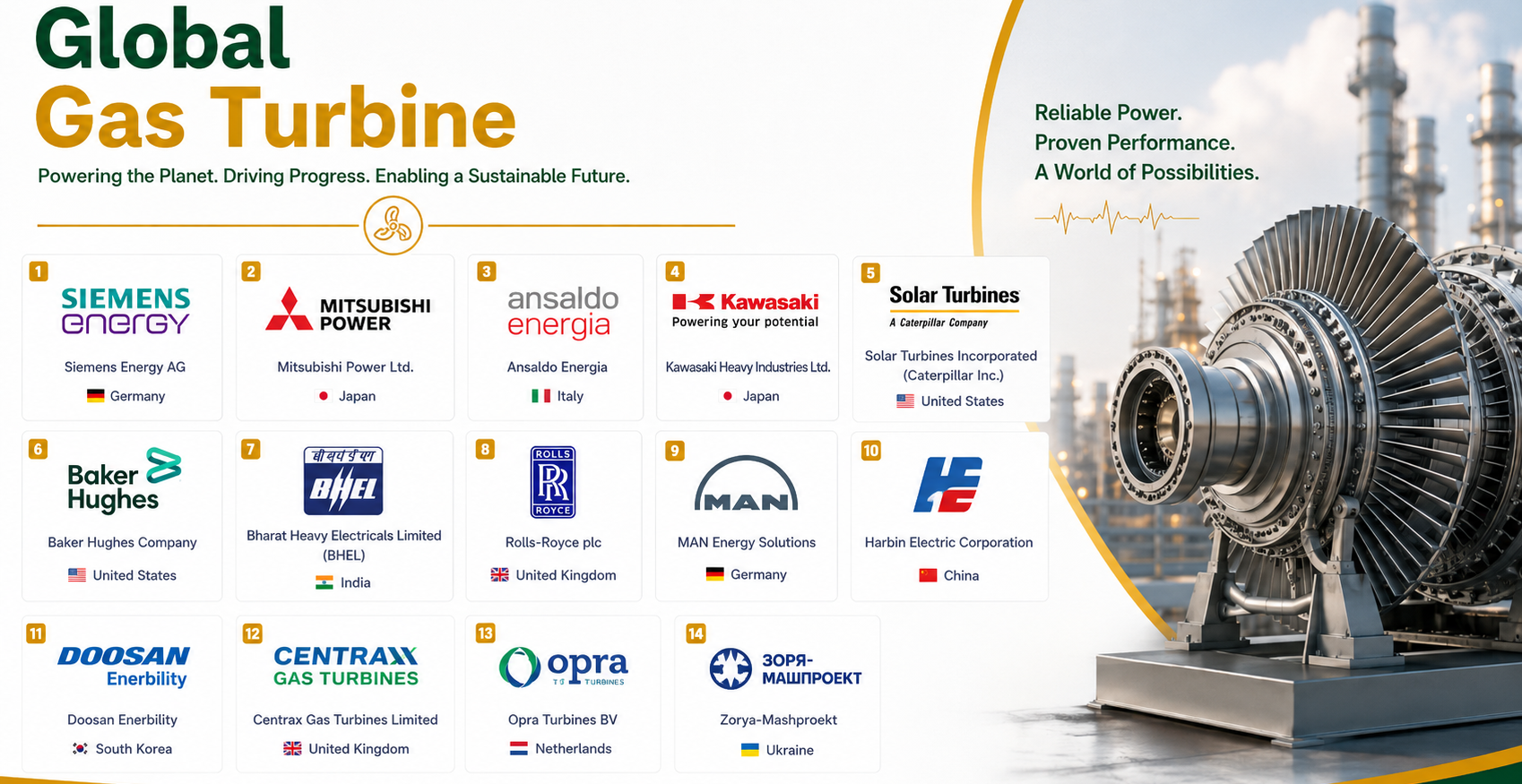
Top 10 Companies in the Gas Turbine Market
- General Electric Company (GE Vernova)
- Siemens Energy AG
- Mitsubishi Power Ltd.
- Ansaldo Energia
- Kawasaki Heavy Industries Ltd.
- Solar Turbines Incorporated (Caterpillar Inc.)
- Baker Hughes Company
- Bharat Heavy Electricals Limited (BHEL)
- Rolls-Royce plc
- MAN Energy Solutions
1. GE Vernova (General Electric)
|
Category |
Details |
|---|---|
|
Company Name |
GE Vernova Inc. |
|
Headquarters |
Cambridge, Massachusetts, United States |
|
Founded |
April 2, 2024 (spun off from General Electric; GE's power business traces to 1892) |
|
Employees |
Approx. 75,000–85,000 |
|
Revenue (2024) |
Approx. USD 35 Billion |
|
Company Overview |
GE Vernova is a purpose-built global energy company spanning Power, Wind, and Electrification segments, with its gas power business supplying heavy-duty and aeroderivative turbines for utility and industrial applications worldwide. |
|
Key Products |
HA-class heavy-duty gas turbines, LM-series aeroderivative turbines, and combined cycle power plant technology, alongside a large installed fleet service business. |
|
Market Position |
A global leader in gas turbine technology, with its HA-class fleet, including 130+ units and 325 on contract, representing one of the largest advanced turbine installed bases worldwide. |
|
Recent Developments |
Successfully tested a commercial-scale 100% hydrogen-fueled gas turbine at a 520 MW combined cycle plant in the Netherlands in March 2026, demonstrating zero-carbon operation feasibility. |
|
Strategic Advantages |
Deep technological leadership in large-frame gas turbines, an extensive global service and aftermarket network, and first-mover position in commercial-scale hydrogen combustion. |
|
Category |
Details |
|---|---|
|
Company Name |
Siemens Energy AG |
|
Headquarters |
Munich, Germany |
|
Founded |
April 1, 2020 (spun off from Siemens AG; Siemens' energy business traces to 1866) |
|
Employees |
Approx. 103,000 |
|
Revenue (2025) |
Approx. USD 43 Billion (€39.1 billion) |
|
Company Overview |
Siemens Energy is a global energy technology company spanning Gas Services, Grid Technologies, Transformation of Industry, and Siemens Gamesa, supplying gas turbines for power generation and industrial applications across more than 90 countries. |
|
Key Products |
H-class and other heavy-duty gas turbines with hydrogen-ready combustion systems capable of blending hydrogen from initial operation to 100% by design intent. |
|
Market Position |
A top-tier global gas turbine supplier, with an estimated one-sixth of the world's electricity generated using Siemens Energy technologies. |
|
Recent Developments |
Won a USD 3.4 billion contract with Saudi Electricity Company in February 2026 to supply sixteen H-class gas turbines totaling 8,960 MW, with hydrogen-ready combustion capable of 50% blending at launch. |
|
Strategic Advantages |
Deep engineering heritage, hydrogen-ready technology leadership, and a broad energy value chain spanning generation, transmission, and storage. |
|
Category |
Details |
|---|---|
|
Company Name |
Mitsubishi Power Ltd. (a brand of Mitsubishi Heavy Industries, Ltd.) |
|
Headquarters |
Tokyo, Japan (Mitsubishi Power Americas headquartered in Lake Mary, Florida, U.S.) |
|
Founded |
1884 (Mitsubishi Heavy Industries); Mitsubishi Power brand established 2019 |
|
Employees |
Approx. 77,000–100,000 (parent company, Mitsubishi Heavy Industries, consolidated) |
|
Revenue |
Approx. USD 33 Billion (parent company, Mitsubishi Heavy Industries, group-wide) |
|
Company Overview |
Mitsubishi Power is the power solutions brand of Mitsubishi Heavy Industries, designing, manufacturing, and maintaining gas turbines and decarbonization technologies across more than 30 countries. |
|
Key Products |
J-series and other heavy-duty gas turbines, combined cycle power plant systems, and hydrogen and ammonia co-firing technology for existing and new turbine fleets. |
|
Market Position |
A leading global gas turbine manufacturer with strong positioning in Asia-Pacific markets and a growing global aftermarket services footprint. |
|
Recent Developments |
Acquired a European gas turbine services provider for USD 1.2 billion in January 2026 to expand aftermarket services across 420 installed turbines in 22 countries. |
|
Strategic Advantages |
Strong home-market position in Asia-Pacific, deep hydrogen and ammonia co-firing expertise, and an expanding global services and maintenance business with high recurring-revenue margins. |
|
Category |
Details |
|---|---|
|
Company Name |
Ansaldo Energia S.p.A. |
|
Headquarters |
Genoa, Italy |
|
Founded |
1853 |
|
Employees |
Approx. 3,500+ |
|
Revenue |
Approx. USD 1–1.5 Billion (est.) |
|
Company Overview |
Ansaldo Energia is an Italian heavy-duty gas turbine manufacturer with a long engineering heritage, focused on high-efficiency power generation and hydrogen-capable combustion technology. |
|
Key Products |
GT36-H2 Advanced and other heavy-duty gas turbine platforms designed for both natural gas and high-hydrogen-blend operation. |
|
Market Position |
A specialized European gas turbine manufacturer competing on efficiency leadership and early hydrogen-capability, particularly within Italian and broader European coal-phase-out markets. |
|
Recent Developments |
Released the GT36-H2 Advanced gas turbine in December 2025, achieving 65.2% combined cycle efficiency on natural gas and 62.8% on 100% hydrogen fuel, the highest-efficiency hydrogen-capable turbine on the market, with first deployment planned for 2028. |
|
Strategic Advantages |
Deep engineering heritage in turbine design, leading-edge hydrogen combustion efficiency, and strong positioning within Europe's accelerating coal-to-gas and hydrogen transition. |
5. Kawasaki Heavy Industries Ltd.
|
Category |
Details |
|---|---|
|
Company Name |
Kawasaki Heavy Industries, Ltd. |
|
Headquarters |
Kobe/Tokyo, Japan |
|
Founded |
1896 |
|
Employees |
Approx. 38,000+ (group-wide) |
|
Revenue |
Approx. USD 13–14 Billion (group-wide; gas turbines are a portion of energy segment revenue) |
|
Company Overview |
Kawasaki Heavy Industries is a diversified Japanese industrial conglomerate whose energy solutions segment produces small- and mid-capacity gas turbines for distributed power generation and cogeneration applications. |
|
Key Products |
Small- to mid-scale industrial gas turbines and cogeneration systems, including hydrogen-capable combustion technology for distributed power applications. |
|
Market Position |
A significant player in the small- and mid-capacity gas turbine segment, particularly strong in cogeneration and distributed generation applications across Japan and Asia-Pacific. |
|
Recent Developments |
Continued investment in hydrogen-related energy technologies as part of Japan's broader Green Growth Strategy targeting hydrogen-capable generation capacity. |
|
Strategic Advantages |
Strong engineering diversification across aerospace, rail, and energy segments, and early leadership in hydrogen-related industrial technology. |
Competitive Landscape
The gas turbine industry is highly consolidated globally, with five main manufacturers, GE Vernova, Siemens Energy, Mitsubishi Power, Ansaldo Energia, and Kawasaki Heavy Industries, controlling an estimated 82-87% of total global production capacity and aftermarket services revenue. This concentration reflects the immense capital intensity, technological complexity, and decades of accumulated engineering expertise required to compete at scale.
Vertical Integration as a Moat: Major manufacturers maintain vertically integrated operations spanning research and development, advanced materials production, precision machining, assembly, project execution, and long-term service contracts, with services and aftermarket revenue representing 48-55% of total company income for many players.
Hydrogen Readiness as the New Battleground: Competitive differentiation increasingly centers on hydrogen combustion capability, with manufacturers racing toward roadmaps for 100% hydrogen operation by 2028-2030. Companies like GE Vernova and Ansaldo Energia have already demonstrated high-hydrogen-blend commercial operation, while Siemens Energy has embedded hydrogen-ready requirements into major new contracts.
Digital Services Driving Recurring Revenue: Digital twin technology and predictive maintenance platforms are becoming standard competitive differentiators, with digitally enabled fleets achieving 99.2% availability versus 96.4% for conventional units, and manufacturers increasingly monetizing this capability through long-term service agreements.
Aftermarket Consolidation: Mitsubishi Power's USD 1.2 billion acquisition of a European gas turbine services provider illustrates how manufacturers are actively acquiring scale in the high-margin maintenance and parts supply business, which typically carries EBITDA margins of 34-41%.
Regional Analysis
Asia Pacific
Asia Pacific commands the largest market share at USD 6,847.3 million, representing 39% of global market value, driven by China's plan to expand gas-fired generation capacity to 195 GW by 2030 and India's program to add 32 GW of gas-fired generation by 2032 to support renewable integration and phase out older liquid-fuel generation.
Middle East & Africa
The Middle East & Africa is the fastest-growing region at a projected 6.2% CAGR through 2034, reaching USD 3,247.8 million in 2025, driven by rapid electricity demand growth, extensive desalination needs, and Saudi Arabia's Vision 2030 program requiring 64 GW of new generation capacity by 2030.
Europe
Europe reached USD 3,892.6 million in 2025 with a projected 3.8% CAGR through 2034, serving as the global laboratory for hydrogen-enabled gas turbine technology, with 28 hydrogen demonstration projects underway and Germany's coal phase-out requiring 19 GW of new gas-fired capacity by 2030.
North America
North America reached USD 3,441.4 million in 2025 with a projected 4.2% CAGR through 2034, supported by mature infrastructure, abundant low-cost natural gas, and continued coal-to-gas replacement, with the United States alone expecting 42 GW of coal retirements between 2025-2030.
Emerging Trends in the Gas Turbine Market
1. Digital Twin and Predictive Maintenance: Advanced virtual turbine models fed by thousands of real-time sensor data points are extending major overhaul cycles from roughly 24,000 hours to 32,000-42,000 hours while reducing unplanned outages significantly.
2. Hydrogen-Ready Combustion Systems: Manufacturers are racing to certify combustion systems for progressively higher hydrogen blends, unlocking both premium pricing on new equipment and a substantial retrofit opportunity across the existing global turbine fleet.
3. Grid Stabilization Service Monetization: As renewable penetration rises, gas turbines are increasingly valued for ancillary grid services like frequency regulation and spinning reserves, which can now represent a significant share of total operator revenue.
4. Aeroderivative Turbine Growth: Aeroderivative gas turbines, built on aircraft jet engine technology, are the fastest-growing design segment, prized for rapid 8-12 minute start times and modular maintenance suited to renewable integration support.
5. AI-Driven Autonomous Optimization: Machine learning algorithms analyzing operational, weather, fuel quality, and grid demand data are enabling real-time adjustments to firing temperatures and fuel-air ratios, improving efficiency and reducing thermal stress on components.
Future Outlook (2025–2034)
The global gas turbine market's trajectory toward USD 26,147.9 million by 2034 reflects the sector's evolving role from a traditional fossil-fuel power source to a strategic transition and stabilization asset within a decarbonizing grid. The 4.8% CAGR forecast through 2034 balances continued coal-replacement demand and rising renewable-integration needs against the ongoing cost pressure from falling renewable energy prices, which are compressing gas turbine capacity factors in high-renewable-penetration markets.
Key investment themes include the continued scale-up of hydrogen-ready and hydrogen-capable turbine technology, growth in the multi-billion-dollar aftermarket retrofit and services business, and expanding grid stabilization service revenue as variable renewable capacity continues its rapid global expansion. Leading companies including GE Vernova, Siemens Energy, and Mitsubishi Power are likely to retain their dominant market position, while specialist players such as Ansaldo Energia continue to compete on efficiency and hydrogen-combustion leadership.
Frequently Asked Questions (FAQ)
1. What is the current size of the global gas turbine market?
The global gas turbine market was valued at approximately USD 17,428.3 million in 2025 and is projected to reach USD 26,147.9 million by 2034, growing at a CAGR of 4.8%.
2. Who are the top companies in the gas turbine market?
Leading companies include General Electric (GE Vernova), Siemens Energy, Mitsubishi Power, Ansaldo Energia, Kawasaki Heavy Industries, Solar Turbines (Caterpillar), Baker Hughes, Bharat Heavy Electricals, Rolls-Royce, and MAN Energy Solutions.
3. Which region dominates the gas turbine market?
Asia Pacific leads the market with roughly 39% of global value, driven by China's and India's gas-fired capacity expansion plans, while the Middle East & Africa is expected to be the fastest-growing region.
4. What is the forecast CAGR for the gas turbine market?
The market is forecast to grow at a CAGR of 4.8% from 2026 to 2034.
5. What are the main growth drivers for this market?
Key drivers include accelerating coal plant retirements, the need for flexible generation to back up variable renewable energy, and the emergence of hydrogen-capable turbine technology as a decarbonization pathway.
6. What challenges does the gas turbine industry face?
The industry faces intensifying cost competition from falling renewable energy prices, along with declining capacity factors and utilization hours for gas turbines in high-renewable-penetration markets like California, Germany, and South Australia.
7. Which turbine technology leads the market?
Combined Cycle Gas Turbine (CCGT) technology leads the market, accounting for roughly 57% of total market value, thanks to its superior thermal efficiency of 58-64% compared to 36-42% for simple cycle operation.
Conclusion
The global gas turbine market sits at a pivotal junction in the energy transition, transforming from a conventional fossil-fuel technology into a strategic bridge asset that enables the rapid scale-up of renewable energy while preserving grid reliability. With a projected size of USD 26,147.9 million by 2034 at a 4.8% CAGR, the sector continues to offer meaningful growth even as it navigates intensifying cost competition from renewables.
Companies led by GE Vernova, Siemens Energy, and Mitsubishi Power are not just building turbines, they are racing to commercialize hydrogen combustion technology, expand high-margin aftermarket services, and monetize grid stabilization capabilities as variable renewable penetration accelerates worldwide. The manufacturers that successfully balance efficiency leadership, hydrogen readiness, and digital service innovation will define market leadership through 2034 and beyond.