
Top 20 Companies Advanced Semiconductor Electronics Market Size, Share
Author:
Intellectual Market Insights Research
Published Date:
04 Jul 2026
Introduction
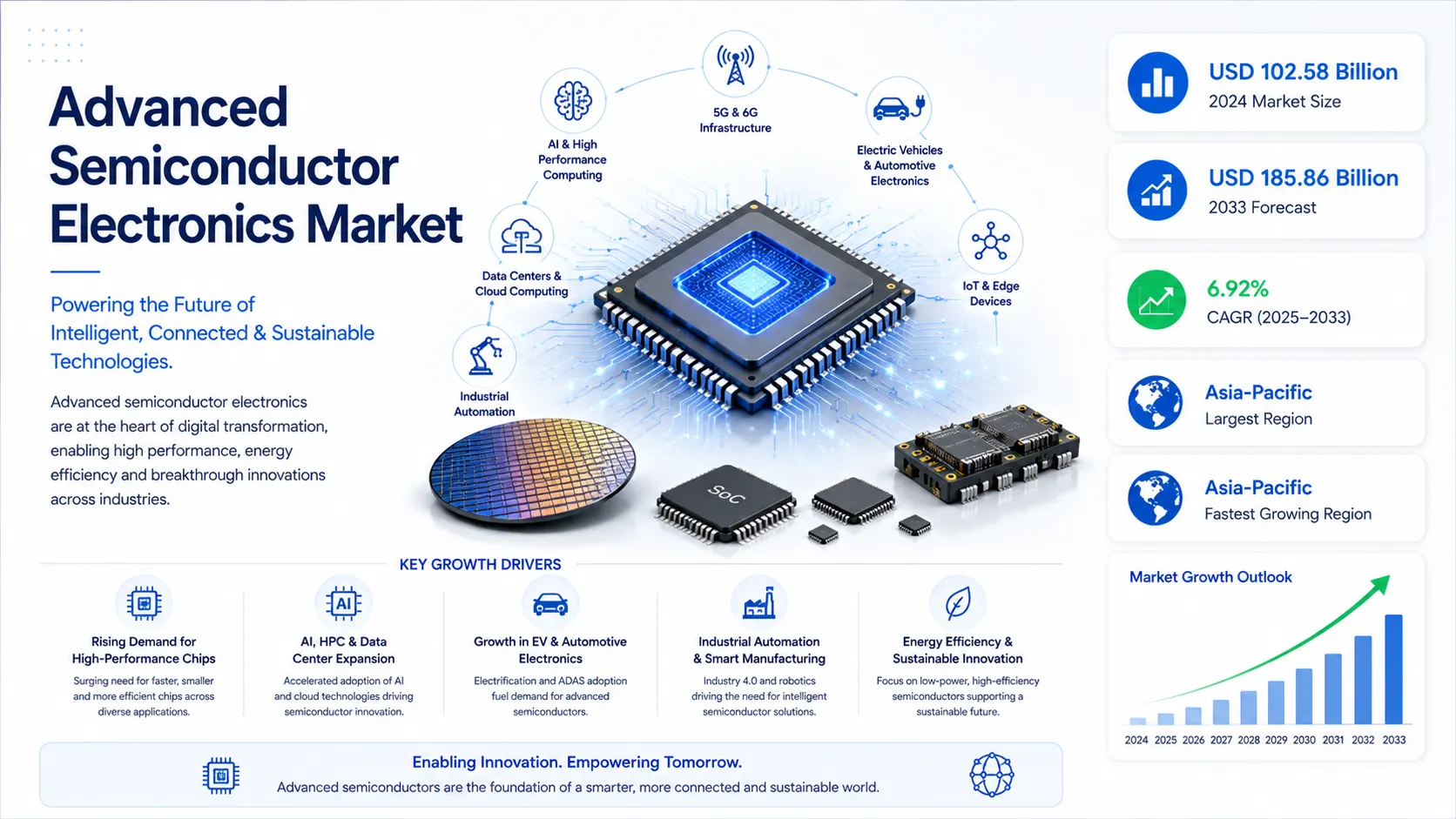
Semiconductors have quietly become the single most strategically important manufactured good on the planet. They sit inside the AI servers powering large language models, the traction inverters in electric vehicles, the radios connecting 5G and emerging 6G devices, and the sensors that let a factory floor run itself. According to the latest research from Intellectual Market Insights Research (IMI), the Advanced Semiconductor Electronics Market was valued at USD 425.8 billion in 2025 and is on track to nearly double to USD 891.4 billion by 2034, expanding at a CAGR of 8.3% between 2026 and 2034.
That growth is not evenly spread. It is concentrated in a handful of high-value categories: AI accelerators and GPUs, high-bandwidth memory (HBM), advanced packaging (2.5D/3D, chiplets, CoWoS), sub-3nm logic nodes, silicon carbide and gallium nitride power devices, and automotive-grade chips built for the electrification and software-defined-vehicle era. Industry data from WSTS shows the broader global semiconductor market grew more than 20% through the first three quarters of 2025, a pace few analysts expected even a year earlier, largely because AI data-center buildouts pulled forward demand for logic and memory simultaneously.
At the same time, the industry is navigating a genuinely unusual geopolitical moment. Export controls, tariff policy shifts, the U.S. government's equity stake in Intel, and aggressive capacity-building in China, the U.S., Japan, and the EU are reshaping where advanced chips get designed, fabricated, and packaged. Firms that once treated manufacturing location as a pure cost decision are now treating it as a risk-management decision.
This report from Intellectual Market Insights Research walks through the full picture: market sizing and segmentation, the drivers and restraints shaping near-term demand, a region-by-region breakdown, and — because no market report is complete without knowing who is actually building the technology — an in-depth look at the Top 20 companies leading the advanced semiconductor electronics space. We also map the market's closest adjacent categories, from semiconductor foundries to GaN power devices, so you can see how this market connects to the broader electronics and semiconductor ecosystem that Intellectual Market Insights Research covers.
Whether you are an investor sizing exposure to the AI infrastructure buildout, a supplier evaluating where to expand capacity, or a strategist tracking competitive positioning among chipmakers, this pillar guide is built to give you a decision-ready view of where the advanced semiconductor electronics market stands today — and where it's headed through 2034.
Market Overview
"Advanced semiconductor electronics" refers to the leading-edge segment of the broader chip industry: logic devices built on sub-7nm process nodes, advanced memory (HBM, DDR5, GDDR7), compound semiconductors (SiC, GaN) for power electronics, and the advanced packaging technologies (chiplets, 2.5D/3D integration, fan-out wafer-level packaging) required to keep performance scaling once traditional transistor shrinkage slows down.
The USD 425.8 billion 2025 base is dominated by logic and memory, but the fastest-growing sub-segments are AI accelerators, HBM, and advanced packaging — all of which are capacity-constrained today, which is itself a major reason capital expenditure across the industry has surged. Foundries such as TSMC and memory leaders like Samsung and SK Hynix have announced multi-year capacity expansions specifically tied to AI and HBM demand, while equipment suppliers (ASML, Applied Materials, Lam Research, KLA) are seeing order backlogs stretch well into 2027 for EUV lithography and advanced deposition/etch tools.
Market Dynamics
The market's core dynamic right now is a bifurcation between AI-linked demand (booming) and traditional end markets like PCs, smartphones, and automotive (comparatively flat to modestly recovering). Memory pricing has swung sharply upward through 2025 as DRAM and NAND capacity gets reallocated toward HBM for AI servers, squeezing supply for conventional memory used in consumer electronics. Meanwhile, foundry capacity at leading nodes remains tightly booked, giving pricing power to the handful of firms — chiefly TSMC — capable of manufacturing at 3nm and below.
Growth Drivers
- AI and data-center buildout: Hyperscalers' capital spending on AI accelerators, networking silicon, and HBM is the single largest demand driver in the market today.
- Automotive electrification and ADAS: The shift to EVs and advanced driver-assistance systems is driving demand for SiC/GaN power semiconductors, sensors, and automotive-grade microcontrollers — a trend also detailed in IMI's Global Automotive Semiconductor Market report.
- Advanced packaging as a performance lever: With Moore's Law scaling slowing, chiplets and 2.5D/3D packaging are becoming the primary route to performance gains.
- 5G/6G and edge computing: Continued network densification and edge AI inference are driving demand for RF front-end and low-power edge silicon.
- Government industrial policy: The U.S. CHIPS Act, EU Chips Act, and similar programs in Japan, India, and South Korea are subsidizing new fab capacity, pulling investment forward.
Top 20 Leading Companies in the Global Advanced Semiconductor Electronics Market
- Taiwan Semiconductor Manufacturing Company (TSMC)
- Samsung Electronics
- Intel Corporation
- NVIDIA Corporation
- Broadcom Inc.
- SK Hynix
- Qualcomm Incorporated
- Advanced Micro Devices (AMD)
- Texas Instruments Incorporated
- Micron Technology
- ASML Holding
- Applied Materials
- Lam Research Corporation
- KLA Corporation
- STMicroelectronics
- Infineon Technologies
- NXP Semiconductors
- MediaTek Inc.
- ON Semiconductor (onsemi)
- Renesas Electronics Corporation
Ranked by a blend of revenue, market share, technology leadership, and strategic significance to the advanced semiconductor value chain. Financial figures are approximate and based on the most recent publicly reported or estimated data as of mid-2026.
1. Taiwan Semiconductor Manufacturing Company (TSMC)
HQ: Hsinchu, Taiwan | Founded: 1987 TSMC is the world's largest dedicated semiconductor foundry and the clearest single point of leverage in the advanced chip supply chain, <cite index="4-1">controlling roughly 70% of global semiconductor foundry revenue in Q3 2025</cite>, generating over $33 billion in quarterly foundry revenue. It manufactures the most advanced logic chips in the world for customers including Apple, Nvidia, and AMD, and is aggressively expanding capacity in Arizona, Japan, and Germany. TSMC's leadership in sub-3nm nodes and CoWoS advanced packaging makes it the indispensable manufacturing partner for the AI accelerator boom, and its pricing power reflects that position.
2. Samsung Electronics
HQ: Suwon, South Korea | Founded: 1969 Samsung is a vertically integrated giant spanning memory (DRAM, NAND, HBM), foundry services, and system-on-chip design. <cite index="5-1,5-2">It ranked as the second-largest semiconductor supplier by revenue in Q3 2025 at roughly $23.9 billion</cite>, driven substantially by memory demand tied to AI servers. Samsung Foundry also competes with TSMC at leading-edge nodes, and the company continues to invest heavily in HBM4 and next-generation DRAM to capture AI-driven memory growth.
3. Intel Corporation
HQ: Santa Clara, California, USA | Founded: 1968 Intel remains a foundational name in semiconductor history, spanning CPU design, data-center processors, and its own foundry manufacturing arm, Intel Foundry. The company has faced a difficult multi-year transition as it works to regain leading-edge process parity, and in 2025 the U.S. government took a 10% equity stake in Intel to support continued domestic advanced manufacturing. Intel's strategy now centers on its 18A process node and expanding foundry customers beyond its own product lines.
4. NVIDIA Corporation
HQ: Santa Clara, California, USA | Founded: 1993 Nvidia has become the commercial face of the AI boom, and by several 2025 estimates <cite index="5-1">it was the dominant semiconductor supplier by revenue at roughly $57 billion in a single quarter</cite>, driven by data-center GPU demand. Its CUDA software ecosystem and full-stack AI infrastructure offering (GPUs, networking via Mellanox/NVLink, and systems) give it a defensible moat well beyond chip design alone. Nvidia's revenue growth through 2025 was overwhelmingly attributed to AI accelerator demand.
5. Broadcom Inc.
HQ: Palo Alto, California, USA | Founded: 1961 (as HP components division; modern Broadcom formed 2018) Broadcom combines custom AI ASIC design (for hyperscaler customers), networking silicon, and a large enterprise software business. It has emerged as a top-four semiconductor supplier by revenue, benefiting heavily from AI-driven networking and custom silicon demand, and its diversified infrastructure and software revenue base gives it more earnings stability than pure-play chipmakers.
Related Markets
Intellectual Market Insights Research covers a wide range of markets adjacent to advanced semiconductor electronics. Below are related categories worth exploring for deeper segment-level analysis:
- Global Automotive Semiconductor Market — chips for EVs, ADAS, and autonomous driving.
- Semiconductor Foundry Market — contract manufacturing capacity and economics.
- Semiconductor Etch Equipment Market — critical fabrication process equipment.
- GaN Power Device Market — wide-bandgap power semiconductors for EVs and renewables.
- MOSFET Relays Market — solid-state switching components.
- Analog and Mixed Signal Device Market — analog ICs underpinning sensing and power management.
- Next Generation Non-Volatile Memory Market — emerging memory technologies beyond DRAM/NAND.
- Display Driver Integrated Circuit Market — display-adjacent semiconductor demand.
- Flip Chip Market — advanced packaging and interconnect technology.
- Flat Panel Displays Market — a major downstream consumer of display driver semiconductors.
Key Industry Trends
- AI-first capacity planning: Foundries and memory makers are prioritizing AI-linked capacity (HBM, CoWoS packaging, leading-edge logic) over legacy product lines.
- Chiplet architectures: The shift from monolithic dies to chiplet-based designs is reshaping both chip design economics and packaging demand.
- Reshoring and regionalization: The U.S., EU, Japan, and India are all incentivizing domestic fab investment to reduce reliance on concentrated Asian manufacturing.
- Compound semiconductor adoption: SiC and GaN are moving from niche to mainstream in EV and industrial power applications.
- Consolidation of equipment supply: ASML, Applied Materials, Lam Research, and KLA continue to consolidate share in the tools required for leading-edge manufacturing.
Market Challenges
Balancing near-term AI-driven capital spending against the risk of over-capacity if AI infrastructure demand normalizes is the central strategic question facing equipment makers and foundries alike. Supply-chain resilience — reducing single points of failure in advanced packaging substrates, rare gases, and specialty chemicals — remains an unresolved structural challenge across the industry.
Segment Analysis
- By Component: Logic devices, memory (DRAM/NAND/HBM), analog & mixed-signal, discrete power semiconductors (SiC/GaN), sensors, and RF components.
- By Node/Technology: Leading-edge (≤5nm), mature nodes (7–28nm, still the volume workhorse for automotive and industrial), and compound semiconductors.
- By Packaging: Traditional wire-bond/flip-chip vs. advanced 2.5D/3D and chiplet-based packaging — the latter growing fastest.
- By Application: Data centers/AI servers, automotive, smartphones & consumer electronics, industrial & automation, telecommunications infrastructure, and aerospace & defense.
Regional Analysis
- Asia-Pacific remains the manufacturing epicenter, anchored by Taiwan (TSMC), South Korea (Samsung, SK Hynix), Japan (equipment and materials leadership), and rapidly scaling Chinese domestic capacity (SMIC, HuaHong).
- North America leads in chip design and AI silicon (Nvidia, AMD, Intel, Qualcomm, Broadcom) and is rebuilding domestic fabrication capacity under CHIPS Act incentives.
- Europe holds strength in semiconductor equipment (ASML) and automotive/industrial-grade chips (Infineon, STMicroelectronics, NXP), while pursuing its own Chips Act-driven capacity expansion.
- Rest of World, including India and Southeast Asia, is emerging as a hub for assembly, testing, and packaging, alongside growing design activity.
Frequently Asked Questions
1. What is the advanced semiconductor electronics market size in 2025? The market was valued at USD 425.8 billion in 2025, according to Intellectual Market Insights Research.
2. What is the projected market size by 2034? The market is projected to reach USD 891.4 billion by 2034, growing at a CAGR of 8.3% from 2026 to 2034.
3. Which company leads the advanced semiconductor foundry market? TSMC leads the foundry segment, controlling approximately 70% of global foundry revenue as of Q3 2025.
4. What is driving growth in the advanced semiconductor electronics market? AI data-center demand, advanced packaging, automotive electrification, and 5G/6G infrastructure are the primary growth drivers.
5. Which region dominates semiconductor manufacturing? Asia-Pacific, led by Taiwan and South Korea, dominates advanced semiconductor manufacturing, though the U.S., EU, and Japan are expanding domestic capacity.
6. What role does AI play in semiconductor demand? AI accelerators, HBM memory, and advanced packaging tied to AI servers have become the single largest growth driver in the industry as of 2025–2026.
7. What are the biggest restraints in this market? Extremely high capital costs for leading-edge fabs, geopolitical and export-control risk, and cyclicality in traditional end markets like PCs and smartphones.
8. What is the difference between advanced and mature-node semiconductors
9. Which companies lead in semiconductor manufacturing equipment?
10. How is the U.S.-China trade relationship affecting the semiconductor market
11. What is HBM and why does it matter
12. Are silicon carbide (SiC) and gallium nitride (GaN) part of this market
13. Is Intel still a leading semiconductor company?
14. Where can I access the full market research report? The full Global Advanced Semiconductor Electronics Market report is available from Intellectual Market Insights Research.
15. How reliable are semiconductor market forecasts given AI demand volatility? Forecasts carry more uncertainty than usual given how concentrated recent growth has been in AI-linked demand; analysts generally present a range of scenarios rather than a single fixed outcome for this reason.
Conclusion
The advanced semiconductor electronics market sits at the center of nearly every major technology trend shaping the next decade — AI, electrification, 5G/6G, and industrial automation. With the market projected to grow from USD 425.8 billion in 2025 to USD 891.4 billion by 2034, understanding competitive positioning among the leading foundries, chip designers, memory makers, and equipment suppliers is essential for investors, suppliers, and strategists alike.
For the complete data set — including detailed segmentation, country-level forecasts, and competitive benchmarking — explore the full Global Advanced Semiconductor Electronics Market Report from Intellectual Market Insights Research, or contact our research team for custom analysis tailored to your business needs.