Share this link via:

The global advanced semiconductor electronics market size was valued at USD 425.8 billion in 2025 and is projected to reach USD 468.2 billion in 2026, expanding to USD 891.4 billion by 2034, growing at a CAGR of 8.3% during the forecast period (2026-2034).
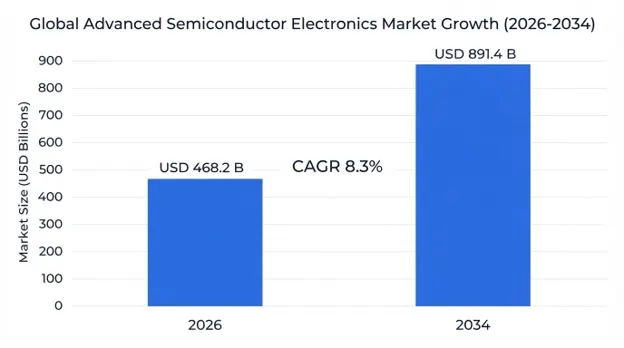
Advanced semiconductor electronics represent the most technologically advanced form of microelectronics manufacturing of microelectronics manufacturing, featuring the most advanced process nodes available today (less than 10 nanometers), advanced materials such as silicon carbide and gallium nitride, and novel packaging architectures and designs that offer a level of functional integration and energy efficiency that is unparalleled in semiconductor electronics history. These devices represent the core hardware building blocks of AI acceleration, autonomous vehicle technology, 5G and future 6G wireless systems, and high-performance computing in today's digital transformation spanning industries.
The market includes state-of-the-art logic processors fabricated on extreme ultraviolet (EUV) lithography with 3nm and 2nm process nodes and featuring gate-all-around (GAA) transistor designs; GAA technology is replacing conventional FinFET designs, delivering improved electrostatic control and lower leakage current. The memory technologies utilized encompass high bandwidth memory featuring 3-dimensional stacking architectures and a bandwidth greater than 3.2 terabytes per second, advanced DRAM architectures specifically geared for AI workloads, and next generation storage-class memory, that span the gap in performance between volatile and non-volatile memory.
Wide-bandgap materials are transforming power electronics and radio frequency applications, due to their ability to sustain high voltage, temperature, and switching frequencies, all while maintaining superior material properties. Silicon carbide power semiconductors are used in 800-volt automotive traction inverters, reducing charging time and increase drivetrain efficiency in electric vehicles, while Gallium nitride devices excel in power amplifiers for fast chargers, consumer electronics, EV charging systems, and 5G base stations. of consumer electronics and 5G base stations with their superior electron mobility and thermal performance.
Additionally, advanced packaging technologies such as 2.5 and 3D integration, chiplet and heterogeneous integration can enhance performance by optimizing interconnection between specialized dies produced at different process nodes and materials, complementing traditional process scaling. They solve the economic and technical constraints of monolithic scaling and can achieve system-level performance enhancements that will continue to advance computation beyond legacy Moore's law trends.
Applications are found in a wide range of technology areas that are also important for economic growth, with semiconductor content growing significantly across automotive platforms moving to electrification and automation; data center infrastructure supporting workloads for cloud and AI; telecommunications equipment for next-generation wireless connectivity. Governments are ramping up investment initiatives to create domestic manufacturing capacity and lessen reliance on geographically concentrated production facilities, and the market is responding to the key technology sovereignty issues.
| Report Coverage | Details |
|---|---|
| Base Year | 2025 |
| Base Year Value | USD 425.8 Billion |
| Forecast Value | USD 891.4 Billion |
| CAGR | 8.3% |
| Forecast Period | 2025-2034 |
| Historical Data | 2022-2025 |
| Largest Market | Asia Pacific |
| Fastest Growing Market | North America |
| Segments Covered | By Product Type, Technology Node, Material, Application, End-User |
| Region Covered | North America, Europe, Asia Pacific, Middle East & Africa, Latin America |
| Countries Covered | US, Canada, Mexico, Germany, France, UK, Netherlands, Japan, South Korea, Taiwan, China, India, Singapore, Australia, Brazil, UAE, Israel |
| Key Market Playes | TSMC, Samsung Electronics, Intel, NVIDIA, AMD, Qualcomm, Broadcom, ASML, Infineon, Texas Instruments |
Get more details on this report - Request Free Sample
The primary factor driving growth in the advanced semiconductor electronics market is the rapid growth in the number of artificial intelligence computing tasks that transform the dynamics of demand into categories such as logic, memory, and interconnect. The execution of tasks for training and inference using large language models requires immense parallel computing power, which can be provided only by GPUs, TPUs, and other custom AI accelerators that use tens of thousands of computer cores running in parallel on clusters of servers. The demand for frontier AI model training have been doubling every six months since 2020, thus outstripping the overall market expansion rate.
Contemporary AI accelerators necessitate the use of state-of-the-art process nodes below 5nm to deliver the required density of transistors and energy efficiency for viable AI model training and inference computations. Every AI training cluster used by hyperscale cloud providers utilizes several thousand sophisticated processors connected via high-bandwidth interconnects where each cluster has semiconductor content value more than USD 400 million at current component prices. The shift from centralized model training to decentralized inference execution generates further demand surges as AI technologies are being integrated into edge computing devices, autonomous solutions, and consumer devices needing inference capabilities.
High-bandwidth memory is one of the key semiconductor categories that is experiencing tremendous growth in demand since AI accelerators necessitate memory bandwidth more than 3.2 terabytes per second per processor which is possible only with 3D stacked memory die incorporated within processor packages. The mathematically predictable demand growth driven by the relation between AI models' parameters and memory is:
$$ ext {Memory Bandwidth Requirement} = ext {Model Parameters imes ext {Precision Bits imes ext {Utilization Factor} $$
The transition of the automotive industry to battery electric vehicles and software-defined vehicle platforms creates ongoing structural growth in automotive semiconductor demand which represents the largest end market trend in the history of the semiconductor industry. Semiconductors used in battery electric vehicles include USD 1,400-2,200 worth of semiconductors per vehicle while in conventional internal combustion engine vehicles the value of semiconductor content is only USD 520. Wide bandgap semiconductors built using silicon carbide materials are witnessing high automotive semiconductor demand growth as the efficiency of traction inverters based on silicon carbide technology is 94-97% compared to only 88-92% for silicon-based products. Adoption of silicon carbide semiconductors in automotive applications results in the following system level advantages justifying higher cost of devices:
$$ ext {EV Semiconductor Content} = ext {Powertrain Electronics} + ext {ADAS Computing} + ext {Infotainment Systems} + ext {Body Electronics} $$
The development of ADAS technologies needs state-of-the-art sensor fusion computing platforms that combine information from radar, lidar, cameras, and ultrasonic sensors using AI inferencing chips. Level 2 automated systems utilize semiconductor value of USD 420, while level 3 automated vehicles will need a semiconductor value of USD 1,180 due to exponential growth in computational needs with automation capabilities.
The most important factor constraining the growth of the advanced semiconductor industry is the huge financial outlay required for state-of-the-art manufacturing facilities, which poses high barriers for competitive participation and keeps manufacturing capacity concentrated in only a few companies having the capability to finance it. Manufacturing facilities for producing semiconductors at process nodes of 3-5 nm will require an investment of USD 18-25 billion for building and equipping the plant, with operating costs of more than USD 3.2 billion per annum.
The cost of an advanced lithographic machine is another unique challenge where the cost of EUV scanner ranges between USD 180-350 million and its delivery time frame takes up to 12-18 months from ASML that is the only worldwide manufacturer. To have a fab with the ability to produce chips the number of machines should be about 15-20 units with total cost more than USD 4 billion.
This level of capital intensity results in the requirement for economically efficient leading-edge manufacturing processes that operate at a utilization rate of more than 85%, as well as the requirement for sufficiently large numbers of customers capable of amortizing costs on millions of wafers per year, which is possible only by firms addressing global markets on a huge scale.
Several market opportunities can be observed in advanced packaging technologies for chiplet architecture that disaggregates highly complicated integrated circuits into function-specific die fabricated at best-suited nodes and reconnected through advanced packaging technologies. It deals with overcoming both economic and technological constraints involved with scaling all the functionalities on leading edge nodes, thus allowing computing functionality to be scaled using 3 nanometers while memory, analog, and RF functions are scaled on best-suited mature nodes.
Advanced packaging technologies support die-to-die communication with bandwidths exceeding 10 terabytes per second with reduced power usage of 65-80% per bit transferred compared to traditional package interconnect solutions. The chiplet paradigm needs standardization of interfaces that can support multi-vendor interoperability and IP licensing opportunities.
Governments worldwide are aggressively investing in domestic semiconductor manufacturing to strengthen technology sovereignty and reduce supply chain dependence. at an unprecedented scale, with both countries investing heavily in domestic production and building the industry.National governments are aggressively promoting semiconductor manufacturing investments in their countries, with both nations heavily investing in the industry and increasing domestic production. The CHIPS and Science Act in the United States has pledged the semiconductor industry with USD 52.7 billion in support, which is expected to bring the investment of USD 200+ billion into the semiconductor manufacturing industry by 2030 by TSMC, Samsung, Intel, and Micron.
Other programs are being implemented in Europe, Japan, India and elsewhere, and are building parallel manufacturing capacity that is reshaping the global manufacturing landscape. These investments generate long-term demand for semiconductor manufacturing equipment, materials and construction services, and open new competitive dynamics as manufacturing capability spreads to other regions.
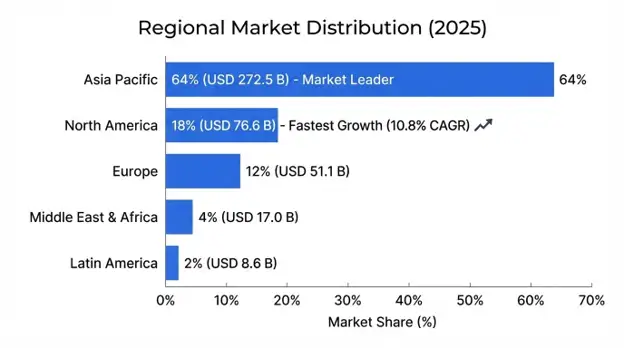
Asia Pacific is the leading regional market in the global advanced semiconductors market with a 64% market share valued at USD 272.5 billion in 2025, driven by decades of sustained manufacturing investments. over five decades through industry policy support. Taiwan Semiconductor Manufacturing Company accounts for about 53% of the revenue of global semiconductors and more than 90% of semiconductors produced using processes smaller than 7 nanometers.
South Korean companies, including Samsung Electronics and SK Hynix,, accounting for about 68% of global production of DRAM chips and 48% of production of NAND flash memory chips. Japan retains strategic control of the semiconductor industry's material sector and equipment sector, with Japanese firms controlling between 60%-85% of global supplies of photoresists, CMP slurries, and specialty gases.
North America is projected to be the fastest-growing regional market with the estimated CAGR rate of 10.8% until 2034 due to unprecedented government-led manufacturing investment in restoring production capabilities in the country. Investments have been motivated by the signing of the CHIPS Act that led to the establishment of state-of-the-art manufacturing capabilities in terms of TSMC plants in Arizona operating at 4 nm node technology, Intel expansion with 18A process technology, and Texas facility by Samsung.
Investments exceeding USD 240 billion position North America as a competitive region in terms of manufacturing advanced semiconductors for the first time after the 1990s. Growth is facilitated by high domestic demand for semiconductors in data centers, automobiles, aerospace, and defense sectors.
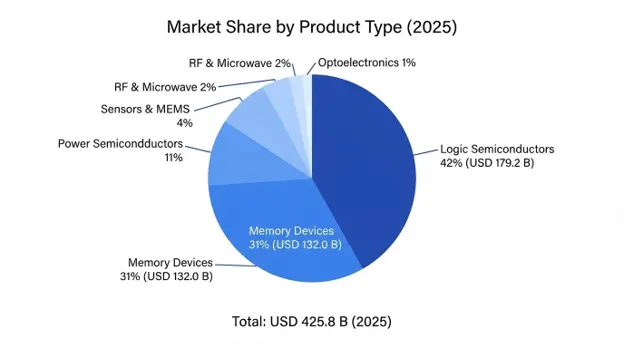
Logic Semiconductors have a high market share of 42% with USD 179.2 billion in value by 2025, recording a 9.1% CAGR till 2034. The category includes microprocessors, graphics processing units, AI accelerators, and application-specific integrated circuits produced using cutting-edge technologies. High prices of logic semiconductors are due to the expensive development and production process:
$$ ext {Logic Semiconductor ASP} = frac ext {Development Costs} + ext {Manufacturing Costs} + ext {Target Margin ext {Volume}} $$
Memory Devices accounted for 31% market share at USD 132.0 billion in 2025, including DRAM, NAND flash, and high-bandwidth memory serving data storage and computational bandwidth requirements across computing and mobile applications.
Technology nodes below 5 nm represent the largest market segment in 2025 with a value of USD 156.8 billion and 12.4% CAGR to 2034 due to the higher cost associated with leading edge products based on gate-all-around transistors. The only players in this segment are TSMC, Samsung Electronics, and Intel with their 18A process.
Market concentration varies across advanced semiconductor segments, ranging from monopolistic positions held by some companies in extreme ultraviolet lithography equipment to strong competition found among mature node components. Differentiation between competing firms is achieved through leading process technologies, production capability, design environment creation, and deep relationships with customers.
March 2026: TSMC launched volume manufacturing of its N2P process node technology that uses backside power delivery networks to deliver an 8% performance boost compared to traditional N2 process node technology with Apple and NVIDIA being its major customers.
February 2026: Intel Corporation qualified its Intel 18A process that uses RibbonFET gate-all-around transistors and announced Microsoft as its first third-party foundry customer in Q3 2026.
January 2026: Samsung Electronics achieved a breakthrough in yield optimization in the 2-nanometer node aimed at initiating volume production in Q2 2026 with automotive and AI accelerator applications announced.
December 2025: NVIDIA unveiled a new generation of AI accelerators with four-point-two times better performance compared to the previous one and with 276 gigabytes of high-bandwidth memory in each module.
November 2025: Wolfspeed finished the establishment of the 200-millimeter silicon carbide fabrication plant with an investment of USD 6.2 billion and being the largest wide bandgap manufacturing plant in the world.
You'll get the sample you asked for by email. Remember to check your spam folder as well. If you have any further questions or require additional assistance, feel free to let us know via-
+1 724 648 0810 +91 976 407 9503 sales@intellectualmarketinsights.com
03 Jul 2026
Intellectual Market Insights Research © 2026. All rights reserved.