
Europe Cybersecurity Market: Top 20 Leading Companies, Size, Trends & Forecast to 2034
Author:
Intellectual Market Insights Research
Published Date:
15 Jul 2026
Introduction
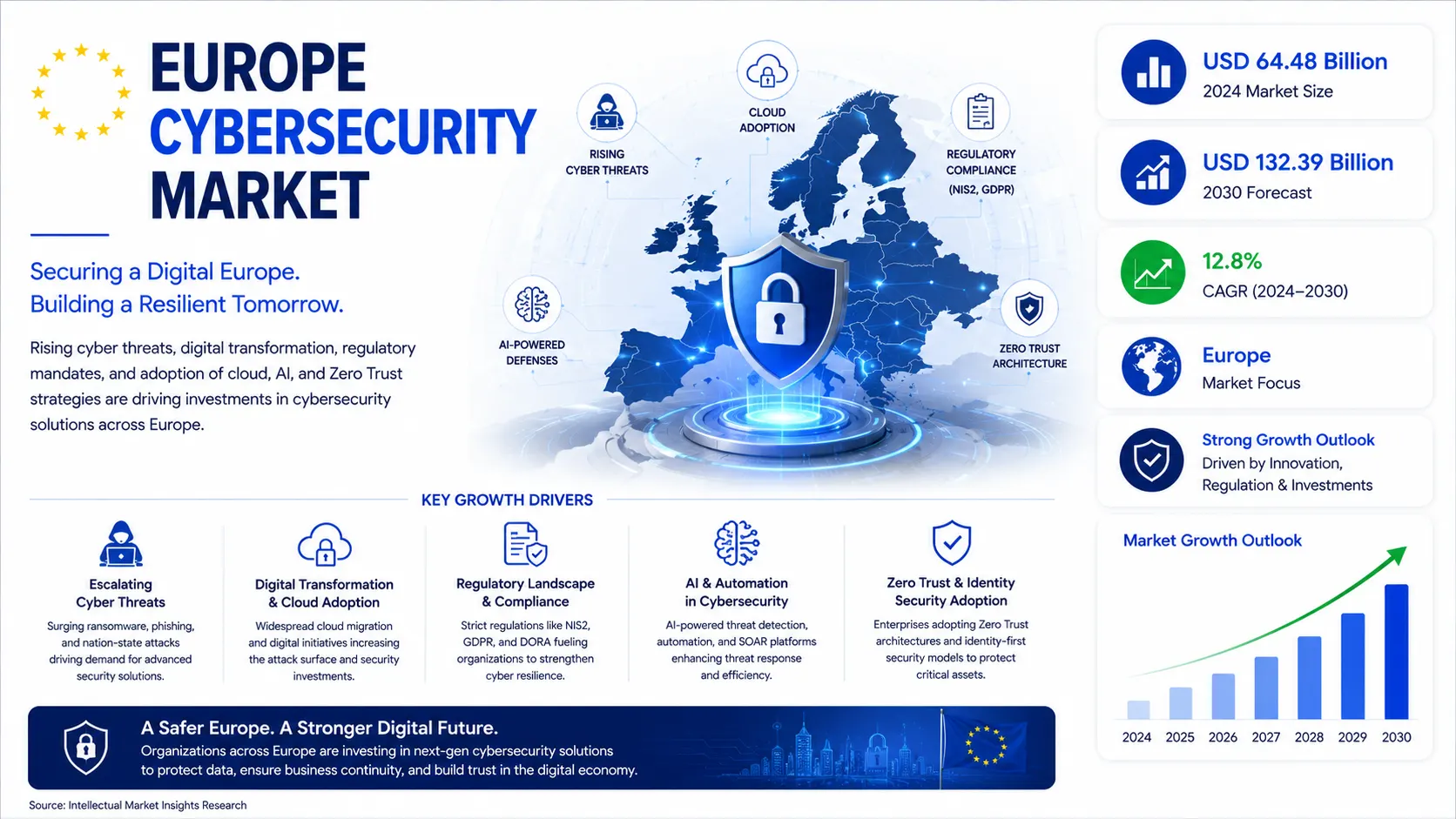
Europe's cybersecurity industry has moved from a discretionary IT line item to a board-level, regulator-mandated priority. According to the Europe Cybersecurity Market report by IMIR Market Research Pvt. Ltd., the market was valued at approximately USD 81.81 billion in 2025 and is projected to reach USD 165.73 billion by 2034, growing at a CAGR of 8.2% across the forecast period. Independent estimates broadly confirm this trajectory: analyst house Mordor Intelligence pegs the 2026 market at roughly USD 69.82 billion with a path toward USD 115.66 billion by 2031, while the EU-focused CBI market brief places 2025 revenue near €67 billion, rising toward €172 billion by 2033. The spread across estimates reflects differing methodologies and currency assumptions, but the direction is unanimous — Europe's cyber-defense spending is compounding at a double-digit-adjacent pace for the remainder of the decade.
What is driving this? Two regulatory instruments dominate the conversation: the NIS2 Directive, in force since October 2024, which expanded mandatory cybersecurity obligations to more than 160,000 European entities across 18 critical sectors, and the Digital Operational Resilience Act (DORA), applicable since January 2025, which forces banks, insurers, and financial ICT vendors to prove operational resilience rather than simply report a data breach after the fact. Layer on the General Data Protection Regulation (GDPR), the incoming Cyber Resilience Act (CRA), and eIDAS 2.0 digital-identity requirements, and it becomes clear why security spending in regulated European industries has shifted from "nice to have" to compulsory operating cost — commonly cited at around 9% of enterprise IT budgets.
The market is not just growing because of compliance, though. The Russia-Ukraine conflict has been linked to a roughly 30% rise in ransomware incidents targeting European organizations, and manufacturing alone saw an 84% jump in attack volume during early 2025, with average breach costs exceeding USD 5.5 million. At the same time, enterprises are racing toward sovereign cloud infrastructure, Zero Trust network architectures, and AI-powered threat detection to keep pace with increasingly automated attackers.
This has created a genuinely two-speed competitive landscape: American and global platform vendors — Cisco Systems, IBM, Palo Alto Networks, Fortinet, and Broadcom among them — continue to anchor large enterprise and telecom deployments, while a fast-growing cluster of Europe-headquartered specialists (Darktrace, Bitdefender, ESET, Thales, Orange Cyberdefense, WithSecure) is winning share on data-sovereignty grounds and deep regulatory fluency. This article profiles the Top 20 companies competing across both camps, followed by segment, component, and regional breakdowns of where Europe's cyber-defense investment is actually flowing.
Europe Cybersecurity Market Overview
The Europe Cybersecurity Market covers software, hardware, and services used to protect networks, endpoints, cloud workloads, IoT devices, and connected vehicles from cyber threats. It was valued at approximately USD 81.81 billion in 2025 and is forecast to reach USD 165.73 billion by 2034 at a CAGR of 8.2%, driven by regulatory enforcement, ransomware pressure, and cloud-security adoption.
The market spans solutions (roughly two-thirds of spend, per third-party estimates) such as firewalls, endpoint detection and response (EDR), identity and access management, and cloud security posture management, alongside a fast-growing services layer — managed detection and response (MDR), incident response retainers, and compliance consulting — expanding even faster than product revenue as enterprises outsource day-to-day security operations to offset a persistent cybersecurity talent shortage, estimated at close to 300,000 unfilled roles across the EU.
Key Takeaway: Regulation, not just threat volume, is now the primary demand lever for European cybersecurity spend.
Market Growth Drivers
Growth is driven by mandatory compliance under NIS2 and DORA, rising ransomware and nation-state activity linked to regional geopolitical tensions, accelerating cloud and hybrid-IT adoption, and expanding OT/IT convergence across manufacturing and energy.
- Regulatory enforcement: NIS2 and DORA convert cybersecurity from a discretionary budget line into a legal obligation, with penalties reaching up to €10 million or 2% of global turnover for non-compliance.
- Ransomware and geopolitical risk: European organizations have experienced a marked rise in ransomware activity, pushing boards to fund continuous monitoring and incident-response capability rather than one-time audits.
- Cloud and hybrid infrastructure growth: Migration to public, private, and sovereign clouds is expanding the attack surface and driving demand for cloud-native security controls.
- 5G and IoT proliferation: Private 5G rollouts in German and Nordic manufacturing hubs, along with connected-vehicle and wearable-device growth, are creating new endpoints that require protection.
- Digital-identity mandates: The eIDAS 2.0 digital wallet framework is generating fresh demand for authentication, certificate lifecycle management, and Zero Trust identity tooling.
Market Restraints
High compliance costs, a persistent cybersecurity skills shortage, and fragmented national regulatory interpretation across EU member states restrain faster market expansion, particularly for small and mid-sized enterprises.
Achieving full NIS2 alignment can cost mid-sized firms up to roughly €2 million, a burden that weighs heavily on organizations in Southern and Central-Eastern Europe where IT budgets remain comparatively tight. The EU faced an estimated shortage of close to 300,000 cybersecurity professionals, complicating in-house implementation and pushing many buyers toward managed services rather than owned infrastructure. Fragmented transposition of EU directives into national law also means multinational buyers must navigate slightly different requirements country by country, slowing procurement cycles.
Market Opportunities
Key opportunities include managed security services for compliance-burdened SMEs, sovereign cloud security offerings, AI-driven threat detection platforms, and post-quantum cryptography readiness.
Vendors that can package NIS2 and DORA compliance evidence collection into a single subscription — rather than requiring enterprises to stitch together point products — stand to capture disproportionate share of the fast-growing services segment. Insurers entering the region with bundled cyber-policy-plus-security-service offerings (for example, Coalition's expansion into Germany) also signal a new distribution channel for prevention-oriented vendors. Longer term, quantum-safe cryptography roadmaps are becoming a genuine differentiator as regulated entities begin planning migration away from classical encryption.
Market Challenges
Vendor consolidation, alert fatigue from fragmented toolchains, and the difficulty of proving measurable resilience — rather than just compliance box-ticking — remain the sector's core operational challenges.
Enterprises running a dozen or more overlapping point solutions increasingly struggle with console fragmentation, slowing incident response and complicating audit evidence collection. Meanwhile, regulators are shifting emphasis from "did you buy a tool" to "can you demonstrate tested resilience," which raises the bar for managed-service providers and increases the operational complexity of compliance programs.
Market Dynamics
The Europe Cybersecurity Market is characterized by rapid vendor consolidation, growing preference for European or EU-hosted data-sovereign solutions, and a decisive shift of buyer priority from prevention alone to prevention plus proven incident-response readiness.
Suppliers are acquiring incident-response and managed-services firms to round out end-to-end offerings, while buyers — especially in financial services and critical infrastructure — increasingly favor vendors that can demonstrate in-region operations, sovereign deployment options, and repeatable managed-service performance across multiple European jurisdictions.
Top 20 Leading Companies in the Europe Cybersecurity Market
|
Rank |
Company |
Headquarters |
Primary Security Focus |
Key Industries Served |
|---|---|---|---|---|
|
1 |
Broadcom (Symantec) |
USA |
Endpoint Security, DLP |
Government, BFSI, Enterprise |
|
2 |
Cisco Systems |
USA |
Network Security, SASE, Zero Trust |
Telecom, Healthcare, Government |
|
3 |
Check Point Software |
Israel |
Network Security, Firewall |
Government, Telecom, Enterprise |
|
4 |
IBM Security |
USA |
SIEM, Threat Intelligence, Consulting |
BFSI, Healthcare, Public Sector |
|
5 |
Palo Alto Networks |
USA |
NGFW, XDR, Cloud Security |
Large Enterprises |
|
6 |
Fortinet |
USA |
Security Fabric, SD-WAN |
Manufacturing, Utilities |
|
7 |
CrowdStrike |
USA |
Endpoint Detection & Response |
Enterprise, Cloud |
|
8 |
Thales Group |
France |
Encryption, Identity Security |
Defense, Government |
|
9 |
Eviden (Atos) |
France |
Managed Security Services |
Public Sector |
|
10 |
Darktrace |
UK |
AI Threat Detection |
Enterprise |
|
11 |
Sophos |
UK |
MDR, Endpoint Protection |
SMEs |
|
12 |
Bitdefender |
Romania |
Endpoint & MDR |
Enterprise, Consumer |
|
13 |
ESET |
Slovakia |
Endpoint Security |
SMEs |
|
14 |
Orange Cyberdefense |
France |
Managed SOC Services |
Telecom, Enterprise |
|
15 |
WithSecure |
Finland |
Co-Security, MDR |
Public Sector |
|
16 |
Rohde & Schwarz Cybersecurity |
Germany |
High Assurance Security |
Defense |
|
17 |
secunet Security Networks |
Germany |
Government Security |
Public Administration |
|
18 |
Trend Micro |
Japan |
Cloud Security, XDR |
Enterprise |
|
19 |
SentinelOne |
USA |
AI Autonomous Security |
Cloud Enterprises |
|
20 |
Gen Digital |
USA |
Consumer & SME Security |
SMB |
1. Broadcom Inc. (Symantec Enterprise Security)
Company Overview
|
Particular |
Details |
|---|---|
|
Headquarters |
San Jose, California, USA |
|
Founded |
1961 (Symantec Enterprise Security acquired in 2019) |
|
Core Business |
Enterprise Cybersecurity Software |
|
Key Solutions |
Endpoint Security, Data Loss Prevention (DLP), Email Security, Web Security, Cloud Security |
|
Target Industries |
Government, BFSI, Healthcare, Manufacturing, Telecom, Defense |
|
Europe Presence |
Germany, France, UK, Italy, Netherlands, Spain and other European countries |
Broadcom Inc., through its Symantec Enterprise Security division, is one of the leading cybersecurity providers in the Europe Cybersecurity Market. The company offers advanced enterprise security solutions designed to protect organizations against ransomware, phishing attacks, insider threats, malware, and sophisticated cyberattacks. Its comprehensive security portfolio supports endpoint protection, cloud workload security, identity management, and data protection, making it a preferred vendor for large enterprises and government organizations across Europe.
Following the acquisition of Symantec's Enterprise Security business and VMware, Broadcom has strengthened its position by integrating cybersecurity with virtualization, networking, and cloud infrastructure. This integrated platform enables enterprises to simplify IT management while improving cyber resilience across hybrid and multi-cloud environments.
European organizations increasingly rely on Broadcom to meet regulatory requirements such as GDPR, NIS2, and DORA. The company continues investing in AI-powered threat detection, automated incident response, and Zero Trust security architecture to enhance enterprise security operations. Its strong customer base, extensive threat intelligence network, and long-standing relationships with regulated industries provide Broadcom with a significant competitive advantage in the European cybersecurity landscape.
Key Strengths
- Comprehensive endpoint and data protection portfolio
- Strong presence in government and financial sectors
- Advanced AI-powered threat intelligence
- Robust Data Loss Prevention (DLP) capabilities
- Integration with VMware cloud ecosystem
- Strong regulatory compliance support for GDPR, NIS2, and DORA
Strategic Focus
- AI-driven cybersecurity automation
- Platform consolidation
- Zero Trust security implementation
- Cloud-native security expansion
- Data protection modernization
- Hybrid cloud security solutions
2. Cisco Systems, Inc.
Company Overview
|
Particular |
Details |
|---|---|
|
Headquarters |
San Jose, California, USA |
|
Founded |
1984 |
|
Core Business |
Network Security & Enterprise Cybersecurity Solutions |
|
Key Solutions |
Secure Firewall, Secure Access (SASE), Duo Identity Security, XDR, Secure Endpoint, Cisco Umbrella |
|
Target Industries |
Telecom, BFSI, Government, Healthcare, Manufacturing, IT & Cloud Services |
|
Europe Presence |
United Kingdom, Germany, France, Italy, Spain, Netherlands, Belgium and other European countries |
Cisco Systems is one of the most influential cybersecurity companies in the Europe Cybersecurity Market due to its strong presence in networking infrastructure and enterprise security. The company provides an integrated cybersecurity portfolio that combines network protection, cloud security, endpoint security, identity management, Zero Trust architecture, and AI-powered threat intelligence into a unified security ecosystem.
Cisco's cybersecurity solutions are widely deployed by telecommunications providers, government agencies, financial institutions, healthcare organizations, and multinational enterprises throughout Europe. Its Secure Access Service Edge (SASE), Secure Firewall, Duo Identity Security, Cisco XDR, and Umbrella platforms enable organizations to secure hybrid workforces, cloud environments, and distributed networks while improving operational efficiency.
As European organizations accelerate digital transformation, Cisco continues investing in AI-driven threat detection, automation, and predictive security analytics. The company is also expanding its Security Cloud platform and Hypershield architecture to help enterprises comply with evolving regulations such as GDPR, NIS2, and DORA while reducing cyber risks across complex IT environments.
Key Strengths
- Strong leadership in network security
- Comprehensive Zero Trust architecture
- Advanced AI-driven threat detection
- Large enterprise and telecom customer base
- Integrated cloud and hybrid security platform
- Extensive global partner ecosystem
Strategic Focus
- AI-native cybersecurity
- Zero Trust implementation
- Secure Access Service Edge (SASE)
- Cloud security expansion
- Security automation
- Unified security platform
3. Check Point Software Technologies Ltd.
Company Overview
|
Particular |
Details |
|---|---|
|
Headquarters |
Tel Aviv, Israel |
|
Founded |
1993 |
|
Core Business |
Enterprise Network & Cloud Cybersecurity |
|
Key Solutions |
Quantum Firewalls, Infinity Platform, CloudGuard, Harmony Endpoint, ThreatCloud AI |
|
Target Industries |
Government, Telecom, BFSI, Manufacturing, Energy, Healthcare |
|
Europe Presence |
Germany, France, United Kingdom, Italy, Spain, Netherlands and major European markets |
Check Point Software Technologies has established itself as one of the most trusted cybersecurity providers in Europe through its prevention-first cybersecurity approach and unified security architecture. The company delivers comprehensive protection across networks, cloud environments, endpoints, mobile devices, and Internet of Things (IoT) infrastructure using its Infinity Platform.
The company's AI-powered ThreatCloud intelligence platform continuously analyzes global cyber threats to proactively prevent ransomware, phishing attacks, advanced persistent threats (APTs), and zero-day vulnerabilities before they impact organizations. Check Point's integrated management platform simplifies cybersecurity operations by providing centralized visibility, policy management, and automated threat prevention.
European enterprises, telecom operators, financial institutions, and government organizations continue to adopt Check Point's solutions because of their reliability, high detection accuracy, and strong compliance capabilities. The company continues investing in SASE, cloud-native security, AI-powered prevention technologies, and Zero Trust security frameworks to strengthen its competitive position within the Europe Cybersecurity Market.
Key Strengths
- Prevention-first cybersecurity approach
- Unified Infinity security platform
- Industry-leading firewall technology
- AI-powered ThreatCloud intelligence
- Strong government and telecom presence
- Excellent compliance and centralized management
Strategic Focus
- AI-powered threat prevention
- Cloud-native application security
- SASE expansion
- Zero Trust architecture
- Unified security management
- Hybrid cloud protection
Segment Analysis
The Europe Cybersecurity Market is segmented by connected-device/technology and end-use component, reflecting the growing need for advanced cybersecurity solutions across critical infrastructure, digital enterprises, and connected ecosystems. Increasing cyber threats, rapid digital transformation, cloud adoption, and stringent regulations such as GDPR, NIS2, DORA, and the Cyber Resilience Act continue to drive demand across all market segments.
By Segment
IoT Devices
IoT device security focuses on protecting connected sensors, industrial equipment, smart home devices, and enterprise IoT ecosystems from cyber threats. Growing Industry 4.0 adoption across manufacturing, energy, and utilities is significantly increasing demand for IoT security solutions. Vendors are investing in AI-powered monitoring, endpoint protection, and real-time threat detection to secure connected devices.
Process Control Systems (PCS)
Process Control System security safeguards industrial control systems (ICS), SCADA networks, and operational technology (OT) environments used in power generation, manufacturing, water treatment, and critical infrastructure. Rising cyberattacks on industrial facilities and stricter NIS2 compliance requirements are accelerating investments in OT cybersecurity and industrial network protection.
Mobiles/Network
This segment includes firewalls, Secure Access Service Edge (SASE), Zero Trust Network Access (ZTNA), Extended Detection and Response (XDR), VPNs, and mobile device management solutions. The widespread adoption of hybrid work, cloud computing, and digital workplaces has made mobile and network security one of the largest revenue-generating segments in Europe.
Connected TV
Connected TV security protects smart televisions, streaming devices, and connected entertainment platforms against malware, unauthorized access, and privacy breaches. The increasing adoption of smart consumer electronics and compliance with the EU Cyber Resilience Act are expected to support steady market growth.
Wearables
Wearable cybersecurity secures smartwatches, fitness trackers, healthcare monitoring devices, and connected medical wearables. As healthcare organizations increasingly rely on connected medical technologies, the need for secure data transmission and patient privacy continues to drive this segment.
Connected Car
Connected car cybersecurity protects vehicle networks, telematics, over-the-air (OTA) software updates, infotainment systems, and Vehicle-to-Everything (V2X) communications. Rapid advancements in connected, electric, and autonomous vehicles are making automotive cybersecurity one of the fastest-growing segments within the European cybersecurity market.
Key Takeaway: IoT Devices, Process Control Systems, and Connected Car security are expected to register the highest growth due to increasing digital connectivity, Industry 4.0 adoption, and the expanding attack surface across critical infrastructure and smart mobility.
By Component
IT & Telecom
The IT & Telecom sector remains the largest consumer of cybersecurity solutions due to extensive cloud adoption, digital infrastructure expansion, and increasing cyber risks. Organizations continue investing in network security, identity management, cloud security, and AI-powered threat detection platforms.
BFSI
The Banking, Financial Services, and Insurance (BFSI) sector represents one of the fastest-growing end users, driven by DORA compliance, increasing digital banking adoption, and the need to secure financial transactions, customer data, and payment infrastructures against sophisticated cyber threats.
Healthcare
Healthcare organizations are significantly increasing cybersecurity investments to protect electronic health records (EHRs), connected medical devices, hospital networks, and patient information. Rising ransomware attacks and strict healthcare data privacy regulations continue to fuel market growth.
Defense & Government
Government agencies and defense organizations require highly secure, sovereign-grade cybersecurity solutions to protect classified information, national infrastructure, and public services. Increasing geopolitical tensions and cyber warfare risks continue to strengthen cybersecurity spending across this sector.
Automotive
The automotive industry is witnessing rapid cybersecurity adoption as manufacturers develop connected vehicles, electric vehicles (EVs), autonomous driving technologies, and smart manufacturing facilities. Securing vehicle communication systems and production networks has become a strategic priority.
Retail & Others
Retail, e-commerce, education, manufacturing, and other industries are increasingly deploying cloud-based cybersecurity solutions to secure customer data, online transactions, supply chains, and digital business operations while minimizing operational risks.
Key Takeaway: IT & Telecom continues to dominate the Europe Cybersecurity Market, while BFSI and Healthcare are projected to experience the fastest growth, supported by stringent regulatory requirements, digital transformation initiatives, and the rising frequency of cyberattacks across critical sectors.
Regional Analysis
Direct answer: Within Europe, the United Kingdom leads with roughly 22–23% market share, followed by Germany, France, and the Nordics, while the Netherlands is projected to post the fastest regional CAGR through 2031. Globally, North America remains the largest overall cybersecurity market, with Asia-Pacific the fastest-growing region outside Europe.
United Kingdom
The UK is Europe's largest national cybersecurity market, with total sector revenue estimated near €10.36 billion in 2025 and roughly 2,165 dedicated cybersecurity companies as of 2024, concentrated around London and the South East. Government-backed national cyber-resilience initiatives and a dense fintech ecosystem sustain demand for both product and managed-service spend.
Germany, France, and DACH
Germany and France anchor continental European demand, propelled by NIS2 transposition, sovereign-cloud initiatives, and strong government procurement for certified, high-assurance solutions. The DACH region (Germany, Austria, Switzerland) is frequently cited as facing one of the largest compliance-driven spending waves in Europe as DORA and NIS2 obligations phase in for mid-market financial and industrial firms.
Netherlands and Benelux
The Netherlands is projected to register the fastest CAGR among major European markets through 2031, supported by a dense data-center ecosystem, advanced digital-government infrastructure, and early adoption of Zero Trust architectures.
Nordics
The Nordic countries combine high digital-maturity enterprises with strong homegrown vendors — WithSecure among them — and consistently rank among the earliest adopters of managed detection and response services in Europe.
Southern and Central-Eastern Europe
Southern Europe and CEE markets show strong percentage growth off a smaller base, though NIS2 compliance costs weigh disproportionately on mid-sized firms in these regions given comparatively tighter IT budgets.
North America (Global Context)
North America remains the largest cybersecurity market worldwide by absolute revenue, underpinned by concentrated hyperscaler and enterprise-security spend, though its growth rate now trails Europe's compliance-accelerated trajectory.
Asia-Pacific (Global Context)
Asia-Pacific is expanding rapidly on the back of digital-economy growth in China, India, Japan, and South Korea, and is closely watched by European vendors expanding through the broader Cybersecurity Market as a template for regulatory-driven demand curves outside the EU.
Key Takeaway: The UK, Germany, and France collectively anchor European cybersecurity demand, while the Netherlands offers the fastest growth rate through 2031.
Frequently Asked Questions
1. How big is the Europe Cybersecurity Market in 2025? The Europe Cybersecurity Market was valued at approximately USD 81.81 billion in 2025, according to IMIR Market Research, with independent estimates from other analyst firms ranging between roughly USD 63 billion and USD 82 billion depending on methodology and currency assumptions.
2. What is the projected size of the Europe Cybersecurity Market by 2034? The market is projected to reach USD 165.73 billion by 2034, growing at a compound annual growth rate (CAGR) of 8.2% from 2025 to 2034.
3. What is driving growth in the Europe Cybersecurity Market? Growth is primarily driven by mandatory compliance under the NIS2 Directive and DORA, rising ransomware and geopolitical-linked cyberattacks, accelerating cloud adoption, and expanding IoT and connected-vehicle attack surfaces.
4. What is the NIS2 Directive and how does it affect cybersecurity spending? NIS2 is an EU directive, effective since October 2024, that expanded mandatory cybersecurity requirements to more than 160,000 entities across 18 critical sectors, with penalties of up to €10 million or 2% of global turnover for non-compliance, making cybersecurity a compulsory operating cost for regulated organizations.
5. What is DORA and which industries does it affect? The Digital Operational Resilience Act (DORA), applicable since January 2025, requires banks, insurers, investment firms, and critical ICT third-party providers across the EU to demonstrate operational resilience, incident-reporting capability, and third-party risk management.
6. Which country has the largest cybersecurity market in Europe? The United Kingdom is Europe's largest national cybersecurity market by revenue, estimated near €10.36 billion in 2025, followed by Germany and France.
7. Which companies lead the Europe Cybersecurity Market? Leading companies include Broadcom, Cisco Systems, Check Point Software Technologies, IBM, Palo Alto Networks, Fortinet, CrowdStrike, Thales, Eviden (Atos), Darktrace, Sophos, Bitdefender, ESET, Orange Cyberdefense, WithSecure, Rohde & Schwarz Cybersecurity, secunet, Trend Micro, SentinelOne, and Gen Digital.
Conclusion
The Europe Cybersecurity Market has entered a structurally different growth phase than the one it occupied even three years ago. What was once a market shaped primarily by threat volume is now shaped just as much — arguably more — by regulation. NIS2 and DORA have converted cybersecurity from a discretionary IT investment into a compulsory, auditable operating requirement for over 160,000 European entities, and that shift alone is expected to help carry the market from roughly USD 81.81 billion in 2025 to USD 165.73 billion by 2034 at an 8.2% CAGR.
The competitive landscape reflects this dual pressure of scale and sovereignty. Global platform vendors — Cisco, IBM, Palo Alto Networks, Fortinet, CrowdStrike, and Broadcom among them — continue to anchor large enterprise and telecom deployments through platform breadth, R&D scale, and AI-native detection investment. At the same time, Europe-headquartered specialists including Thales, Darktrace, Bitdefender, ESET, Orange Cyberdefense, WithSecure, secunet, and Rohde & Schwarz Cybersecurity are converting regulatory fluency and data-sovereignty credibility into durable competitive advantage, particularly in government, defense, and financial-services procurement where in-region delivery is increasingly a hard requirement rather than a preference.
Looking ahead, the innovation roadmap for the sector centers on three convergent forces: AI-native, autonomous detection and response designed to offset Europe's near-300,000-person cybersecurity skills gap; continued OT-IT convergence as manufacturing, energy, and automotive sectors digitize under Industry 4.0 and NIS2 pressure; and early positioning around post-quantum cryptography as long-data-retention government and financial entities begin migration planning. Vendors that can combine platform consolidation, demonstrable compliance evidence, and genuine European data-sovereignty credentials are best positioned to capture disproportionate share of this growth.
For organizations evaluating cybersecurity investment, partnership, or competitive positioning within this space, deeper segment, country, and company-level data is available in IMIR's full Europe Cybersecurity Market report. Readers may also find value in IMIR's related coverage of the Industrial Cybersecurity Market, AI in Cybersecurity Market, and the Global Cybersecurity Market for a broader competitive and geographic view.