
Top 20 Leading Companies in the Global Cloud Computing Market 2025–2034: Growth, Trends & Competitive Landscape
Author:
Intellectual Market Insights Research
Published Date:
17 Jul 2026
Introduction
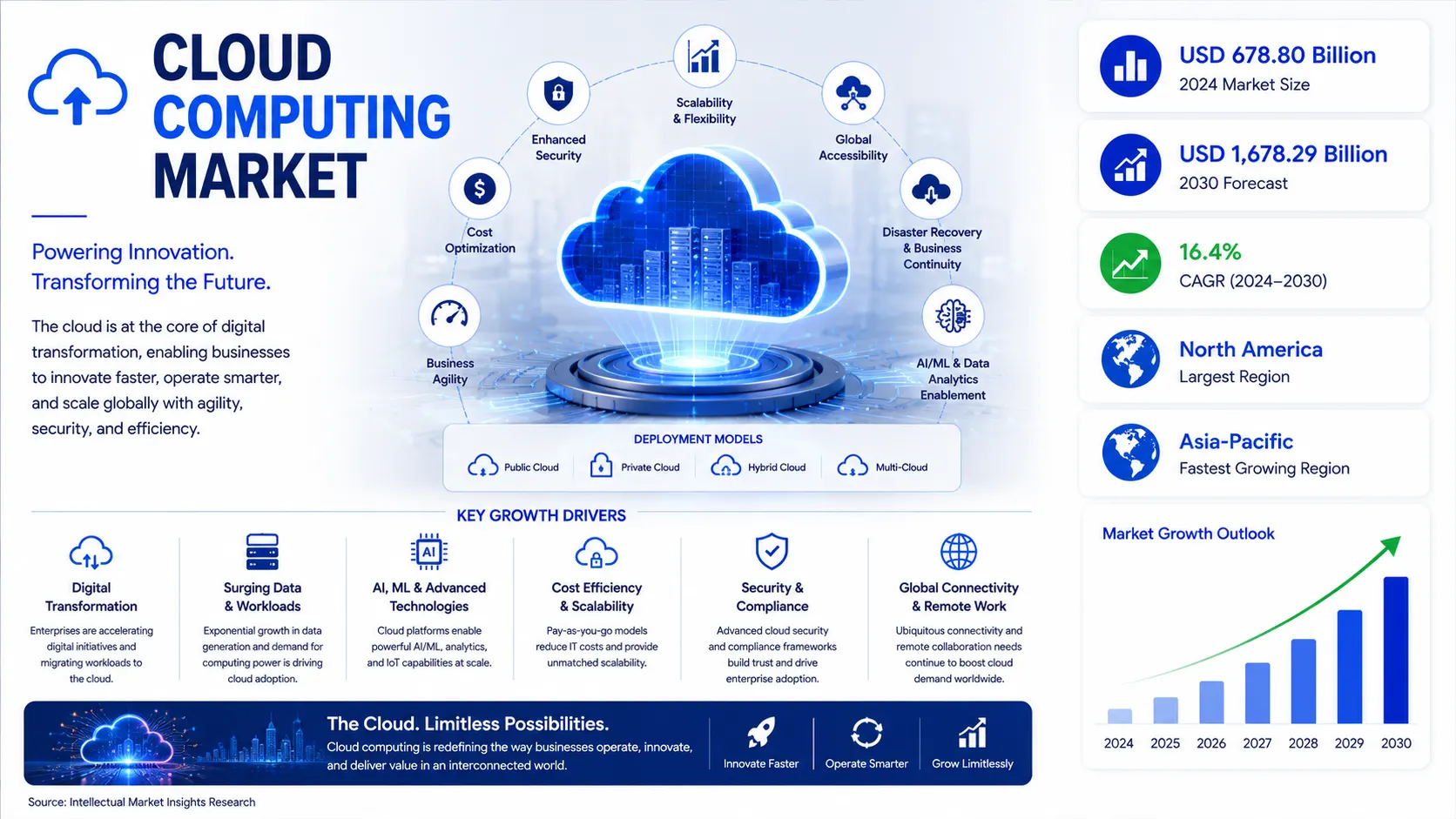
The global Cloud Computing Market was valued at approximately USD 9.98 billion in 2024 and is projected to reach USD 48.81 billion by 2034, growing at a robust CAGR of 17.2% during the 2025–2034 forecast period. Cloud computing refers to the on-demand delivery of computing power, storage, databases, networking, and software over the internet, replacing the capital-heavy model of on-premises IT infrastructure with flexible, pay-as-you-go services.
This market matters because it now sits underneath almost every other digital trend in the economy. Enterprise AI training, real-time analytics, e-commerce scaling, telemedicine, smart manufacturing, and remote collaboration all depend on cloud infrastructure to function at scale. As industries shift from static IT budgets to elastic consumption models, cloud platforms have become the default operating layer for growth.
A handful of technology shifts are reshaping demand. First, the explosion of artificial intelligence and machine learning workloads is pushing enterprises toward high-performance GPU and TPU cloud instances that would be prohibitively expensive to own outright — a dynamic closely tied to the broader Edge AI Hardware Market. Second, hybrid and multi-cloud strategies are now standard practice, letting enterprises avoid vendor lock-in while meeting data residency requirements — a theme explored further in IMIR's Cloud Migration Market report. Third, pay-as-you-go pricing continues to democratize enterprise-grade computing for small and mid-sized businesses in emerging economies, a trend also visible in the adjacent Digital Lending Market, where cloud-native fintech platforms are scaling rapidly.
The competitive landscape is dominated by a small group of hyperscale providers — Amazon Web Services, Microsoft Azure, and Google Cloud — alongside strong regional and enterprise-focused challengers such as Alibaba Cloud, Oracle Cloud, IBM Cloud, Salesforce, and Tencent Cloud. Business opportunities are opening fastest in industry-specific ("vertical") cloud solutions for healthcare, banking, and manufacturing, and in emerging markets where SMEs are adopting Software-as-a-Service (SaaS) tools in place of legacy IT systems entirely.
This report provides a comprehensive, data-backed view of the Cloud Computing Market — covering growth drivers, restraints, segment and regional performance, and in-depth profiles of the Top 20 companies defining where the industry goes next.
Cloud Computing Market Overview
The Cloud Computing Market stood at USD 9.98 billion in 2024 and is set to nearly quintuple to USD 48.81 billion by 2034, at a 17.2% CAGR, driven primarily by AI/ML infrastructure demand, hybrid-cloud adoption, and SME digitalization.
Cloud adoption has moved from being an IT cost-optimization decision to a board-level competitiveness issue. Enterprises no longer ask whether to move to the cloud — they ask how fast and how securely. This shift has been accelerated by the availability of hybrid and multi-cloud architectures that let organizations combine the strengths of different providers: for example, running sensitive workloads on a private cloud while bursting AI training jobs onto a hyperscaler's public infrastructure.
Government policy is also a quiet but powerful growth lever. Programs such as the UAE's AWS Connected Community initiative, run jointly with the Ministry of Economy, are explicitly designed to bring SMEs onto cloud platforms through subsidized access, training, and technical support — a model several other developing economies are now replicating.
Market Drivers
Digital Transformation Across Industries — Businesses are moving core operations to the cloud to cut capital expenditure on physical infrastructure while gaining on-demand elasticity. Streaming platforms like Netflix run global services entirely on cloud infrastructure rather than owned servers, illustrating how cloud economics support internet-scale operations without proportional infrastructure investment.
Rising Adoption of AI, IoT, and Big Data Analytics — Cloud platforms are the default environment for training and deploying machine learning models because they offer elastic compute, high-speed storage, and managed AI toolchains on demand. Providers such as Google Cloud AI package pre-trained models for image recognition and fraud detection, reducing the in-house data science lift required by adopters — a dynamic that also connects to demand in the Artificial Intelligence (AI) in Supply Chain Market.
Market Restraints
Data Protection Regulation — Laws such as the EU's GDPR and the California Consumer Privacy Act (CCPA) impose strict data-localization, encryption, and consent-management requirements. For multinational cloud users, this often means running region-specific instances rather than a single global deployment, increasing cost and architectural complexity.
Cloud Service Outages — Downtime at a major provider can cascade across thousands of dependent businesses simultaneously. The 2021 AWS outage that disrupted Netflix, Disney+, and multiple financial platforms is the standard industry example cited when enterprises justify multi-cloud redundancy budgets.
Market Opportunities
Industry-Specific Cloud Solutions — Healthcare, banking, and manufacturing are increasingly adopting purpose-built cloud stacks rather than generic infrastructure. IBM Watson Health supports diagnostic workflows, JPMorgan Chase uses cloud infrastructure for fraud detection and risk management, and Siemens MindSphere applies cloud-based IoT to predictive maintenance on factory floors.
Emerging-Market and SME Cloud Adoption — SMEs across India and Southeast Asia are adopting Microsoft Azure and Google Workspace to access enterprise-grade CRM, accounting, and collaboration tools without heavy upfront IT investment, letting smaller firms compete directly with larger incumbents.
Market Challenges
Security and trust remain the industry's central challenge. Enterprises remain cautious about handing sensitive data to third-party vendors, and each high-profile breach reinforces this hesitation. Meeting this challenge requires providers to continuously invest in encryption, Zero Trust architectures, and independent compliance certification rather than treating security as a one-time checkbox.
Market Dynamics Summary
|
Factor |
Direction |
Primary Impact |
|---|---|---|
|
AI/ML workload growth |
Accelerant |
Drives high-margin compute demand |
|
Hybrid/multi-cloud adoption |
Accelerant |
Expands total addressable spend |
|
SME digitalization |
Accelerant |
Broadens customer base beyond enterprise |
|
Data protection regulation |
Restraint |
Raises compliance cost, slows migration |
|
Outage/security risk |
Restraint |
Increases redundancy spend, slows trust |
Top 20 Leading Companies in the Global Cloud Computing Market
The companies below were selected based on global market presence, service breadth (IaaS/PaaS/SaaS), infrastructure scale, innovation pace, and strategic partnership activity — including all companies profiled in IMIR's underlying Cloud Computing Market report, supplemented with additional globally significant vendors for full competitive context.
- Amazon Web Services, Inc. (AWS)
- Microsoft Azure
- Google Cloud
- Alibaba Cloud
- Google (Enterprise & Workspace Cloud Services)
- IBM (Hybrid Cloud & Red Hat OpenShift)
- Oracle Cloud Infrastructure (OCI)
- Salesforce, Inc.
- Tencent Cloud
- SAP (SAP Business Technology Platform)
- VMware LLC (a Broadcom company)
- Rackspace Technology, Inc.
- DigitalOcean Holdings, Inc.
- The Descartes Systems Group Inc.
- CloudHesive
- Coastal Cloud
- GroundCloud
- Huawei Cloud
- Fujitsu Limited
- NEC Corporation
1. Amazon Web Services, Inc. (AWS)
Company Overview
|
Particular |
Details |
|---|---|
|
Headquarters |
Seattle, Washington, USA |
|
Founded |
2006 |
|
Core Business |
Public Cloud Infrastructure (IaaS/PaaS) |
|
Key Solutions |
EC2, S3, RDS, Lambda, SageMaker, Bedrock, VPC |
|
Target Industries |
BFSI, Healthcare, Retail, Media, Government, Manufacturing |
|
Global Presence |
Americas, Europe, Asia-Pacific, Middle East, Africa |
Amazon Web Services (AWS) is the largest cloud infrastructure provider in the Global Cloud Computing Market and is widely regarded as the pioneer of modern public cloud computing. The company offers the broadest portfolio of cloud services, covering compute, storage, databases, analytics, networking, artificial intelligence, machine learning, and developer tools.
AWS serves organizations ranging from startups to Fortune 500 enterprises and government agencies. Its strong ecosystem of technology partners, managed service providers, and independent software vendors gives customers extensive flexibility in building and scaling cloud applications. The company continues to invest heavily in AI infrastructure, including custom Trainium and Inferentia chips, to reduce the cost of training and deploying large AI models.
AWS also maintains a strong focus on security, compliance, and sustainability, making it a preferred cloud platform for regulated industries and large-scale enterprise workloads.
Key Strengths
- Largest global cloud infrastructure footprint
- Broadest cloud service catalog
- Strong AI and machine learning ecosystem
- Mature security and compliance capabilities
- Extensive partner network
- High scalability and reliability
Strategic Focus
- Generative AI infrastructure
- Custom cloud silicon
- Multi-region expansion
- Industry-specific cloud solutions
- Sustainability and renewable energy
- Enterprise modernization
2. Microsoft Azure
Company Overview
|
Particular |
Details |
|---|---|
|
Headquarters |
Redmond, Washington, USA |
|
Founded |
2010 |
|
Core Business |
Hybrid Cloud & Enterprise Cloud Services |
|
Key Solutions |
Azure Virtual Machines, Azure Arc, Azure AI, Azure Kubernetes Service, Microsoft 365 Integration |
|
Target Industries |
Enterprise IT, Government, BFSI, Healthcare, Manufacturing |
|
Global Presence |
More than 60 cloud regions worldwide |
Microsoft Azure is one of the leading cloud platforms in the Global Cloud Computing Market and is particularly strong among large enterprises migrating existing Microsoft-based IT environments. Azure's key advantage is its deep integration with Windows Server, Active Directory, Microsoft 365, Dynamics, and enterprise productivity tools.
The platform supports public cloud, hybrid cloud, edge computing, and multi-cloud management through Azure Arc, enabling organizations to manage infrastructure across on-premises data centers and multiple cloud providers from a unified control plane.
Microsoft has aggressively expanded its AI capabilities through its partnership with OpenAI, integrating generative AI across Azure AI services and the Copilot ecosystem. This has significantly strengthened Azure's position in enterprise AI adoption.
Key Strengths
- Strong enterprise customer base
- Best-in-class hybrid cloud capabilities
- Deep integration with Microsoft ecosystem
- Advanced AI and Copilot offerings
- Extensive compliance certifications
- Strong global data center network
Strategic Focus
- Enterprise AI adoption
- Hybrid and multi-cloud management
- Azure Arc expansion
- Industry cloud solutions
- Security and compliance automation
- Sustainable cloud operations
3. Google Cloud
Company Overview
|
Particular |
Details |
|---|---|
|
Headquarters |
Mountain View, California, USA |
|
Founded |
2008 |
|
Core Business |
Data Analytics, AI, and Cloud Infrastructure |
|
Key Solutions |
BigQuery, Vertex AI, Compute Engine, Kubernetes Engine, Cloud Storage |
|
Target Industries |
Technology, Media, Retail, Healthcare, Financial Services |
|
Global Presence |
North America, Europe, Asia-Pacific, Middle East |
Google Cloud differentiates itself in the Global Cloud Computing Market through leadership in data analytics, artificial intelligence, and cloud-native technologies. The platform is particularly popular among engineering-driven organizations building custom AI models, large-scale analytics platforms, and containerized applications.
Google Cloud's BigQuery and Vertex AI services are widely recognized for their performance and ease of use in machine learning and data-intensive workloads. The company also plays a major role in the Kubernetes ecosystem, which has become a standard for modern cloud application deployment.
To strengthen its infrastructure competitiveness, Google has invested in custom hardware such as Axion Arm-based processors and AI accelerators, helping customers reduce cloud computing costs for high-performance workloads.
Key Strengths
- Strong AI and machine learning capabilities
- Leading data analytics platform
- Kubernetes and cloud-native leadership
- Innovative infrastructure hardware
- Strong developer ecosystem
- Advanced networking technology
Strategic Focus
- Vertex AI expansion
- Proprietary cloud hardware
- Cloud-native application development
- Data analytics leadership
- Carbon-free cloud operations
- Enterprise AI partnerships
4. Alibaba Cloud
Company Overview
|
Particular |
Details |
|---|---|
|
Headquarters |
Hangzhou, China |
|
Founded |
2009 |
|
Core Business |
Cloud Infrastructure & AI Services |
|
Key Solutions |
Elastic Compute Service, ApsaraDB, MaxCompute, AI Services, Security Services |
|
Target Industries |
Retail, E-commerce, Logistics, Finance, Government |
|
Global Presence |
China, Southeast Asia, Middle East, Europe, APAC |
Alibaba Cloud is the largest cloud infrastructure provider in China and a rapidly growing international cloud vendor. The company benefits from Alibaba Group's extensive e-commerce, logistics, and fintech ecosystem, giving it deep expertise in handling large-scale digital commerce workloads.
Alibaba Cloud has expanded aggressively across Southeast Asia and the Middle East, offering cloud infrastructure, AI services, database platforms, and security solutions tailored to regional enterprises and governments. The company is also investing heavily in generative AI through its Qwen model family.
Its strong domestic market position and growing international availability zones make Alibaba Cloud the most significant non-US hyperscaler in the global cloud industry.
Key Strengths
- Dominant position in China
- Strong e-commerce infrastructure expertise
- Competitive pricing
- Growing AI capabilities
- Expanding international data center network
- Strong government and enterprise relationships
Strategic Focus
- International cloud expansion
- Generative AI services
- Industry-specific cloud platforms
- Data sovereignty solutions
- Middle East growth
- AI-driven enterprise transformation
5. IBM (Hybrid Cloud & Red Hat OpenShift)
Company Overview
|
Particular |
Details |
|---|---|
|
Headquarters |
Armonk, New York, USA |
|
Founded |
1911 |
|
Core Business |
Hybrid Cloud, Enterprise AI, and Cloud Consulting |
|
Key Solutions |
Red Hat OpenShift, IBM Cloud, watsonx, Cloud Paks, Hybrid Integration |
|
Target Industries |
BFSI, Government, Healthcare, Telecommunications, Manufacturing |
|
Global Presence |
Americas, Europe, Asia-Pacific, Middle East |
IBM has positioned itself differently from hyperscalers by focusing on hybrid cloud, enterprise AI, and regulated-industry workloads rather than competing on raw public cloud scale. The acquisition of Red Hat gave IBM OpenShift, a leading Kubernetes-based platform for running applications consistently across on-premises, public cloud, and edge environments.
IBM's watsonx AI platform is becoming a central part of its enterprise AI strategy, helping organizations build, govern, and deploy AI models securely. The company also combines cloud technology with consulting and systems integration services, making it a preferred partner for large digital transformation projects.
IBM's strength lies in complex enterprise environments where security, compliance, and interoperability are critical.
Key Strengths
- Strong hybrid cloud platform
- Red Hat OpenShift leadership
- Enterprise AI governance capabilities
- Deep consulting expertise
- Strong regulated-industry presence
- Multi-cloud interoperability
Strategic Focus
- Hybrid cloud expansion
- Enterprise AI and watsonx
- OpenShift ecosystem growth
- Edge and telecom cloud
- Security and governance
- Large-scale transformation projects
|
Particular |
Amazon Web Services (AWS) |
Microsoft Azure |
Google Cloud |
Alibaba Cloud |
IBM Hybrid Cloud |
|---|---|---|---|---|---|
|
Headquarters |
Seattle, Washington, USA |
Redmond, Washington, USA |
Mountain View, California, USA |
Hangzhou, China |
Armonk, New York, USA |
|
Founded / Launched |
2006 |
2010 |
2008 |
2009 |
1911 (Hybrid Cloud Strategy) |
|
Parent Company |
Amazon.com, Inc. |
Microsoft Corporation |
Alphabet Inc. |
Alibaba Group |
IBM Corporation |
|
Cloud Type |
Public Cloud (IaaS, PaaS, SaaS) |
Hybrid & Public Cloud |
Public Cloud |
Public Cloud |
Hybrid Cloud |
|
Core Services |
Compute, Storage, Database, AI/ML |
Hybrid Cloud, AI, Compute, Storage |
AI, Analytics, Containers, Compute |
Compute, Database, AI, Security |
Hybrid Cloud, AI, OpenShift |
|
Flagship Products |
EC2, S3, Lambda, SageMaker |
Azure VM, Azure Arc, Azure AI |
BigQuery, Vertex AI, GKE |
ECS, ApsaraDB, MaxCompute |
Red Hat OpenShift, watsonx |
|
Primary Customer Base |
Enterprises, Startups, Government |
Large Enterprises, Government |
Developers, Enterprises |
Enterprises, Retail, Government |
Regulated Industries, Enterprises |
|
Major Industries Served |
BFSI, Healthcare, Retail, Media, Manufacturing |
BFSI, Government, Healthcare, Manufacturing |
Technology, Retail, Media, Healthcare |
Retail, Logistics, Finance, Manufacturing |
BFSI, Healthcare, Telecom, Government |
|
AI Capabilities |
SageMaker, Bedrock, Trainium, Inferentia |
Azure AI, Copilot, OpenAI Integration |
Vertex AI, Gemini AI |
Qwen AI Models |
watsonx AI |
|
Hybrid Cloud Support |
Moderate |
Excellent |
Strong |
Moderate |
Excellent |
|
Global Presence |
Americas, Europe, APAC, Middle East, Africa |
60+ Global Regions |
Global |
China, APAC, Middle East, Europe |
Global |
|
Competitive Advantage |
Largest cloud infrastructure and service portfolio |
Deep Microsoft ecosystem integration |
AI and data analytics leadership |
China market leadership and cost competitiveness |
Enterprise hybrid cloud and consulting expertise |
|
Strategic Focus |
AI Infrastructure, Sustainability, Global Expansion |
Enterprise AI, Hybrid Cloud, Security |
AI Innovation, Cloud-native Applications |
Global Expansion, AI Services |
Hybrid Cloud, Enterprise AI, OpenShift |
|
Business Model |
Subscription & Pay-as-you-go |
Subscription & Consumption-based |
Consumption-based |
Subscription & Pay-as-you-go |
Enterprise Subscription & Consulting |
Segment Analysis
The market is segmented by Deployment Model, Service Type, Enterprise Size, and Industry Vertical, with Software-as-a-Service (SaaS) and large enterprises currently generating the largest share of global revenue.
By Service Type
Software-as-a-Service (SaaS) leads the market, delivering ready-to-use applications over the web without local installation or maintenance. Microsoft 365 is the sector's clearest example — Word, Excel, and Teams delivered as continuously updated cloud services rather than installed software. SaaS dominance stems from its low barrier to entry: individual users and enterprises alike can subscribe instantly without procurement cycles.
Infrastructure-as-a-Service (IaaS) provides virtualized servers, storage, and networking on a pay-as-you-go basis. Amazon EC2 is the category-defining product, letting businesses run applications and store data without owning physical hardware. IaaS remains critical for organizations needing granular control over their compute environment.
Platform-as-a-Service (PaaS) targets developers directly, bundling databases, runtime environments, and deployment tooling so teams can build and ship applications without managing underlying infrastructure. Google App Engine is a widely cited example of PaaS abstraction done well.
By Enterprise Size
Large enterprises currently account for the majority of cloud spend, driven by multi-year digital transformation programs, hybrid and multi-cloud architectures built for regulatory compliance, and high-value, customized service agreements with dedicated vendor support.
Small and Medium Enterprises (SMEs) represent the market's fastest-growing enterprise-size segment. Cloud eliminates the upfront capital cost of IT infrastructure, letting SMEs access enterprise-grade tools on subscription terms — a dynamic also shaping the Global Workforce Management Market, where SMEs are similarly moving to cloud-delivered HR tooling.
By Industry Vertical
IT & Telecom is the pioneering adopter, using cloud for application hosting, big-data management, and network infrastructure. BFSI relies on cloud for secure transaction processing and real-time fraud detection — PayPal's AI-driven fraud systems run on cloud infrastructure for this reason. Healthcare & Life Sciences uses cloud to power electronic health records and AI-assisted diagnostics. Retail & E-Commerce — Amazon itself runs its global storefront on AWS — leans on cloud for inventory and payments analytics. Manufacturing deploys cloud-based IoT for predictive maintenance, exemplified by Siemens MindSphere. Government & Public Sector bodies, such as the UK's G-Cloud framework, use cloud for e-governance and cybersecurity. Education relies on tools like Google Classroom for remote learning delivery, and Energy & Utilities applies cloud to smart-grid management, as seen in GE's Predix platform.
Regional Analysis
In short: North America led the market with roughly 39% revenue share in 2024, while Asia-Pacific is forecast to register the fastest CAGR of the forecast period at approximately 22.9%, driven by China, India, and Japan.
North America
North America, led by the United States, held the largest regional share in 2024, at approximately 39% of global revenue. Growth is anchored in deep SaaS penetration across ERP, CRM, marketing automation, and HR management, alongside expanding edge computing and 5G rollouts that extend cloud capability closer to end users for latency-sensitive use cases like autonomous vehicles and telemedicine.
Europe
Europe's cloud market is expected to grow strongly through 2030, driven by national digitalization agendas and heightened enterprise awareness of cloud benefits. The EU's data privacy framework simultaneously drives demand for compliant, EU-hosted cloud services. The UK market benefits from mature adoption across finance, healthcare, and public services alongside government-backed cloud-adoption campaigns, while Germany leads continental Europe on the back of Industry 4.0 manufacturing initiatives requiring secure, data-intensive cloud infrastructure.
Asia-Pacific
Asia-Pacific is projected to post the fastest regional CAGR, at roughly 22.9%, supported by rapid economic growth, rising internet penetration, and a large, increasingly tech-native population. China holds the region's largest share, powered by domestic cloud giants Alibaba Cloud and Tencent Cloud alongside supportive government digitalization programs. India's market is expanding quickly on the back of its startup ecosystem and policy-driven digitalization push, while Japan's cloud adoption is spreading across healthcare, finance, and manufacturing, alongside growing cybersecurity investment.
Latin America
Latin America is an emerging growth pocket for cloud adoption, with Brazil and Mexico leading regional uptake as businesses digitize payments, retail, and logistics operations. Cost-effective SaaS tools are helping regional SMEs bypass legacy on-premises IT entirely.
Middle East & Africa
The Middle East and Africa region is seeing accelerating cloud investment, led by Saudi Arabia and the UAE as part of broader national digital-economy strategies. Government-backed initiatives — including the previously mentioned AWS Connected Community program in the UAE — are actively lowering the barrier for SME cloud adoption across the region.
Key Industry Trends
- Artificial Intelligence & Machine Learning: Cloud providers are racing to build proprietary AI silicon (AWS Trainium, Google Axion, Huawei Ascend) to reduce dependency on third-party GPU supply and lower the cost of AI training and inference at scale.
- Automation & Industry 4.0: Cloud-connected IoT and predictive-maintenance platforms, exemplified by Siemens MindSphere, are becoming standard infrastructure inside manufacturing environments rather than pilot projects.
- Edge Computing: As 5G networks mature, cloud providers are pushing compute capacity closer to end users to support latency-sensitive applications like autonomous vehicles and real-time industrial automation.
- Hybrid & Multi-Cloud Architecture: Enterprises increasingly run workloads across multiple providers simultaneously, both for regulatory compliance and to avoid single-vendor dependency, fueling demand for multi-cloud management tooling from vendors like VMware and Rackspace.
- Cybersecurity & Zero Trust: As breach costs rise, cloud vendors are embedding Zero Trust network architectures and AI-powered threat detection directly into their platforms rather than treating security as an add-on service.
- Sustainability & ESG: Major hyperscalers have made public carbon-reduction commitments — Microsoft's carbon-negative-by-2030 pledge and Google's 24/7 carbon-free energy target are increasingly factored into enterprise procurement decisions.
- Industry-Specific ("Vertical") Cloud: Purpose-built cloud stacks for healthcare, banking, and logistics are outgrowing generic infrastructure offerings, as seen in the rise of platforms like Descartes for logistics and GroundCloud for last-mile delivery.
Frequently Asked Questions
1. How big is the global Cloud Computing Market? The global Cloud Computing Market was valued at approximately USD 9.98 billion in 2024 and is projected to reach USD 48.81 billion by 2034, growing at a CAGR of 17.2% during the forecast period.
2. Which region leads the Cloud Computing Market? North America led the market in 2024 with roughly 39% of global revenue, driven by widespread SaaS adoption across ERP, CRM, and business intelligence use cases, while Asia-Pacific is projected to post the fastest CAGR at approximately 22.9%.
3. Who are the top companies in the Cloud Computing Market? Leading companies include Amazon Web Services, Microsoft Azure, Google Cloud, Alibaba Cloud, IBM, Oracle Cloud, Salesforce, Tencent Cloud, SAP, and VMware, alongside specialized providers like Rackspace, DigitalOcean, and regional players such as Huawei Cloud, Fujitsu, and NEC.
4. What are the three main types of cloud computing service models? The three core service models are Infrastructure-as-a-Service (IaaS), which provides virtualized servers and storage; Platform-as-a-Service (PaaS), which offers development and deployment tools; and Software-as-a-Service (SaaS), which delivers ready-to-use applications over the internet.
5. What is driving growth in the Cloud Computing Market? Key growth drivers include enterprise digital transformation, rising AI/ML workload demand, hybrid and multi-cloud adoption, and rapid SME cloud adoption in emerging markets supported by government digitalization initiatives.
6. What are the biggest restraints on cloud computing adoption? The two biggest restraints are stringent data-protection regulations such as GDPR and CCPA, which raise compliance costs, and the risk of service outages, which pushes enterprises toward costly multi-cloud redundancy strategies.
7. What is the difference between public, private, hybrid, and multi-cloud? Public cloud runs on shared, third-party-owned infrastructure; private cloud is dedicated to a single organization; hybrid cloud combines private and public environments; and multi-cloud refers to using multiple public cloud providers simultaneously, typically to avoid vendor lock-in.
Conclusion & Outlook
The global Cloud Computing Market is entering a decade of sustained, structurally-driven growth, expanding from roughly USD 9.98 billion in 2024 to an estimated USD 48.81 billion by 2034. This trajectory is underpinned less by novelty adoption and more by cloud infrastructure becoming the default operating layer for AI, digital commerce, and enterprise IT modernization worldwide.
The competitive landscape will likely continue consolidating at the infrastructure layer, with AWS, Microsoft Azure, and Google Cloud extending their hyperscale lead through proprietary AI silicon investment, while regional champions like Alibaba Cloud, Tencent Cloud, and Huawei Cloud defend and expand share in markets prioritizing data sovereignty and cost competitiveness. At the same time, a healthy ecosystem of specialized managed-services providers, vertical SaaS platforms, and systems integrators — from Rackspace and DigitalOcean to Descartes and Coastal Cloud — will continue capturing value in the implementation and customization layer above raw infrastructure.
Looking ahead, three forces will define competitive positioning through 2034: proprietary AI infrastructure investment, hybrid and multi-cloud interoperability, and demonstrated compliance with tightening global data-protection regulation. Investment opportunities are strongest in industry-specific cloud platforms, AI-optimized infrastructure, and cloud-native cybersecurity tooling, particularly across the fast-growing Asia-Pacific, Latin American, and Middle Eastern markets.
For businesses evaluating cloud strategy, vendor selection, or market entry, IMIR's underlying Cloud Computing Market report provides granular regional, segment, and competitive data. Explore IMIR's related coverage of the Technology & Media industry reports for adjacent market intelligence, or contact our research team for a customized analysis tailored to your specific market-entry or investment questions.