
Top 25 Leading Companies in the Global Automated Guided Vehicle Market Growth Forecast, Global Industry Outlook to 2031
Author:
Intellectual Market Insights Research
Published Date:
10 Jul 2026
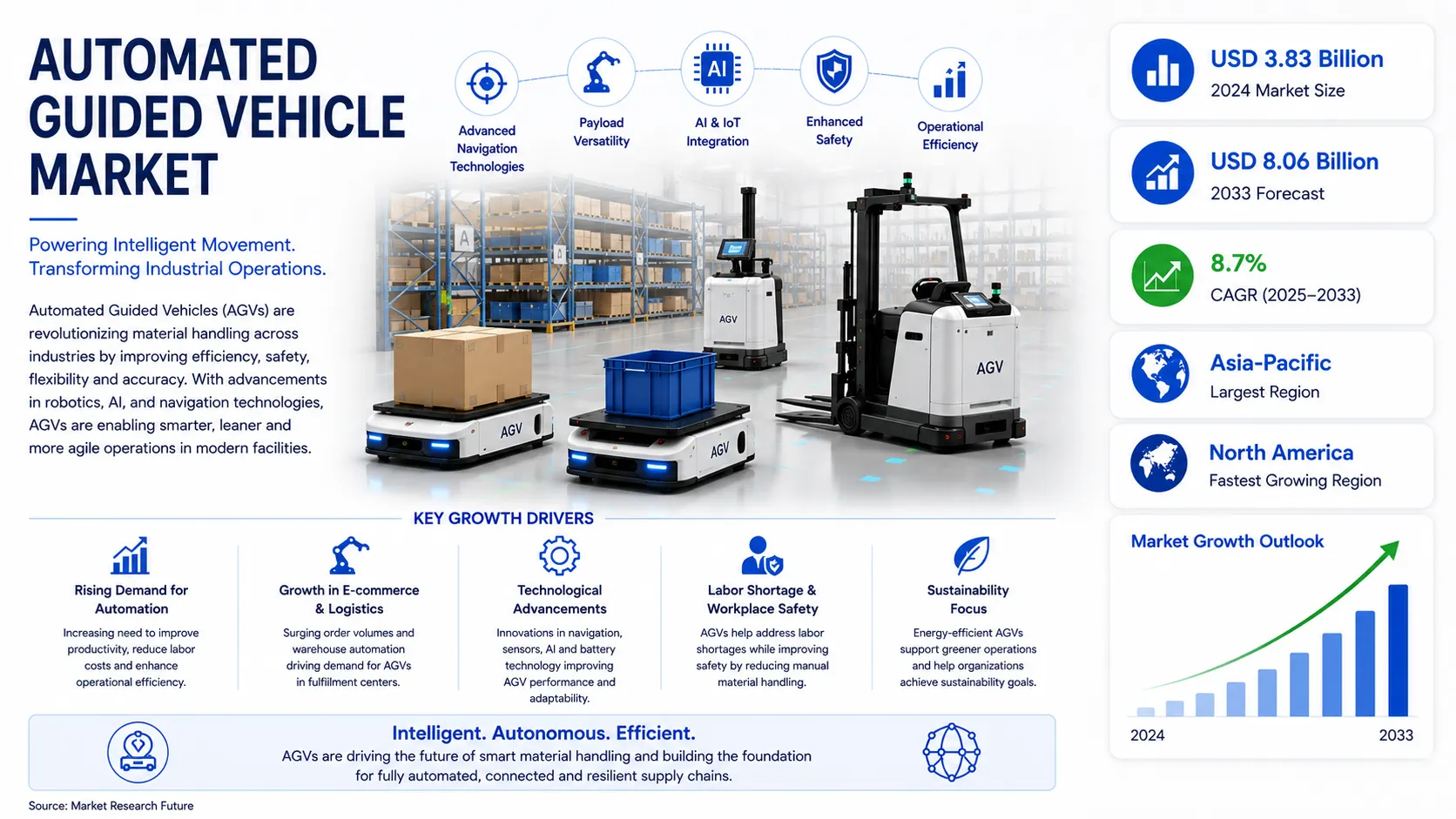
Top Automated Guided Vehicle (AGV) Companies Leading the Global Market
Introduction
The Automated Guided Vehicle (AGV) Market has moved from a niche factory-floor technology to a foundational pillar of modern intralogistics. According to IMIR Market Research, the global AGV market was valued at USD 4.28 billion in 2022 and is projected to reach USD 9.84 billion by 2031, growing at a compound annual growth rate (CAGR) of 9.7% between 2022 and 2031. This trajectory reflects a broader industrial shift: warehouses, distribution centers, and manufacturing plants are under sustained pressure to move more goods, faster, with fewer labor constraints and tighter safety margins.
AGVs — driverless, sensor-guided vehicles that move materials along programmed or dynamically mapped paths — sit at the intersection of several converging forces. E-commerce order volumes continue to strain fulfillment networks. Labor availability in warehousing and manufacturing remains tight in most developed economies. And capital costs for automation have fallen even as the sophistication of navigation, fleet orchestration, and safety systems has risen sharply. Where earlier-generation AGVs relied on buried wires or reflective tape, today's fleets increasingly use laser guidance, vision-based navigation, and inertial systems that allow far more flexible deployment across tow vehicles, assembly line vehicles, forklift trucks, unit load carriers, and pallet trucks.
The market's growth is not uniform. Automotive assembly lines remain the historical core application, but logistics, e-commerce fulfillment, food & beverage, healthcare, and aerospace are now meaningful and fast-growing verticals. Navigation technology is also bifurcating: legacy magnetic and inductive guidance systems continue to serve stable, fixed-layout facilities, while laser guidance and vision-based systems are capturing share in dynamic, high-mix environments. This is closely tied to the industry's broader convergence with autonomous mobile robots (AMRs) and warehouse automation systems, where the line between "guided" and "autonomous" vehicles is increasingly blurred at the software layer.
Regionally, Asia-Pacific is emerging as the largest and fastest-growing AGV market, propelled by China's manufacturing automation drive and Japan's mature robotics supply chain, while North America and Europe continue to see strong replacement and greenfield demand tied to e-commerce logistics and automotive electrification. Against this backdrop, a relatively concentrated group of established material-handling manufacturers and specialized robotics firms is shaping how the market evolves — through platform software, fleet management systems, navigation IP, and increasingly, AI-driven optimization. This article profiles the ten companies IMIR Market Research identifies as leading this market, and examines the growth drivers, challenges, and regional dynamics defining the AGV industry's next phase.
Growth Drivers
E-commerce and warehouse throughput pressure. Rising order volumes and same-day/next-day delivery expectations are pushing distribution centers to automate pallet movement, case picking, and cross-docking. AGVs reduce dependency on manual forklift operators while enabling predictable, repeatable throughput.
Labor shortages in logistics and manufacturing. Persistent difficulty hiring and retaining warehouse and plant-floor labor in North America, Europe, and parts of Asia is accelerating automation investment, with AGVs offering a comparatively fast payback period relative to full robotic cell conversions.
Advances in navigation and AI. The shift from wire-guided and magnetic-tape systems toward laser guidance, vision-based navigation, and SLAM (simultaneous localization and mapping) is reducing installation costs and enabling AGVs to operate in more dynamic environments — a trend closely tied to broader industrial analytics and machine-vision adoption.
Industry 4.0 and factory digitalization. Integration of AGVs with warehouse management systems (WMS), manufacturing execution systems (MES), and enterprise resource planning (ERP) platforms is turning fleets into data-generating assets, supporting real-time inventory visibility and predictive maintenance.
Investment and M&A activity. Strategic acquisitions by established material-handling players and continued venture investment in AGV/AMR startups are expanding product portfolios and accelerating go-to-market timelines, particularly in fleet-management software and robotic process automation layers that orchestrate mixed human-robot workflows.
Government and regional manufacturing initiatives. Reshoring and nearshoring programs in North America and Europe, alongside China's manufacturing automation policy push, are expanding the addressable base of automotive, electronics, and general manufacturing facilities investing in AGV fleets.
Battery and power system improvements. Longer-duration lithium-ion batteries and opportunity-charging designs are reducing AGV downtime, improving fleet utilization economics and lowering total cost of ownership.
Market Challenges
Integration complexity. Deploying AGVs into brownfield facilities with existing WMS, ERP, or MES infrastructure often requires custom middleware, and inconsistent communication protocols across vendors can slow rollouts.
High upfront capital costs. While operating costs are favorable over time, the initial investment in vehicles, infrastructure (charging stations, mapping, safety zoning), and fleet-management software remains a barrier for small and mid-sized facilities, though leasing and Robotics-as-a-Service (RaaS) models are narrowing this gap.
Safety and regulatory compliance. Standards such as ISO 3691-4 for driverless industrial trucks, along with evolving national workplace-safety requirements, add certification timelines and cost for vendors expanding into new geographies.
Competitive intensity and price pressure. The market includes both diversified global material-handling conglomerates and specialized robotics startups, creating pricing pressure — particularly in the mid-market segment — and pushing vendors toward software and services differentiation rather than hardware alone.
Skilled workforce shortage. Deployment, integration, and ongoing maintenance of AGV fleets require technicians with combined mechanical, electrical, and software skills, and this talent pool remains constrained relative to demand.
Supply chain and component availability. Sensors, semiconductors, and battery cells used in AGV production are subject to the same global supply chain volatility affecting the broader automation equipment sector, occasionally extending lead times for custom configurations.
Competition from AMRs. The rise of more flexible autonomous mobile robots, which do not require fixed guide paths, is prompting traditional AGV vendors to hybridize their offerings or risk losing share in dynamic, high-mix warehouse environments.
Top 25 Leading Companies in the Global Automated Guided Vehicle (AGV) Market
- Daifuku Co., Ltd.
- KION Group AG (Dematic)
- Toyota Industries Corporation
- Jungheinrich AG
- Swisslog Holding AG
- Murata Machinery, Ltd. (Muratec)
- Seegrid Corporation
- BALYO SA
- EK Robotics GmbH
- JBT Corporation
- SSI SCHAEFER Group
- OMRON Corporation
- Mitsubishi Logisnext Co., Ltd.
- Elettric80 S.p.A.
- Hyster-Yale Materials Handling, Inc.
- Rocla AGV Solutions
- VisionNav Robotics
- ForwardX Robotics
- Geek+
- KUKA AG
- ABB Ltd
- Bastian Solutions, LLC
- MoviGo Robotics
- DS Automotion GmbH
- Kivnon Logística S.L.
1. Daifuku Co., Ltd.
Headquarters: Osaka, Japan
Founded: 1937
Daifuku Co., Ltd. is the world's largest material handling and intralogistics automation company and a global leader in the Automated Guided Vehicle (AGV) market. The company provides intelligent AGVs, Autonomous Mobile Robots (AMRs), conveyor systems, warehouse management software, and airport baggage handling solutions. Daifuku serves industries including automotive, e-commerce, electronics, food & beverage, pharmaceuticals, and airports.
With operations in more than 25 countries, Daifuku continues to drive Industry 4.0 adoption through AI-enabled automation, fleet management software, and smart warehouse technologies. Its comprehensive automation portfolio and decades of engineering expertise have positioned the company as one of the most trusted names in warehouse and factory automation worldwide.
Why Daifuku Leads the AGV Industry
- World's largest material handling automation company.
- Extensive portfolio of AGVs and AMRs.
- Strong presence in automotive and e-commerce sectors.
- Advanced warehouse automation technologies.
- Global service and support network.
Company Snapshot
|
Attribute |
Details |
|---|---|
|
Company |
Daifuku Co., Ltd. |
|
Founded |
1937 |
|
Headquarters |
Osaka, Japan |
|
Industry |
Material Handling & Warehouse Automation |
|
Core Products |
AGVs, AMRs, Conveyors, AS/RS, Warehouse Automation |
|
Key Markets |
Automotive, Logistics, Airports, E-commerce |
|
Competitive Advantage |
Complete intralogistics automation solutions |
|
Growth Drivers |
Smart factories, warehouse automation, Industry 4.0 |
|
Why It Stands Out |
Global leader in automated material handling |
2. KION Group AG (Dematic)
Headquarters: Frankfurt, Germany
Founded: 2006
KION Group AG is one of the world's leading providers of industrial trucks, warehouse automation, and supply chain solutions. Through its Dematic division, the company delivers advanced AGVs, AMRs, robotic picking systems, automated storage and retrieval systems (AS/RS), and intelligent warehouse software.
Serving retail, e-commerce, manufacturing, healthcare, and food distribution industries, KION combines AI, IoT, and cloud-based warehouse management technologies to optimize logistics operations. The company's global presence and strong focus on digital transformation make it a leading player in the AGV market.
Why KION Group Leads the AGV Industry
- Global warehouse automation leader.
- Advanced AGV and robotic solutions.
- Strong Dematic automation platform.
- AI-powered warehouse software.
- Large international customer base.
Company Snapshot
|
Attribute |
Details |
|---|---|
|
Company |
KION Group AG |
|
Founded |
2006 |
|
Headquarters |
Frankfurt, Germany |
|
Industry |
Warehouse Automation & Material Handling |
|
Core Products |
AGVs, AMRs, AS/RS, Robotics, Warehouse Software |
|
Key Markets |
Retail, Manufacturing, Logistics |
|
Competitive Advantage |
End-to-end warehouse automation |
|
Growth Drivers |
E-commerce growth, labor shortages |
|
Why It Stands Out |
Industry-leading Dematic automation platform |
3. Toyota Industries Corporation
Headquarters: Kariya, Aichi, Japan
Founded: 1926
Toyota Industries Corporation is a global leader in industrial equipment and material handling solutions. Through Toyota Material Handling, the company develops automated guided vehicles, autonomous forklifts, logistics automation systems, and smart warehouse technologies.
The company integrates artificial intelligence, autonomous navigation, IoT connectivity, and fleet optimization software to improve warehouse productivity and manufacturing efficiency. Its strong engineering expertise and worldwide dealer network have established Toyota Industries as one of the most trusted AGV providers globally.
Why Toyota Industries Leads the AGV Industry
- Global leader in forklift automation.
- Strong autonomous logistics portfolio.
- Reliable industrial engineering.
- Extensive worldwide distribution.
- Continuous innovation in smart warehouses.
Company Snapshot
|
Attribute |
Details |
|---|---|
|
Company |
Toyota Industries Corporation |
|
Founded |
1926 |
|
Headquarters |
Kariya, Aichi, Japan |
|
Industry |
Material Handling Equipment |
|
Core Products |
AGVs, Automated Forklifts, Warehouse Automation |
|
Key Markets |
Manufacturing, Warehousing, Logistics |
|
Competitive Advantage |
Global material handling leadership |
|
Growth Drivers |
Industrial automation and smart manufacturing |
|
Why It Stands Out |
Pioneer in automated forklift technology |
4. Jungheinrich AG
Headquarters: Hamburg, Germany
Founded: 1953
Jungheinrich AG is a leading provider of intralogistics solutions specializing in electric forklifts, Automated Guided Vehicles (AGVs), warehouse automation, and digital fleet management. The company helps businesses optimize material flow through intelligent automation and energy-efficient technologies.
Jungheinrich serves automotive, retail, food & beverage, pharmaceuticals, and manufacturing industries worldwide, offering scalable automation solutions designed for modern distribution centers and factories.
Why Jungheinrich Leads the AGV Industry
- Comprehensive AGV portfolio.
- Strong European market presence.
- Intelligent warehouse software.
- Energy-efficient automation systems.
- Advanced fleet management technologies.
Company Snapshot
|
Attribute |
Details |
|---|---|
|
Company |
Jungheinrich AG |
|
Founded |
1953 |
|
Headquarters |
Hamburg, Germany |
|
Industry |
Intralogistics & Warehouse Automation |
|
Core Products |
AGVs, Electric Forklifts, Warehouse Management Systems |
|
Key Markets |
Europe, North America, Asia |
|
Competitive Advantage |
Smart intralogistics expertise |
|
Growth Drivers |
Automated warehouses, labor optimization |
|
Why It Stands Out |
High-performance warehouse automation solutions |
5. Swisslog Holding AG
Headquarters: Buchs, Aargau, Switzerland
Founded: 1900
Swisslog Holding AG is a global warehouse automation company specializing in Automated Guided Vehicles, Autonomous Mobile Robots, robotic picking systems, automated storage solutions, and healthcare logistics automation. As part of the KUKA Group, Swisslog combines robotics, AI, and data analytics to deliver intelligent automation solutions.
Its AGV systems are widely deployed across e-commerce, healthcare, food & beverage, retail, and manufacturing facilities, enabling businesses to improve operational efficiency and supply chain performance.
Why Swisslog Leads the AGV Industry
- Global warehouse automation expertise.
- AI-enabled logistics solutions.
- Advanced robotic integration.
- Strong healthcare automation portfolio.
- Backed by KUKA's robotics technology.
Company Snapshot
|
Attribute |
Details |
|---|---|
|
Company |
Swisslog Holding AG |
|
Founded |
1900 |
|
Headquarters |
Buchs, Aargau, Switzerland |
|
Industry |
Warehouse Automation |
|
Core Products |
AGVs, AMRs, Robotic Picking Systems, AS/RS |
|
Key Markets |
Healthcare, Retail, Manufacturing, Logistics |
|
Competitive Advantage |
Intelligent robotics and warehouse automation |
|
Growth Drivers |
E-commerce expansion, smart logistics |
|
Why It Stands Out |
Global leader in integrated warehouse automation |
6. Murata Machinery, Ltd. (Muratec)
Headquarters: Kyoto, Japan
Founded: 1935
Murata Machinery, Ltd. (Muratec) is a globally recognized industrial automation company specializing in Automated Guided Vehicles (AGVs), automated storage and retrieval systems (AS/RS), cleanroom automation, and factory logistics solutions. The company serves a wide range of industries, including automotive, semiconductor, electronics, pharmaceuticals, and logistics. Muratec's AGV solutions are designed to optimize material flow, reduce labor dependency, and enhance operational efficiency through intelligent navigation, fleet management, and real-time monitoring technologies.
With decades of expertise in factory automation, Muratec continues to invest in smart manufacturing technologies, robotics, and Industry 4.0 solutions, enabling manufacturers and distribution centers to improve productivity while minimizing operational costs.
Why Muratec Leads the AGV Industry
- Extensive experience in factory automation.
- Advanced AGV and AS/RS technologies.
- Strong presence in semiconductor and electronics manufacturing.
- AI-enabled fleet management systems.
- Global engineering and customer support network.
Company Snapshot
|
Attribute |
Details |
|---|---|
|
Company |
Murata Machinery, Ltd. (Muratec) |
|
Founded |
1935 |
|
Headquarters |
Kyoto, Japan |
|
Industry |
Industrial Automation & Material Handling |
|
Core Products |
AGVs, AS/RS, Cleanroom Automation, Warehouse Systems |
|
Key Markets |
Automotive, Electronics, Semiconductor, Logistics |
|
Competitive Advantage |
Integrated factory and warehouse automation |
|
Growth Drivers |
Smart manufacturing, Industry 4.0, warehouse automation |
|
Why It Stands Out |
Pioneer in intelligent factory logistics solutions |
7. Seegrid Corporation
Headquarters: Pittsburgh, Pennsylvania, USA
Founded: 2003
Seegrid Corporation is one of North America's leading providers of Autonomous Mobile Robots (AMRs) and vision-guided Automated Guided Vehicles (AGVs). The company develops autonomous tow tractors, pallet trucks, and lift trucks powered by proprietary vision-guided navigation and artificial intelligence technologies. Its automation solutions help manufacturers, warehouses, and distribution centers improve productivity, workplace safety, and operational efficiency.
Seegrid's advanced software platform provides fleet management, analytics, and predictive maintenance capabilities, enabling organizations to optimize material handling operations while reducing labor shortages and operational costs.
Why Seegrid Leads the AGV Industry
- Industry-leading vision-guided navigation technology.
- AI-powered autonomous material handling.
- Strong presence in North American manufacturing.
- Advanced fleet management software.
- Focus on warehouse safety and productivity.
Company Snapshot
|
Attribute |
Details |
|---|---|
|
Company |
Seegrid Corporation |
|
Founded |
2003 |
|
Headquarters |
Pittsburgh, Pennsylvania, USA |
|
Industry |
Autonomous Mobile Robotics |
|
Core Products |
Autonomous Tow Tractors, Pallet Trucks, Lift Trucks |
|
Key Markets |
Manufacturing, Warehousing, Logistics |
|
Competitive Advantage |
Proprietary vision-guided navigation technology |
|
Growth Drivers |
Labor shortages, warehouse automation, AI adoption |
|
Why It Stands Out |
Leader in vision-guided autonomous vehicles |
Segment Analysis
By Type — Tow Vehicles: Tow vehicles (or tuggers) pull trailers of goods along a route and remain a preferred solution for high-volume, repetitive material transport in automotive and manufacturing plants. Their relatively simple mechanical design and lower cost per unit make them a common entry point for facilities beginning automation, particularly where loads are already palletized or bin-based.
By Type — Assembly Line Vehicles: Purpose-built for synchronized movement along production lines, these AGVs are deeply embedded in automotive and electronics assembly, where precise timing and positioning are critical to line balancing. Their growth tracks closely with automotive production automation and EV manufacturing capacity expansion.
By Type — Forklift Trucks (AGV Forklifts): Automated forklift trucks handle palletized loads at height, replacing manual counterbalance and reach-truck operations. This segment overlaps significantly with the broader forklift market and is seeing strong adoption in cold storage and high-bay warehousing.
By Type — Unit Load Carriers: Designed to transport a single unit load (a pallet, bin, or cart) between fixed points, these vehicles are common in distribution centers and are increasingly integrated with automated storage and retrieval systems.
By Type — Pallet Trucks: Lower-profile automated pallet trucks handle floor-level transport in tighter aisles, often serving as a bridge technology between manual pallet jacks and full AGV forklift deployment, especially in mid-sized 3PL facilities.
By Application — Transportation & Storage: The largest application segments, covering intra-facility movement of raw materials, work-in-progress, and finished goods, alongside automated storage and retrieval interfacing.
By Industry — Automotive & Manufacturing: Automotive remains the anchor vertical given decades of AGV deployment on assembly lines, while broader manufacturing (electronics, industrial equipment) is expanding adoption as flexible, modular production layouts become more common.
By Industry — Logistics & E-commerce: The fastest-growing industry vertical, driven by fulfillment center expansion, same-day delivery pressure, and integration with 4PL logistics networks.
By Navigation Technology — Laser & Vision Guidance: These technologies are gaining share over legacy magnetic and inductive guidance because they eliminate the need for embedded infrastructure, reduce installation time, and support dynamic re-routing — closely tied to advances in the broader machine vision market.
By Mode of Operation — Indoor vs. Outdoor: Indoor deployment dominates current volumes (warehouses, plants), while outdoor AGV applications — yard logistics, ports, and open-air distribution hubs — represent a smaller but growing segment as ruggedized navigation and weatherproofing improve.
Regional Analysis
North America: North America is a mature, high-value AGV market anchored by e-commerce giants, automotive manufacturers, and 3PL providers investing heavily in fulfillment automation. The U.S. leads regional demand, supported by labor cost pressure, reshoring of manufacturing capacity, and a dense ecosystem of robotics vendors and system integrators. Replacement-cycle demand for AGV fleet upgrades — moving from wire-guided to laser and vision-based systems — is a significant growth driver here.
Europe: Germany, France, Italy, and the U.K. lead European AGV adoption, driven by strong automotive and industrial manufacturing bases and strict workplace-safety standards (including ISO 3691-4) that favor certified automated solutions. Europe's push toward Industry 4.0 and energy-efficient manufacturing is reinforcing AGV investment, particularly among Tier 1 automotive suppliers and food & beverage processors.
Asia-Pacific: Asia-Pacific is expected to be the fastest-growing regional market, underpinned by China's large-scale manufacturing automation initiatives, Japan's deep robotics manufacturing base (home to several of the market's leading vendors), and South Korea's semiconductor and EV battery production investments. India and Southeast Asian markets are emerging as new growth pockets as e-commerce infrastructure expands.
Latin America: Brazil, Mexico, and Argentina represent the region's primary AGV demand centers, largely tied to automotive manufacturing and expanding logistics infrastructure supporting nearshoring trends into the U.S. market. Adoption remains earlier-stage relative to North America and Europe, with significant headroom for growth.
Middle East & Africa: Growth in this region is linked to logistics and free-zone warehousing investment in the UAE and Saudi Arabia, alongside broader industrial diversification initiatives. While the current market share is comparatively small, government-backed logistics and manufacturing investment programs are expected to support steady expansion.
Frequently Asked Questions
1. How big is the global Automated Guided Vehicle market? The global AGV market was valued at USD 4.28 billion in 2022 and is projected to reach USD 9.84 billion by 2031, growing at a CAGR of 9.7%.
2. Who are the top companies in the AGV market? Leading companies include BALYO, JBT, KUKA AG, Toyota Material Handling, Oceaneering International, Seegrid Corporation, Daifuku, E&K Automation, inVia Robotics, and SSI Schaefer.
3. What is the difference between an AGV and an AMR? AGVs typically follow fixed, pre-programmed paths using guidance infrastructure like magnetic tape, wires, or lasers, while autonomous mobile robots (AMRs) navigate dynamically using onboard sensors and mapping software without fixed paths.
4. Which region leads the AGV market? Asia-Pacific is expected to see the fastest growth, driven by manufacturing automation in China and a mature robotics ecosystem in Japan, while North America and Europe remain large, mature markets.
5. What industries use AGVs the most? Automotive and general manufacturing remain the largest historical users, while logistics, e-commerce, food & beverage, and healthcare are the fastest-growing adopting industries.
6. What navigation technologies do AGVs use? Common navigation methods include laser guidance, vision guidance, magnetic guidance, inductive guidance, and optical tape guidance, with laser and vision-based systems gaining share due to lower infrastructure requirements.
7. What is driving growth in the AGV market? Key drivers include e-commerce-driven warehouse automation, persistent labor shortages, advances in AI and navigation technology, Industry 4.0 adoption, and improving battery technology.
8. What are the main challenges facing AGV adoption? Integration complexity with existing systems, high upfront capital costs, safety certification requirements, and competition from more flexible AMR platforms are among the top challenges.
9. What is Robotics-as-a-Service (RaaS) in the AGV context? RaaS is a subscription-based commercial model where companies pay for AGV hardware, software, and support as an ongoing service rather than a large upfront capital purchase, lowering the barrier to automation adoption.
10. Are AGVs used outside of warehouses and factories? Yes — emerging outdoor applications include yard logistics, port operations, and open-air distribution hub movement, though indoor deployment remains dominant.
11. How do AGVs integrate with warehouse management systems? AGVs communicate with WMS and MES platforms via APIs or middleware, receiving task assignments and reporting completion status, enabling synchronized inventory and production tracking.
12. What safety standards apply to AGVs? ISO 3691-4 is a key international standard governing the safety requirements for driverless industrial trucks and their systems, alongside regional workplace-safety regulations.
13. Is the AGV market consolidating or fragmenting? The market includes both large diversified material-handling conglomerates (Daifuku, Toyota Material Handling, KUKA) and specialized robotics firms (Seegrid, inVia Robotics), suggesting a market that remains competitively diverse rather than highly consolidated.
14. What role does AI play in modern AGV systems? AI enables dynamic fleet routing, congestion avoidance, predictive maintenance, and adaptive task prioritization, moving AGV fleets beyond static, pre-programmed operation.
15. Where can I access the full Automated Guided Vehicle Market report? The complete market report, including detailed segmentation, forecasts, and competitive analysis, is available from IMIR Market Research.
Conclusion
The global Automated Guided Vehicle market is entering a phase of structural, rather than cyclical, growth. The forces driving adoption — e-commerce-fueled warehouse expansion, sustained labor constraints across manufacturing and logistics, and the steady maturation of AI-driven navigation — are unlikely to reverse over the 2022–2031 forecast period covered in IMIR Market Research's analysis. What is changing is the character of the market itself: the sharp line that once separated fixed-path AGVs from dynamically navigating AMRs is dissolving, and the ten companies profiled in this report illustrate just how differently vendors are approaching that convergence.
Some, like Daifuku, Toyota Material Handling, and SSI Schaefer, compete on the strength of decades of material-handling manufacturing scale and systems-integration capability, bundling AGVs into much larger intralogistics projects. Others, like Seegrid and inVia Robotics, have built their businesses around a specific technological or commercial innovation — infrastructure-free vision navigation, or subscription-based RaaS delivery — that appeals to a different segment of buyer. Still others, like BALYO, compete not by selling vehicles at all, but by licensing the navigation intelligence that other manufacturers build into their own hardware. This diversity of business models is itself a signal of a market still working out its long-term structure, rather than one that has settled into a small number of dominant, interchangeable suppliers.
Looking ahead, several developments are likely to shape competitive positioning through 2031. Fleet-management software — increasingly AI-driven and cloud-connected — will likely become a larger share of vendor revenue and a more important differentiator than vehicle hardware alone, as most navigation and mechanical capabilities converge toward a common baseline. Safety certification and cybersecurity, particularly as fleets become more networked, will raise the bar for market entry and reward vendors with established compliance track records. And commercial model innovation, particularly RaaS and leasing structures, will likely expand the addressable market beyond large enterprises to mid-sized manufacturers and 3PLs that have historically found automation capital costs prohibitive.
Regionally, Asia-Pacific's combination of manufacturing scale and robotics supply chain depth positions it to remain the fastest-growing market, while North America and Europe will continue to generate substantial replacement-cycle demand as facilities upgrade from legacy wire-guided systems to laser and vision-based platforms. For manufacturers, logistics providers, and investors evaluating this space, the companies profiled here represent not just current market leaders, but a useful cross-section of the strategic approaches — scale integration, technology specialization, and software-led commercial models — that will determine who captures the largest share of the AGV market's continued expansion toward and beyond USD 9.84 billion by 2031. For deeper segmentation, regional breakdowns, and competitive benchmarking, the full Automated Guided Vehicle Market report from IMIR Market Research provides the complete underlying analysis.